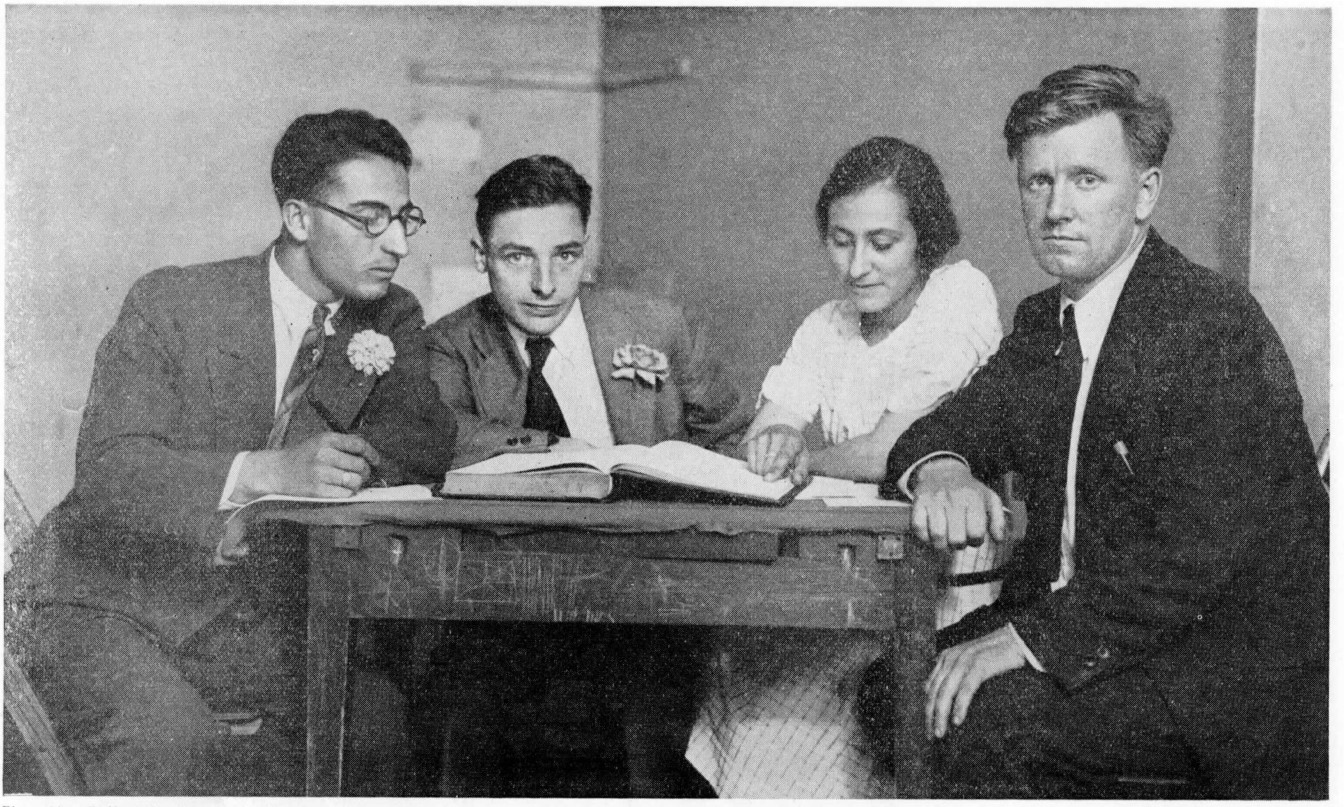
Mass arrests and a mass trials of hundreds of militant New Bedford strikers.
‘Seven Hundred Strikers On Trial’ by Amy Schechter from Labor Defender. Vol. 3 No. 11. November, 1928.
THE first week in November the largest mass trial of workers in the history of the United States opens in New Bedford. Over 700 textile workers will be tried before the Superior Court on appealed sentences imposed during the bitterly fought six-months’ New Bedford strike just ended and the Fall River strike broken after a brief heroic struggle against overwhelming terror by the same millowner-government-police-labor bureaucrat combination.
Except for fifty, all the defendants are members of the left wing New Bedford and Fall River organizations affiliated with the recently formed National Textile Workers Union, which the millowners recognized as a dangerous enemy and are doing everything in their power to shatter. The numbers jailed in the New Bedford and Fall River strikes, the viciousness of the sentences imposed, the excessive bail, the torture of strikers held for bail, are a sure measure of the millowners fear of the militant spirit and strength of unorganized masses of workers when organized and lead by the left wing.
During the strike the millowners saw men and women who had slaved in their mills year after year, suffering silently, leaderless, forced to take cut after cut–10%, again 10%, then 22 1/2% within a short period in New Bedford–suddenly awake, battling for their rights in organized fashion, singing songs of the class struggle as they fought…singing as they went to jail. They saw the basis laid for permanent organization along industrial lines in the mills, a powerful barrier to further exploitation, and knew that the strike must be crushed and the left wing union driven be crushed and the left wing union driven out of town if their dictatorship over the mills of New Bedford was to continue unchallenged.
When three months of starvation policy had failed to break the solid strike front, and not over two hundred of the twenty-eight thousand New Bedford strikers were back in the mills, the Cotton Manufacturers Association demanded swift and effective police action to break the strike.
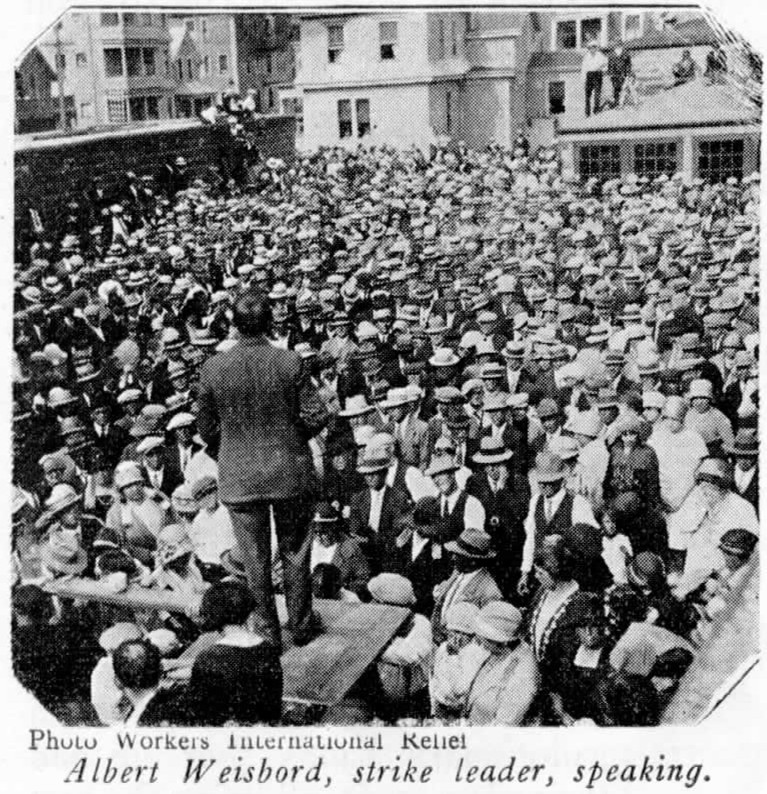
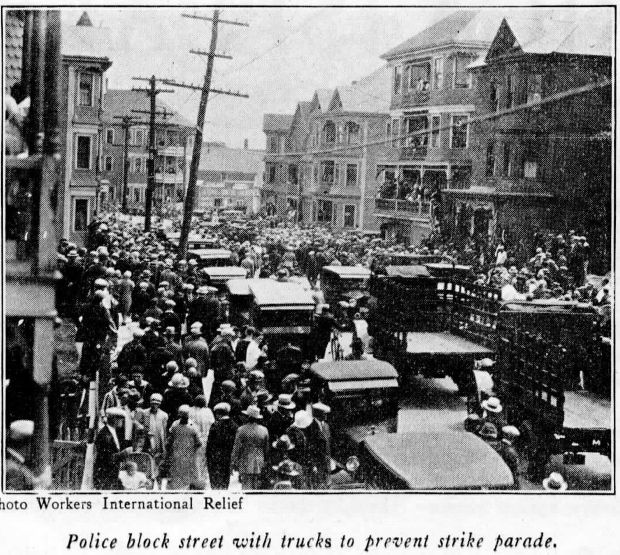
The campaign of terror began. Mass picketing was outlawed by Judge Milliken, life appointee of the Governor of Massachusetts. Hundreds of extra police were brought in from Boston, Dartmouth, Taunton, other towns. Two National Guard Companies were held ready for service…Deputy sheriffs appointed to read the Riot Act to peaceful picket lines. Clubbing, blackjacking, mass arrests…Protesting crowds of strikers massing around the jai answering the songs the prisoners inside were singing, driven back by the bared bayonets of National Guards. Picket captains beaten up in jail, flung against steel cell walls, tortured.
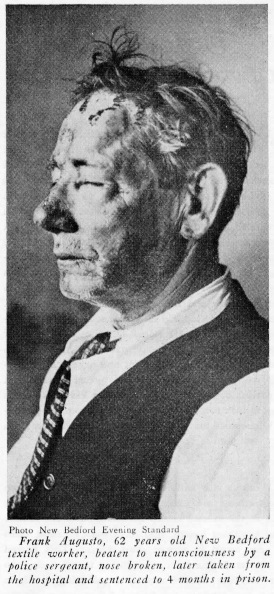
The farce of trying the arrested strikers followed…Massachusetts trying prisoners of the class war. Prisoners brought in still bleeding from police attacks, were charged with assaulting four officers, seven officers. Charges of loitering, disturbing the peace, disorderly conduct, rioting, inciting to riot, interfering with an officer…a dozen different names for the one crime…picketing the mills to keep out the scabs.
Scores of cases were rushed through on the same day, police as witnesses, muddled testimony, clumsy lies…all accepted as gospel truth by the judge…always the maximum sentence…
The hot grey August sky weighing down through the glass courtroom roof. Spectators benches crowded with prisoners overflowing from the dock. Some brought in handcuffed…Fathers and sons, together in the dock, mothers and daughters. Strong, vital men and women, Portuguese with vivid dark faces, Poles, peasant stock, not yet marked by the mills, by generations in the mills like the Lancashire millworkers scattered among the prisoners, stunted, consumption ridden. Old Judge Milliken, bloodless New England aristocrat’s face tense with hatred for the strong warm defiant life in the dock, droning out savage sentences in his querulous old man’s voice. Still the strike front held. Pickets out on bail returned straight from jail to the lines. Many were brought in and sentenced again and again, some twelve, some fourteen times.
New strikebreaker tactics were sought. The manufacturers turned to Batty, Binns and Riviere, United Textile Workers Union officials for aid, so that some sort of fake settlement might be rushed with their membership, less than 10% of the strikers, the strike officially declared an outlaw strike and still stronger measures taken to crush it.
The millowners proposed a compromise settlement on the basis of a 5% instead of a 10% cut. Batty and Binns strongly advocated its acceptance by their locals.
The New Bedford Textile Workers Union denounced the compromise on a cut in wages already at starvation level–$17 weekly average–as a direct strike sellout. Thousands of workers rallied to anti-sellout demonstrations throughout the city. The U.T.W. vote taken on Monday October 1, was overwhelmingly against the compromise.
Press and pulpit denounced the N.B.T.W.U. influence as responsible for the vote and called on the strikers to follow their duly authorized leaders. A revote was arranged for the following Saturday. A week of terrific pressure from all sides followed for the strikers. The U.T.W. officials announced that shortly all relief would be cut off. Storekeepers put up notices that the following week credit to strikers would be stopped. Landlords took steps for evictions. Press and pulpit joined the campaign.
Hundreds of police were massed at the polling places when the revote was taken, October 6. Left wing sympathizers among the U.T.W. members, pointed out by the officials, were kept from the polls. Some of Batty s members boycotted the vote in disgust. By a small majority of the two thousand voting, the sellout went through.
That was Saturday. Monday the mills opened, and an atrocious concentrated terror campaign was launched to drive the strikers back through the gates. “Go to work or go to jail was the decree issued by Chief of Police McCleod to strikers. “Get out of town or go to jail” was the decree for organizers. Every attempt at picketing mercilessly smashed. N.B.T.W.U. members were picked up on the streets, in their homes, without warrants, charged with being “idle and disorderly” since April 15, the date the strike begun. Central and South end headquarters were raided. The relief store was raided, and strikers waiting for bread jailed. Cars were stopped and searched…All the organizers were jailed. Jack Rubinstein, organizer, horribly beaten up in his cell…for “kicking a policeman in the Passaic strike…” the police told him between blows. The local International Labor Defense representative was jailed, to prevent prisoners from getting bail. Mill superintendents visited strikers homes in person, giving them till Wednesday to return or be permanently blacklisted.
The skilled English and French-Canadian workers of the U.T.W., the thousands of unorganized workers, were flowing back to work. The N.B.T.W.U. released its members “from outside strike obligations.”
The strike is broken, but the fight has just begun. The workers, returning to the mills, find the 10% notices still posted in many of them, larger cuts, as high as 20% in some; 50% to 100% speed-up in mill after mill. More looms for weavers, more sides for spinners, machines geared up to increase the speed.
The millworkers newly conscious of their power, will not tolerate these conditions for long. Manufacturers know it, and are determined to keep them leaderless.
Every step of the New Bedford Textile Workers Union to entrench itself inside the mills will be violently opposed by the mill-owners, and their agents, the United Textile Workers officials. The coming trial of the 700, will be utilized to the full to break the union by putting the union organizers and most militant strikers out of the way. Individual sentences run to three years.
The trial is tremendously significant for all militant workers. Seven hundred workers on trial in the state which carried through the murder of the workers Sacco and Vanzetti for the same crime, for battling for the rights of the working-class. Seven hundred class war fighters, passive, unorganized till a few months ago, newly awakened to consciousness through the struggle–on trial before a Massachusetts court. A desperate effort of the millowners to crush down the wave of revolt against daily intensified exploitation spreading through milltowns throughout the United States; through the striking milltowns of the north of France, where textile workers are marching from town to town with red banners; through Poland, with 100,000 millworkers out today; through India, through the world.
Labor Defender was published monthly from 1926 until 1937 by the International Labor Defense (ILD), a Workers Party of America, and later Communist Party-led, non-partisan defense organization founded by James Cannon and William Haywood while in Moscow, 1925 to support prisoners of the class war, victims of racism and imperialism, and the struggle against fascism. It included, poetry, letters from prisoners, and was heavily illustrated with photos, images, and cartoons. Labor Defender was the central organ of the Scottsboro and Sacco and Vanzetti defense campaigns. Editors included T. J. O’ Flaherty, Max Shactman, Karl Reeve, J. Louis Engdahl, William L. Patterson, Sasha Small, and Sender Garlin.
PDF of issue: https://www.marxists.org/history/usa/pubs/labordefender/1928/v03n11-nov-1928-LD-ORIG.pdf
 Revolution's Newsstand