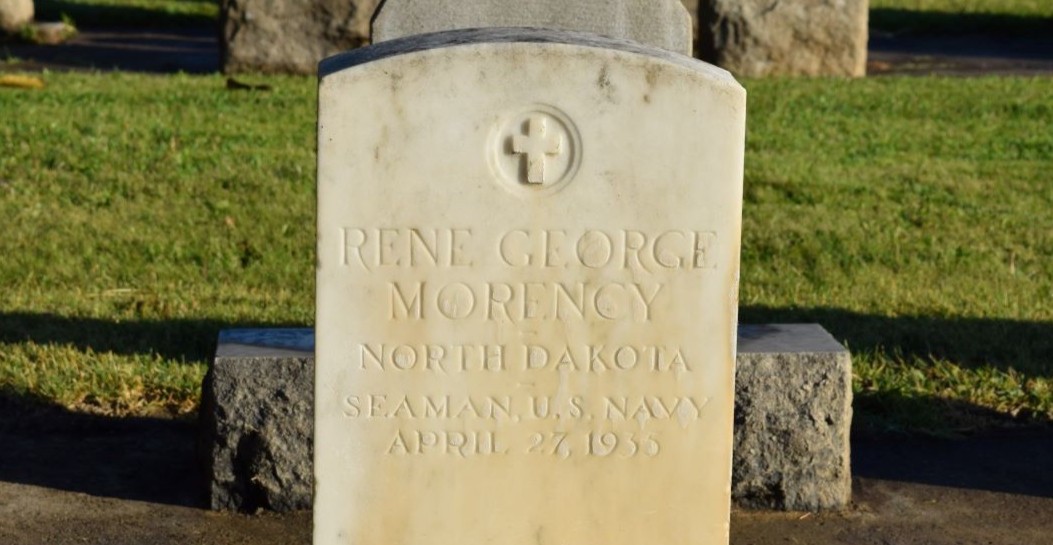
Rene George Morency, vice-president of his local union, was murdered by a boss’ son during a warehouse strike in Stockton, California on April 27 and buried on May Day, 1935.
‘Murdered Picket is Buried with Honors on May Day’ from Western Worker. Vol. 4 No. 36. May 6, 1935.
6000 Workers March in Funeral of Their Murdered Comrade in Stockton—All Work Stops as Union Labor Turns Out to Honor Here.
STOCKTON, Calif., May 1. Stockton stood still today while organized labor buried one of its heroes.
For two hours nothing moved in the downtown section while 6000 workers marched silently and powerfully through its streets, following the cortege of Ray Morency, striking warehouseman who was murdered on the picket line last Saturday.
Police vanished from sight. Traffic halted, truckmen and others voluntarily stopped their trucks wherever they were for ten minutes of silence in honor, business houses closed. Printers changed their schedules, refusing to work those two hours.
And if there were any vigilantes in the crowd of twelve to fifteen thousand who lined the sidewalks of the three-mile parade, they bared their heads and kept their mouths shut.
It was the greatest demonstration of the strength of organized labor that has ever been seen in the San Joaquin Valley, and like the great funeral march in San Francisco last July for two workers murdered in the waterfront strike, it will not be soon for gotten.
Following the shooting of Morency by Chas. Gray, twenty-five-year-old son of a trucking contractor who was scabbing for warehouse owners against the 350 men who were striking, the I.L.A. local Weighers, Warehousemen and Cereal Workers took charge.
Police attempts to interfere were repulsed. “We will handle this ourselves,” they said. And they did.
I.L.A. Honor Guard.
From Sunday on a steady stream of workers filed past the bier of Morency, the 35-year-old veteran, where he day with guards of hon- or from the I.L.A., banked with increasing loads of floral pieces.
Long before 10 o’clock this morning, a long line was pouring through the Stockton Mortuary and then silently forming their ranks in the streets outside-I.L.A. men, longshoremen, scalers, bargemen, warehousemen, and their women auxiliaries. Workers from the SERA jobs came down and formed their ranks. A delegation of striking miners from Amador took their place in line. And from San Francisco six huge busloads and over twenty cars came as a caravan down the highway. More than 600, it is estimated, made the trip to show their solidarity with the Stockton strikers.
Among them were sixty women from the I.L.A. Women’s Auxiliary, some of them long past sixty years old, who marched with set jaws through the heat the three miles to the cemetery. With them were girls from Nathan’s sackroom here who refused to work while a comrade was being buried. The I.S.U. of San Francisco sent their men. Throughout the march were many Communist Party members, come to pay a final tribute to a fellow worker. Every local union in Stockton was represented.
From the funeral parlor the body was taken to the Catholic Church where some 2000 men jammed the church with a crowd it had never seen before. Ill at ease, not knowing what to do, they seemed to be saying “Well, if Ray’s family wants this, okay. But we’ll do a lot more than this down on the picket line for Ray later.” Outside the street was packed for blocks, waiting.
They March.
When the service was over the march began. In columns of four densely packed they marched, into the heart of the city. Street cars. stopped and waited while a hundred, two hundred, a thousand, two thousand passed. But still they came pouring their column into Hunter Street until it seemed they never would stop. Two blocks long, four blocks, six blocks–and still they came, workers, farmers, old men, women, children, passing between the densely packed sidewalks.
Down to the struck warehouses they marched along Weber Ave. where the picket lines patrolled, they grimly passed the spot at Weber and Center where four strikers held a big flag over the spot where Morency was shot down.
The County Courthouse was silent and deserted as the funeral marched past. Gray, the murderer had been taken away, reputedly to a jail in another county. But the men doubted that he was in custody anywhere. Remembering the whitewashings of the Pixley murderers, “he won’t get away. with it,” they told themselves Gray’s family also have fled the county, under police escort.
The Grand Jury is to meet tomorrow at which time a murder indictment against Gray will be sought.
At the cemetery a brief prayer, a salute of honor from a squad from the Veterans of Foreign Wars, and then a long line marched single file past the casket and away. There was no long ceremony. And from the expressions on the faces of these who filed past it was clear none was necessary.
The clenched fists, the set jaws said plainly for all to read: “Good: bye, Ray. We’re going back now and win that strike for you.”
Western Worker was the publication of the Communist Party in the western United States, focused on the Pacific Coast, from 1933 until 1937. Originally published twice monthly in San Francisco, it grew to a weekly, then a twice-weekly and then merged with the Party’s Daily Worker on the West Coast to form the People’s Daily World which published until 1957. Its issues contain a wealth of information on Communist activity and cultural events in the west of those years.
PDF of full issue: https://www.marxists.org/history/usa/pubs/westernworker/1935/v4-n35-43-may-1935.pdf
 Revolution's Newsstand