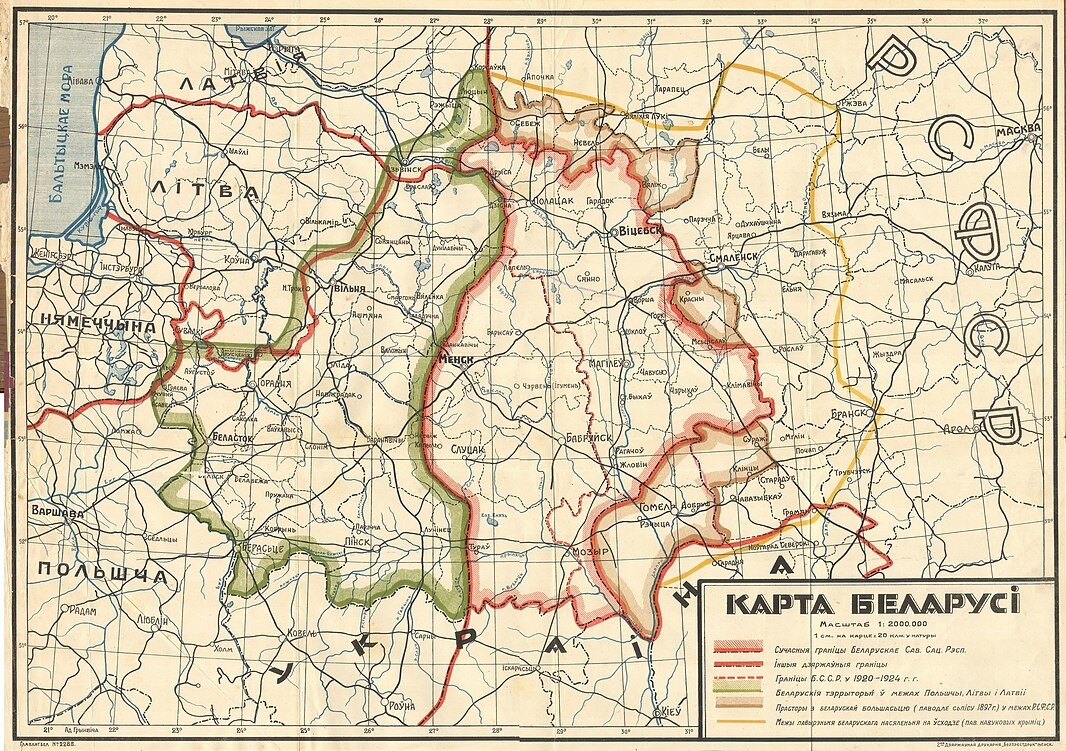
The Byelorussian Soviet Socialist Republic was (re)established in part of historic ‘White Russia’ with the end of the Polish-Soviet war on July 30, 1920. It would be independent until joining the U.S.S.R. in 1924.
‘White Russian Soviet Republic’ by A.D. from Soviet Russia (New York). Vol. 4 No. 2. January 8, 1921.
ON JULY 30, in the city of Minsk, the establishment of a White Russian Soviet Republic as an integral part of the Russian Federal Soviet Republic was proclaimed. Upon this occasion, in the whole of White Russia freed from Polish occupation great celebrations took place in which the local labor organizations participated. It is necessary to point out that the Jewish Socialist Union “Bund”, which has a strong organization in the provinces of Minsk, Grodno, and Mohilev, also participated in proclaiming the White Russian Soviet Republic. In the declaration proclaiming independence, the following paragraph is found among others:
“Based upon the decision expressed at the Soviet Convention of February, 1919, an independent White Russian Republic is declared in the name of workers and peasants. All the laws and decrees of the Polish occupation as well as the reestablishment of private property are abrogated; the right of private property in land is abrogated forever. The ‘Supreme Council’ and all White guard governments of landowners and capitalists are declared abolished. The Soviet of the Republic is to determine its ethnographic boundaries with the western bourgeois states. Up to the time of a convention of the Soviets the power is vested in the Military Revolutionary Committee.”
In the Declaration of Independence the fact is emphasized that in White Russia there is established a Soviet regime, based on the principle of proletarian dictatorship. White Russia will have an army, diplomacy, and Supreme Council of National Economy, in common with Soviet Russia. The official languages of White Russia will be, besides the White Russian, also the Russian, Polish and Jewish languages.
Two chief problems are facing the Soviet Government of White Russia at the present time: the liquidation of the Polish inheritance and the laying down of a foundation for Socialistic construction. The Polish government of occupation (and prior to it the German) have done nothing in the sphere of bettering the economic life. On the contrary in this respect much has been destroyed by them. The economy of the large estates was almost completely destroyed. The Polish land owners, the proprietors of these estates, fled to Warsaw long ago. It is unnecessary to say that to improve and perfect the new economic apparatus in these former nests of noblemen will prove extremely difficult. The peasant households suffered tremendously from constant requisitions. An acute lack of agricultural machinery is felt. The village life has been demolished to the roots. The displacing of the Czar’s officials, first by the Germans, and later by the Polish authorities from Warsaw, and the movements of tremendous armies, have destroyed the traditional habits and the normal course of the country life and work. The collapse of the agricultural life has assumed extreme proportions. We need hardly state that the upbuilding of a new communistic life under these conditions must be accompanied by the greatest difficulties. But that is not all.
In White Russia there are very few intelligent workers and intellectuals in general. The White Russian national rebirth took place only in the year 1905 when the waves of the revolution had finally reached the White Russian woodlands. In the year 1905, there was organized in White Russia the first socialist organization—the White Russian Socialist Hromada. This organization played the roll of a pioneer in the life of White Russia. In Minsk, Vilna, and Grodno there were organized the first circles of class-conscious workers. In 1906, in Vilna there was published the first socialist weekly in the White Russian language, Nasza Dolia, During the same year, in Petrograd, there was established a publishing society which had for its aim the publishing of socialistic pamphlets in the White Russian language. However, Nasza Dolia (Our Fate), and its publishing society, could not exist long. The reaction which conquered the revolution in 1907 was on the march throughout Russia. In White Russia the reaction throttled the first labor organization of White Russia—the White Russian Socialist Hromada. Nasza Dolia was closed. Its place was taken by a semi-socialist weekly Nasza Niva (Our Field). The White Russian popular movement developed very slowly, chiefly because it was first of all a movement of peasants. The majority of laborers in the small cities of White Russia as well as in the towns were Jews, Poles, and Russianized White Russians. White Russian literature, schools, and in general the national creative labor, will only now under the conditions of a free life receive the possibility of developing normally.
Only half of all the White Russians make up the population of the White Russian Soviet Republic. More than three millions of White Russians live in those provinces which according to the Riga Compact went to Poland. The question of their future fate is yet to be decided, and we must believe that the deciding word in this question will belong to the White Russians themselves, when their consciousness will completely ripen, to speak with Poland in a different language than the one in which they have spoken until now.
The Warsaw government and in general the Polish bourgeoisie believe that the question of these three million White Russians which went to Poland will be decided by their assimilation. Warsaw thinks that the White Russians of the province of Grodno, southern part of Vilna, and western part of the province of Minsk who are in the majority Catholics (half of the White Russians belong to the Greek Orthodox Church, the other half are Catholics) will sooner or later be Polonized. The Polish clergy of White Russia, which never declines the role of Polish assimilators, has been working in this direction for a long time. It is hardly necessary to conceal that individuals amongst the White Russian intellectuals also sympathize with the PoIonizing plans of Warsaw. However the culture bearers of Poland will not succeed in White Russia for the simple reason that the White Russians make up that social element which cannot be reconciled with the Polish bourgeoisie. The White Russians are peasants, poor peasants in their majority. Capitalistic Poland, ruled as it is by the Ksiondz (Polish Catholic priest), landlords, and bankers will never be able to satisfy the White Russian landless peasantry. The White Russian peasants will never be reconciled with the Polish szlachta, the owners of tremendous estates in White Russia.
The very fact that the eastern part of White Russia will exist as a Soviet Republic, this very fact alone will revolutionize the western part which at present belongs to the Polish Republic. The example of Soviet White Russia will be extremely contagious for the White Russian peasants who will have to live under the domination of the Polish landlords. All this taken together will create a spirit in favor of uniting both parts of White Russia, and when the psychological moment will arrive to transform this spirit into a political fact there can be no doubt that the best form of government structure for the United White Russia will be a Soviet regime. But we repeat the deciding word in this case will belong to the White Russian people, when the latter has realized its interest and has finally broken with the tradition of economic and political slavery.
Soviet Russia began in the summer of 1919, published by the Bureau of Information of Soviet Russia and replaced The Weekly Bulletin of the Bureau of Information of Soviet Russia. In lieu of an Embassy the Russian Soviet Government Bureau was the official voice of the Soviets in the US. Soviet Russia was published as the official organ of the RSGB until February 1922 when Soviet Russia became to the official organ of The Friends of Soviet Russia, becoming Soviet Russia Pictorial in 1923. There is no better US-published source for information on the Soviet state at this time, and includes official statements, articles by prominent Bolsheviks, data on the Soviet economy, weekly reports on the wars for survival the Soviets were engaged in, as well as efforts to in the US to lift the blockade and begin trade with the emerging Soviet Union.
PDF of full issue: https://www.marxists.org/history/usa/pubs/srp/v4-5-soviet-russia%20Jan-Dec%201921.pdf
 Revolution's Newsstand