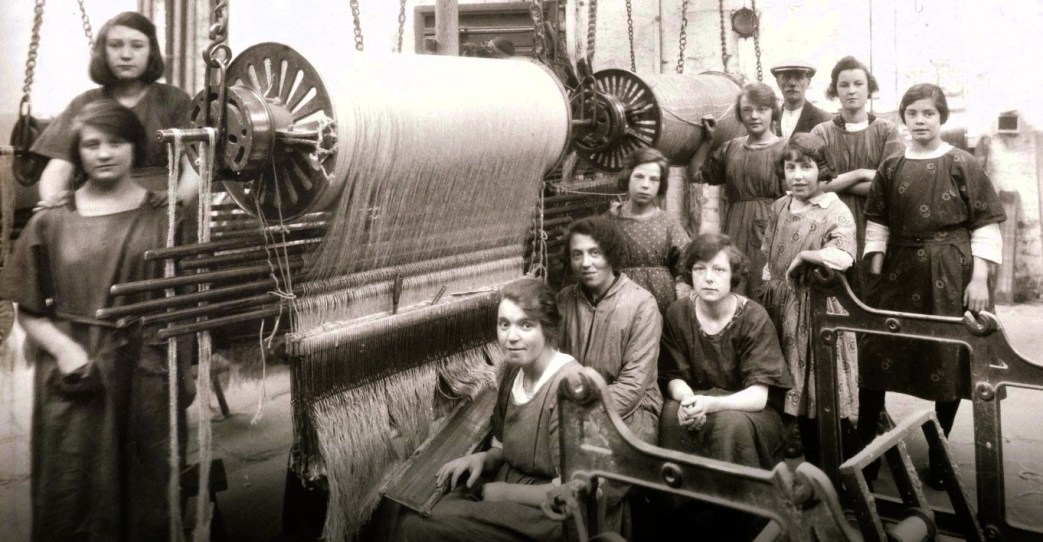
The fiber used to make twine and sacks, grown in India and processed in Dundee; the super-exploitation of the Empire’s Scottish mill women.
‘Women Jute Workers in Dundee’ by Mary Brooksbank from International Press Correspondence. Vol. 9 No. 54. September 27, 1929.
Here in Dundee the thin edge of the wedge of rationalization is being applied in the jute industry. In one mill the workers have been put back on the 10-hours day, with one spinner actually tending 4 frames. The pretext for this being a hurried Government (Labour) order. The effect of this imposition upon the physique of the women employees can be readily imagined, when it is explained that prior to and during the war the usual practice was 1 spinner 1 frame, but since then a few of the mills have instituted double spinning, until it has become the general rule, despite the fact that there are from 12,000 to 14,000 unemployed in the city, the majority of whom are jute workers.
Here it must be explained that a spinner tending 2 frames does not receive double wages, nor anything like it, the average wage for a single frame being 30s., but for tending two frames 36s. is the usual, which means a saving of £1.4.0 for the employer and more acute unemployment amongst the workers.
Here in Dundee we have the tragic position of young men being thrown on to the scrap heap under a minimum wage agreement which places the employers under an obligation to pay a higher rate to these young workers when they reach 18, but instead of paying the higher scale, they are paid off and younger workers taken on.
Dundee is a classic example of capitalist exploitation of women. Here the women are very often the principal breadwinners, and work under the most harassing and heartbreaking conditions, their abject poverty compelling many of them to work up until within a few hours of confinement. Infants of a few weeks are carried out in the early hours to be looked after, either in nurseries, which are hopelessly inadequate to meet the of such a big industrial city where female labour predominates, or as is more often the case, taken to some neighbours, where the sole interest in them is the few shillings they receive for their keep.
The life of the working women of Dundee is one absolute drudgery. 8 3/4 hours in the mill and when she goes home she has to do the cooking for the next day, her washing and the manifold tasks that are a feature of the daily run of the working class wife and mother.
Can we wonder that the infantile mortality so far as city is concerned is the highest in the country. But there are signs that militancy is asserting itself amongst our working women here, for we find them listening eagerly and with the utmost sympathy to the Communist Party message. Tired wives and mothers after a day’s toil in mill or factory will often sit hours listening to our speakers, and our workgate meetings are raising the keenest discussion.
The heroism of these women is a constant inspiration for
those of us who are carrying on the fight against rationalism and war preparations.
International Press Correspondence, widely known as”Inprecorr” was published by the Executive Committee of the Communist International (ECCI) regularly in German and English, occasionally in many other languages, beginning in 1921 and lasting in English until 1938. Inprecorr’s role was to supply translated articles to the English-speaking press of the International from the Comintern’s different sections, as well as news and statements from the ECCI. Many ‘Daily Worker’ and ‘Communist’ articles originated in Inprecorr, and it also published articles by American comrades for use in other countries. It was published at least weekly, and often thrice weekly. Inprecorr is an invaluable English-language source on the history of the Communist International and its sections.
PDF of full issue: https://www.marxists.org/history/international/comintern/inprecor/1929/v09n54-sep-27-1929-inprecor.pdf
 Revolution's Newsstand