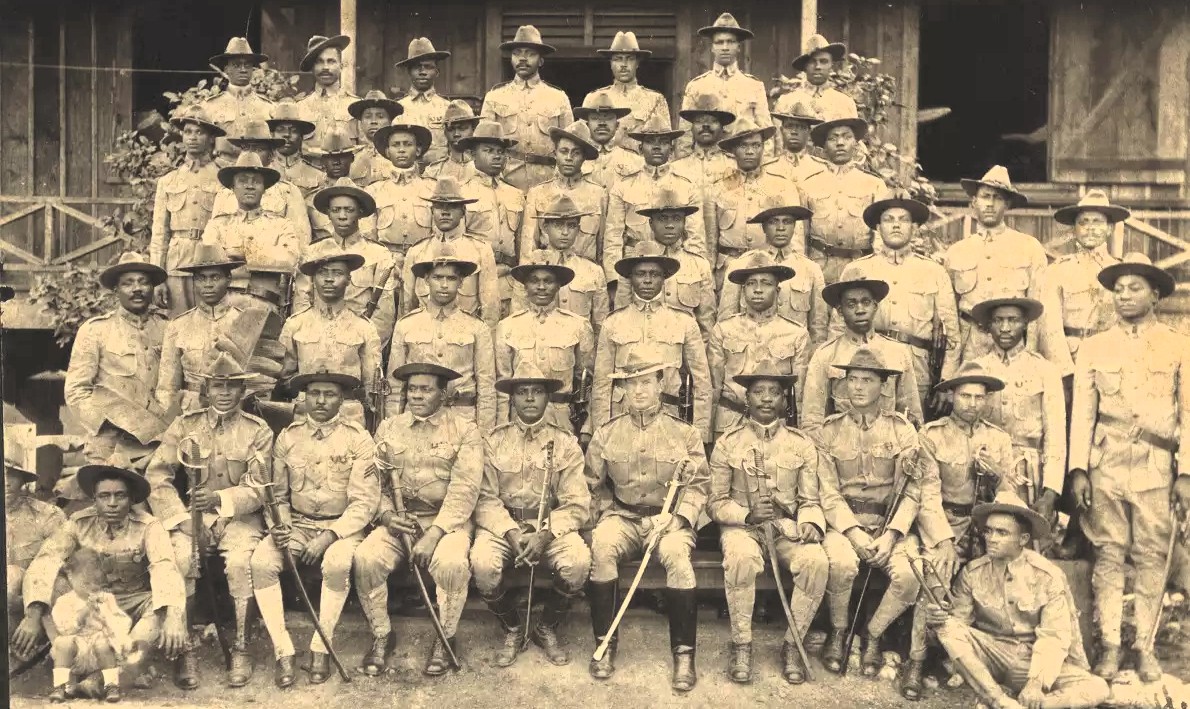
Otto Hall, older brother to Harry Haywood, on the Black soldiers’ experience in the Philippines, including those who deserted to the Filipino insurgents.
‘Negro Soldiers and Yankee Imperialism’ by Otto Hall from The Daily Worker. Vol. 9 No. 113. May 12, 1932.
THE recent, discussions in Congress over the passage of the so-called Philippine independence bill, which purports to guarantee independence to these islands within a definite period of years, recalls some interesting events that occurred during the early years of American occupation. These events deal with the use of Negro troops in carrying through the “pacification’’ of the natives in order to facilitate their exploitation by the American imperialists. The present war situation, in which Yankee imperialism has become definitely involved in tire preparations of world imperialism to attempt to destroy the Soviet Union, makes it important that the working class has a clear understanding of its tasks at this time. That Negro soldiers in the American army revolted against attempts of American imperialists to use them in the repression of colonial toilers, thanks to the efforts of the capitalists and their Negro reformist tools to conceal this, is not generally known to American workers.
That Negro toilers have been used in all capitalist wars in America, and that their reward has always been more enslavement, repression, and lynchings, is common knowledge. After the Civil War, four Negro units of the American army were created. These were the Ninth and Tenth cavalry regiments and the Twenty-fourth and Twenty-fifth Infantry. These outfits were officered almost entirely by whites, usually southerners who were presumably, better able to “handle the Negro.”
After the Spanish-American war, during the Philippine insurrection, the Twenty-fifth Infantry regiment was sent to these islands to carry through the “pacification” of the revolutionary Philippine masses. How these Negro toilers reacted to this situation is very interestingly set forth by Stephen Bonsai, in an article which appeared in the “North American Review” on June 7, 1907. In an article entitled “The Negro Soldier in War and Peace,” Bonsai writes:
“In the Philippines, the services of the Negro regiments have not attracted much favorable comment, though I believe that, under fire and in the open field, their behavior has been soldierly. In the earlier days of the occupation, it was a subject of congratulation among officers that the colored troops got on more quickly and in closer touch with the native populations than did their white brothers in arms. Many of the Negroes learned the native languages with surprising facility. Soon, however, these acquirements came to be anything but a subject of congratulation.
“While the white soldiers, unfortunately got on badly with the natives, the black soldiers got on much too well…until the time came, in 1901, when many observant officers expressed the opinion that the color line had been drawn to our disadvantage, and that the Negro soldiers were in closer sympathy with the aims of the native population than they were with those of their white leaders and the policy of the United States.
“The desertions from the Negro regiments were large—much larger I believe, than from the white organizations: And these desertions were of a different character. The white deserted because he was lazy and idle and found service life irksome. But the Negroes deserted in scores and for the purpose of joining the insurgents, and many of them, like the celebrated Fagin, became leaders and fought the white troops or their former comrades with zest and ability.” (Emphasis mine, O.H.)

The statement made by this jingoist against the white soldiers is a lie. They did not desert because they were lazy. Because many of them were poisoned by the imperialist ideology of white superiority, the great majority of the deserters did not go over to the Filipinos. But their desertion was in itself a revolt against the rotten food and army slavery in a hot climate, and miserable pay.
That the Negro soldiers were able to find common cause with their oppressed Philippine brothers is natural and demonstrates the revolutionary potentialities of this section of the working class. That these troops, without a conscious revolutionary leadership, could react in the most revolutionary manner and feel their revolutionary kinship to the oppressed Filipinos who were fighting against American imperialist oppression, gives the direct lie to the Lovestone-Pepper theory of “the reactionary Negro masses.”
Thanks to these theories, that have been dominant in the American labor movement, the importance of the role of the Negro toilers in the common fight of the working class against the imperialist war machinations had not been sufficiently understood by a large section of the American workers. The Negro bourgeois reformist tools of the American imperialists, have also faithfully carried through their treacherous role of hiding these facts from the Negro workers in order to make them believe that they have no revolutionary traditions of struggle, and have always been submissive.
It is necessary to add here that the Negro troops, after these incidents, were speedily removed from the Philippines, and that very few have been used since by the United States to “pacify” colonials. After this, the whole policy of American activities on these islands was changed, and the rigid “color line” formerly drawn against all classes of the natives was withdrawn, and an attempt made to reconcile the native bourgeoisie to American occupation by granting them a small share of the opportunity to exploit the Philippine masses.
This experience with the Negro troops proves that the Negro toilers in uniform will not lend themselves so easily to the schemes of the imperialists to crush the resistance of the colonial masses. The Negro workers, along with the rest of the working class are learning that when they help the imperialists to exploit the colonial toilers they are but tightening the yoke of oppression around their own necks.
The Daily Worker began in 1924 and was published in New York City by the Communist Party US and its predecessor organizations. Among the most long-lasting and important left publications in US history, it had a circulation of 35,000 at its peak. The Daily Worker came from The Ohio Socialist, published by the Left Wing-dominated Socialist Party of Ohio in Cleveland from 1917 to November 1919, when it became became The Toiler, paper of the Communist Labor Party. In December 1921 the above-ground Workers Party of America merged the Toiler with the paper Workers Council to found The Worker, which became The Daily Worker beginning January 13, 1924.
PDF of full issue: https://www.marxists.org/history/usa/pubs/dailyworker/1932/v09-n113-NY-may-12-1932-DW-LOC.pdf
 Revolution's Newsstand