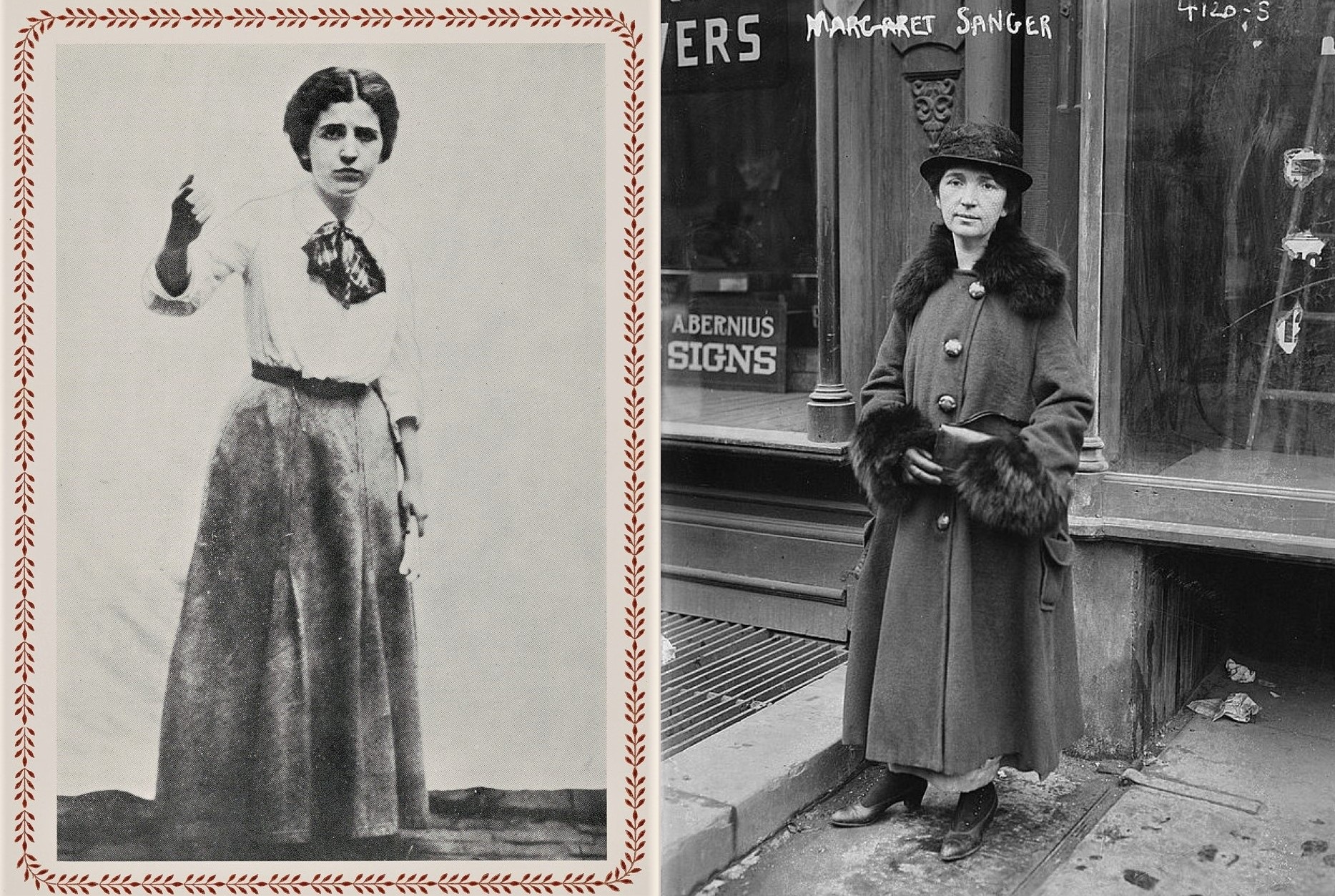
Flynn defends Sanger’s early birth control activities.
‘The Case Of Margaret Sanger’ by Elizabeth Gurley Flynn from Solidarity. Vol. 7 No. 315. January 22, 1916.
It was an agreeable surprise on my lecture trip last year, that a number of applications for the lecture “Small Families; A Working Class Necessity,” were made. It proved one of the most effective topics, yet a few years ago it was a tabooed subject in America, classified as “vulgar and obscene” both by law and public opinion. The radical change in attitude which now permits and invites a frank and serious discussion of this subject, is largely due to the indefatigable efforts of one woman–Mrs. Margaret Sanger.
She has devoted the last three years exclusively to the task of popularizing in this benighted country an idea long ago accepted throughout Europe. She has sacrificed time, energy, meager funds, family life, and has been an exile from her children for over a year. She returned to a happy reunion with them in October, only to be crushed with grief by the tragic death of her little daughter in November.
That her efforts have been fruitful is evidenced by the fact that many magazines, including The New Republic, Harper’s Weekly, Physical Culture, The Masses and the Pictorial Review have within the past year opened their columns to birth control articles. But after this splendid pioneer of American womanhood, single-handed, has battered down the bars to popular discussion–only the more radical of the periodicals are willing to acknowledge her service and to support her in the resultant legal battle.
While we now discuss birth control with comparative freedom, it is well to remember that Mrs. Sanger is to face a jury in the U.S. District Court on Jan. 18th, to answer to eleven Indictments for articles published in her paper, “The Woman Rebel.” These articles did not convey specific information as to HOW to prevent conception, but merely gave reasons WHY the people should have and use such information. The famous little booklet identified with her name, “Family Limitation,” does not enter into this case. In other words, the pioneer is to be imprisoned for advocating what dozens of editors have since exploited with impunity.
Why this discrimination? One of the illuminating objections raised by the Postal Inspectors is that the language is simple, outspoken, easily understood by all. The rich can buy information, the college-bred people have access to it through their medical and scientific libraries, only the poor who most need education are denied it completely. The masters of the bread are determined to keep so valuable a weapon out of the arsenal of labor. Mrs. Sanger is therefore prohibited from saying in popular terms to the poor what professors and magazine writers say in learned, polished phrases to prosperous readers, who already practice family limitation.
Birth control among the workers, not as a solution of the class war, but as a valuable contribution towards that end, is a logical conclusion for a woman of Mrs. Sanger’s varied experiences. She is herself a worker, her father and brothers are glass workers. Her childhood was spent in an atmosphere of strikes, lockouts and union activities. It is natural for her to write in the language of her own people. As a trained nurse she came to the East Side of New York City. Where could one view a more horrible object lesson? More concentrated poverty, filth, suffering and degradation to the square foot than anywhere else in America, is to be found in that seething cauldron of human suffering. Unwelcome babies, dying by the hundreds in summer’s heat and winter’s cold, dwarfed and stunted children fainting in school from hunger, haggard mothers over-worked in sweat shops, crowded brothels, jails, and breadlines–all spelled to her a slave society with an oversupply of slaves. She became a social revolutionist.
As organizer of the Woman’s Committee of the Socialist Party, she co-operated with large numbers of woman strikers, including the laundry and garment workers, and served on the committee that brought the Lawrence children to New York. Again during the Paterson strike she assisted in the transporting of children to workers’ homes elsewhere. She went to Hazelton, Pa., to help in the I.W.W. silk strike there and earned the undying admiration of the boys and girls, by slapping the face of the political boss of the town, a Mr. McKelvey, who appeared daily, on the picket line to insult the strikers. Her close contact with the textile centers furnished further arguments for birth control. Infant mortality, abortions, early deaths of mothers, child workers–are a few of the appalling facts common in Lawrence, Lowell, Fall River and Paterson.
It is easily appreciated from the foregoing that Mrs. Sanger is not an idle theorist, but one whose ideas have grown to fruition out of daily contact with workers and their problems.
She urges the women of the working class to decide the conditions of their maternity and to refuse to bring more children into the world than can be properly fed, clothed, housed, and educated. She advises the workers to cease hampering themselves in strikes and class battles, with a large number of helpless, hungry children and to refuse to furnish an over-production of slaves–food for mine and loom, prostitution, prison and cannon.
Mrs. Sanger is pleading “not guilty” because while she freely admits writing and publishing most of the articles, she denies they are obscene and indecent, as charged by the penal codes. She does not deny the facts; she denies the legal interpretation and defies such an ambiguous and medieval law.”
In this courageous stand, she is entitled to the unqualified support of all workers. If she is acquitted, she may be called to trial immediately on the pamphlets, “Family Limitation,” and on her right to give the specific information, her main battle will be waged. So it is vitally important to win this first round and while her willingness to go to prison for her ideals is admirable it is much more of a victory to build up such strong public opinion in Mrs. Sanger’s favor that she won’t have to go to pris on. Free she can carry on the good work she set out to do and we should make every effort to secure her vindication.
All you who have profited immeasurably by Margaret Sanger’s work can never hope to fully repay her, but you can demonstrate your appreciation by a contribution to her defense fund. Her address is 26 Post Ave., New York city. If 10 per cent. of those who have her pamphlet send $1 she will be amply supplied with funds.
Write a letter to your local press on her case. Write a letter to her, that she can use to demonstrate the demand for her work and the popular sympathy with her attitude towards the obscenity clause. Demonstrate to this noble member four class that her work is not in vain and that thousands of grateful men and women throughout this country are lined up solidly with her for free motherhood and the abolition of a slave society.
The most widely read of I.W.W. newspapers, Solidarity was published by the Industrial Workers of the World from 1909 until 1917. First produced in New Castle, Pennsylvania, and born during the McKees Rocks strike, Solidarity later moved to Cleveland, Ohio until 1917 then spent its last months in Chicago. With a circulation of around 12,000 and a readership many times that, Solidarity was instrumental in defining the Wobbly world-view at the height of their influence in the working class. It was edited over its life by A.M. Stirton, H.A. Goff, Ben H. Williams, Ralph Chaplin who also provided much of the paper’s color, and others. Like nearly all the left press it fell victim to federal repression in 1917.
PDF of full issue: https://www.marxists.org/history/usa/pubs/solidarity-iww/1916/v7-w315-jan-22-1916-solidarity.pdf
 Revolution's Newsstand