Harrison George on the risible history of Australian Labour and the failure of the Australian left to succinctly and successfully challenge their ‘leadership’ of the working class. With examples from the sell-out of the 1929 New South Wales miners struggle.
‘The Struggle in Australia’ by Harrison George from Pan-Pacific Monthly (San Francisco). No. 34. February, 1930.
With a Few Words About the Aussie Militants
WHILE the details of the struggle in Australia have not come to hand since the violent collisions in New South Wales, sufficient material is at hand to give an approximate picture of what is going on upon the island continent.
The coal miners of the Northern New South Wales fields have been sold out by their leaders. These miners were locked out on March 1st, 1929, because they would not accept a wage cut of twelve and one-half per cent. On November 29th their leaders, the officials of the union, agreed upon the following terms:
1. Resumption of work on December 9th.
2. The wages of all contract workers shall be reduced twelve and one-half per cent, and the wages of all day workers shall be reduced by six-pence per day.
3. Prior to December 9th, the owners will submit figures to the committee of employees to show that the reductions mentioned in Clause Two represent nine-pence per ton on the average.
4. The legal right of the colliery managers to dismiss workers shall not be questioned.
5. In the event of any employee feeling that he has been unfairly dealt with, a committee shall be appointed consisting of two proprietors and two representatives of the union, for the purpose of considering the case of any man dismissed. It is understood and agreed that in no circumstances shall a stoppage take place while the matter is under consideration.
6. The employees undertake not to place any restrictions on output.
7. The Miners Federation and the other unions agree to take all steps possible to avoid petty stoppages.
That the miners understood this agreement as a sell-out is clear from the battles that have since ensued. But the miners should have been more awake to the betrayal, as the previous actions of their officials had given them every reason to be vigilant and to organize to prevent the very thing that occurred. In the August number of the Pan- Pacific Monthly, the article entitled “Australian Letter” gave sufficient facts to alarm the rank and file of any union as to the conduct of a struggle with the bosses.
It must be marked as a weakness of the militants in the Australian Trade Union Movement that they could make no sharper criticism of the course the struggle was taking at the time the above mentioned article was written. Looking back we see, for example, the following: “Not much has been accomplished by the miner’s leaders during the month. It is true that the combined mining unions’ council reaffirmed its decision not to withdraw the safety men, but that could hardly be regarded as a particularly commendable decision.”
MARVELOUS RESTRAINT–BUT NO VIRTUE
It should have been clear to the revolutionary elements in the New South Wales unions at the time when the above quotation was written that not only were the miners’ leaders “not accomplishing much,” but that they were accomplishing one thing preparing for an eventual surrender and merely relying upon the same thing the bosses relied upon wearing out the spirit of struggle. More, the decision not to withdraw the safety men was not only “not commendable,” but should have been instantly denounced as an act of treachery to the strike.
The duty of the revolutionary workers in such cases is not to hand out withered bouquets and weak comment, such as “things might be worse, but then again, things might be better and after all, harsh terms may hurt somebody’s feelings.”
The fact is, that without the militant workers indulge in plain speaking and decisive organization steps, they themselves are responsible for the confusion among the workers which allows treacherous leaders to carry sell-outs into effect. It should have been obvious that the rank and file were ready for struggle against such eventualities, from the resolution adopted as far back as May 23rd last, by the miners’ lodges in the South Maitland fields, which not only protested against the craft disruption of the strike, but actually pleaded for the withdrawal of the safety men.
ARBITRATION “PROTECTION”–AN EXPLODED FANCY
Later events in their broad outlines are known. The dependence upon the “Labor” Party winning the federal elections, and the sudden reversal from attacking the arbitration courts system to supporting it (the two mistakes went hand in hand) should by now have been shown for the illusions they were. The “Labor” government has been shown to be a twin brother to the “labor” imperialist government in Britain. The very conference at which the terms of the sell-out were arranged, was called by the “Labor” Prime Minister. And this gentleman has done nothing to enforce the decision of the Federal Arbitration Court, as unsatisfactory and ambiguous as that was, regarding the opening of the struck mines in N.S.W. on pre-dispute rates. Not any court, but the organized militancy of the workers, is proven to be the only safeguard of proletarian interests.
The fairy tale that the Arbitration Court constituted an “obstacle for the employers” has been proven a mere delusion, and in being a delusion, it constituted a very decided obstacle to the struggle of the workers.
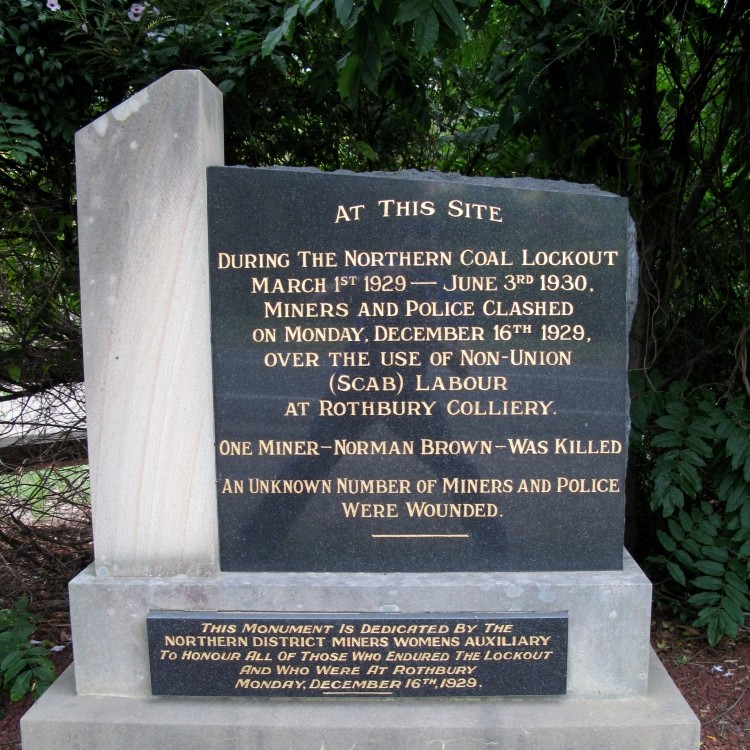
From press dispatches we gather that there has been a wide revolt of the miners against the betrayal, and what the militants have done to make up for their previous half-hearted “opposition” seems to appear in the course of events as the dispatches tell. The militant march of the miners on the Rothbury colliery, the clash with the police and the sound of battle reaching across the Pacific, are signs that the workers of Australia will not tamely submit to the attack of the employers and their betrayal by fossilized bureaucrats who have no place in union office.
Shattering all ancient illusions of an Australian-patented scheme to attain socialism without struggle, the shots of police rifles, the clubs falling on the heads of 30,000 worker demonstrators in Sydney, have ended the dream that “Australia is different.”
There is only one thing which will prevent the employers from making Australian workers into half-starved colonial slaves no better off than the workers of India: that is–their will to struggle and the joining of their struggle with the other workers of the Pacific; yes, most particularly with the Indian workers.
The situation in Australia requires a straight-out fight, and leaders who do not equivocate. If the present leaders are incapable of meeting the test, the rank and file will and must throw them out and raise up new leaders from the ranks. And the struggle for correct and audacious leadership, revolutionary leadership, is an essential part of the struggle against the employing class. That is basic.
“LABOR” DOES WORK OF NATIONALISTS
From material at hand, it seems, however, that reformists in the A.C.T.U. (Australasian Council of Trade Unions) are in a conspiracy with the new Federal “Labor” government to revive the Mondist “industrial peace” policy which was discredited in the Timber and Waterside strikes under the conservative “Nationalist” government. Thus we see the Scullin “labor” regime trying to put over an attack upon the workers which the conservative government could not–and “labor leaders” actively supporting this capitalist scheme for hamstringing the unions.
It must be remarked as especially “brilliant” on the part of the A.C.T.U. reformists, that while they can allow one section after another of Australian labor to be beaten in strike struggles with never a thought of bringing the whole movement into strike action to support the section under attack, they have suddenly discovered “discipline” to use in forcing the major state labor councils into line in behalf of reviving, for the benefit of the employers, the “industrial peace” conference.
On this matter as well, the militants failed to take up a stout enough opposition, from the positive angle of bringing support, strike solidarity support, not mere money, to the aid of the Timber Workers, whose really good spirit and fight was allowed to die of inanition in mid-October. Now, while defeat is at times unavoidable, there are all kinds of defeats, and in any case the revolutionary core of a strike movement must show growth and consolidation of itself. We say “must” because, if we do not consider the class struggle ended and the working class hopelessly subjected, the end of a conflict, even though a defeat, must leave a residue of workers newly conscious of their class, its mission and the lessons of the struggle, to constitute the revolutionary vanguard of further struggles.
DESERTION OF CLASS INTERESTS IS OPPORTUNISM
In this, as in other matters, the really revolutionary workers of Australia have so far failed to extend and consolidate their influence sufficiently. And if we look for the reason, we must say that the basic fault is a lack of incisive attitude toward reformism and reformists. Where can they find a justification for remarking that “until this year the Queensland trade union congress has been of militant character,” but that (this year) “on this occasion the reactionaries organized effectively and dominated the congress”–without a word as to what the militants were doing, if anything, to organize also. If the militants are to sleep soundly while the reactionaries are organizing, the result is not the fault of the reactionaries, but of the “militants.”
In the case of Queensland, in fact, of all Australia, where the social fascist nature of reformism is becoming pronounced and with the strength of capitalism behind it more aggressive, the revolutionary elements can take no pride in being caught out in the storm. We see, for example, that the Queensland congress rejected a resolution condemning the principle of expelling Communists from trade unions; yet concerning this we learn in a letter that the revolutionary workers are meditating doing something about this “if the policy of expelling Communists from trade unions is really adopted,” which, in the face of the resolution passed, is tried to be explained by the phrase in parenthesis “(which is not the case yet).”
WHY THE “IF”?
This is plainly a failure to recognize facts and a concurrent dependence upon trade which is showing fascist tendencies, a failure union legalism with a surrender to reformism to recognize the whole character of class relations in this period and a self-complacent blinking at one’s own mistakes. In a period when the fight against reformism, and “left” reformism especially, is the foremost task of revolutionary workers, it is not “anachronistic” that “there has been no clash” on a large scale with reformism; but it is illustrative of the fact that, with reformism on the offensive, the revolutionary workers yield to it here and yield to it there, and make no consistent fight against it–hence there is “no clash,” and the “militants” comfort themselves with the assurance that, so far, they have not been hung, drawn and quartered and exposed in the market place.
The world wide tide of great mass struggles has touched Australia, and the Australian proletariat has shown itself fully as ready for militant leadership as in any country. It is up to the revolutionary workers to furnish that sort of leadership and cease making mere pretensions of doing so, lest not only they be found bringing up the rear and making post-mortem analyses of lost battles, but sharing the responsibility for loss of working class conditions, instead of playing the role of a decisive factor in changing the course of struggle to the benefit of the interests of the proletariat.
The Pan-Pacific Monthly was the official organ of the Pan-Pacific Trade Union Secretariat (PPTUS), a subdivision of the Red International of Labor Unions, or Profitern. Established first in China in May 1927, the PPTUS had to move its offices, and the production of the Monthly to San Francisco after the fall of the Shanghai Commune in 1927. Earl Browder was an early Secretary of tge PPTUS, having been in China during its establishment. Harrison George was the editor of the Monthly. Constituents of the PPTUC included the Australian Council of Trade Unions, the All-China Federation of Trade Unions, the Indonesian Labor Federation, the Japanese Trade Union Council, the National Minority Movement (UK Colonies), the Confédération Générale du Travail Unitaire (French Colonies), the Korean Workers and Peasants Federation, the Philippine Labor Congress, the National Confederation of Farm Laborers and Tenants of the Philippines, the All-Union Central Council of Trade Unions of the Soviet Union, and the Trade Union Educational League of the U.S. With only two international conferences, the second in 1929, the PPTUS never took off as a force capable of coordinating trade union activity in the Pacific Basis, as was its charge. However, despite its short run, the Monthly is an invaluable English-language resource on a crucial period in the Communist movement in the Pacific, the beginnings of the ‘Third Period.’
PDF of full issue: https://fau.digital.flvc.org/islandora/object/fau%3A32146/datastream/OBJ/download/The_Pan-Pacific_Monthly_No__34.pdf
 Revolution's Newsstand