
The Young Communist League of India, like the Party, went through reorganization in the aftermath of the Meerut arrests. Introducing its draft program, the Y.C.L. makes a sharp distinction between itself and Congress presenting the situation and special demands of young Indian workers, women, peasants, students, soldiers, and children.
‘Draft Platform of Action of the Young Communist League of India’ from International Press Correspondence. Vol. 12 No. 11. March 10, 1932.
Draft Platform of Action of the Young Communist League of India
Colonial Slavery of the Youth.
British imperialism works for the enslavement of the young and adult generation of the working class, peasantry and town poor through the landlords, native princes and money lenders with the support of the Indian bourgeoisie. It condemns the whole toiling population to an unbearable slavery, endless poverty and slow starvation.
The working youth of India has to bear on its shoulders a double burden of merciless exploitation at the hands of both British and Indian factory owners. The labour of young workers is a daily torture, dulling the mind and exhausting the body. Their daily torment of 12 to 14 hours of grinding toil is mocked by their paltry wage. The factory owners, in order to increase their profits, snatch the last piece from the workers’ wages through the fining system.
The young workers, broken down by poor food, physical exhaustion, sickness, mutilated by the machines, incapacitated for work, are thrown out on the streets to starve without receiving any assistance. The growing army of unemployed composed largely of young workers, still further hastens the process of degeneration and starvation of vast masses of the Indian peoples.
The youth employed in the small workshops and handicraft industries are absolutely at the mercy of the employer and his foreman. Only complete physical exhaustion limits their working day.
The growing burden of taxation imposed by British imperialism, the rent and exorbitant interest paid to the landlords and moneylenders, force the young peasants to overwork themselves on their land, to go out and get employment as farm labourers to save themselves and their families from starvation. In the native states the fate of the youth is absolutely dependent on the will of the princes and rajahs who have full power of life and death.
Young students live under terrible conditions. British imperialism uses the whole state machinery to disseminate special means of education among the Indian students, so as to make docile slaves of them, who can be used as minor officials, clerks, etc., since most of the state apparatus in the State machine and institutions are filled by proteges of Imperialism.
The great majority of children are mercilessly exploited, receiving a contemptible wage for an unlimited working day. By fist and stick the jobbers wake the children who from sheer exhaustion have fallen asleep or lost consciousness. Purchase of children for slavery in the factory is a common practice. These children get no wages, and are absolutely at the mercy of the foremen.
Young workers and all toilers in our country are completely deprived of political rights. The only right possessed by the youth in common with all other toilers is the right to starve.
Oppression and the lack of all rights have awakened in the minds of the young workers and toilers, a burning hatred and indignation against their enslavers, against British Imperialism, against the landlords, princes, moneylenders and capitalists.
Awakening with an elemental force, the militant revolutionary movement of the young workers, peasants, students and town poor pours into the general stream of growing revolutionary struggle of the Indian proletariat, peasantry and all toiling masses for the overthrow of British Imperialism, the landlords, princes and moneylenders.
Only by the violent and merciless destruction of the political and economic rule of British Imperialism, only by the decisive destruction of its main support in our country–the landlords, native princes and moneylenders, will the Indian youth, together with all the toiling classes succeed in winning independence and establishing a Workers’ and Peasants’ Soviet Government in India.
“An agrarian revolution against British capitalism and the landlords must be the basis for the revolutionary emancipation of India…World history and the lessons of the class struggle in India prove that only the leadership of the working class can ensure the confiscation of the land and far-reaching democratic reconstruction of a revolutionary character. The working class in India, organized by the industrial process itself and by the class struggle, will, under the leadership of its Communist vanguard, perform its historic task of organising the scattered masses of peasantry and the poor of the towns for the struggle against the landlords and British domination.” (Platform of Action of the C.P. of India.)
The National Reformists in the Struggle for the Youth.
The greater the force with which the class struggle develops in our country, the more determined and fiercer the struggle of the Indian bourgeoisie for influence and ideological domination over the youth. The political class organisation of the Indian bourgeoisie–the National Congress, headed by Gandhi, J. Nehru and Bose, strive to bring under its influence wide sections of young workers, peasants and students, in order to use the youth against the revolutionary struggle of the toiling masses.
Now, having signed an agreement with British Imperialism (the Gandhi-Irwin Pact) and delivered hundreds of real devoted fighters for independence to the prison vengeance of the English, it is once more exposed as a faithful and obedient servant of the British imperialists, as the champion of the Indian manufacturers and landlords.
The Congress Youth Leagues, like the whole National Congress, including J. Nehru and Bose, stand for reforms within British rule, thus preserving the worst forms of oppression and enslaving of the toiling masses. They are for sitting at the spinning wheel, they call upon the youth to boycott foreign goods, picket the drink shops and spread the products of the Indian mills, thus turning the energies of the youth towards fulfilling the class interests of the Indian bourgeoisie and enlarging the profits and incomes of the Indian mill-owners and merchants while preserving the present ruling system. They thus turn the youth away from the revolutionary struggle for complete independence.
Nehru and Bose, like Gandhi, carry out the role of agents of the Indian bourgeoisie in the revolutionary youth movement. Every time the wide masses of workers, peasantry and town poor violently express their hatred of British imperialism, of the princes and landlords, money-lenders and capitalists, Nehru and Bose preach Gandhi’s doctrine of non-resistance.
The call for non-violence is an expression of the terrible fear felt by the landlords, princes and money-lenders in face of the powerful ever-growing rise of the revolution which spells their inevitable doom. The call for non-violence is the expression of the infamous cowardice of the Indian bourgeoisie for the collapse of the system of colonial exploitation. The call for non-violence is the calculated treacherous effort of the representatives of the Indian bourgeoisie, Gandhi, Nehru and Bose, to disarm the toiling masses completely, and to render them helpless in the face of the massacres and the brutal violence of the British army and police. Nehru and Bose, by their opposition to the revolutionary violence of the toiling masses, defend the continual unlimited, open and brutal violence of British imperialism towards the toiling masses of our country, they defend the daily ruin and robbery of the toilers by the British officials, by the landlords, princes and moneylenders. The aim of Nehru and Bose is to suppress and defeat the revolutionary struggle of the toiling masses.
The only difference between Nehru, Bose and Gandhi lies in the fact that Gandhi openly defends the interests of the bourgeoisie and the landlords and the allies of British imperialism, while Nehru and Bose cover up their defence of the landlords and capitalists by pseudo-revolutionary phrases about independence, about Socialism, in order to keep their influence over the masses of toilers and youth who are becoming disillusioned by the National Congress.
When Nehru and Bose come out before the youth with phrases about independence, about a socialist republic and Socialism, they try to conceal the fact that to obtain freedom from British imperialism, it is essential to overthrow imperialism by violence and to destroy its main support in our country, i.e. the landlords, princes and moneylenders.
Only the violent overthrow of British imperialism, only the complete destruction of landlordism, the native princedoms and usury, will create the conditions for the toilers, under the leadership of the working class, to carry on a further struggle for Socialism. Without the violent destruction of British imperialism and its lackeys, the independence of India, the workers and peasants republic, and Socialism, are empty words. The concrete demands of Nehru and Bose are the class demands of the Indian bourgeoisie under the cover of pseudo-revolutionary phrases. Nehru and Bose are most dangerous enemies in the struggle for independence and for a Workers’ and Peasants’ Government, just because of the fact that by dulling the consciousness of the youth through their revolutionary phrases, they are leading the youth to defend the interests of the Indian bourgeoisie, thus making it easier for the National Congress to come to an agreement with British imperialism, to betray the toiling masses and the struggle for independence.
The agents of the Indian bourgeoisie, the “lefts” Nehru and Bose try to win the lead over separate groups of students and young peasants. Realising the great role played by the students and peasant youth in the general revolutionary struggle, Nehru and Bose are striving to make them the transmitters of bourgeois influence to the broad masses of the working class, peasantry and town poor.
Naujavan Bharat Sabba, while it has in its ranks some groups of revolutionary students and peasant youth, is unable as a whole to carry on a real revolutionary fight. It limits itself to the carrying on of campaigns for the non-payment of taxes to the British Government, for the boycott of British officials, for the violation of Forest Laws, and does not, at the same time, arouse the peasantry to struggle for the seizure of the landlord’s lands, for the cancellation of indebtedness to the moneylenders, for the overthrow of the native princes, for the revolutionary struggle for independence.
The rule of British imperialism in our country will be completely and finally overthrown by the simultaneous destruction of its main support, the landlord system of the princes and moneylenders.
A lack of understanding of the class struggle and disappointment because of the treachery of the National Congress has led groups of the revolutionary youth to commit terrorist acts against representatives of British imperialism, landlords, moneylenders, etc. While greeting the heroism and self-sacrifice of the terrorists, the Young Communist League at the same time declares that victory will not be obtained by the method of individual terror, but by the revolutionary armed insurrection of the masses of the working class, the peasantry, the poor of the towns and the Indian soldiers, under the banner and leadership of the Communist Party.
All real revolutionary organisations which unite in their ranks the toiling youth, as well as the revolutionary students, will rally under the banner of struggle of the Y.C.L. of India.
The experience of the revolutionary struggle of the working youth of the Soviet Union, of China, Germany and other countries under the leadership of the Young Communist International has proved that the Y.C.L. alone leads the revolutionary struggle of all the toiling youth and that only the Y.C.L. represents and defends their interests.
Revolutionary youth of Nadjavan Bharat Sabhas! Establish Y.C.L. cells. Through merciless exposure of Nehru and Bose, rally the toiling youth under the banner of the revolutionary struggle for the overthrow of British imperialism.
The Y.C.L.–Vanguards of the Toiling Youth.
Only the working class under the leadership of the Communist Party can fulfil the role of leader in the struggle for the overthrow of British imperialism. This is especially clear to-day when the world is divided into two parts, when the contradictions and struggle between bourgeoisie and proletariat grows fiercer every day, when the proletariat of the U.S.S.R., under the leadership of the Communist Party, is building socialism, and the conditions of the toiling masses grow better day by day, while in the capitalist countries there prevails an unprecedented crisis, mass unemployment and robbery and ruin of the working class and peasantry. The Y.C.L. is in full agreement with the programme of the Communist Party, and fights for its realisation with youthful energy and enthusiasm and devotion to the cause of the emancipation of the toiling masses. The Y.C.L. of India will work under the direct guidance of the Communist Party and the Y.C.I., linking up all its work with the struggle of the workers and peasants against the exploiting classes. The programme of the Y.C.L. of India is the programme of class struggle of the proletariat and of the toiling youth for the violent overthrow of British imperialism for the establishment of the workers’ and peasants’ soviet power in India and eventually for the realisation of Socialism.
The Y.C.L. is the school of Communism for the toiling youth. Organisationally it is an independent, militant, political class organisation of the proletarian youth of town and country, attracting into its ranks the revolutionary peasant and student youth. The Y.C.L. carries on economic, political and cultural work among the masses of toiling youth, subordinating all its activities to the task of overthrowing imperialist slavery, to the winning of power by the working class and peasants. The Youth can learn Communism only by “linking up every step of its study, education and training with the incessant struggle of the proletariat and the toilers against the old exploiting society” (Lenin). The Y.C.L. of India is guided in all its work by these principles of the great leader of the workers and peasants of the whole world and particularly of the oppressed East—Lenin.
Young Workers! Organize Y.C.L. cells in the mills, factories and mines! Every mill, every factory, must become a stronghold of the Y.C.L., because only the working youth, which is an inseparable part of the working class, organised and consolidated by its very work in industry and by the class struggle, is destined to be the leader of all toiling youth.
The millions of young farm labourers in our country form the most downtrodden and exploited section of the village population, and therefore they are the most consistent, determined and irreconcilable fighters for the interests of all the peasants. They form the main support of the Y.C.L. in the villages.
Revolutionary youth in the towns and villages! Revolutionary students! Form Y.C.L. cells! Create a mass Y.C.L. organisation in India.
Only the mass organisations of the Y.C.L., connected with hundreds of thousands of young workers and peasants, are able to lead the revolutionary youth of town and country.
Young women workers and peasants! Join the ranks of the Indian Y.C.L. It is the only real defender of your interests. Only under the banner of the Indian Y.C.L. can you free yourselves from oppression, slavery and lack of all rights.
Hindu and Moslem youth! Do not let the provocation of British imperialism set you against each other. Form a united front of struggle under the leadership of the Indian Y.C.L. and the C.P. against the British imperialists, because you both suffer the same from British and native exploiters alike.
Revolutionary youth! The existing castes are supported by British imperialism and the landlords to cloud your minds, and thus make possible your slavery.
The Y.C.L. creates mass auxiliary organisations such as sport, cultural and other organisations, directing their work in the spirit of the class struggle of the proletariat. The Y.C.L. supports and develops the organisations of Red sportsmen in India.
The Y.C.L. calls upon young proletarians, peasants, students and all the toiling youth of India to struggle for the realisation of the slogans of the Indian revolution as put forward by the Communist Party:
1. The complete independence of India by means of the violent overthrow of British rule. The annulment of all debts, the expropriation and nationalisation of all British factories, banks, railroads, sea and river transport and plantations.
2. The establishment of a Soviet Government, the right of national minorities to self-determination up to the point of separation. The abolition of native states. The establishment of an Indian Federal Workers’ and Peasants’ Soviet Republic.
3. The confiscation without compensation of all the lands, forests and other property of the landlords, native princes, the churches, the British government, the officials and the money-lenders, and their handing over for use by the toiling peasants. The cancellation of all slave agreements and peasant debts to money-lenders and banks.
4. The 8-hour working day for adults and 6-hour day for young workers, up to 18 years and the radical improvement of conditions of labour for the workers, increased wages, and state maintenance for the unemployed. Equal pay for equal work.
The Path of Economic Struggles.
1. The economic strike which aims at the immediate improvement of the conditions of life of the working youth and of the working class as a whole is a preparatory step towards the political general strike. The Y.C.L. of India, leading the whole struggle of the working class youth, takes part energetically in every struggle for the immediate improvement of the situation of young workers and of the whole of the working class.
2. The Y.C.L. of India appeals to the youth to support the revolutionary left wing of the trade unions and assist the Party and the revolutionary trade unions to prepare for the general revolutionary strike, as the main task of the present stage of the revolutionary struggle of the working class.
3. In order to organise the broad masses of the working youth for the defence of their daily interests and for the support of the general revolutionary struggle of the toiling masses, the Y.C.L. of India calls on the working youth to establish youth sections in all the trade unions and to elect youth representatives in the factories.
Our task in the reformist trade unions is to expose mercilessly the treacherous role of the reformists of all shades from the open agents of British capital, such as Joshi, Chamanlal and Firi, to the pseudo-left national reformists such as Bose, Nehru, Ruikar, Jinwalla, Kandalkar, who are agents of the Indian bourgeoisie and are united in the struggle against the revolutionary wing of the trade unions. The national reformists of all shades preach class peace with the employers instead of the class struggle and fight not for the interests of the workers, but for the safety of the employers’ pockets.
Young workers! Help the revolutionary trade unions to lead the struggle of the working class of our country! Help the Communist Party and the Red trade unions to create a really powerful revolutionary trade union movement in India, to organise revolutionary factory committees in the factories!
Fight for the affiliation of the Indian trade union movement to the Red International of Labour Unions.
The Y.C.L., together with the trade unions, appeals to its organisations and members, to the whole of the class-conscious youth, to organise and lead strikes of young workers in the struggle for the immediate interests of the working youth. The Y.C.L. draws all the working youth into the general proletarian movement.
The Y.C.L. of India calls upon the young farm labourers to take the initiative in the formation of a union of farm labourers and to take the most energetic part in its work for the defence of the interests of all farm labourers.
What the Y.C.L. Fights For.
The special demands of Young Workers.
A real improvement of the situation of working youth is impossible while British imperialism dominates our country. Only a workers’ and peasants’ revolution and eventually a proletarian revolution can carry out this task. This can clearly be seen from the example of the Soviet Union. It is only in the Union of Soviet Socialist Republics that the young workers from 14 to 16 years of age work four hours a day and young workers of 16 and 18 years of age work 6 hours a day receiving full wages as if they had worked an 8-hour day. It is only there that the young workers can go to sanitoriums at the expense of the State. Unemployment among youth does not exist. The working youth can study in factory schools where theoretical study is combined with work in industry. Hundreds of thousands of young workers are being educated in workers’ faculties, technical schools and universities, and are supported by the State.
The Y.C.L. of India struggles for this programme of the demands of the working youth which have so far been carried out only in one country–the U.S.S.R. In addition, the Y.CL. supports and struggles for all the partial demands which are directed towards improving the conditions of the young workers and of the working class as a whole, closely linking up these demands with the struggle for the general political slogans and the final aims of the Communist Movement.
The Y.C.L. puts forward the following partial demands:
1. The Y.C.L. of India is fighting for freedom of speech and assembly for all toiling youth, freedom of the press for workers and farm labourers of all ages. The Y.C.L. is fighting for the right of the youth to join trade unions and for election to all trade union offices.
2. Maximum limitation of the working day of the young workers without reduction of wages; against low wages, for higher wages; equal pay for equal work for women, youths and men; prohibition of the employment of children under the age of 14 and a simultaneous increase in the wages of their parents.
3. A weekly rest period at full pay and a paid annual holiday of 4 weeks for the youth under the age of 18; prohibition of the employment of youths under the age of 18 in all harmful industries and factory departments; prohibition of night work for young workers under the age of 18; special safeguarding of the labour of girl workers.
4. Introduction of professional training for adolescents. at the expense of the State and employers, paying the adolescents a minimum living allowance; equal rights for girls to learn a profession, prohibition of apprentices being used on work not connected with the profession they are learning.
5. Social insurance at the expense of the state and employers; abolition of the system of money fines and physical punishment.
The Y.C.L. calls upon the young workers to organise the struggle of the unemployed youth for regular benefits at the expense of the state and employers, for work and opportunities to study.
The Y.C.L. calls upon the unemployed youth to carry on mass forms of struggle (demonstrations) and to struggle together with the organised youth and adult workers for the partial demands of the employed.
Monthly payment of benefits equal to the minimum cost of living, the abolition of payment of rent during unemployment, free supply of fuel and food by the municipal councils.
The Y.C.L. calls upon the working youth of the towns to help the young farm labourers in the villages and on the plantations to organise the struggle against all conditions of serfdom, against forced and contract labour, against the lack of rights and the exploitation of youth and child labour. This struggle is one of the main tasks linked up with the struggle of the masses of the peasants and peasant youth against the imperialists, princes, landlords and moneylenders.
Demands of the Peasant Youth.
The Y.C.L. calls upon the toiling youth of the villages to organise, together with all the toiling masses, political demonstrations by collectively refusing to pay taxes and rent, or to carry out the orders of the government and its agents or to do any work for the landlords. native princes and money-lender. Toiling youth of the villages! Struggle against the payment of any debts to the government, the landlords, the money-lender and the banks. Rouse the peasant to struggle for the demands of the Communist Party of India and put forward in its platform of action:
1. Confiscation without compensation of all land and estates, forest and pastures of the landlords, moneylenders, feudalists and imperialists and the transfer of this land to the toiling peasants through peasant committees. Complete cancellation of all indebtedness and taxes.
2. Confiscation of the whole system of irrigation. Transference of the control and supervision of the work of irrigation to revolutionary peasant committees elected by the working peasantry.
The Y.C.L. calls upon the toiling youth in the villages to organise, together with all the toiling peasantry, revolutionary peasant committees, in order to carry on a fight to fulfil all the revolutionary democratic demands, thereby emancipating the peasantry from the yoke of British imperialism, landlords and moneylenders.
The Y.CL. of India puts forward the following demands of the young agricultural labourers in the villages.
1. Maximum limitation of the working day. Equal pay for equal work for young and adult agricultural labourers. Against low wages, for high wages, against serfdom and slave contracts.
2. Establishment of professional schools for young agricultural labourers and all the village youth and the opportunity to study at the expense of the state up to the age of 16, the agricultural labourers to be paid an allowance equal to the minimum cost of living.
The Y.C.L. of India is firmly convinced that the complete, consistent and permanent achievement of the above-mentioned political and social demands is possible only by the violent overthrow of British domination and the creation of a Federal Workers’ and Peasants’ Soviet Republic.
The Demands of the Students.
The Y.C.L. of India calls upon the revolutionary young students to struggle under the banner of the Communist Party and Young Communist League of India for:
1. Freedom of speech and assembly, freedom of the press and revolutionary organisations in India.
2. Freedom of universities, free right to choose principals and teachers. Self-government in the universities and the secondary and elementary schools. The right to study in the native language.
3. General education free of charge with allowances at the expense of the state for needy students.
Work among Soldiers and their Demands.
The army and police is the force by means of which British imperialism mercilessly suppresses the revolutionary movement in our country. British imperialism is preparing also in our country the mailed fist for military intervention against the U.S.S.R. and the revolutionary emancipation movement in the whole of the East. In order to free our country from the domination of British imperialism, in order to prevent British imperialism from using India as a military base against the U.S.S.R. and the revolutionary emancipation movement in the whole of the East, the Y.C.L. of India calls for the spreading of revolutionary propaganda among the soldiers and police, and the explanation of the necessity for an armed insurrection, together with the toiling masses of the country, against British rule.
The majority of the soldiers and police are also toilers, who have not realised their class interests. The Y.C.L. of India calls upon the revolutionary young workers, peasants and students, to explain to the soldiers and police that their interests are the same as the interests of the toiling masses in the town and village, that the only way to receive land and work, to abolish indebtedness, is the way of the revolutionary overthrow of British rule, the destruction of the system of landlordism and moneylenders.
The Y.C.L. of India considers that the appeal of the “left” nationalists to the soldiers to leave the army and to resign in accordance with Gandhi’s teachings of non-violence is a treacherous appeal, The Y.C.L. follows the instructions of the great leader of all the toilers–Lenin, who said to the toiling youth going into the army:
“You will soon be grown up. They will give you a gun. Take it and learn how to use it. This knowledge is necessary for the proletariat: not in order to shoot down their brothers, the workers of other countries, but in order to fight against the bourgeoisie of their own country, in order to put an end to exploitation, poverty and wars, not by means of pious wishes, but by victory over the bourgeoisie and by disarming it.”
The immediate duty every Y.C.L. member and of the whole revolutionary youth is to take part in the “establishment of a secret organisation of the revolutionaries in the army” (Lenin), the task of which is to struggle for the daily demands of the soldiers, to rally them under the slogan of revolutionary struggle for the overthrow of British imperialism.
The Y.C.L. of India puts forward the following partial demands of the soldiers, closely linking them up with the struggle for the general political slogans of the revolution:
1. Service in native province. To return home in possession of weapons. Officers to be elected by soldiers. The Indian soldiers to receive increased pay at the expense of decreasing the pay of the officers and military officials. Abolition of courts martial and their replacement by comrades courts.
2. Improvement of food and clothing for the soldiers and the transfer of control and supervision over all the questions of food into the hands of the soldiers themselves. The right. to use their free time according to their own discretion.
3. The right of the soldiers to discuss their needs jointly. The right to attend public meetings and places on the same terms as other citizens. The right to read and keep books, newspapers and journals in the barracks without being checked up by the officers. Complete abolition of censorship on letters received by the soldiers. Prohibition of the use of soldiers as household servants for officers.
The Y.C.L. of India calls upon the young workers, peasants and revolutionary students to establish everywhere separate workers’, peasants’ and students’ detachments and also joint detachments for the safeguarding of the peoples’ demonstrations, strikes and for revolutionary self-defence, and also for the purpose of systematically preparing the revolutionary struggle of the Indian people. Through the arming of the people, advance to the overthrow of British imperialism.
Work Among Children.
1. The Y.C.L. of India calls upon all the toiling youth to struggle for the complete prohibition of child labour up to the age of 14 in industry, agriculture, handicraft and auxiliary industries.
2. The Y.C.L. of India calls upon the toiling youth to assist the children in their struggle for general free education for all children up to the age of 16, in their native language at the expense of the state; in their struggle against nationalist, militarist and religious education, against physical punishment and conservative teachers, for the organisation of self-government in the schools, for the furnishing of food, clothing and school books.
3. The Y.C.L. of India calls upon the Communist Party of India, the Red Trade Unions, all the workers and peasants and all the toiling youth to assist the League in establishing a mass Communist children’s movement for the conscious participation of the children in the struggle for economic emancipation.
4. The Y.C.L. of India calls upon the proletarian children to establish revolutionary children’s organisations to take part in the general struggle of the working class.
Conclusion.
The Y.C.L. of India calls upon the proletarian and toiling youth of India to rally under the banner of the Indian Y.C.L. and Communist Party for the successful conquest of power and emancipation from the yoke of the imperialists, landlords, princes and money-lenders. Only the successful solution of these problems will open up the possibility, with the help of the international proletariat and the class offensive of the exploited masses of our country, of the revolution developing through a number of stages into a proletarian revolution, thereby creating the requisite conditions for the development of our country on socialist lines, avoiding the further stage of domination of the capitalist system. (Programme of the C.P.)
Young proletarians and toilers of India! In this struggle we are not alone. The proletarian youth of the whole world and the whole working class will come to our aid. We shall be assisted especially by the revolutionary youth and all the revolutionary forces of China who have established a workers’ and peasants’ Soviet government on a territory with a population of 60 million and are successfully defeating the united attacks of the imperialists, Chinese landlords and bourgeoisie; they are the best example for us. We shall be assisted by the proletarian youth and toilers of Great Britain, led by the Y.C.L.G.B. and the Communist Party which are struggling together with us for the overthrow of blood-thirsty British imperialism. We shall be supported by the youth and toilers of the Soviet Union, the stronghold of the world proletarian revolution, the only country in the world where socialist society is being successfully built up, the only country in the world where the material and cultural conditions of the toiling masses are daily improving. Following the example of the proletariat of the U.S.S.R. we must overthrow the ruling classes in India and commence the building up of a new society.
Adult and young workers of Great Britain! Young workers of the Soviet Union, of Soviet China, of Germany and of the whole world! We are firmly convinced of your determined, bold and powerful support of the growing revolution in India.
The revolutionary movement in our country grows ever wider, more powerful, more open and bolder. The working class, the poor in the towns, the peasants in the villages are in revolt. All the toilers are rising like one. The great struggle is developing with unprecedented rapidity.
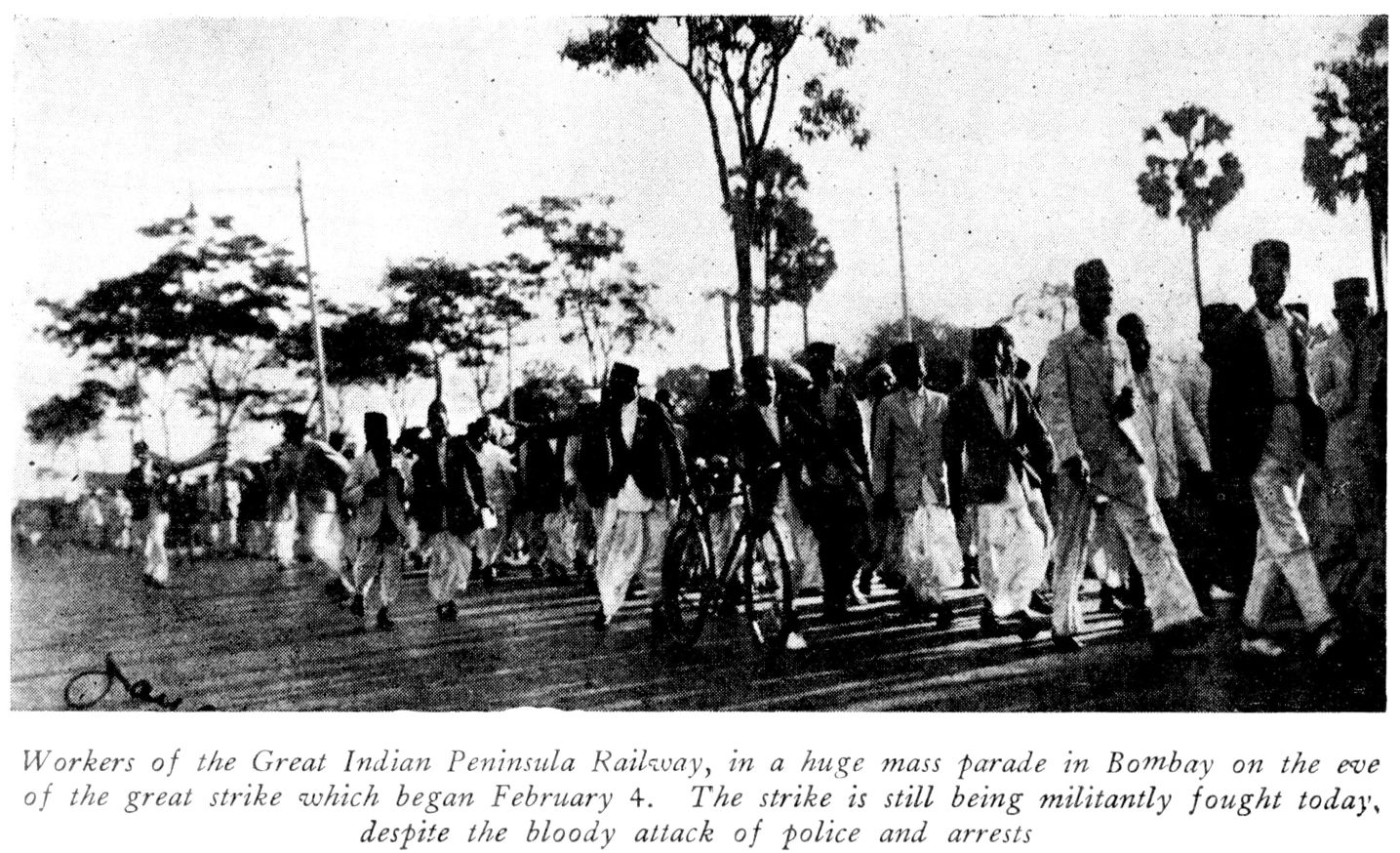
Neither arrests, nor prisons, neither bullets nor whips, can stop the growing and powerful rise of the revolutionary movement.
The revolutionary youth of India, under the leadership of the Y.C.L. and Communist Party, will strain all its forces to achieve the greatest consciousness, firmness, simultaneousness and coordination in the actions of the working class, town poor and peasantry.
Proletarian youth of the town and village! Revolutionary young peasants! Revolutionary students! Close your ranks around the Communist Party and the Y.C.L. for the final violent defeat of British imperialism and of its supporters—landlords, princes and moneylenders.
For the independence of India through armed insurrection! Long, live a Workers’ and Peasants’ Soviet Government in India!
Long live the working class, the leader of the toiling masses and its vanguard, the Communist Party of India.
Be ready to defeat the bloody slaughter that is being prepared by the imperialists against the U.S.S.R., the fatherland of the world proletariat and of the oppressed toilers of the East!
Stand firm for the defence of the Chinese revolution! The revolution in India is a death blow to imperialism! Long live the general staff of the world revolution–the Communist International!
Long live the world revolution!
International Press Correspondence, widely known as”Inprecorr” was published by the Executive Committee of the Communist International (ECCI) regularly in German and English, occasionally in many other languages, beginning in 1921 and lasting in English until 1938. Inprecorr’s role was to supply translated articles to the English-speaking press of the International from the Comintern’s different sections, as well as news and statements from the ECCI. Many ‘Daily Worker’ and ‘Communist’ articles originated in Inprecorr, and it also published articles by American comrades for use in other countries. It was published at least weekly, and often thrice weekly. Inprecorr is an invaluable English-language source on the history of the Communist International and its sections.
PDF of full issue: https://www.marxists.org/history/international/comintern/inprecor/1932/v12n11-mar-10-1932-Inprecor-op.pdf
 Revolution's Newsstand