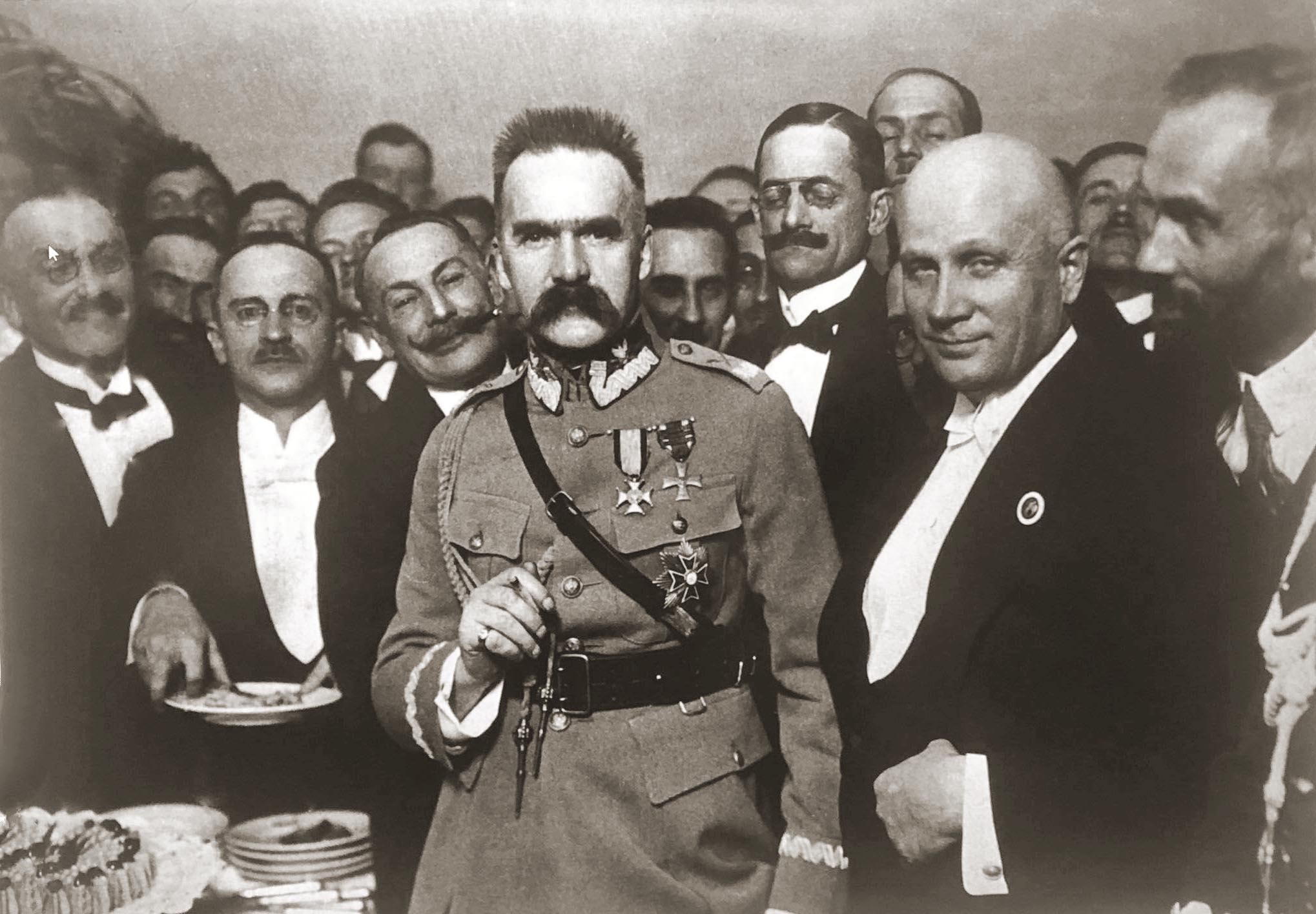
Polish imperialism, with British backing, stokes reactionary nationalism and anti-semitism in Ukraine as it seeks to undermine Soviet power and territoriality expand.
‘Pilsudski and the Question of the Ukraine and White Russia’ by G. Turin from Communist International. Vol. 4 No. 2. February 15, 1927.
THE attack against the U.S.S.R. which Fascist Poland is undoubtedly preparing, under the dictatorship of its present protector, England, demands a number of preparatory measures; the main task is to prepare a “Hinterland,” a base for operations in the Hastern border district. Poland is not united from the national point of view. Almost half the population, certainly not less than 42 per cent. consist of alien nationalities, and amongst these the most hostile to Poland are the Ukrainians and the White Russians (numbering about eight millions). Therefore, it is quite clear that the Polish replica of ramshackle Austria, which even in peace time is kept together only with the aid of bayonets and bullets, must feel particularly insecure in time of war. The success of this attack against the Workers’ and Peasants’ Republic may to a certain extent paralyse the separatist tendencies of the oppressed national minorities. Consequently, it is clear that a component part of the adventurist plans of the present Pilsudski Government must be to safeguard the border districts.
“An attack upon the Soviets,” writes Consulibus, adherent of Pilsudski,1 “implies first of all the proper safeguarding of our frontier from within, i.e., the regulation of border affairs so that they may not become the Achilles heel of Poland. Who knows but that our lack of desire to raise this question is the source of the policy of compromise with the Soviets? The Soviets create the atmosphere in our border districts that they desire. For that reason we must regulate our relations with the Eastern border districts irrespective of the various conceptions of the tasks of the Polish State, for the present conditions prevailing in these border districts merely give our enemies the chance at an opportune moment, to incite these districts against Poland.”
Whatever turn the question of regulating relations between Western Ukraine and Western White Russia may take, it is necessary to confirm the following indisputable fact: the Ukrainian and White Russian question is the Gordian knot of Polish politics and its disentanglement is extremely problematical, Bourgeois aristocratic Poland, stretched on the Procrustean bed of internal national contradictions and revolutionary irredentism roused by the existence of the Soviet Republics and their correct national policy (Ukrainisation, etc.), turns desperately from plans of incorporation (National Democrats) to plans of federation (Pilsudski and the P.P.S.), but as a matter of fact, continues the old policy of “zoological” nationalism and White Terror. In an article written in the Government organ “Novi Courier Polski” entitled “Problems of the National Minorities,” Vladimir Srokovski is obliged to admit that “Polish democracy is incapable of solving the national problem, which is becoming more and more complicated into a desperate tangle and apparently cannot be solved by any single practical measure.” Unsupported phrases about autonomy put out by this “democracy” will hardly ever assume concrete form, because autonomy would be tantamount to diminishing Polish power in the border districts, and to this the national democrats, the P.P.S., Stanislav Grabski or Pilsudski would never agree.
This fact is not concealed to-day even by the P.P.S. which is most generous with its phrases about autonomy. For example, Holuvko prior to the May coup was a most zealous apostle of autonomy for the Eastern border districts; his tone is now a whole octave lower. At a debate that was held at the Institute for the Study of National Minorities,2 which took place on the 16th of June, he stated that autonomy was not.an urgent question because the old administrative apparatus hampers it. In his opinion it is necessary to start from “real politics.” It is necessary first of all to remove the obstacles that stand in the path of autonomy, and to “create the necessary psychological conditions so that Ukrainian public opinion may be prepared to compromise.” How these “psychological conditions” are to be created Holuvko does not say. We are left to presume by means of the Institute’s tea parties.
Proud Words at a Parade
The May coup of Pilsudski caused the Petlurist camp to bestir itself. At a parade of Legionaries arranged in Coltsi, on the occasion of the twelfth anniversary of Pilsudski’s march from Cracow into Congress Poland, the remnants. of Petlura’s forces rallied together under the slogan of “We are menaced by a common enemy” in order to swear allegiance to the White Eagle: “We Ukrainians in an alien land profoundly believe that the White Eagles led by their leader would help us to break the chains of Moscow and liberate our holy Ukraine.”
The Petlurists and Pilsudski-ists recalled their old friendship of 1920, and although this time Pilsudski “out of politeness” to the national democrats does not make any open promises to the remnants of the Ukrainian national revolutionaries, “secretly” he does not forget them for a moment. It is proposed to give the Petlurists rights of citizenship; Petlurists must be our first choice in appointments to government positions including also the secret service (where in fact they are employed at the present time). The Petlurists will be organised into a military reserve, which in the event of war may be formed into Ukrainian regiments. In short, the Petlurists must serve as the material with the aid of which the “government of moral purification” will be able to extend in the Western European territories a network of parties connected with the secret. service after the manner of those established by its predecessors.
The Western Ukrainian petty bourgeois parties— the Ukrainian National Democrats3—and the Radicalst do not lag behind the Petlurists. “The assassination of Petlura has revealed how piffling is the distinction between the clerical Ukrainian national democrats and the rich farmer Ukrainian Socialist Revolutionary Party, between the compromisers D. Devitski and V. Batchinski and the “activists” of the Socialist Revolutionary camp like Shopoval. The whole of this company in unison exalt Petlura into the national “holy of holies” and represent a united anti-Semitic pogrom in their campaign of lies and slander against the U.S.S.R.
A Britisher in Charge
The assassination of Petlura has clearly shown how at the command of the London Stock Exchange via Warsaw, the Western Ukrainian petty bourgeois camp, in Conjunction with the Petlurist emigrés are prepared, in return for a mess of pottage, to offer their services to Western European capital and to take the path which they trod in 1918-20.
Ukrainian nationalists are following the advice of Stead, the representative of the British Foreign Office with whom they carried on negotiations in Warsaw. In these negotiations Stead made no concrete promises to anyone, but simply advised all the anti-Soviet groups to unite around Pilsudski. The representatives of the Ukrainian National Democrats, Dmitrov Levitski, Tsilevitch, Lutski and Peliev, have come to agreement with Pilsudski; the latter will make concessions to the Ukrainians after he has consolidated his position in Poland and broken the resistance of the National Democrats. Until that has been accomplished the agreement between Pilsudski and the Ukrainian National Democrats is to be kept secret. At the present time, in agreement with the Ukrainian National Democrats, a number of prominent Petlurists are establishing themselves in Volhynia; these include the well-known co-operator, Baranovski. Alexander Kovalevski is proceeding there in the capacity of bank manager, etc. There are persistent rumours to the effect that in agreement with Pilsudski the Podebriatsk Academy will be transferred from Czecho-Slovakia to Vora and will be subsidised by the State.
The White Russian nationalist parties do not lag behind the Ukrainian nationalists. The group of Pavlokevitch and the remnants of the Balohovitch group are to-day putting forward the slogan of the unification of Eastern White Russia with Western White Russia. The independents, under the banner of Kremitch and the Priest Stankevitch, “regard as their ideal the independence of the united territories of the White Russian peoples and friendly relations with neighbouring peoples in the form of a federation with them.”
However, this time the hopes of the Ukrainian and White Russian counter-revolutionaries will be disappointed. The appearance of opposition tendencies in the ranks of the Ukrainian national democrats and the Ukrainian Socialist Revolutionary party and the appearance of a tendency towards amalgamation on a platform of class struggle among the Ukrainian Lefts, the peasant party, the “Seliansk League” in Volhynia, and “The will of the people” group in Galicia, the strengthening of the influence of the \White Russian “Gromada” among the peasantry, all serve to indicate that the masses are swinging to the Left and strive to establish a united front with the proletariat of Poland. If the Ukrainian and White Russian lackeys of Western European “civilisation” (read “Capital”) dare to raise their hands to support fresh military adventures against the U.S.S.R., they will be lopped off in the struggle for emancipation of the workers and peasants.
NOTES
1. Cf. Consulibus’ ‘Evidences of our Mistakes in our Foreign Policy,’ Warsaw, 1926.
2. The Ukrainian National Democratic organisation. The Right Wing, the Dilo group represents the clergy and the well-paid State officials, trading bourgeoisie, etc. They stand for fighting the Communist Party and strive to reach a compromise with reactionary Warsaw. The Left Wing, the Rada group, representing the working intelligentsia and certain groups of the exploited peasantry, tend towards the Soviets and are opposed to compromise with bourgeois Poland.
3. The Ukrainian Radical Social Party. This also is not a united party. In it there are three tendencies: (1) the Right Wing, representing a section of the Party leadership, led by Batchincki, which strives to co-operate with the Ukrainian National Democratic Party ; (2) the Centre which is under the influence of the Ukrainian emigrés and Socialist Revolutionaries (Shopoval) and supports the platform of irreconcilable struggle with the Communists, and alleged struggle against the Ukrainian National Democrats and (3) the Left Wing represents the lower ranks of the peasantry in the Radical Party, who are discontented with the policy of the Party leaders, particularly in the Rogatinsk, Stanislav, Colominsk and other areas. These incline towards the Communist Party of Western Ukraine.
The ECCI published the magazine ‘Communist International’ edited by Zinoviev and Karl Radek from 1919 until 1926 irregularly in German, French, Russian, and English. Restarting in 1927 until 1934. Unlike, Inprecorr, CI contained long-form articles by the leading figures of the International as well as proceedings, statements, and notices of the Comintern. No complete run of Communist International is available in English. Both were largely published outside of Soviet territory, with Communist International printed in London, to facilitate distribution and both were major contributors to the Communist press in the U.S. Communist International and Inprecorr are an invaluable English-language source on the history of the Communist International and its sections.
PDF of full issue: https://www.marxists.org/history/international/comintern/ci/vol-4/v04-n02-feb-15-1927-CI-riaz-orig.pdf
 Revolution's Newsstand