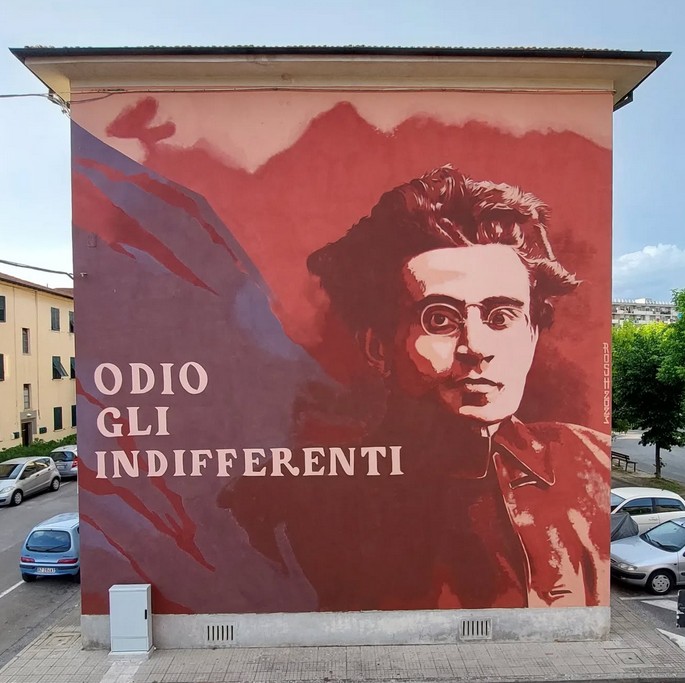
After so many years in Fascist prisons, Gramsci’s health had seriously deteriorated with an international campaign succeeding in moving him to a clinic, but failing to win his release. While, obviously, very well known in Italy and the European Communist movement, Gramsci’s international stature largely began with the mid-30s solidarity effort, with articles like the one below introducing his history to readers.
‘How Anti-Fascist Fighter, Antonio Gramsci, Organized Factory Councils in Turin’ by Roneoli from The Daily Worker. Vol. 11 No. 297. December 13, 1934.
The toilers of Italy recently celebrated the 14th anniversary of the capture of the factories of Milan and Turin. The following are a few reminiscences on the revolutionary activity—in connection with the above—of Comrade Gramsci who is at present suffering in jail in fascist Italy. These reminiscences should serve as a new stimulus for the toilers of all countries, in order to strengthen the campaign for the liberation of Gramsci and of all the imprisoned anti-fascists.
ANTONIO GRAMSCI took the initiative in creating factory councils in Turin, immediately after the end of the World War in 1919.
Turin is an industrial centre second in importance in the whole of Italy. In view of the peculiar nature of the local industry, the proletariat in Turin is distinguished by its greater unity, its greater discipline, and a highly developed class-consciousness.
During the war the social-democratic trade union leaders joined the “Civil Mobilization Committee”—an organization comprised of Royal Army officers and of “representatives” of the working class, and which was formed in order to solve—on the basis of class conciliation—all productional problems of interest to the workers. The masses were dissatisfied with this institution, and the dissatisfaction acquired such an acute form that the employers and trade union leaders were compelled to allow the workers to elect their own representation in every separate factory and workshop. This representation was called the “Internal Commission” and consisted of from 5 to 9 workers elected by the collective of workers in the given factory. Under the pressure of the masses these “Internal Commissions”—particularly in Turin—acquired a clearly expressed character of class struggle. Above all, they were closely connected with the masses, whose daily interests they defended in the factories, and much more effectively so than the local trade unions.
Antonio Gramsci realized the deep-rooted revolutionary significance which the development of this movement of “Internal Commissions” could have, and, together with his closest collaborators Ercoli, Terracini and others—he explained this significance to the workers by means of articles in the “Ordine Nouvo” as well as by speeches at many mass meetings. He avoided all formalism, he based his work on the experiences of the masses—and, always keeping the revolutionary aims of the movement in view—he did his very utmost, in a steady, methodical and most clever way, to develop these “Internal Commissions” into a mighty factory council movement.
THE factory councils were composed of the representatives of all the factory departments and shops, and were elected by all the workers in the given factory whether organized or not. The representatives in the factory councils were, however, exclusively workers who were members of working-class trade unions. In this manner the factory councils were set against the employers as institutions representing the class trade unions—(the leadership of which was very soon won by the Communists)—and the whole collective of the workers.
Under mass pressure the employers were compelled to give the workshop “commissars” and the factory councils the right to solve or to participate in the solution of all questions of interest for the workers, namely:—admittance to work, and dismissals, wages for piece-work, day work, etc., working hours, factory regulations, and other such questions. Thus in accordance with Gramsci’s conceptions and also in deed, the factory councils expressed the revolutionary will of the masses, the will of the working class in setting, within the factories, their power against the power of the employers.
At the same time the factory councils were the kernel and school of proletarian power. And indeed, in 1919, 1920 and 1921, the owners of the Turin factories were although still the owners, no more the masters with full power. And during the capturing of the factories, in September, 1920, the Turin workers showed themselves to be, as far as they were concerned, fully capable of winning full power. It was only the treachery of the social-democratic leaders, on a national scale, which forced them to return the factories to the capitalists.
With the triumph of fascism, the factory councils together with the attainments of the workers, were destroyed. But the memory of the factory councils is still strong in the minds of the proletariat of Turin and of the whole of Italy. And on the 14th anniversary of the capture of the factories, in these days when the campaign for the liberation of Antonio Gramsci is particularly intensified, this memory is stronger than ever before.
The brave and stubborn struggle of the Italian proletariat will succeed in snatching Gramsci from the clutches of his murderers, and the struggle for power will be the continuation and completion of the excellent struggle for the factory councils conducted by the Turin workers under the leadership of Antonio Gramsci.
The Daily Worker began in 1924 and was published in New York City by the Communist Party US and its predecessor organizations. Among the most long-lasting and important left publications in US history, it had a circulation of 35,000 at its peak. The Daily Worker came from The Ohio Socialist, published by the Left Wing-dominated Socialist Party of Ohio in Cleveland from 1917 to November 1919, when it became became The Toiler, paper of the Communist Labor Party. In December 1921 the above-ground Workers Party of America merged the Toiler with the paper Workers Council to found The Worker, which became The Daily Worker beginning January 13, 1924.
PDF of full issue: https://www.marxists.org/history/usa/pubs/dailyworker/1934/v11-n297-Nat-dec-13-DW-LOC.pdf
 Revolution's Newsstand