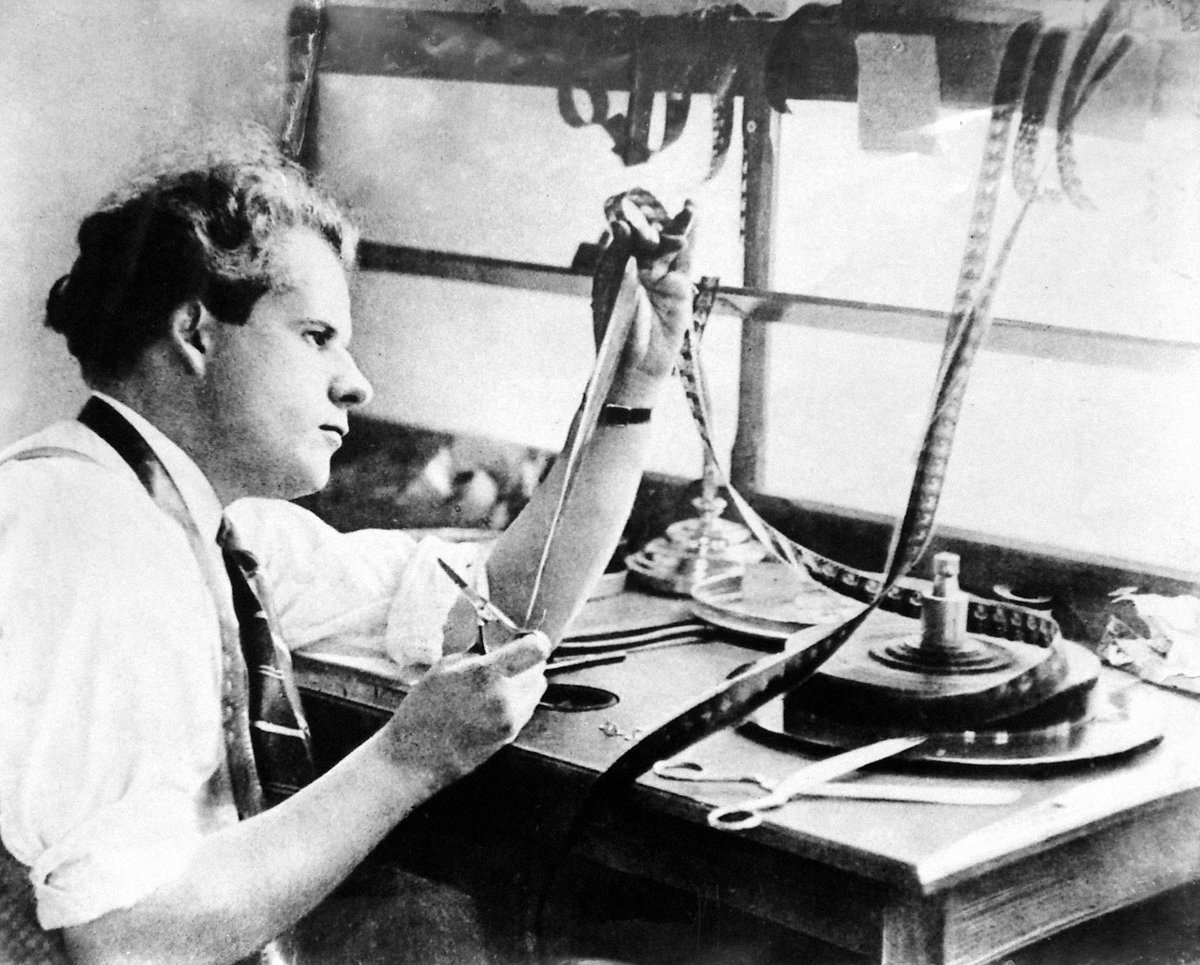
Since its inception, film has been a foundational medium for the dissemination of bourgeois propaganda and the reification of their rule. How to produce revolutionary films of technical and artistic quality that are seen when it is impossible to ‘compete’ with the resources of capitalism has been a central problem faced by the radical filmmaker, leaving cinema largely in the hands of our enemies. A look at this issue in 1934 with some suggestions for ways out from Ralph Steiner.
‘Revolutionary Film Production’ by Ralph Steiner from New Theatre. Vol. 1 No. 8. September, 1934.
EVERY one will admit the potential importance of the film in the struggle for a sane and decent world. Few realize its actual importance today. The present size of the organized audience which now sees Soviet and other working class films turns that potential importance into a very real and exciting fact. Last year in 1,580 theatres, workers’ groups, and organizations in the United States, Canada, Mexico, Cuba and South America 400,000 people were entertained by, excited by, educated by, and strengthened by seeing revolutionary films. This great audience should not only be a great inspiration to film makers but also a definite responsibility.
I assume that the primary function of a film group is film production. Certainly the counteracting of reactionary propaganda in films through reviews and general activity in the class struggle is essential, but unless a film group is actively engaged in making films its function will be incomplete. If the film is eventually to be a powerful weapon in the class struggle, film groups must learn to speak effectively through the medium of the film rather than with words. The use of the film by the bosses necessitates the use of the film by the workers. And even though we must continue to use words for articles and reviews of capitalist films, those words will have more strength and meaning after we ourselves have increased our knowledge and judgment through our own production.
What activity and progress has there been in the revolutionary film movement? What have film groups produced in the past few years? No one acquainted with the few films made so far, can deny that film production–in quality and quantity–is painfully in need of a stimulus. In relation to the exciting activity and progress in the fields of literature, theatre, music and dance the film has not even started to move.
Good film making is not easy, but also it is not impossible. None of the arts are easy, but good work is being done in them. If we, the potential revolutionary film makers in America, believe in the necessity for good films and are serious in our desire to make them, then an examination of the obstacles in our path is immediately imperative. These obstacles are two-fold: the inherent limitations of the medium and the difficulties of proper organization.
Before going into the limitations of the film we must start by defining the Revolutionary Film. It is one which clearly and forcefully reflects and directs the class struggle. For the highest standards of effectiveness we must demand the clearest exposition of the theme and the maximum impact of that theme on the audience. The first requires of the film maker a clear political knowledge,1 the ability to transfer that clarity into the scenario, and a high order of technical proficiency.
For a clear political understanding it is obvious that the producer must have a basic foundation in the principles of the class struggle.
The foremost obstacle is then the lack of a high order of technique, which can only result from training and experience. Since we have in this country no background of revolutionary film making and no Pudovkins or Eisensteins to teach us, we must find our own direction and we must train ourselves. How can we train ourselves? By a school, perhaps, but not a school in the traditional sense, since we have to admit that we have no one in this country who can lead and instruct us. Therefore the only school possible is one based on production. A school based on production should differ very greatly from a film group making films for public exhibition. Such a school would first formulate the basic problems of the film, and then proceed to solve them with very short films. The success or failure of these short problem films would not depend on whether they resulted in films “good” or “bad” in themselves, but on how much they could teach us. Since there would be no thought of exhibition, these films would need to be only long enough for the completion of the problem–perhaps as short as two or three minutes on the screen. The problems would have to be kept so simple that their solutions or failures would lead to clear, definite, and helpful conclusions–the selection of too complex problems can easily result in films too complicated for analysis. From long, expensive and painful experience I have learned the importance of selecting film problems which are not beyond my ability to carry out, and which will not take so long for completion that I may get lost before finishing. The natural ambition to make important and impressive films must be tempered at first by the realization that one can learn only from work which one is able to carry to a profitable conclusion. “Biting off more than one can chew, and then chewing it” is certainly not the motto for a film school.
All the revolutionary films that have been attempted in this country have been documentary (news reel, non-acted). This form has been adopted because of the immediate need for incontrovertible visual evidence of what is actually taking place in the struggles of the workers. Another reason for the sole use of this form is the belief that it is easy to use or that it is easier than the acted film. The immediacy of the need cannot be denied, but there is no truth in the idea that the documentary film is simple to make or that it is necessarily simpler than the acted form. It would seem natural to assume that the documentary was an easy form since the material to be photographed is already in existence, and does not have to be created by the producer. This idea is not only fallacious but very harmful.
The documentary film demands first that the director and cameraman locate and select the truest, most accurate, and strongest examples from the material which exists in the world to illustrate each image in the scenario. It then demands that they record that material on film so that it will say clearly, accurately, and forcefully to the audience what that image in the scenario had to say. The word-images of the scenario must be turned into visual images. That step in the process has so far constituted the big stumbling block in the way of film makers. Saying something on film is akin to writing a sentence: there must be nouns, verbs, adjectives and adverbs, but they must be visual nouns, verbs, and adjectives, and if each is not a strong and accurate visual image the film sentence will necessarily be weak or meaningless. I say this, all “montage experts” to the contrary. The erroneous idea that the effectiveness of the shots does not matter so much since through montage (the manner of putting them together) they could be made effective has weakened us too long. The skill necessary to handle expertly the elements of the documentary form can only be acquired from laboratory work designed to educate and develop producers in this field.
One great limitation of the documentary film lies in the difficulty of photographing certain events and material: events that have happened in the past, events which happen only once, and those of which capitalist society may not be sufficiently proud to want recorded. The revolutionary cameraman may often find the police and other agents of the present order not too helpful to him in getting the best shots of strike scenes, cops “preserving the peace” and shots of what the rich do with “their” wealth. Even when these hindrances are not present there is the annoying fact that events happen in time. They will not slow up, stop, or repeat themselves to allow the cameraman to photograph them in the most dramatic manner. A documentary film of the October revolution made by the most sensitive and capable director alive could not be as effective as the created films Ten Days That Shook the World or The End of St. Petersburg. The cameraman and director would have had to be omniscient (in advance), omnipresent, free-floating, impervious to bullets and invisible in order to photograph the events with the maximum dramatic effect.
All these difficulties are inherent in the documentary form. As in any art form, the limitations do not detract from the art, but serve to define and direct the creator toward the utmost use of that art. The acknowledged limitations of his medium can be one of the artist’s most serviceable instruments. When these limitations are recognized and utilized, only then will result the true revolutionary form for the revolutionary document.
Another obstacle in the way of film production is the expense. The cost of the negative, developing and printing is high. However, those unacquainted with film making costs have exaggerated ideas, perhaps based on Hollywood costs. One reel (ten minute) standard size films have been made for less than one hundred dollars. With substandard film, adequate for audiences of 500, the cost of a ten-minute film can be as low as fifty dollars.
Even these amounts may be formidable to workers’ film groups. Successfully promoted showings of Soviet and other films can defray these production costs. Well managed periodic showings would create an organized supporting audience. Again another reason for short films presents itself: short films are proportionately cheaper to make than long ones.
Finally, organizational and structural faults have to a great extent held back film production. The leadership of organizations may have good political and organizational ability but their lack of understanding of the problems involved in production has contributed to no small extent to the backwardness of the revolutionary film movement in this country. The leadership may not have the qualities necessary for making good cameramen or directors, and never intend to engage in those capacities, but a certain amount of experience in film making would give them a conception of “what it takes” to make films.
In any large group of “enthusiasts” there are necessarily only a few with sufficient ability, energy, responsibility, and purpose for a high standard of film making. The major portion of the leadership’s time, energy and thought should be concentrated on those selected few. The major portion of the group’s finances should be concentrated on them and their work. They should be supported by the group as a whole so that they can devote their full time to production. A fine example of this concentration idea is the Workers’ Laboratory Theatre “Shock Troupe.” Here a small group live in cooperative quarters and are financed by the theatre as a whole. They are thus able to spend ten to twelve hours a day accomplishing an extraordinary amount of excellent work.
If the film groups of America are to retain a right to the word “film” in their names, they must immediately get into active, planned, and continuous production. Nothing less than fine workmanship will be acceptable in their product. Film makers must keep in mind that the statement “there is no art without propaganda” is also true in the reverse: there can be no effective propaganda without good art.
1. Not only is there a definite relation between the political understanding (a basic comprehension of politics, economics, history and sociology from a Marxist point of view) of the producer and the political validity of his film, but more than that, a muddy political viewpoint will result in a muddy technique; only from political clarity can come a clearly stated scenario, and good technique can derive only from the exercise of technical knowledge applied to the clear ideas of a scenario. Thus in an “anti-war” film I recently attempted, my lack of understanding of the political nature of imperialist war affected the conception of the film. My lack of clarity of the real issues underlying war came out in the scenario as vague symbolism. And what is important from the technical angle, the vagaries of the scenario presented no technical problems for me or the camera to sink our teeth in.
The New Theatre continued Workers Theater. Workers Theater began in New York City in 1931 as the publication of The Workers Laboratory Theater collective, an agitprop group associated with Workers International Relief, becoming the League of Workers Theaters, section of the International Union of Revolutionary Theater of the Comintern. The rough production values of the first years were replaced by a color magazine as it became primarily associated with the New Theater. It contains a wealth of left cultural history and ideas. Published roughly monthly were Workers Theater from April 1931-July/Aug 1933, New Theater from Sept/Oct 1933-November 1937, New Theater and Film from April and March of 1937, (only two issues).
PDF of full issue: https://www.marxists.org/history/usa/pubs/workers-theatre/v1n08-sep-1934-New-Theatre.pdf
 Revolution's Newsstand