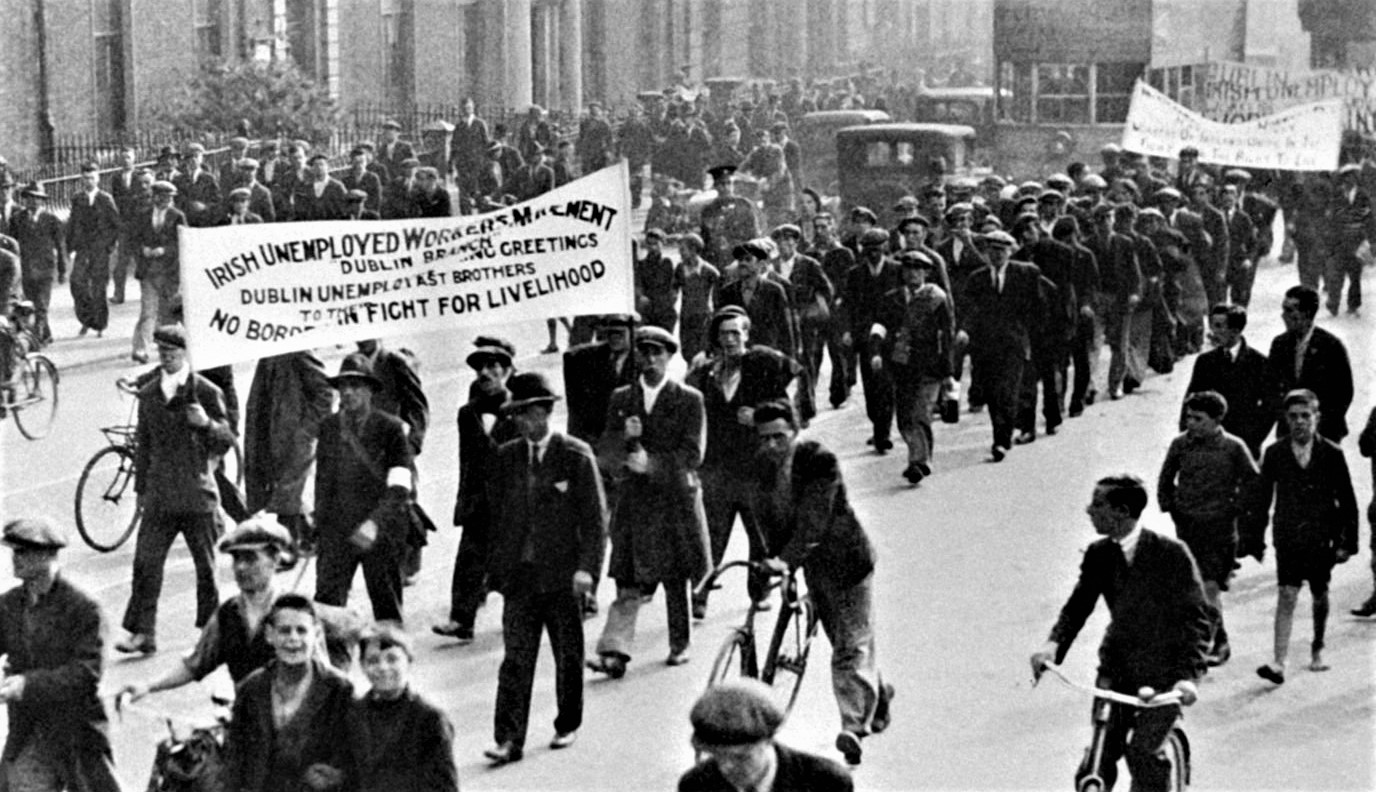
The mid-1930s saw a radicalization in Ireland and in an echo of the Civil War a decade previous, saw confrontations between Republicans and fascist Blueshirts. Within the Irish Republican Army a left wing developed and split, uniting with Communists to form the Republican Congress in April, 1934. Already at its second national gathering that September differences which would mean the demise of Congress were struggled over. Those differences, broadly, included those for immediately forming a new party to fight for a Workers Republic, focusing its fire on the two partitionist states in Ireland supported by Michael Price, Roddy and Nora Connolly, against the C.P.I. lining up with the I.R.A. left-wing around George Gilmore and Peadar O’Donnell who saw Congress taking advantage of disappointment in De Valera’s ‘Republican’ government, rallying progressive and anti-imperialist forces against fascism and for national unity. Though short-lived, Congress remains a point of reference for the Irish left and socialist Republicans. Jimmy Shields, then editor of the British Daily Worker, attended the divisive meeting as a fraternal delegate and wrote this report.
‘Struggle in Ireland Entering New Stage’ by Jimmy Shields from International Press Correspondence. Vol. 14 No. 53. October 12, 1934.
The Irish Republican Congress, which met in Dublin on September 29 and 30, marks the commencement of a new significant stage in the carrying forward of the struggle for Irish national liberation and the achievement of an Irish Workers’ and Farmers’ Republic.
This Congress represented a rallying centre for uniting the toiling masses of Ireland in a great campaign directed towards the smashing of the British imperialist stranglehold on the country, the wiping out of the imperialist border which now divides the North from the South, and the establishment of a free, united and independent Ireland.
There were 186 accredited delegates present, elected from numerous Republican groups, from units of the Irish Citizen Army, a whole series of trade union organisations, Tenants’ Leagues, the Communist Party, the Unemployed Workers’ Movement, and many other bodies. The splendid character of the response to the Congress Call should give serious food for thought to the membership of the Irish Republican Army, whose leadership refused to be associated with the Congress movement.
In addition to the report submitted by the Congress Organising Bureau, the delegates present had before them a number of important resolutions for consideration. There were resolutions dealing with the agricultural situation, the struggle against fascism, unemployment, the industrial situation, the position in the Gaeltacht, and resolutions regarding future Congress policy and organisation. It was on the latter resolutions (those dealing with general policy and organisation) that the main attention of Congress proceedings ultimately centred.
In this connection two main opposing resolutions had been brought forward from the Organising Bureau almost on the eve of the opening of the Congress, in place of the original “Republican Resolution” previously submitted to the delegates. This course was necessitated as a result of difference of opinion which had arisen within the Organising Bureau itself on political and organisational questions.
One of these resolutions, known as Majority Resolution A, had been brought forward in the name of the Army Council, Irish Citizen Army, and adopted by a majority of the Organising Bureau, amongst which were included Michael Price, Nora Connolly O’Brien, and R.J. Connolly. Briefly stated, its main thesis was to the effect that the line of policy which should go out from the Congress should be that accounts must first be settled with the two existing capitalist States in Ireland and then afterwards would come the successful struggle to break the hold of British imperialism, and therefore the slogan of action must be laid down as the direct struggle for a Workers’ Republic.
A further Majority Resolution was brought forward concerning the question of organisation, which proposed in effect that Congress should proceed to the setting up of a new political party.
In opposition to this line a Minority Resolution B was put forward in the names of three other members of the Organising Bureau, namely, George Gilmore, Peadar O’Donnell and Frank Ryan. This resolution stressed that the Congress must become the rallying centre for the mass movement expressing all the forces for complete national independence, and called for a new and decisive campaign to achieve this through building the united front of the working class and small farmers in the struggle against the imperialist and native exploiters. On the question of future Congress organisation, the Minority Group brought forward, in opposition to the proposed formation of a new party, a further resolution advocating the keeping intact of the existing form of Republican Congress organisation, and its further strengthening and extension on the widest possible united front basis.
Both the opposing resolutions on policy referred to the leading role which the working class must play in the fight, dwelt on the danger of harbouring any illusions as regards the role played by Irish capitalism, and raised demands for the repudiation of the Anglo-Irish Treaty of 1921, immediate withdrawal of all British troops from Irish soil, and the scrapping of the Military Tribunal in the South and the Special Powers Act in the North.
In addition, however, to the fundamental difference of line manifested between them, both resolutions strongly contrasted with each other on one other vital essential.
Whereas the Majority Resolution only referred in vague general terms to the struggle for the “needs of the small farmers and workers,” without attempting to specify further on the matter, the Minority Resolution concretely laid down as follows:
“The Republican Congress will campaign to organise the widest possible backing for all working class and small farmer struggles: it will work to achieve ever wider support for wage movements, unemployed demands, workers’ housing struggles. It will back and initiate struggles of landless men for free land. The Congress raises the demand that all bank actions against working farmers must be withdrawn, that every attempt by banks to collect either interest or capital must be campaigned against with all possible energy; that working farmers be freed from Land Annuities; that wages on all work under the Land Commission and Board of Works shall be not less than 40 shillings weekly. The Congress pledges itself to support agricultural wage earners in their fight for increased wages and social insurance, and will help to organise an agricultural wage earners’ union.”
A keen debate on both these resolutions occupied the major bulk of the Congress proceedings.
The political resolution of the Majority Group was introduced by R.J. Connolly, who prefaced his remarks by stating that there was a distinct difference of opinion within the Congress as to what was the correct line to pursue. He pointed out how the working class was coming to the forefront in the struggle and from this drew the conclusion that the main slogan should be that of the Workers’ Republic, claiming that this slogan had always typified the revolutionary struggle in Ireland and was the only slogan which would really arouse mass enthusiasm.
Nora Connolly, who seconded, argued that only by raising such a slogan as that which the Majority Resolution advanced would it be possible to bring the workers of Northern Ireland into the fight.
As against this, Peadar O’Donnell, on behalf of the Minority, declared that the mistake must not be made of confusing the stage of struggle which was facing the country at the moment. He emphasised that it was necessary to detach those large masses of genuine nationalist opinion who were still under the influence of De Valera, demonstrate to them that the Fianna Fail government had betrayed the fight for the Irish Republic, and gather the whole power of the Republican masses in united front action on the basis of the line set out by the Minority Resolution to drive forward for the unity and independence of Ireland.
Michael Price, who spoke in support of the Majority Resolution, claimed that the Minority viewpoint was based on opportunism and expediency and ran counter to the aims for which James Connolly fought.
Sean Murray, of the Communist Party of Ireland, opposed the line of the Majority Resolution. He stated that it sidetracked the question, and that the purpose of the Congress must be to form a mighty Republican movement on the basis of an alliance between the workers and the masses of poor farmers which would smash Britain’s hold. In the past, he said, the leadership of the Republican movement had been in the hands of the Irish capitalists, who had betrayed it. It was true that only under working-class leadership could the struggle for the Irish Republic be led to victory, but the Majority Resolution put obstacles in the way of this and failed to realise that capitalism could not be smashed without the smashing of British imperialism.
Many other delegates spoke in favour of one or other of the respective resolutions, and it was obvious from the nature of some of the contributions made, e.g., particularly a number of the country delegates, that quite a number were not clear as to the actual character of the differences involved.
Finally, when the vote was taken, the Minority Resolution was adopted by 99 votes as against 84 votes for the Majority.
At a later stage in the discussion which then commenced on the agricultural resolution, the Standing Orders Committee announced that the organisational resolution, proposing the formation of a new party which had been put forward, had been withdrawn.
On the conclusion of the discussion on the agricultural question, the Congress was flung open for nominations for an Executive which would be charged with leading and directing the campaign on the lines of the decisions adopted. Amongst those nominated for Executive position were the chief spokesmen on behalf of the defeated Majority Resolution–Michael Price, Nora Connolly and R.J. Connolly.
Michael Price declined to accept nomination. He stated that he had left the I.R.A. because it would not accept his slogan of a Workers’ Republic as the main line of fight, and it would be inconsistent for him to accept nomination for the Executive on these grounds. He had but one place to turn to the Citizen Army. Nora Connolly similarly declined to accept nomination, stating that her position was the same as that of Price, while R.J. Connolly also declined but said his position was somewhat different, as although he would not accept nomination for the Executive, he would give the Congress his unstinted support on the concrete issues of united front activity.
An Executive of 40 was finally elected to function in a national capacity, and this included in its numbers Peadar O’Donnell, Frank Ryan, George Gilmore, Sean Murray, Cora Hughes, May Laverty, Jim Larkin junior, and others.
The remaining resolutions on industrial struggles, unemployment and the struggle against fascism, were adopted unanimously after they had been well debated.
The Congress delegates gave a very fine reception to the fraternal delegates who attended the proceedings, and the speeches of greeting conveyed on behalf of the League Against Imperialism by R. Bridgeman, the greetings from the Indian Political Group by S. Saklatvala, and also those delivered by Frank Ryan, delegates from the Irish Workers’ Clubs in America, and M. Raylock of the British Youth Anti-War and Anti-Fascist Movement, were enthusiastically applauded.
Barney Conway, delegate representing the Workers’ Union of Ireland, moved a resolution demanding the release of all anti- fascist and anti-imperialist fighters. His impassioned appeal for all support being given to the struggling workers of Austria and Germany, and for the fight for Ernst Thaelmann’s release and the release of Tom Mooney, evoked a wonderful response.
The great task now facing the Republican Congress is to proceed at top speed with the carrying of its decisions into actual life. The situation in Ireland is abundantly ripe for the carrying through of the great campaign which the Congress has planned, a campaign which will sweep Ireland from end to end, will rouse the Irish masses to a new and higher level of the revolutionary anti-imperialist struggle and will carry this forward under working-class leadership to the successful accomplishment of the smashing of imperialism’s grip and the opening up of the way for complete national and social emancipation.
International Press Correspondence, widely known as”Inprecorr” was published by the Executive Committee of the Communist International (ECCI) regularly in German and English, occasionally in many other languages, beginning in 1921 and lasting in English until 1938. Inprecorr’s role was to supply translated articles to the English-speaking press of the International from the Comintern’s different sections, as well as news and statements from the ECCI. Many ‘Daily Worker’ and ‘Communist’ articles originated in Inprecorr, and it also published articles by American comrades for use in other countries. It was published at least weekly, and often thrice weekly. Inprecorr is an invaluable English-language source on the history of the Communist International and its sections.
PDF of full issue: https://www.marxists.org/history/international/comintern/inprecor/1934/v14n53-oct-12-1934-Inprecor-op.pdf
 Revolution's Newsstand