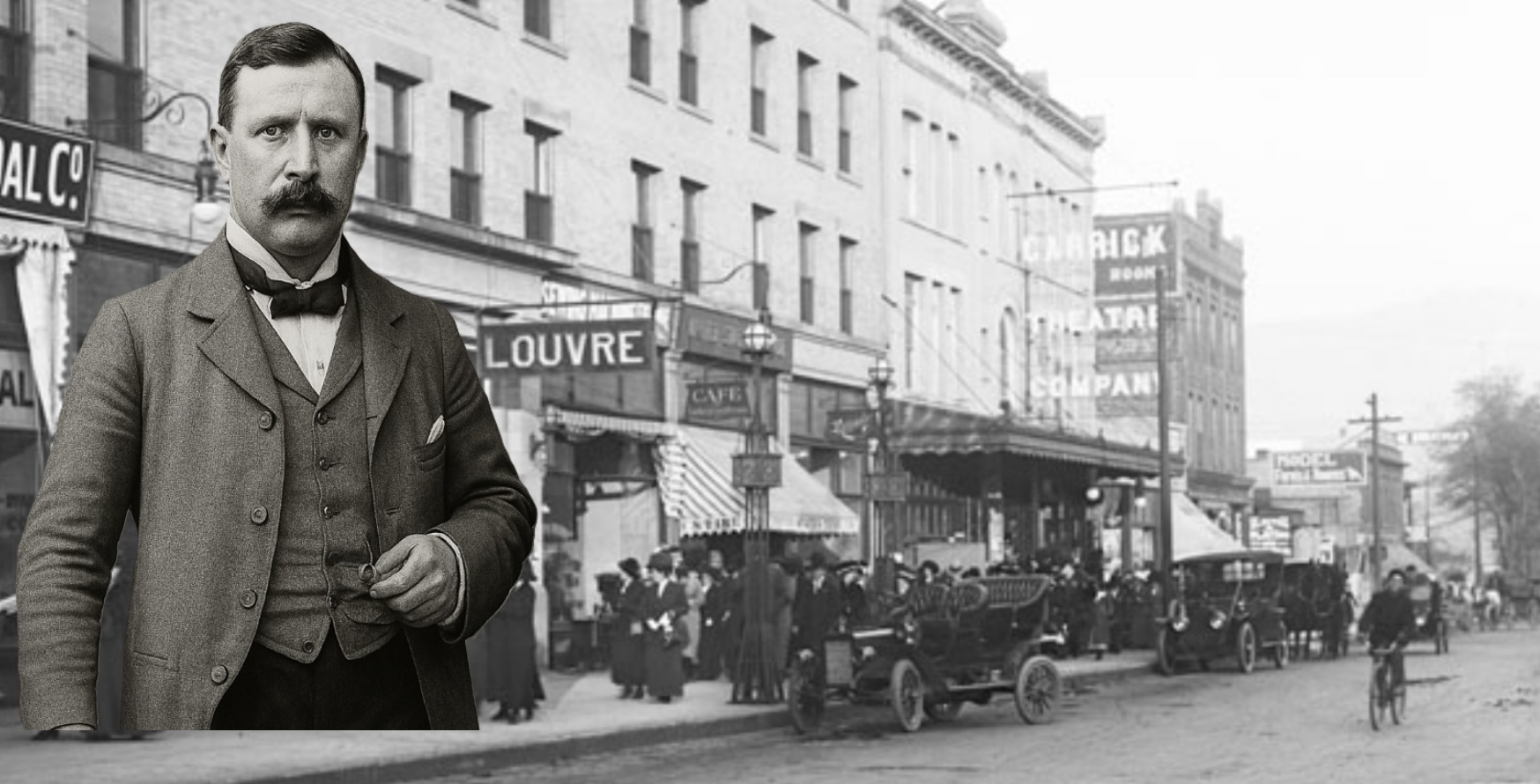
Giving a welcome boost to Salt Lake City activists, Tom Mann speaks at that city’s Garrick Theater hosted by I.W.W. Local 69 during his 1913 U.S. speaking tour.
‘Tom Mann Stirs Salt Lake City’ by Ed Rowan from Solidarity. Vol. 4 No. 46. November 22, 1913.
(Special to Solidarity) Salt Lake City, Utah, Nov. 10. Industrial unionism, the hope of the dawning age, renewed its forces with greater impetus than ever in Salt Lake City on Sunday, Nov. 9. This date will linger in the minds of thinking workers for years to come, and the inspiration given by Tom Mann. Speaking in the Garrick Theatre, under the auspices of Local 69, to an attentive and crowded house, it was a banner event indeed. Tom Mann has been politely nicknamed England’s best, also “Old Solidarity,” and he proved his worth in short order, to his hearers’ delight.
At 8 p.m. Sam Scarlett opened the meeting as chairman, introducing our English fellow worker in a short, neat and appropriate manner. Everyone present settled in their seats, while for two hours Tom Mann presented the most powerful address on unionism ever heard in this city. Starting out by defining the causes of and remedy for poverty, he said, “In England progress has been made as in this nation, but there still remains a large number of persons below, the poverty line. These persons cannot maintain themselves in normal health, because they are unable to purchase. sufficient food to properly nourish their bodies, or those of their children. Hundreds of thousands of children are dying annually because of this, and parents die from 15 to 20 years before their time for the same reason. There never was a time when the workers received so little for their labors as they do today, and the only reason is that they are incapable of agreeing on one common ideal. It is only by direct action that these de- sired results can be obtained. I have no confidence in legislative methods, for they cannot and do not bring results. Legislative instruments are not the means to use to achieve economic emancipation.
“Workingmen must drop the sectional unionism idea, and the minute they do and decide to exhibit solidarity, that minute the capitalistic class will lose its power. We are not going to appeal to the governments, to the capitalists, nor to the politicians, but will depend on our own good senses, to adjust affairs. Labor can and will control the world. Labor can render useless the armies and navies, and make it impossible for nations to declare war against each other simply by shutting off their supply of fuel, food, and ammunition. Men will refuse to fight for national flags, and will no longer respect their countries. The governments are for the rich, and the laws are made for them. We need no governments and no laws. We want free society with every man jointly sharing everything with his neighbor, until we bring labor to a point where men will work but four hours a day four days a week, and twenty years in a lifetime and perhaps even less!” Continuing his speech Tom Mann skillfully contrasted conditions in the steel industry of Pennsylvania pointing out the 12 hour day, 7 days a week in free America, with conditions in other countries he had worked and organized in. He dwelt on the present strikes in Colorado and Michigan, showing the defects existing where scabs were hauled by union men to bolster up the capitalist system in forcible language, that hit the mark. By this time, the audience was so enthusiastic he then described how the transport workers battled to victory in Great Britain 1911, with all the graphic details, including his “Don’t Shoot” episode. On concluding his speech the applause was deafening. and he arose again and called for three cheers for “International Solidarity,” which met with a ringing response. The meeting was a huge success all around, in every wav, and Local 69 wishes to go on record, that it will be a great boost for industrial unionism in Utah. As a spur to further activity on militant lines, Tom Mann is a tonic for lagging rebels. “Solidarity is the motto,” so on with the propaganda.
Yours for One Big Union. Press Com., Local No. 69, per Ed. Rowan.
The most widely read of I.W.W. newspapers, Solidarity was published by the Industrial Workers of the World from 1909 until 1917. First produced in New Castle, Pennsylvania, and born during the McKees Rocks strike, Solidarity later moved to Cleveland, Ohio until 1917 then spent its last months in Chicago. With a circulation of around 12,000 and a readership many times that, Solidarity was instrumental in defining the Wobbly world-view at the height of their influence in the working class. It was edited over its life by A.M. Stirton, H.A. Goff, Ben H. Williams, Ralph Chaplin who also provided much of the paper’s color, and others. Like nearly all the left press it fell victim to federal repression in 1917.
PDF of full issue: https://www.marxists.org/history/usa/pubs/solidarity-iww/1913/v04n46-w202-nov-22-1913-solidarity.pdf
 Revolution's Newsstand