Austin Lewis on the lack of legal recourse for workers in California’s company towns, many ruled by the Lumber Barons, and the consequences for the class struggle. It’s hard not to feel the entire United States is one big company town.
‘Company Owned Towns in California’ by Austin Lewis from New Review. Vol. 4 No. 5. May, 1916.
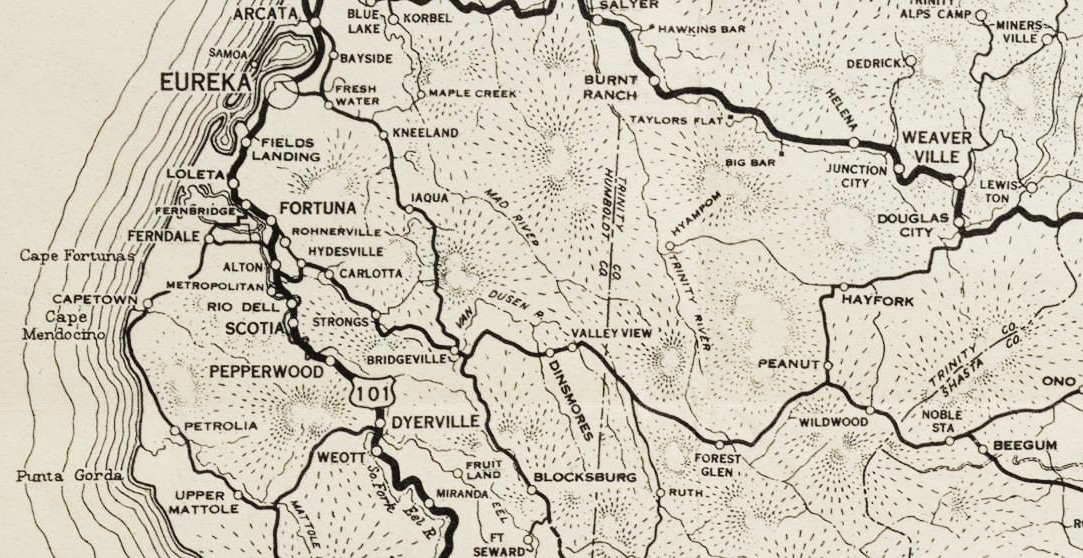
A FEW months ago a detective for the dominant lumber company, who was also a deputy sheriff, was shot by some Italian laborers at Scotia, California. Among other grievances of the laborers against the detective it was charged that he was partial and unfair in the enforcement of prohibition, which the company had forced on the town. It was also charged that he acted as a spy upon such laborers as did not deal at the company store.
A recent decision in a case, where practically a similar state of facts existed, but where the company’s agent did the shooting, deserves attention. It sheds a sinister light upon the management of such towns. The view of the court is interesting, by reason of its strange perversity, and as affording another instance of the mechanical reaction of industrial events upon the legal mind. One might easily be reading an English case of 1830.
This historic decision is entitled “People of the State of California vs. W.P. Sidwell, Vol. 21, Cal. Appellate Decisions, p. 705,” and was handed down a few weeks ago. Following is an abridged statement of the facts as set out in the opinion.
The town of Westwood was brought into existence by the Red River Lumber Company, some three years ago, and there are approximately 2,500 employees of the company. The company prohibits the use of intoxicating liquors and also forbids gambling in the town.
The company employed a special officer who was also a deputy sheriff. He was instructed to break open any room or to enter any house where he suspected that gambling was going on, so as to be able to report the names of the parties so employed to the company and to bring about their discipline and probably their dismissal. W.P. Sidwell was at times mentioned a special officer of the company.
On March 14th, 1915, Sidwell heard voices in the Hotel Swille about midnight in room 8. He broke open the door, taking his pistol in his left hand and thrusting the door with his right shoulder. As he pushed the door his pistol went off simultaneously and shot and killed an Italian laborer, called Escrivano, who was sitting at a table in the room thus invaded. Sidwell was found guilty of involuntary manslaughter in the lower court and sentenced to one year’s imprisonment.
He appealed from the judgment on the ground that the lower court erred in refusing to instruct that “the company had the right to authorize the accused to break into rooms and houses for the purpose of ascertaining whether the rules of the company against gambling were being violated, and that the defendant in breaking into the room of the deceased on the occasion of the shooting was actually within his legal rights.” On the contrary the court told the jury that the breaking into the room of the deceased by the defendant “was a wrong” (quoted from the opinion).
The Court refused to permit the defendant to show that the penalty of violating the rule against gambling would be the discharge of those found therein engaged from the employment of the company and furthermore disallowed testimony which would have tended to show that the employees were dissatisfied with the inhibition against gambling, and had threatened to resist violently any officer who invaded their room.
The judgment of the lower court was upheld upon the ground that the accused had shown criminal negligence in the use of his weapon. All the questions of the invasion of the rights of the individual by the forcible entry of an armed officer into his room were ignored.
The outrageous killing is described by the court as a “most unfortunate affair”; “but,” to use the language of the opinion, “precisely how or in what manner the pistol was discharged the evidence does not disclose, nor, indeed, under the circumstances, is it. to be supposed that anyone should know unless it was the defendant himself.”
Judge Burnett adds to the court opinion the following remarks: “The mere circumstances that gambling was carried on was not sufficient, as I view it, to justify the defendant in breaking through the door with a loaded pistol in his hand. His desire and that of the company to suppress gambling was, of course commendable, but the method resorted to was too drastic. Human life is too precious to be jeopardized for the purpose of ascertaining whether parties are engaged in a peaceful game of poker. Defendant should have directed the inmates to open the door before resorting to such violence, and I think he should have gone away, rather than plunge into the room with his loaded revolver in his hand. Our aversion to vice should not blind us to the more vital consideration of life itself.”
This sort of work by the courts makes peaceful development exceedingly difficult. Two men are under a life sentence in a California jail for no other crime than taking the leadership of a strike of migratory workers in which an officer was killed. Now we find that the killing of a migratory worker by a corporation official is reckoned as merely culpable negligence and punished accordingly.
The New Review: A Critical Survey of International Socialism was a New York-based, explicitly Marxist, sometimes weekly/sometimes monthly theoretical journal begun in 1913 and was an important vehicle for left discussion in the period before World War One. Bases in New York it declared in its aim the first issue: “The intellectual achievements of Marx and his successors have become the guiding star of the awakened, self-conscious proletariat on the toilsome road that leads to its emancipation. And it will be one of the principal tasks of The NEW REVIEW to make known these achievements,to the Socialists of America, so that we may attain to that fundamental unity of thought without which unity of action is impossible.” In the world of the East Coast Socialist Party, it included Max Eastman, Floyd Dell, Herman Simpson, Louis Boudin, William English Walling, Moses Oppenheimer, Robert Rives La Monte, Walter Lippmann, William Bohn, Frank Bohn, John Spargo, Austin Lewis, WEB DuBois, Arturo Giovannitti, Harry W. Laidler, Austin Lewis, and Isaac Hourwich as editors. Louis Fraina played an increasing role from 1914 and lead the journal in a leftward direction as New Review addressed many of the leading international questions facing Marxists. International writers in New Review included Rosa Luxemburg, James Connolly, Karl Kautsky, Anton Pannekoek, Lajpat Rai, Alexandra Kollontai, Tom Quelch, S.J. Rutgers, Edward Bernstein, and H.M. Hyndman, The journal folded in June, 1916 for financial reasons. Its issues are a formidable and invaluable archive of Marxist and Socialist discussion of the time.
PDF of full issue: https://www.marxists.org/history/usa/pubs/newreview/1916/v4n05-may-1916.pdf
 Revolution's Newsstand