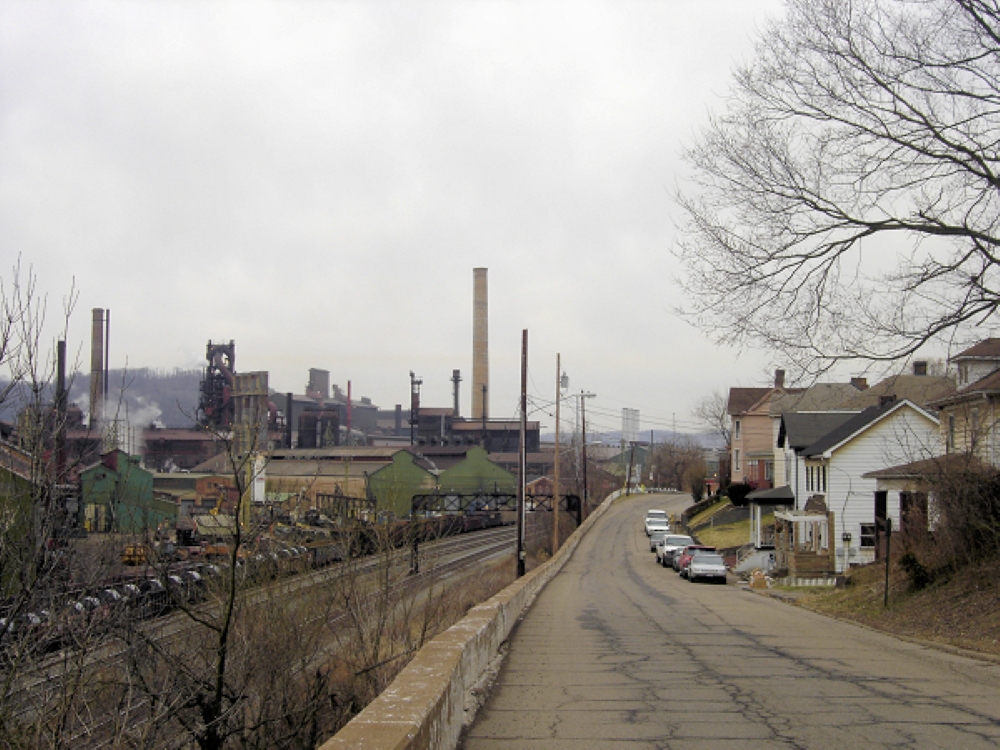
A chapter from legendary labor reporter Mary Heaton Vorse’s marvelous book on the Great Steel Strike of 1919 sees her travel with Mother Jones through the Steubenville, Ohio area–a seat of the conflict.
‘Dark Towns’ by Mary Heaton Vorse from Men and Steel. Boni and Liveright Publishers, New York. 1920.
Mother Jones
MOTHER JONES wove in and out of the steel strike. She was never long away. During her absence from Pittsburg one could hear of her being in Joliet or in the Calumet Basin. She had greater intimacy with the workers than any one else in America.
She is their “Mother.”
The foreign workers rarely meet Americans. The only Americans that some meet are bosses, landlords or tradesmen.
Mother Jones is the only American woman that thousands of them have ever spoken to. She goes about surrounded with the protecting love of young men whose names she does not know. She goes up and down the country, and with her walks the memory of the long fight of the working people of America. It is a matter of record that her home is wherever there is a fight for justice. No Minor prophet ever foretold the downfall of an arrogant city in bitterer words than she foretells the downfall of what she calls “the ruling powers.”
When the convention ended I went with Mother Jones to Ohio. She sat beside me in the train talking; she talked—almost as to herself. You might fancy that you heard the heart of the workers muttering.
“There was never a convention like this before. They never met before to talk only about liberty. Oh, it’s coming; it’s coming!…There’s a terrible bitter tide rolling © up and welling up in this country. There’s gall mixed with — the mud that’s churned under the workers’ feet in the city alleys. “Look at these towns; tock out of the window. Nothing to rest the eyes. I say to you there has never been a crueler despotism than there is in this country to-day. Look out there! Look at the stacks of the mills like trees in a black forest! Lock at the blast furnaces and smoke as far as your eye can reach, and the wealth that comes out of it made by the blood of slaves.”
She cannot endure the suffering of the workers’ children. She cannot endure the indifference of rich women. The two in her mind are sharply related. The indifferent women are blood-stained creatures to her. Brutal, cruel, abandoned, she makes you feel this. Exaggerations in her mouth become real. She talks about “Brutal women hung about with the decorations they have bought with the blood of children.” This is to her a literal fact.
“Oh, God, the little children—to face it all! And our women are so brutal. They don’t dream that in the great upheaval that’s coming, their own children will meet with the same conditions. Then people go to church! They’re mad as they were in the days of Babylon!”
Steubenville
We got to Steubenville. The clang of trolleys, the shriek of railways, noise and bustle, the bright green eyes of drug stores, red brick blocks—this is Steubenville’s Main Street. Off the Main Street is the Secretary’s office of the Steelworkers’ Committee. Here the strike flowed aboveground. Posters were hung in public places of Steubenville saying Mother Jones was going to speak. I felt “that I had come back from Pennsylvania to America; the terror was lifted. In the organizer’s office a union painter was asking for permission to keep his contract.
“If I don’t keep my contract, the chimneys will rust.”
It is strange to see life ebb out of the industry when the men flowed out of the mills by the Ohio River. The fires were banked; the industry was dead. In Fallonsby, Mingo, down into Wheeling and Bellaires, and the surrounding towns, there were only dead furnaces, empty mills, dark towns. Already the furnaces looked extinct. They looked as though they had been deserted for years.
I asked the Steubenville organizer: “What do you do to keep alive the enthusiasm among the men?”
“We don’t have to do anything,” he answered. “The men walked out and they stay out.”
Meeting in Mingo
The meeting was in Mingo, the meagerest of steel towns. The mills, the workers—that is all. The meeting was in the town hall, a rickety building. We rode there in a bumping jitney around sharp curves, following the road which had been carved on the hillside above the river. Below is the dark bulk of the mills, whose black chimneys have been eaten by rust.
Mother Jones stood on a raised platform in the middle of the room. The hall was crowded with steel workers. Most of them stood. A few sat on benches. They crowded up to the platform. They stood there with upturned faces full of a mute devotion.
She is their mother in truth. She is the mother of the revolt in their souls. The hall was full of men who could not understand her words. What difference does it make what words she used? They understood her anger. Her defiance and her fearlessness they understood too. Their lack of knowledge of her words stripped her meaning to the fiery essentials.
It seemed wonderful to hear her say without police interference what she wanted to say. It was a great satisfaction to see a labor meeting in a town hall.
There was a ripple of uneasiness. Slips of paper were being passed from hand to hand. Something had happened. I went to the secretary through the crowd. He shoved a roll of leaflets in my hand. The leaflets were an appeal to the workers to protest against the blockade of Russia.
“Lucky I saw that,” he said. “Lucky I got ’em in time. Can’t have things like that circulated here.”
Above our heads Mother Jones was talking about Freedom and the solidarity of the workers.
“Why not?” I asked.
He looked at me despairingly. He was frightened.
“Why, they’d take it back to the Polish Priest! We’d have the state troops down on us in no time. They’d call us Bolsheviks!” Mother Jones stopped speaking. Applause broke out. She plowed through the crowd to us. She read the leaflet. “Well, what’s the matter with it?” she asked. “Can’t you protest about the blockading of women and children?” The organizer pleaded with her. “You don’t know what it’s like here. I’m afraid they’ll stamp us out.” She snatched the word from him. “Afraid? There’s only one thing you should be afraid of—of not being a man!”
Weirton
Perhaps Mother Jones was too harsh to the organizer. The next day I heard from him that terror sniffs greedily on the outskirts of Steubenville. In Pennsylvania terror walks openly around. The strike flows underground. In Ohio the strike walks openly on the streets. Terror lurked out of sight. But it does not flow underground everywhere—in Ohio. The organizer of Steubenville told me about the town of Weirton. This town is not incorporated. It has no charter. It belongs to a steel company. He gave me some affidavits of steel workers.
“Read these and you will see why I acted like I did last night,” he said. “They searched the workers’ houses. If they found any Socialist literature they railroaded them out of town. They took them out of bed at night. It made no difference that they owned their houses. It made no difference that their children were there. If we speak of Russia they holler ‘Revolution’ and will call in the troops on us.”
Ohio and Pennsylvania are not much different after all. It was a matter of degree.
Thought had become socially perilous in both states. For all steel workers it was perilous to have socialistic opinions. Working people on strike had been forbidden to think together about starving and blockaded Russia. Their thoughts had been blockaded. It was dangerous for them to ask, “Why should we starve Russian children?”
Pensions
In the steel towns of Allegheny County, for all their foul slums, the brick houses shoulder each other in friendly fashion and there is fellowship in the welter of life which pours through the courts and alleys. But the smaller steel towns on the Ohio River are God-forgotten. The flavor of life there is that of stale hopelessness. The houses are down-at-the-heels. The streets are deep in mud. I walked down the streets of such a town with the organizer. “I want to stop in,” he said, “and see an old fellow. He’s scabbing, but he can’t help it.”
The mills here made a pretense of work. The “white collar crew” and the foremen kept the furnaces alive.
There were, too, a few “loyal men.” “This old fellow,” said the organizer, “he feels so bad at what he’s doing, I drop in just to cheer him up. He’s an old union man. He belonged to the Sons of Vulcan and he was an Amalgamated man. He’s within six months of getting his pension. He comes to me and he says, ‘Son, I’ve been a union man all my life. What’ll I do? My pensions six months off.’ I said to him, ‘Pa, you keep right on working.’ It wasn’t regular of me, but it didn’t seem right to ask him to give up everything he had. One of his sons was killed in the steel works. His other one’s got a parcel of children. He and his old woman are counting on the pension.”
We picked our way through the mud and stopped by a meager frame house. One of the shutters hung awry in a dismal fashion. The house was not more dilapidated than its neighbors. All the houses in this row had something wrong. We went inside. An old man sat listlessly by the window.
“Howdy,” he said.
“How are you, John?” said the organizer.
“So so,” he answered without looking up.
“How are you, Ma?”
“Oh, I’m fair,” the old woman answered, her anxious eyes on the organizer’s face.
The talk lagged. There was no light in that house. It was as if some unseen thing lay dead amongst us. The thing that was dead was the man’s pride in himself. We rose to go. The old man bade us a listless good-by. He did not look at us. His wife followed us to the door.
“His heart’s broke,” she said. “He can’t rest. He talks in his sleep that he’s a scab.”
Tamo Daleko
In Steubenville is a Serbian colony crowded in wooden houses near the mills. These houses have the slack, neglected air of steel town houses. Humanity bursts out from their doors. But the great Serbian holiday, Kossova day, was celebrated in this town. In this town the Serbs also celebrate the day which their families embraced Christianity. On such a day they give a Slava—a great feast. The memory of their oppression by the Turks is fresh. Their national independence is recent. Their age-long fight against the Turks lives in their songs.
I stood waiting to cross the noisy street. Trucks slambanged past. The engine on the railway overhead hooted. A man beside me was whistling. He was whistling Tamo Daleko, the song which the Serbs sang in exile. After the great defeat in 1915 by the Austrians they retreated over the Ibar Pass, they went over the Albanian hills. They went to Corfu. They reconstructed their regiments and when every one thought Serbia dead, Serbian regiments reappeared on the Bulgarian front. Tamo Daleko was the song for a defeated nation. But the Serbs sang it when they marched to victory.
“Where did you learn that song?” I asked him.
“In Corfu. My father was a Serb in the Banat. When war come I go home. I march on the great retreat.”
“How did you get back here?” I asked him.
“I get wounded on Monastir front. I am American citizen. They send me home from France.”
“Are you striking?” I asked him.
The jam of the street loosened up. He strode on ahead. He threw at me over his shoulder,
“Sure I strike.”
From his abundant gayety he turned to wave at me and went off singing to win the strike. His smile had the assurance of victory.
He made me understand the strike. The brothers of these men working in the steel mills had overthrown Czar and Austrian Kaiser. In America they fought Gary.
Johnstown
Here and there on the Ohio River some mill was flying a smoke streamer. Some towns on Monongahela did not strike. But Youngstown was dark as a pocket and Johnstown was shut down flat. Johnstown lies in a cup of hills.
The Cambria Steel Company is the core of the town. From the railway station I looked down into the yards. Rust was over all. Piles of scrap covered with rust, mounds of billets covered with rust, carloads of pig-iron covered with rust. Paint scaling from black chimneys. Rust crawling up chimneys. In this yard nothing stirred. There was no sign of life.
A man walked slowly through the empty yard. It was startling to see anything move through that quiet place, through the mounds of iron on which rust had fallen like a red snow. It seemed the graveyard of industry. Johnstown’s men had left the mills in rust and silence. Around the mills crowded wooden houses, desolate and blackened by years of falling soot.
The main street is noisy. The stores are full of cheap, bright colored things; stores with violent colored clothing, stores with shiny furniture. Windows full of enamel kitchen ware. All the things the workers’ wives want, shiny and new. Up and down walked groups of idle steel workers, big men drifting on the slack tide of idleness into the hall of their headquarters. Cambria Steel shut down.
For eight weeks nothing moving and nothing making, and for eight weeks the encroaching rust thickening on the billets, crawling stealthily up the black chimneys.
During the first week in November a quarter of a million steel workers were still on strike. There was power and discipline in the self-control and quiet of the strikers. The roots of the strike went deep
Men and Steel by Mary Heaton Vorse. Boni and Liveright Publishers, New York. 1920.
Contents: Introduction, PART I) STRIKE BACKGROUND, The Principality of Steel, Steel Mills, Men and Machines, Steel Towns, Steel Masters and Labor, PART II) THE STEEL STRIKE, Strike and Strike Leaders, Violence, Strike Meetings, Senators and Steel Workers, Outside People, PART III) SILENCE, Dark Towns, Silence, Commissary, Anonymous People, PART IV) THE DYING STRIKE, The Break, White Terror, The Dying Strike, Strike Derelicts, Aliens. 185 pages.
PDF of original book: https://archive.org/download/mensteel00vors/mensteel00vors.pdf
 Revolution's Newsstand