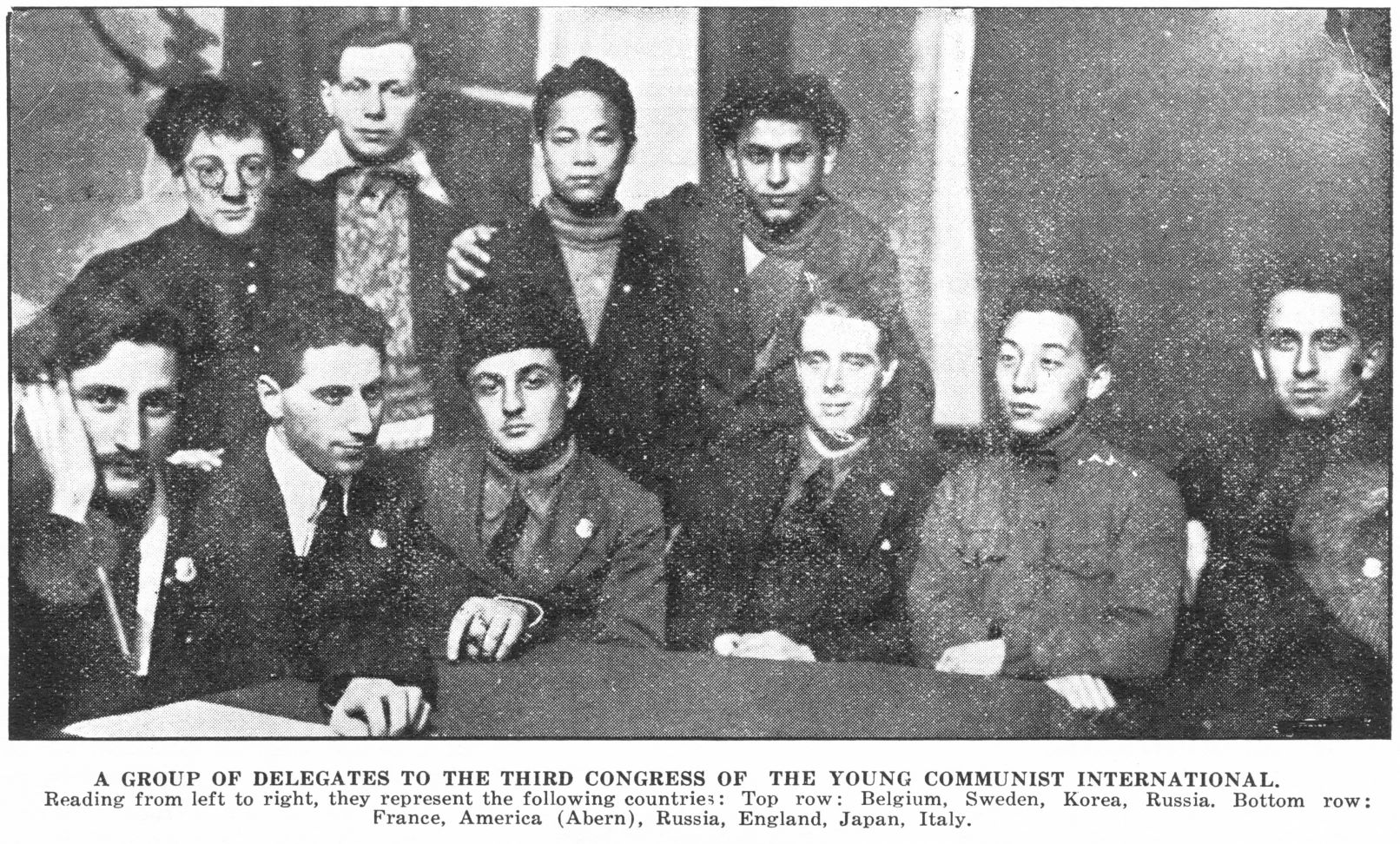
Energized by its recent international Congress, a leader of the Young Communist International on its work.
‘After the Congress of Communist Youth’ from Communist International. Vol. 1 No. 13. September-October, 1920.
By a Member of the Executive Committee of the International of Communist Youth
A Sketch of the Activities of the Executive Committee of the International of Communist Youth
THE Berlin Congress marks one of the most important stages in the progress of our movement. At this Congress took place the unification (with insignificant exceptions) of nearly all the Leagues of Youth, in the World International of Communist Youth. That this unification was not a mere matter of form can be seen from the fact that all the most important decisions of the Congress were passed unanimously by all the delegates of the fourteen organisations which were represented at this assembly.
After the Congress, our International was joined by several more organisations: the Revolutionary-Socialist Union of Youth “De Zaaier” (Holland); the newly-founded “League of Young Socialists” (Manchester); the American “Independent Young People’s Socialist League”; “the “Young People’s Socialist Union in South-Slavic countries” (only just formed); the “Communist Young People’s Union of Lithuania and White Russia” (Bieloruss); the “Brussels Communist Group,” formerly “Federation Bruxelloise des Jeunes Gardes Socialistes”; the Bulgarian “Young People’s Communist Union.”
The first task set before the new Executive Committee was to establish solid connections with all our organisations, and at present we already have an apparatus by means of which we are able to impart our decisions to all separate organisations, so that we may be always posted concerning all that is being done by them, and regularly receive through them the literature of the Leagues of Youth and the various Communist Parties.
In this work of keeping up connections, our principal organs are the various secretariats created by the Congress, to convey the directions of the Executive Committee to the different places. The object of these directions is the awakening in the working youth of all countries of clearer class-consciousness, the reconstruction of organisations, and their firmer union on the basis of the program adopted by the Berlin Congress.
The work is carried on by us, so to speak, in three directions.
1. The ideological guidance of organisations which have already joined us, and giving them moral and material assistance. We must say that, in this respect, the Executive Committee has not had to display much activity, so satisfactory and successful has been the work of the separate organisations, especially that of the larger ones, the Swedish, Italian, Russian, and German, which, owing to a continuous influx of new members, constantly expand the limits of their activities and acquire an ever greater importance for the entire labour movement in those countries.

Our interference was called for in Austria, where, principally owing to the mediation of our local secretariat, we succeeded in adjusting some dissensions which had arisen in the organisation on account of some acts of the Executive Committee. In Switzerland the Communist Youth at one time had quite decided to secede from the Party, but found themselves financially in a very embarrassing situation; and, wishing to save themselves alive, seized upon some broad (and very unclear) mottoes like “independence of all parties,” and the like. The Executive Committee hastened to the Swiss comrades’ assistance, supported them with money and literature, summoned their delegates for a personal talk, and sent a representative to their conference. In Denmark, after a referendum which took place in the autumn of last year, a pretty strong social-patriotic opposition formed in the League of Youth. All the Executive Committee’s efforts had almost no effect, because of the compromising tactics followed by the local Executive Committee. In the end, however, we succeeded in overcoming the tendency to preserve unity at all costs. About one-third of the opposition (reactionary) was expelled from the League, and at the April Congress the Danish League of Youth decided to join our International. In Lithuania and White Russia, after the departure of the Red troops, an illegal organisation was again created, which suffered greatly from lack of money and literature. The Executive Committee gave such assistance as it could; among other things it issued a leaflet containing the manifesto, program and constitution of the International of Youth, and another leaflet with Münzenberg’s article.
2. Agitation among kindred organisations which for some reason or other have not yet joined the International of Communist Youth. As such we number the following: The Federation of Young People’s Socialist Organisations of France, the Union of Young Workers of Czecho-Slovakia, the Belgian Young Guard, the Finnish Socialist Union of Youth. In all these organisations the Executive Committee strives to create an opposition of its own, in order by means of it to conquer the whole organisation, or, where it does not succeed in that, to bring about a clearly defined split. In France the opposition, which has its centre as before in the Department of the Seine, was organised very quickly, and founded the “Committee for Autonomy and Adhesion to the Third International.” (Comité pour l’autonomie et l’adhesion à la III. Internationale), which maintains a constant connection with the Loriot group. The Committee determined to have its demands attended to at the Party Congress and, if not successful in that, to secede from the Party.
In Czecho-Slovakia there is a strong opposition, which is at present organising its Press, and issues its own organ in Prague, The Vanguard. In Bohemia, the Executive Committee is just at this moment conducting an energetic struggle against the tendency to found a new “Independent” International of Youth; the main centres of these tendencies being the Central Committee of the local Union of Youth, with Dannenberg at the head of it. In Belgium, we had somewhat to alter our tactics, because of the Brussels group having already gone out of the Young Guards Union, and we must hope that the Flemish groups, which also have taken their stand on the radical platform, will, under the influence of the Brussels comrades and the Executive Committee, also leave the Young Guard, which has wholly fallen under the tutelage of the Belgian Labour Party. In Finland, a referendum is expected, to which the radical majority compels the hesitating Central Committee, which consists of “Right” Socialists. Thus the situation there recalls the one in Denmark last summer. But the Finnish radical opposition appears to be stronger than the Danish opposition.
Lastly, the Executive Committee also carries on an agitation in the German-Austrian League of Working Youth. (This is the only organisation which has not gone over from the old International of Youth, to the Communist International of Youth.)
After we had, by special letter, informed the Central Committee and all local groups of the true state of things, and supplied them with all the material concerning our Congress, it was decided once more to debate the question of the International of Communist Youth. (At the October Congress, Dannenberg, in his report on this question, had presented an entirely wrong view of our International). This debate was to have taken place at a conference, to which a representative of the Executive Committee was to have been admitted. The result of this conference, which was appointed for the end of March, is not yet known.
3. Creation of new organisations. must, first of all, make mention of the Communist League of Youth founded in Yugo-Slavia. This union was formed by the fusion into one Communist group of the former young people’s organisations of Serbia, Croatia, Slavonia, Bosnia, Herzogovina, etc. The non-Communist elements in the young people’s organisations of these countries, forming an insignificant minority, remained ununited. The Central Committee of the new organisations issues a bi-weekly periodical, the Zrena Castava. A specially conspicuous part in the unification of the South-Slavic organisations was played by the Paris Federation of Communist students. A new League of Youth was created also in England, the first nucleus of it in Manchester. This union, properly speaking, is still in the first stage of organisation.
Even from this brief sketch, a sufficiently clear outline may be gained of the theoretical foundation and practical methods on which was built the work of the Executive Committee. A further deepening and elaboration of the principles underlying the program will be helped by the monthly periodical issued in German by the Executive Committee (The International of Youth). The Congress decided that this periodical should be issued also in other languages, but this could not as yet be carried out on account of difficulties of a financial and technical nature. Only in Scandinavia there came out so far an assorted issue containing the principal articles that had appeared in Nos. 14 to 17).
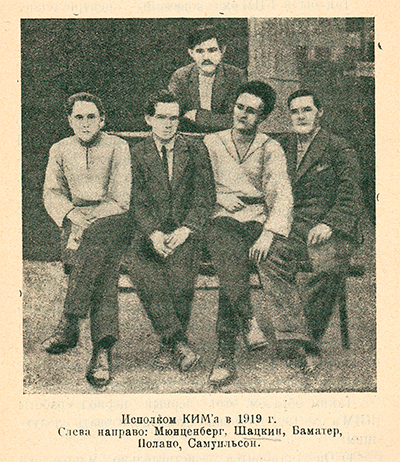
A similar issue is being prepared for publication in French and Italian. In many countries, as, for instance, Sweden, Spain, Yugo-Slavia, Italy, Lithuania, England, America, and France, the manifesto and resolutions of the Congress (published in No. 16), etc., have been published in pamphlet form. As a supplement to the periodical, there appears every ten days or so an issue of Internationale Jugendkorrespondenz, in which we publish all the news and information of the movement. Since November 12, issues have appeared, all the time increasing in volume. At the same time we are continuing the publication, “International Young People’s Library (Internationale Jugendbibliothek). Not long ago appeared No. 4: “The Socialist Education” of Youth and the Young People’s Socialist Movement”; No. 5, “Two papers on the Problem of the Proletarian Organisation of Youth after the State has passed into the hands of the proletariat”; No. 6, “Posthumous Works of Eugene Levine”; besides which, outside of the established program, has appeared Münzenberg’s “Socialist Organisation of Youth Before and During the War,” and we are preparing for publication the minutes of the first Congress of the Communist International of Youth, entitled, “Under the Red Banner,” and an appeal to the Youth of all countries entitled, “Down with Frontiers.” The last two publications are intended to be issued in all languages. Parallel with this agitational and publishing activity, the Executive Committee proceeds all the time with its internal political work–directed towards deepening the fundamental principles of the movement. Thus material has been collected concerning the struggle of the young people’s international organisations against militarism, and with the aid of this material were prepared “Theses on the Anti-militaristic Tactics of the Young Communist Organisations,” which will be brought up for discussion at the next meeting of the bureau. Material has also been collected on questions of the Trade Union movement. Furthermore, the Executive Committee occupies a very definite position regarding the Communist Organisation of Students. The Executive Committee addressed a letter expressing the principles of its attitude to the International Student Conference at Geneva, sent a delegate to that conference, and in addition issued special instructions concerning the relations of Young People’s organisations in various countries to the organisations of the educated youth.
All this work the Executive Committee had to accomplish under unspeakably trying conditions. The members of the Committee continually had to leave work to go off on business; arrests and sickness interfered with our work, or our printing offices would be closed, or private owners would go back on us and stop work.
The ECCI published the magazine ‘Communist International’ edited by Zinoviev and Karl Radek from 1919 until 1926 irregularly in German, French, Russian, and English. Restarting in 1927 until 1934. Unlike, Inprecorr, CI contained long-form articles by the leading figures of the International as well as proceedings, statements, and notices of the Comintern. No complete run of Communist International is available in English. Both were largely published outside of Soviet territory, with Communist International printed in London, to facilitate distribution and both were major contributors to the Communist press in the U.S. Communist International and Inprecorr are an invaluable English-language source on the history of the Communist International and its sections.
PDF of full issue: https://www.marxists.org/history/international/comintern/ci/old_series/v01-n13-1920-CI-grn-goog-r1.pdf
 Revolution's Newsstand