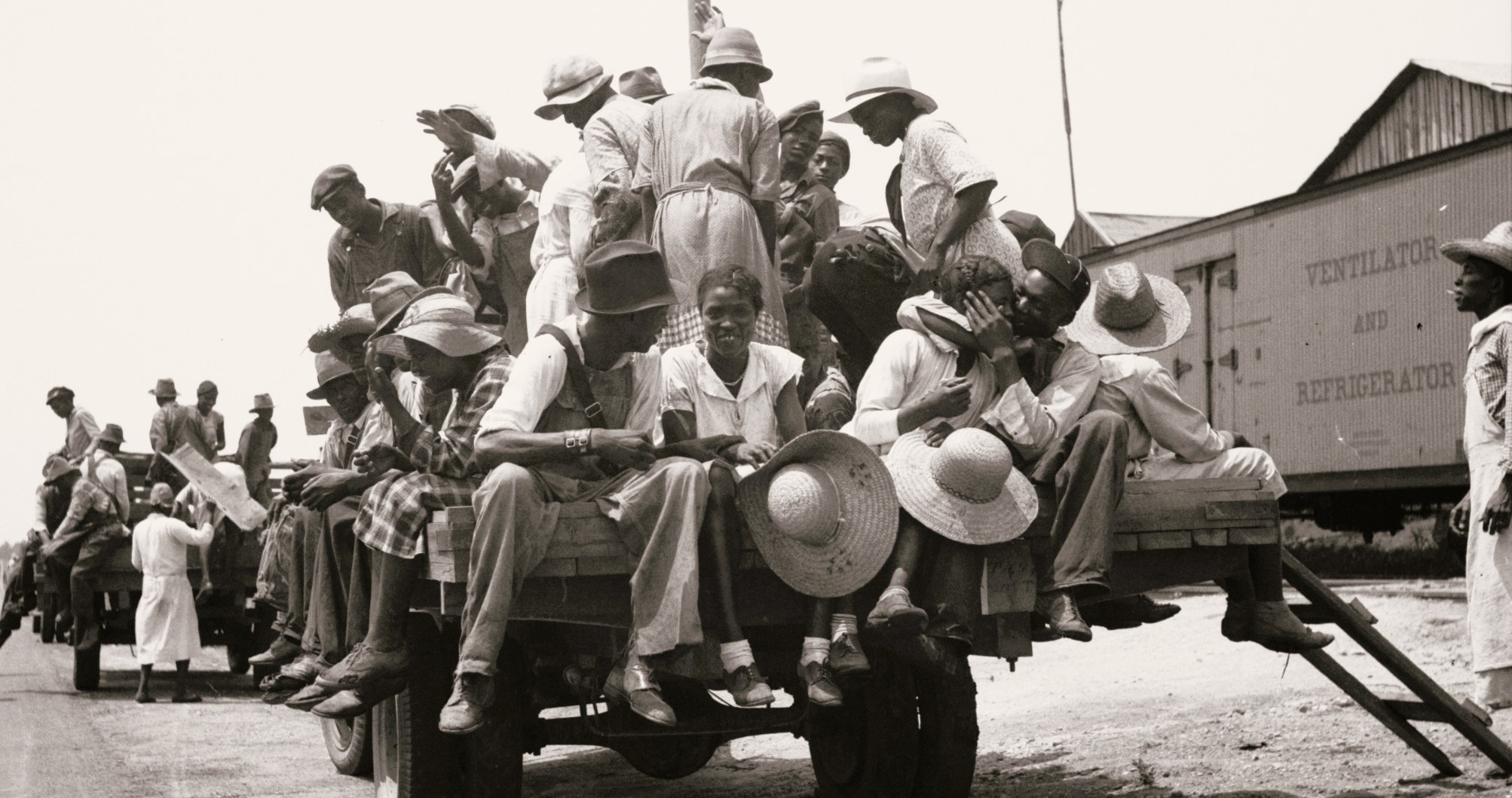
Humming the Tin Pan Alley tune ‘Everything is Peaches Down in Georgia,’ Otto Hall looks at the reality for workers in that state, Black and white, two years into the Great Depression.
“Everything is Peaches Down in Georgia” by Otto Hall from The Daily Worker. Vol. 9. No. 163. July 9, 1932.
The Song and the Facts
THE “Tin Pan Alley” song writer, who wrote this song, should look at Georgia today. He would certainly find that things are a long way from being “peaches” down there now, and that they never were—for the majority of the toiling population of this state, Negro or white. The gentleman who wrote this song is typical of the “inspired” capitalist song writers of the day. He probably has been about as far South as the “Battery,” and is therefore well qualified to write these songs that glorify capitalist America.
If the workers and poor farmers in the North are, in this third year of the crisis, suffering and have had their living standards reduced to the starvation level, the condition of the toilers in this section is one hundred-fold worse. Particularly is this true in the state of Georgia. Negro and white tenant farmers, unable to live any longer on the farms, are picking up their few belongings (if they happen to have any) and flocking to the cities, thus adding to the ever-growing number of unemployed in the urban centers. The so-called independent small farm owners are having their farms taken away from them by the mortgage bankers for back debts, and by the state for inability to keep up their taxes.
The Hoover Farm Board has given these farmers some lefthanded help by buying thousands of sacks of flour and shipping it to the big plantation owners and mortgage bankers in the towns, who pay the freight on this flour and
store it in their granaries and sell it at high prices to the poor farmers and Negro share-croppers in spite of the fact that each sack is plainly marked “not to be sold.” There are hundreds of abandoned farms in this state, where the farmers have been forced to leave and their farms taken over by the bankers and the state.
More Negroes Forced Into Peonage.
As for the Negroes, who greatly outnumber the whites in the rural sections, there are scarcely a handful of farm owners left. Overseers are now standing over the Negro share-croppers and tenant farmers with guns, driving them to work like convicts. These workers are finding it increasingly harder to escape this slavery, and whenever the runaways are picked up in the cities they are promptly shipped back by felons. In Monroe County, some Negro farmers were sent government loan checks through the banks, amounting to several thousands of dollars. These checks were brazenly confiscated by the bankers and rich farmers of that territory, and the Negroes were terrorized into allowing themselves to be robbed of this money. Many of the Negro families, who have escaped this slavery, have stated openly that they will die before they will allow themselves to be sent back.
White Workers Forced to New Low Level.
One of the most noticeable effects of the crisis in this section is that the standard of living of a great majority of the whites has already reached a level as low as that of the Negroes. It is a common expression down here, that a white man can be hired cheaper that what it used to cost to hire a Negro. Whites are glad to get jobs now that used to be considered exclusively “n***r jobs.”
This situation, which is of the greatest importance in the development of the revolutionary movement today and is speeding the unity of Negro and white workers, means that capitalism is no longer able to maintain the material basis for the ideology of white superiority among ever larger sections of the white working class. White workers, in these parts, are beginning to realize that the capitalist bunk about “Anglo-Saxon superiority,” merely gives them the privilege (?) of starving separately from the Negroes.
Atlanta Cuts Off Relief.
The immediate need of working-class unity has lately been placed before the workers of Atlanta and the rest of the state in its sharpest form. The entire capitalist press of this section has been carrying on an intensive back to the farm agitation. In spite of the fact that numerous workers, Negro and white, have been forced to leave their farms because of inability to live on them any longer, editorial after editorial has appeared in the press lauding the back to the farm movement.
The real purpose behind all this agitation was brazenly exposed at a meeting of the County Commission, together with a group of charity fakers. According to the local press, this meeting was called for the purpose of taking up an emergency situation that had arisen in Atlanta due to the recent closing of the relief stations which affected twenty-two thousand workers. These workers, who constitute about one-fourth of the totally unemployed in Atlanta, were receiving a miserable pittance through the Community Chest fund. When this relief closed down, it doomed these workers to quick starvation with the rest of the unemployed. In spite of the fact that only a few months ago the Community Chest fakers collected over eight hundred thousand dollars from the workers of this city, they now claim to be without funds and unable to continue the miserable relief they have been giving.
They came to the meeting of the County Commissioners with proposals to add to the already heavy tax burden of the poor workers and home owners in order to maintain their high-salaried jobs.
Mr. Frank Neely, executive director of the local Community Chest and a sixty-five hundred dollar a year faker, shed crocodile tears over the plight of all the starving workers and said that though he was hard-boiled, his heart bled for those poor families that came to his office for relief.”
Urge Back to Ruined Farms Plan.
But it remained for Mr. Walter S. McNeal, Jr., a big banker and real estate man of Atlanta, to make the proposal, that was hailed by the press and the County Commissioners as the most concrete proposal of the evening. He pointed out that there are hundreds of farms in the state that had been taken over for taxes and were now lying idle. He stated that the city and county authorities should round up all the “idle” in the city, together with their families, and ship them out to these farms and make them work for their board. He cynically remarked that, “a little elbow grease won’t hurt them.” Commissioner Hendrix stated at the meeting that he did not believe that there were any starving people in Atlanta, and if there were any he had not seen them.
The local unemployed committee, although a small committee consisting of about a dozen members, immediately issued ten thousand leaflets, exposing the fakery of the Community Chest and the slavery scheme of the local politicians, calling on the workers, Negro and white, to demonstrate at the County Court House Thursday morning at 10 o’clock. The leaflets called on the workers to bring their families to the office of Commissioner Hendricks in the County building and show him that there are starving people in the city of Atlanta, and to demand the reopening of the relief stations and immediate relief.
1,000 Demand Immediate Relief. On Thursday morning, June 30, the workers of Atlanta showed the bosses that they would not tolerate any forced labor program and that they would fight against starvation. About a thousand working men, women and children, Negroes and white, almost equal in numbers, went down to the court house, walked up to the Commissioner’s office on the fourth floor and demanded relief. This was the first time any demonstration of workers had ever occurred in the city of Atlanta. Although the police were there in numbers, they did not dare interfere with them. The police of this section are noted for their brutal treatment of Negro workers, but this time they were unusually polite. When one copper told a Negro worker in the corridor that they were going to send them all back to the farm and make them earn their keep, this worker answered him by telling him that he knew two people who wouldn’t go. The cop asked him who were these. This worker said: “It will be me and you if you come after me.” The cop backed away and said that he was only fooling.
Bosses Attack Unity of Negro and White.
The authorities were particularly concerned over the show of solidarity among the Negro and white workers. They were able to break this due to our weak organization among the whites. None of the white comrades whom we had assigned to take charge of the white workers showed up, thus leaving these workers without and leadership. So that when the fakers called the white workers into the County Commissioner’s Office, they shut the door on the Negro workers, and there was nobody among the white workers to protest this. The Negroes tried to get into the office, but were blocked by the police. It is obvious that had any white worker raised his voice in protest against this maneuver the rest of the workers would have followed him and we would have defeated it at the outset. Because, up to that time, all the workers, Negro and white, were mingling together. Agitation will be carried on in the future among the white workers, exposing the bosses’ method of breaking up the solidarity of Negro and white.
The fakers talked to the white workers about an hour, behind closed doors, telling them that the county had no money and advising them that if they had any relatives on the farms to go back there. These workers were very much dissatisfied over this conference, and went away mumbling that they were in the same position that they were before. But, as a direct result of this demonstration, the County Commissioners held a meeting the next morning and decide to vote six thousand dollars for immediate relief for the unemployed. Even the capitalist press admitted that it was due to cur demonstration that the authorities took this step.
Must Push Fight for Negro Rights
The local Unemployed Committee, has received considerable prestige among the workers of this section as the result of this partial victory, and is following this up with organization meetings and further demonstrations before the city and county authorities. Particularly are they alive to the dangerous situation that is being created by the desperate efforts of the bosses to prevent the growing unity of the Negro and white workers. There must be a wide educational campaign carried on among the white workers exposing the separation schemes of the bosses, and the comrades here, must not, as they have in the past, depend upon the spontaneous development of Negro and white unity. The struggle for Negro rights must be in the forefront of all our struggles, and the fight for the right of the Negroes to determine their own form of movement, particularly in this big section of the “black belt,” must be pushed more determinedly.
Finally the intensification of our unemployed campaign connected up with the election campaign issue gives us the possibility to break through this terror that has been in existence particularly since the trial of the “Atlanta Six.” With continued work, we can look forward to the time when everything will REALLY be “peaches” down in Georgia.
The Daily Worker began in 1924 and was published in New York City by the Communist Party US and its predecessor organizations. Among the most long-lasting and important left publications in US history, it had a circulation of 35,000 at its peak. The Daily Worker came from The Ohio Socialist, published by the Left Wing-dominated Socialist Party of Ohio in Cleveland from 1917 to November 1919, when it became became The Toiler, paper of the Communist Labor Party. In December 1921 the above-ground Workers Party of America merged the Toiler with the paper Workers Council to found The Worker, which became The Daily Worker beginning January 13, 1924.
PDF of full issue: https://www.marxists.org/history/usa/pubs/dailyworker/1932/v09-n163-NY-jul-09-1932-DW-LOC.pdf
 Revolution's Newsstand