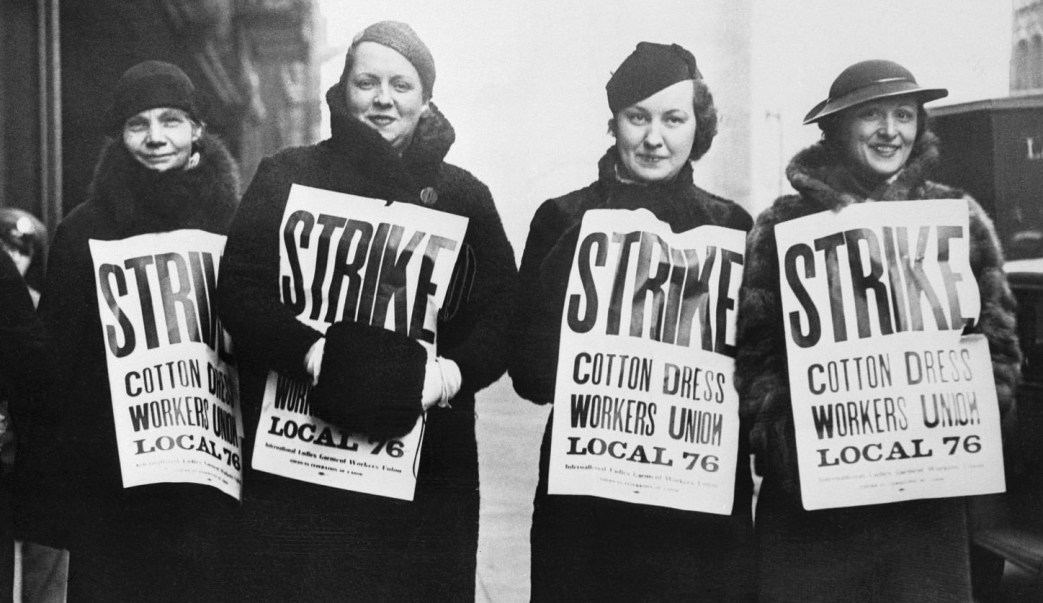
On of the largest and most important union of the first half of the twentieth century was the International Ladies Garment Workers’ Union. As such, it was often the scene of sharp struggle over leadership, practice and orientation with various Left forces playing key roles in the union. Here, a look at the work of the Trade Union Educational League, some of whose members were expelled by the union for their militant activity, and the Communist Party in the long 1924 Chicago strike of 3500 I.L.G.W.U. members in the face of injunctions and large scale arrests.
‘Ladies’ Garment Workers in Struggle’ by I. L. Davidson from Labor Herald. Vol. 3 No. 2. April, 1924.
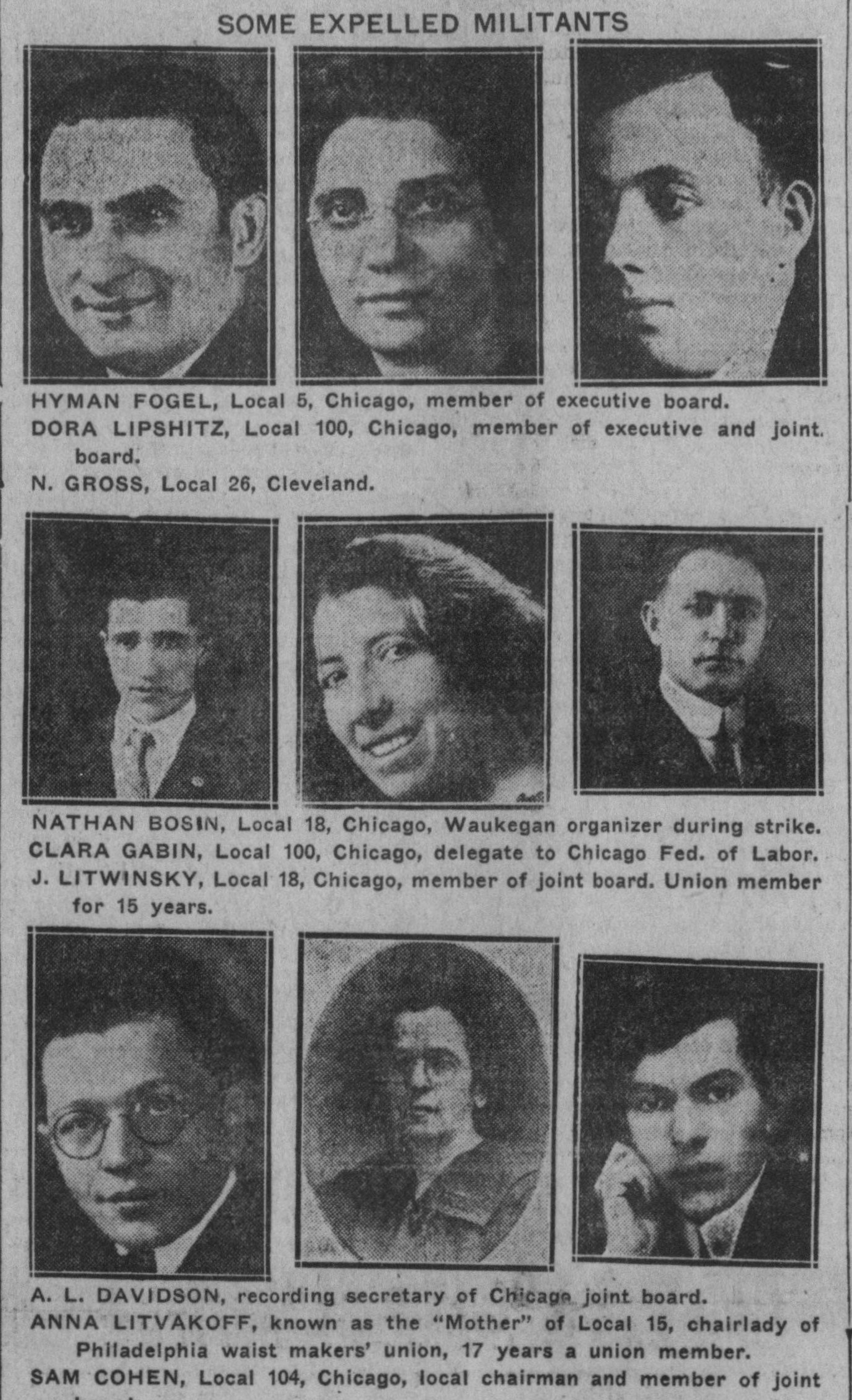
IN their participation in the Chicago strike of the International Ladies’ Garment Workers’ Union, the members expelled last summer for their educational work in behalf of amalgamation and the labor party have once and for all killed the hypocritical charge of dual unionism. They are serving on strike committees, walking the picket line, going to jail and serving the strike in every way. Once again they have demonstrated their complete devotion to the union and also the complete confidence in which they are held by the membership.
On Feb. 22nd, when it had finally been decided that the action of the employers in refusing to negotiate a new agreement made a strike necessary, the expelled members sent the following letter to the union:
“Joint Board of the I.L.G.W.U. Chicago, Ill.
“Dear Sirs and Brothers:-
“In view of the impending strike action in the Ladies’ garment industry, we, the undersigned expelled members of the I.L.G.W.U., wish to state again our determination to do everything in our power to make the cause of the workers victorious over the employers, and to this end we again declare our willingness to undertake whatever tasks the organization may assign to us.
“We state, at the same time, that the action which will do most to solidify and encourage the members of the union, and render the best fight possible, will be the complete reinstatement of the expelled members in full rights within. the union.
“When this communication came before the Joint Board that body demonstrated its understanding of the falsity of all charges against the expelled members, as well as their value as practical workers in the union, by accepting the proffered services. On Feb. 27th, when the strike began, the expelled members were all at their posts at strike headquarters, and have served steadily since then in some of the most important work. Dora Lipshutz, one of the expelled, is secretary for the strike committee at the downtown headquarters.”
Injunctions and Police Brutality
The clothing employers quickly called in their allies in the city and county government, particularly the police and the counts. Judge Dennis Sullivan, a notorious enemy of labor, issued injunctions covering most of the shops effected by the strike involving about 3,500 workers. Large squads of police and hordes of private gunmen were thrown into the battle. Arrests of pickets have been daily occurrences, more than 350 men and women being taken from the picket line and hauled to jail in the police wagon. Among these have been the expelled members.
Police brutality is increasing in the strike as this is written. The employers seem determined to teach the workers the lesson that the present government in all its phases is a bosses’ government. Sophie Altschuler, one of the left-wingers and an active militant, was beaten up by policeman No. 3181 so badly as to be confined in bed for some time. Dozens of other girls have felt the policemen’s fists and clubs and bear their marks. After being subjected to official violence, they have all been thrown into jail. Nine of them have been convicted of violating the Sullivan injunction, and one, Florence Corn, has already been sentenced to 30 days in the county jail.
The Department of Labor is reported to have sent Benjamin Marshman, a “Federal conciliator,” to attempt arbitration. He is supposed to have approached the employers but they refused all intervention. They are evidently counting upon the disruption of the officialdom for the past eight months having weakened the union so much that they can treat it with contempt. Marshman was evidently sent only for use if the employers needed him, however, because he never approached the union.
Support from the Chicago Federation of Labor was requested at the meeting on March 2nd. The Federation appointed a Committee of Fifteen to mobilize the forces of the labor movement behind the striking girls. This Committee has been calling upon the City Hall politicians in an attempt to convince them that the police should be more gentle. Such efforts have not accomplished much as yet, for the police have intensified their rough tactics rather than otherwise.
Mass Picketing to Defy Injunction
On March 14th, the beginnings were made of an application of mass picketing when 100 union men and women from other trades marched in a body to the strike zone to join the union pickets The effect of this was to put even more energy into the strikers, and at the meeting of the Chicago Federation on the 16th the demand was made that the C.F. of L. itself endorse and organize mass picketing, both as a demonstration of the solidarity of the whole labor movement with the garment workers and as one of the most effective weapons of the strike itself.
Del. Johnstone of the Painters’ Union pointed out that the injunction is threatening the very life of the labor movement. He showed that if the Chicago Federation were to allow the garment workers’ strike to be strangled by this legal weapon, that the rest of the labor movement could expect the same treatment. This is a fact recognized by the whole American Federation of Labor for many years. Johnstone quoted the declaration of the 1916 Convention of the A.F. of L. at Baltimore:
“We, therefore, recommend that any injunction dealing with the relationship of employer and employee…be wholly and absolutely treated as usurpation and disregarded, let the consequences be what they may…Kings could be and were disobeyed, and sometimes deposed. In cases of this kind judges must be disobeyed, and should be impeached.”
The Daily Worker in the Strike
As usual in strikes, the capitalist press has been carrying propaganda for the employers, discouraging the strikers and charging them with all sorts of crimes. Not a single capitalist daily has mentioned the police brutality or explained the reasons for the strike. The garment workers, however, have suddenly awakened to the fact that they are no longer dependent upon the Chicago Tribune, the Daily News, or the Hearst papers. For the first time in years Chicago has a daily paper that carries the workers’ own story of the struggle-The Daily Worker. At every strike meeting and on the picket line, as well as into the homes of the garment workers generally, The Daily Worker has carried the message of the union and reported every day all the important events of the battle. Even the hostile union officials have been forced to admit the tremendous effectiveness of The Daily Worker in making this a real strike, and to call upon it for assistance which has been immediately forthcoming. There is no doubt but that the new working class daily has proven its value to the Chicago labor movement in this strike.
The Trade Union Educational League has been throwing its full influence into support of the striking garment workers. It has been mobilizing its members to distribute The Daily Worker at the various meetings, in cooperation with the Young Workers’ League and the Workers’ Party. It is preparing to furnish groups of its members for mass picketing as soon as the Chicago Federation of Labor gives its approval and calls for this move against the injunction while exerting every effort to strengthen the union and help win the strike, it has not for one moment forgotten those expelled members who were victimized because in time of peace they pointed out the only means by which the union could effectively prepare for war. The attitude of the League is well expressed in a statement issued during the strike which read as follows:
“The exposure of States Attorney Crowe as an agent of the clothing employers to crush the Garment Workers’ Union, it but another proof of the policies advocated by the Trade Union Educational League. With all the Employers’ Associations united against them, using in addition to private thugs and gunmen the officials of the Government, the garment workers should more than ever realize the need of amalgamation of all needle trades unions into one powerful organization, and the political unity of all labor into a great Labor Party. Those same members of the International Ladies’ Garment Workers’ Union, associated with the T.U.E.L., who were expelled for propaganda within the union for amalgamation and a Labor Party, are now proving by their sterling services to the strike, that they can fight for the smallest needs of the workers as well as for these larger needs of industrial unionism and political solidarity which are now more than ever the crying necessity. Workers, the Trade Union Educational League calls upon you to support the strike, and at the same time to unite your union more closely by reinstating the expelled members.
League Goes Into Action
That the T.U.E.L. is willing to give more than formal support and lip-service to the struggle. of the garment workers was proven by the manner in which the Chicago Local League militants followed up the above statement with action. Regardless of what trade they follow they joined in the organization of support of the union pickets with volunteers from other unions. This sharing in the daily battle by League members and their stand on the picket lines with the girl strikers, defying with them blizzards, police, and injunctions, going to jail in solidarity with them, has raised a great demand that the C.F. of L. committee of 15 should organize mass picketing in the name of the entire Chicago labor movement.
While the struggle against the employers is thus going on in Chicago, the militants in the I.L.G.W.U. have not for one moment forgotten the necessity for those large policies advocated by the Trade Union Educational League, which are more than ever necessary for the needle trades unions if they are to live and grow. Above all they have not forgotten the necessity of securing again the right to carry on educational activity which has been denied to them by their officials. The expelled members in Chicago have appealed their case to the Sixteenth Biennial Convention, which meets in Boston early in May. The elections of delegates for this Convention are now going on and every militant garment worker should be exerting all possible influence to see that only those are elected who are pledged to restore working class democracy within the union.
The Labor Herald was the monthly publication of the Trade Union Educational League (TUEL), in immensely important link between the IWW of the 1910s and the CIO of the 1930s. It was begun by veteran labor organizer and Communist leader William Z. Foster in 1920 as an attempt to unite militants within various unions while continuing the industrial unionism tradition of the IWW, though it was opposed to “dual unionism” and favored the formation of a Labor Party. Although it would become financially supported by the Communist International and Communist Party of America, it remained autonomous, was a network and not a membership organization, and included many radicals outside the Communist Party. In 1924 Labor Herald was folded into Workers Monthly, an explicitly Party organ and in 1927 ‘Labor Unity’ became the organ of a now CP dominated TUEL. In 1929 and the turn towards Red Unions in the Third Period, TUEL was wound up and replaced by the Trade Union Unity League, a section of the Red International of Labor Unions (Profitern) and continued to publish Labor Unity until 1935. Labor Herald remains an important labor-orientated journal by revolutionaries in US left history and would be referenced by activists, along with TUEL, along after it’s heyday.
PDF of full issue: https://www.marxists.org/history/usa/pubs/laborherald/v3n02-apr-1924.pdf
 Revolution's Newsstand