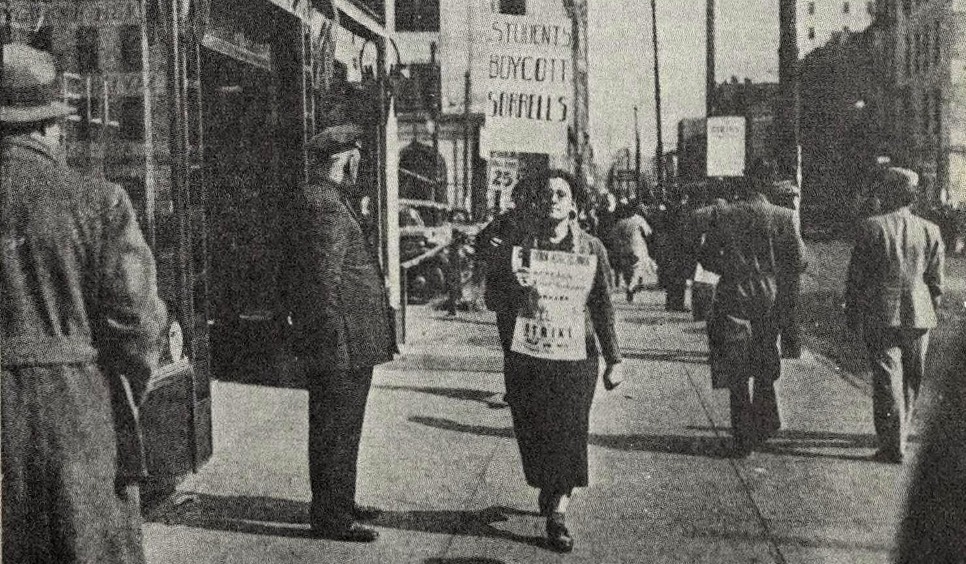
When the bussers struck for a union at Sorrell’s restaurant, a popular student hangout near Brooklyn College, campus radicals come to their aid and build a student boycott.
‘Brooklyn Wins a Strike’ by Beatrice Gomberg from Student Review (N.S.L.). Vol. 4 No. 2. December, 1912.
ON Tuesday, October 23, twenty-two bus boys and countermen of Sorrell’s Cafeteria walked out on strike. On Thursday October 25 they returned to work having won all of their demands. What happened in between is a chapter in the history of the American student movement.
Sorrell’s Cafeteria is the largest and most popular student meeting and eating place in the vicinity of Brooklyn College. The students comprise a large majority of the customers although there are business men and workers who patronize the cafeteria.
After several unsuccessful conferences with Sorrell’s, the workers struck under the leadership of the Cafeteria section of the Food Workers Industrial Union. The demands of the workers were:
1. Fifteen dollars a week for bus boys. Twenty-five for countermen. (This meant a three dollar increase.)
2. Recognition of the Food Workers Industrial Union.
3. Security of Jobs.
The Brooklyn College N.S.L. knew that it would play an important part in the coming strike. Almost as soon as the strike began an Evening Session N.S.L.’er was on the picket line. The strikers stood around and proudly point to him. “Students,” they said to each other.
Wednesday morning the Day session, with a membership of 175, distributed leaflets stating the demands of the strikers and calling upon students to boycott Sorrell’s. Students picketed all morning. Boards were chalked up in classrooms and we joined the picket line.
We walked back and forth with the cops shooing us on, gently. We were students, you know. We were waiting for a platform for an open air meeting. Just then I saw the Students L.I.D. approaching in a body. “We are coming down to support the strike. We are going to hold an open air meeting.”
We didn’t have a platform and we could not get a flag and it was a united front so we waited for their platform. The Student L.I.D. chairman announced it as a meeting of “the Student League for Industrial Democracy, supported by the union and the N.S.L.” Unfortunately, no mention of the name of the union or the meaning of the letters N.S.L. or that it was a joint meeting. Anyhow, it was large and very successful.
On Thursday we found the streets blocked with the cars so that it would be difficult to hold an open air meeting. Until the meeting started we strolled in groups of two or three, but our noonday walk never went beyond the building which housed Sorrell’s. It was mass picketing and everybody knew it. The place was emptier than it had been on the day before.
There was no rush this lunch hour and it was drawing to a close when we started our meeting. We had agreed to have an N.S.L.er as chairman and a certain number of speakers from each participating organization. Before the meeting got under way, someone was arrested.
Dave London and Nat Polakoff were walking in front of Sorrell’s for almost an hour. Someone from the store next to Sorrell’s said, “Why don’t you wipe the snot off your nose?” Dave approached him and said, “Do you want to speak to me as—” Dave would have finished, “as a gentleman?” but was interrupted by a spit in the eye. There was a tussle. The man came out with a black eye which both boys insist is not their handiwork.
Dave called a policeman and preferred charges against the man. On the arrival of the policeman, the spitter and his brother, a lawyer, who happened to be with him, persuaded the law to arrest Dave and Nat instead.
We started the open-air meeting and it lasted for three hours with many short speeches. The crowd included students and non-students. The students came and went, but many non-students stood quietly by for three hours, listening intently, obviously sympathetic. Then some people from the crowd came to the chairman and asked to speak. One was a student who had eaten in Sorrell’s and wanted to defend his position. We gave him the platform.
Then the non-students began. A member of the Empire State Motion Picture Operators Union, an unemployed father of a City College student, a Negro who spoke of the conditions of the Negro students, a white collar worker from the neighborhood, someone who was just a worker. They were entirely sympathetic. They thought it was a wonderful thing that students had left their ivory towers—though it was only the whitecollar worker who used that expression, the rest explained in simple, workers’ language.
Two hours after the meeting was over, 5:27 to be exact, the strike was settled, the workers receiving a two dollar wage increase, union recognition and security of jobs.
We had won the strike, the union told us that themselves. But better still, we had gained the confidence of the workers around the neighborhood and in the union. They will be ready to call upon us now and know that we will respond enthusiastically.
Emerging from the 1931 free speech struggle at City College of New York, the National Student League was founded in early 1932 during a rising student movement by Communist Party activists. The N.S.L. organized from High School on and would be the main C.P.-led student organization through the early 1930s. Publishing ‘Student Review’, the League grew to thousands of members and had a focus on anti-imperialism/anti-militarism, student welfare, workers’ organizing, and free speech. Eventually with the Popular Front the N.S.L. would merge with its main competitor, the Socialist Party’s Student League for Industrial Democracy in 1935 to form the American Student Union.
PDF of full issue: https://archive.org/download/student-review_1934-12_4_2/student-review_1934-12_4_2.pdf
 Revolution's Newsstand