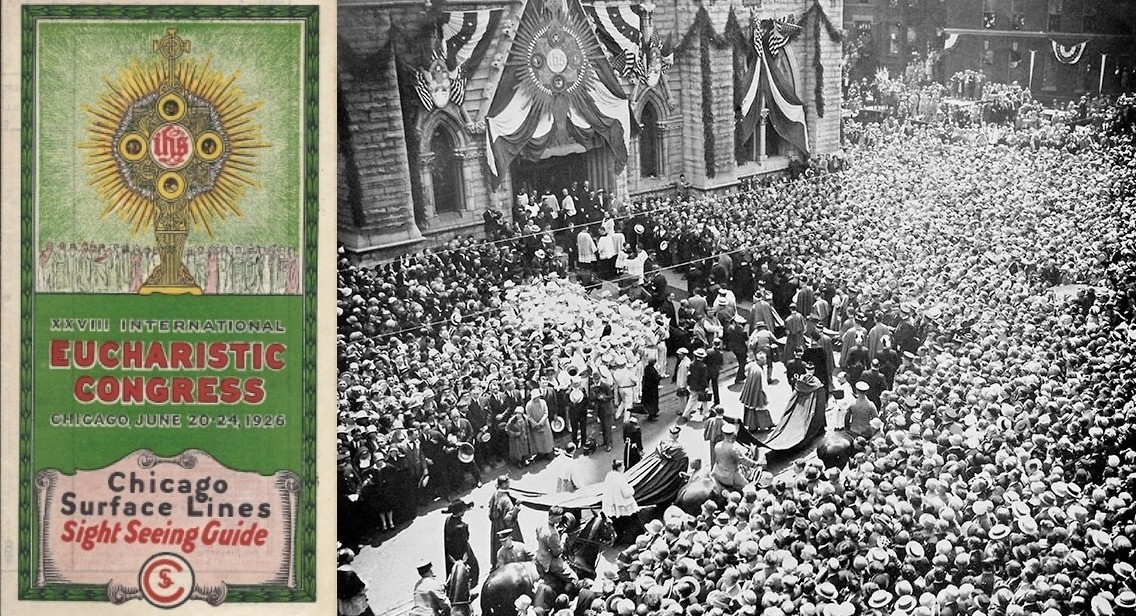
Thurber Lewis on the Vatican’s post-World War One pivot to the United States, with Chicago chosen to host 1926’s International Eucharistic Congress.
‘The Eucharistic Congress’ by Thurber Lewis from The Daily Worker Magazine. Vol. 3 No. 129. June 12, 1926.
On June 20-24 Chicago will be the scene of a great medieval revival. On those four days the International Eucharistic Congress will divide its ceremonies between Chicago and the seat of the Roman Catholic Diocese at Mundelin, Ill., a few miles distant.
It will be the 28th biennial congress and the first to be held in the United States. Every two years a city is chosen in a different part of the world. The congresses are attended by the leaders of the Roman hierarchy, thousands of priests, monks and nuns. They are presided over by a papal nuncio, appointed by the pope. Catholics who can afford it come from the far corners of the earth.
What is the purpose of these congresses?
The Religious Meaning of The Eucharist
The church claims they are purely spiritual reunion of millions of Catholic believers who come as pilgrims from the four quarters of the globe to do honor to Christ and to confess their faith before men. The congresses are called “Eucharistic” because they are a glorification of the sacrament. The word comes from a combination of two Greek terms which mean “to re Joice.” Its religious meaning was given by the Gospel of St. Luke (XXII, 19) in which the Greek terms “Eucharistisas” is used in the sentence, “and taking bread…He gave thanks.” The word thus became a way of indicating the sacrament of the blood and body of Christ.
According to the New Testament, which has been superimposed on the old Hebrew books, when Christ sat at the Last Supper the night before his death and said, referring to the bread, “Take ye and eat, this is my body,” and, referring to the wine, said, “Drink ye all of this, this is my blood,” he, without probably any intention of doing so, laid the basis of what has become the central tenet of the catholic faith.
The Real Body And Blood of The Christ.
Catholics implicitly believe that when they eat consecrated bread and when they drink consecrated wine, they are eating and drinking the actual, REAL body and blood of Christ. They believe that at the last supper and in the words given above, Christ, thru his divine power, transformed his blood and body into wine and bread by adding the words, “Do this for a memory of me,” he conferred the same power he himself exercised upon the disciples sitting around him and thru them upon all ordained priests for all time.
This is called “Transubstantiation,” that is, the substance of blessed wine and bread become the substance of the blood and body of Christ.
Thus the Eucharistic Congress is what might be called a World Mass–it is presided over by the highest primates of the various countries–in worship of the transubstantiated body and blood of Christ.
Gigantic Preparations For Congress
The wine and bread, or wafers, to be used on this occasion have been blessed by the pope and are being transported to Chicago under the careful watch of the Swiss guards of the Vatican. Millions of dollars are being spent in the preparations. Great thrones have been erected upon which will sit the papal nuncio and visiting cardinals. One million pilgrims are expected. Great processions of nuns and monks in the garbs of their different orders will be led by archbishops and primates in purple and red robes. Masses thousands of voices will be sung, including those of 62,000 children. Services in honor of the Eucharist will be participated in by hundreds of thousands. These are the bare facts of the International Eucharistic Congress.
Why The United States This Year?
Why was the United States chosen for this year’s congress?
There is no doubt that the church of Rome gives considerable thought to the matter of the location of the congress’ biennial sessions. The church of Rome is in a large measure a political institution. Its political influence in some countries, especially the Latin countries and Austria, is enormous. It influence in Mexico was at one time quite as great. The Roman church, in Mexico, has played the role of a landlord and oppressor of the peons. Things have changed there. The church is having trouble with the new Mexico. Its priests are being expelled. Its educational system has been replaced by a lay system supervised by the government.
Count D’Yanville, the secretary of the Eucharistic Congress, is authority for the statement that the holding of the Congress in the United States this year has very much to do with the troublous times the church is having in Mexico. This means that the Catholic church, by a display of strength in the United States, hopes to influence the Mexican government to deal more easily with its representatives and institutions in the Southern Republic.
20,000,000 Catholics in America
That is one creditable reason. Another is that there are, according to the church’s estimates, 20,000,000 Catholics in the United States. There are 1,000,000 in Chicago alone. A great pageant of this sort will certainly have the effect of arousing their church patriotism and perhaps of also influencing those outside the faith to be favorably impressed with the power of the church. Certainly so ancient and wise an institution as the Roman Catholic Church does not overlook these things. Certainly there are other considerations for them than merely “a confession of faith before men.”
The Feudal Power Of The Church Is Still Felt
By such dictums and upon such faith, the Roman church was the pervading influence of feudalism. The answer to questions of knowledge as opposed to questions of belief was the stake! By the sheer momentum of the great power accrued to itself during those superstitious days and by the fact that capitalism, succeeding feudalism, did not contain the basis for the extinction of ignorance and superstition–aye, in this, its decrepit period, it spreads both for its own maintenance–the Roman church, and all others, can still carry on.
The greater part of the millions of Catholics throughout the world are workers of the cities or toilers on the land. The vast majority of workers who are Catholics are to be found in countries with a predominantly peasant population. In America it is different. The majority of Catholic workers are engaged in industry. This is, of course, because they came originally from those countries in which catholicism dominates the minds of the peasant population from which most of the slaves of heavy industry in the United States have been drawn. Although very few of them will come to the Eucharistic Congress because they haven’t the money, they will watch the news of it with great interest. Even now the European papers are full of it. It certainly is getting its share of the news here.
What Can The Church Do For Workers?
But what has the Congress, or for that matter the church, to offer to the workers? Does the church make their hours of slaving for a master shorter? Does it put food in the mouths of their families when times are hard—strike or unemployment?
Does it help to lessen in one degree the debasing exploitation that makes capitalists superfluously wealthy and the workers that much poorer? No. That is not its work. Its work is the work of the “spirit.” It teaches humility.
It teaches that if your brother is shot down during a strike It is God’s will. It teaches you to be obedient—to whom? To your master, to your boss.
The papal nuncio will sit upon his high golden throne in the name of a distant, mysterious authority. Cowled monks, the white of the Dominicans, the brown of the Capuchins, the black of the Benedictines will parade slowly, carrying before them crosiers of gold. The Swiss Guards, in sixteenth century habiliment, will hold their ancient spears at attention. Te Deuma will be sung by thousands of pious voices. Red robed cardinals will march under yellow and white canopies following the ostensorioum, that contains the holy wafers. A million knees will sink to the ground in prayer.
And in every part of the globe—workers will continue to slave.
The Daily Worker began in 1924 and was published in New York City by the Communist Party US and its predecessor organizations. Among the most long-lasting and important left publications in US history, it had a circulation of 35,000 at its peak. The Daily Worker came from The Ohio Socialist, published by the Left Wing-dominated Socialist Party of Ohio in Cleveland from 1917 to November 1919, when it became became The Toiler, paper of the Communist Labor Party. In December 1921 the above-ground Workers Party of America merged the Toiler with the paper Workers Council to found The Worker, which became The Daily Worker beginning January 13, 1924.
PDF of full issue: https://www.marxists.org/history/usa/pubs/dailyworker/1926/1926-ny/v03-n129-supplement-jun-12-1926-DW-LOC.pdf
 Revolution's Newsstand