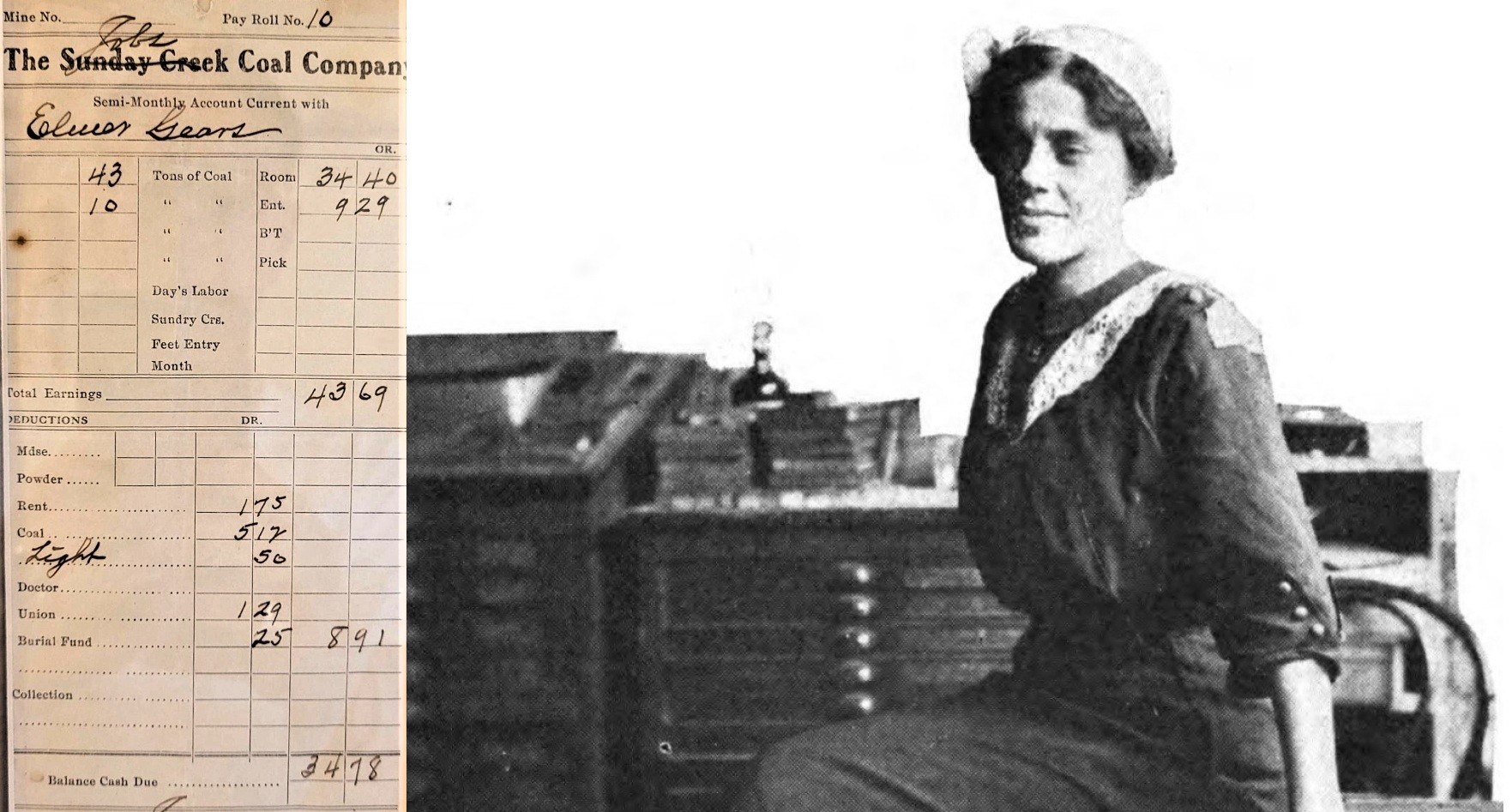
The seventh of Marcy’s series sees her delve into Marx’s ‘Value, Price, and Profit’ to explain workers’ wages.
‘Beginners Course in Socialism and the Economics of Karl Marx: VII. Wages’ by Mary E. Marcy from International Socialist Review. Vol. 11 No. 11. May, 1911.
THERE are several ways whereby wage-workers may try to improve their conditions today. In Lesson V we discussed Low Prices and their effect upon the condition of working class life. We discovered that as the prices on the necessities of life fall, wages fall proportionately because of the competition among wage-workers for jobs.
It would be impossible for an employer of labor to arbitrarily lower wages, just as it is impossible for capitalists to arbitrarily raise the prices on commodities. The conditions must be favorable to such a rise or fall in prices. It is the Army of Unemployed men and women that force wages (or the price of labor-power) down when the cost of living falls. We were unable to find where low prices would benefit the working class.
In discussing prices in the last two lessons, we have not said much about WAGES, Nor the price of labor-power. Labor-power is a commodity just as stoves, coats or flour are commodities. And the value and price of labor-power are determined exactly as the price and value of all other commodities are determined.
Wage-workers are always trying to get higher wages, or a better price for their labor-power.
It is easy to understand that the gold miner who secures a rise in wages from $2.00 to $3.00 a day, leaves less surplus value for the mine owner. He receives back MORE of his product. And the aim of socialists or revolutionary workmen and women is to become owners of their ENTIRE product.
Confused economists have repeatedly claimed that a rise in wages was no benefit to the proletariat. They insisted that the capitalists would raise prices on the necessities of life so that the workers would be just where they were before.
But in Value, Price and Profit, Chapter II, Page 17, Marx says: “Plow could that rise of wages affect the prices of commodities? Only by affecting the actual proportion between the demand for, and the supply of, these commodities.”
“It is perfectly true that, considered as a whole, the working class spends, and must spend, its income upon necessaries. A general rise in the rate of wages would, therefore, produce a rise in the demand for, and consequently (TEMPORARILY) in the market prices of, necessaries.
“The capitalists who produce these necessaries would be compensated ‘for the risen wages by the rising market prices of their commodities.”
Note, Marx says that TEMPORARILY the prices on necessaries would probably rise, owing to the INCREASED DEMAND for food, clothing and better houses; not because the capitalists decided to raise prices. And then note what begins to follow immediately:
“What would be the position of those capitalists who do not produce necessaries? For the fall in the rate of profit, consequent upon the general rise in, the price of wages, they could not compensate themselves by a rise in the price of their commodities, because the demand for their commodities would not have increased
“Consequent upon this diminished demand, the prices of their commodities would fall. In these branches of industry, therefore, the rate of profit would fall.
“What would be the consequence of this difference in the rates of profit for capitals employed in the different branches of industry? Why, the consequence that generally obtains whenever, from whatever reason, the AVERAGE RATE OF PROFIT comes to differ in the different spheres of production.
“Capital and labor would be transferred from the less remunerative to the more remunerative branches; and this process of transfer would go on until the supply in the one department of industry would have risen proportionately to the increased demand, and would have sunk in the other departments according to the decreased demand.
“This change effected, the general rate of PROFIT would again be EQUALIZED in the different branches. As the whole derangement originally arose from a mere change in the proportion of the demand for, and supply of, different commodities. The cause ceasing, the effect would cease and prices would return to their former level and equilibrium…
“The GENERAL RISE in the rate of wages would, therefore, after a temporary DISTURBANCE OF MARKET PRICES, ONLY RESULT IN A GENERAL FALL in the RATE OF PROFIT WITHOUT ANY PERMANENT CHANGE IN THE PRICES OF COMMODITIES.”
We will use a concrete illustration to explain Marx’s point. In a mining camp the miners secured a gain in wages of from $2.00 to $3.00 a day. The man who ran the only restaurant in the camp thought he could raise the price of board from $4.00 to $5.00 a week. For a week or two the miners paid the advanced price, but the third week a new restaurant was opened by a man who heard of the “prosperity” in this particular camp and inside of two months there were FOUR restaurants competing for trade in Golden Gulch. This competition among the restaurant keepers forced board down to $3.00 a week. Some of them moved away until board fell to the AVERAGE rate of board in that state.
As long as prices were better there new investors came to Golden Gulch, and when they fell below the average price for board investors went away.
Marx says that when workmen and women get higher wages, they spend this increase in better food, better homes and better clothing. This stimulates the demand for food, clothing and houses. More capitalists begin to invest in food production, in houses and in the manufacture of clothing. The competition among capitalists often brings the prices on these things down BELOW the rates charged before the workers received their increase, until these capitalists find they can make more money in other fields, when they invest in other industries and prices fall to what they were before the rise in wages.
On the very last page of Value, Price and Profit, Marx says again:
“A general rise in the rate of wages would result in a fall of the general rate of profit, but, broadly speaking, not affect the prices of commodities.”
“The general tendency of capitalist production is not to raise, but to sink the average standard of wages.”
“Trade Unions work well as centers of resistance against the encroachments of capital. They fail partially from an injudicious use of their power. They fail generally from limiting themselves to a guerilla war against the effects of the existing system, instead of simultaneously trying to change it, instead of using their organized forces as a lever for the final emancipation of the working class, that is to say, the ultimate abolition of the wages system.”
Questions:
If you were getting three dollars a day for digging gold out of a mine and you secured $4.00 by striking, would there be as much surplus value left for your Boss as before?
On what do wage-workers usually spend their money? On luxuries?
If the working CLASS is able to force up wages two dollars a week to every man and woman will they spend the increase on automobiles, trips to Europe or upon more and better clothing and food?
What happens when there is a sudden increased demand for a commodity? Does the price of this commodity rise or fall (temporarily)? If the capitalist producing this commodity for which there is a suddenly increased demand is able to get higher prices for it, will this attract other capitalists into the same field of production in the hope of securing bigger profits?
What happens when several big capitalists fight for a field of production where prices are high?
Do these capitalists remain producing a commodity after its price falls so low that they cannot make the average rate of profit?
When they go into another sphere of production do prices on this commodity fall to normal again?
Why cannot a capitalist raise prices at his own will? Suppose a wealthy ranch owner has a splendid stock of horses when the U.S. troops are sent down to the Mexican borderline. Horses are very scarce, since automobiles have won favor with the leisure class. He sells these horses at an enormous price. There is still talk of war. What does every other ranchman in the country plan to do. when he hears of the profits of the lucky owner of the horses? Do they all go into the COAL BUSINESS?
EVEN if there is still rumor of war. will the price on horses be as high in a few years as it is now? Why not?
NOTE to those taking up the Study Course. We are going to publish in the June number of the Review the best six or seven hundred word article from any one of the Study Clubs showing WHY Low Prices Do Not Help the Working Class. We shall also be glad to publish the names of classes or comrades who send in particularly good articles on this subject. We will also pay $5 cash or send $10 worth of books published by Chas. H. Kerr & Co. for this article, and $5 cash or $10 worth of our books will be sent to the Study Club sending in the best 1,000-word article on “Why Capitalists Cannot Arbitrarily Raise Prices” and on the best article of 1,000 words on “Why Higher Wages Benefit the Wage Workers.” Typewrite your articles, if possible, and send them in early if you want to see them in the June Review.
The International Socialist Review (ISR) was published monthly in Chicago from 1900 until 1918 by Charles H. Kerr and critically loyal to the Socialist Party of America. It is one of the essential publications in U.S. left history. During the editorship of A.M. Simons it was largely theoretical and moderate. In 1908, Charles H. Kerr took over as editor with strong influence from Mary E Marcy. The magazine became the foremost proponent of the SP’s left wing growing to tens of thousands of subscribers. It remained revolutionary in outlook and anti-militarist during World War One. It liberally used photographs and images, with news, theory, arts and organizing in its pages. It articles, reports and essays are an invaluable record of the U.S. class struggle and the development of Marxism in the decades before the Soviet experience. It was closed down in government repression in 1918.
PDF of full issue: https://www.marxists.org/history/usa/pubs/isr/v11n11-may-1911-ISR-gog-Corn-OCR.pdf
 Revolution's Newsstand