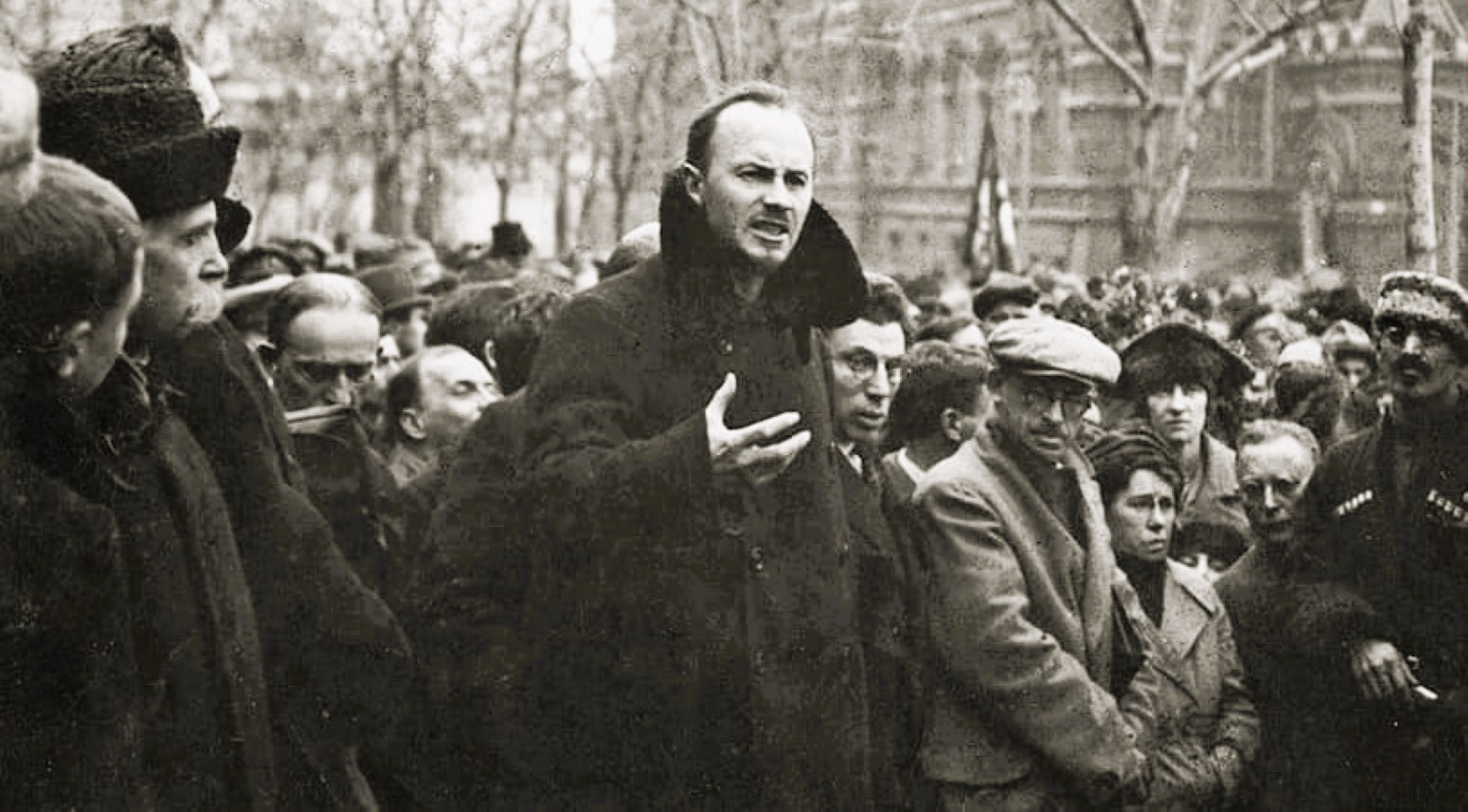
Zinoviev, Chair of the Comintern since its 1919 founding, was expelled from the Politburo and his positions in the International in July, 1926 after his break with Stalin and the formation of the ‘United Opposition’ with Trotsky’s supporters and others. Along with the British General Strike and China’s revolution, the Opposition would be the main topic of the Seventh Enlarged Plenum (expanded leadership) meeting of the Comintern held in late in 1926 as a new leadership and orientation under Bukharin was inaugurated. Below is Bukahrin’s first address to the Comintern as its leading voice.
‘The International Situation and the Tasks of the Comintern’ by Nikolai Bukharin from International Press Correspondence. Vol. 6 No. 88. December 20, 1926.
Comrades, you have before you a printed, comprehensive report containing an analysis of the present situation with statistics and various exhibits that is all in my printed report). I therefore consider it entirely superfluous to enter upon a repetition of the ideas I have developed in that report. My present task consists in emphasising certain essential questions.
In my printed report I characterised the situation as one between two waves of the revolution. I would consider it desirable, therefore, to enter into a little, or if they prefer, even an extensive polemic with our opponents, and particularly with the Social Democrats.
THE GENERAL APPRAISAL OF THE PRESENT EPOCH.
How does the Social Democracy, which after all, wants to be a “workers” party–even though in quotation marks–appraise the present situation?
According to the Social Democrats we are living in a normal epoch of capitalist development. According to this the status in which capitalism finds itself is supposed to be an almost normal, yes, even a quite normal one. According to the Social Democrats, the new element in this development consists in the new organisational form of capitalism, within national as well as international spheres. In a whole series of countries competition on the part of organised capital is on the decline and powerful organisations are also arising on a world-economic scale. The political expression of all these processes, according to the Social Democrats, are such factors as the League of Nations, the Pan-European movement, the various conventions and treaties between the different countries, etc. All these factors are supposed to be so important, so tremendous, and so pregnant with extraordinarily great importance for the analysis of the present situation, that they are alleged to introduce a fundamental change in the condition of things. The Social Democracy dares to maintain that the generally accepted Marxist theses, for example, the famous all-inclusive and universally known thesis on the inevitability of wars in the epoch of capitalism, is already out of date, and no longer corresponds with realities. Therefore, the Social Democrats say, that we are approaching a new phase of capitalist development. At this moment, we are said to have peace not in heaven, but on earth. The so-called pacifist ideas, etc., are already now taking on flesh and blood, and the League of Nations itself is to be an instrument of these noble efforts on behalf of peace. Hilferding, and other theorists of the Social Democracy also, have expressed this quite clearly.
If we remain with both feet on the ground of reality, can assertions of this sort really be maintained? In our eyes such statements, when compared with the reality, are comical: from the standpoint of reality this whole theory is simply a bluff. And in fact can one perchance in any way compare the present situation with pre-war conditions? Can we possibly maintain that capitalism is passing through a “normal” epoch and that it is developing under “normal” conditions? In my opinion, we can say only the direct opposite, and the mere fact of the existence of the Soviet Union suffices for the statement that capitalism is living under abnormal conditions. The fact of the existence of our proletarian Republic is in itself the expression of the extraordinary condition, the extraordinary situation in which capitalism now finds itself.
We are confronted with so tremendous an event as the Far-Eastern revolution, the beginning of which we see in the great revolution in China. Is this perhaps the expression of a “normal” development? Is this perhaps a little detail? Is this perhaps an insignificant factor? Of course not. This factor possesses such tremendous and historic specific gravity that for this reason alone the present situation cannot be considered as normal.
The decline of Great Britain, the contradictions within the capitalist social order all these are also no little details, these are facts of greatest importance which must not be underestimated. Looking upon these events from the viewpoint of capitalist contradictions and of the diplomatic moves taking place between the various nations, the question arises as to whether one can maintain that these contradictions have become less. By no means! Who has attempted to prove this? Who has ever tried to furnish evidence to substantiate it? We maintain that since the war the contradictions have become greater, and that they are being reproduced anew on a wider scale and on a higher stage. The most powerful among the existing factors consists in the dictatorship of the proletariat in what was Russia, and in the Chinese Revolution. These two factors furnish eloquent proof that the former foundation of the capitalist social order no longer exists. And in fact, we see at the present time how efforts are being made to rescue capitalism with the aid of extraordinary, extremely intensified methods of exploitation in those countries in which no immediately revolutionary situation exists and in which the curve of capitalist development is temporarily even rising.
The lack of all those conditions which formerly constituted the foundation of capitalism, makes itself felt, therefore, in a sharpened struggle against the working class since only through such a sharpening can the bourgeoisie hope for the salvation of the capitalist order of society.
FOR OR AGAINST THE STABILISATION OF CAPITALISM?
There immediately arises before the workers’ parties the absolutely fundamental question: for the Stabilisation of Capitalism or against the Stabilisation of Capitalism? And, to a certain extent, this question becomes the parting of the ways within the working class, according to which the Social Democracy is for the stabilisation, while we are opposed. This decisive principal policy is determined by a whole series of other tactical premises. Thus, e.g. the Social Democracy is against the Soviet Union. Why? Because the existence of the Soviet Union is a factor that directs itself objectively against the stabilisation of capitalism. The Soviet Union is the destructive factor in the confines of the capitalist world economy and of the whole system of capitalist nations.
Of course, in the process of the exchange of commodities, capitalism is able to make profits from the Soviet Union, but this has a secondary significance: all trade treaties, all recognition of the Soviet Union etc., all these are phenomena of secondary importance. In principle not this is what is weighty, not this determines the line of world history. The bourgeoisie understand this excellently.
On the whole, the Social Democracy is against the Far-Eastern Revolution. One can say even of a relatively so Left inclined Social Democracy as the Austrian, even of the Party of Otto Bauer, that it stands hostile or half-hostilely neutral towards the Far-Eastern Revolution, Why? Because the Far-Eastern Revolution is a tremendous factor of a destructive nature, a powerful factor which blocks the way of capitalist stabilisation. The Social Democracy is even against all so-called “disorder” in Western Europe, and against every sort of “disorder” as such. It is extremely hostile towards the British strike. It was of course against the General Strike in England and especially against its extension, since this is tantamount to the undermining of the normal “order”.
Any and all elements destructive of or interfering with the stabilisation of capitalism, regardless of whether they involve the Far-Eastern Revolution, the Soviet Union, or a big political or economic strike in Europe all are fought by the Social Democracy in one form or another. And vice versa, almost every factor that fosters and favours the stabilisation of capitalism enjoys the support of the Social Democrats. Why is this? The Social Democrats of all countries support, e.g., a robber organisation like the League of Nations, because in their eyes it represents the best means for the liquidation of the contradictions in capitalism, as well as the best means of advancing the stabilisation of capitalism even though only for a time, for the immediate future. In this connection the Social Democracy looks upon the League of Nations as an instrument of peace that must be supported. The Social Democracy holds that, in essence, the League of Nations is an instrument of stabilisation and for that reason–an instrument of peace. Consequently the Social Democracy is also for the pan-European movement, for a “just distribution” of the colonies, etc., etc. The conclusions that we have to draw from this are about the following:
The treason committed by the Social Democracy in our epoch, in our own day, in recent weeks and months, is a far greater treason than that which it committed in August 1914. The clear recognition of this fact has not yet penetrated thoroughly even in our own ranks. One may say also that the proletariat as a whole has not yet come to a recognition of this. For this reason our task consists primarily in enlightening the working class on this fact.
Why is the treason of the Social Democracy greater in our own day than it was in August 1914? The reason is very simple! In August 1914 the Social Democracy defended the viewpoint of capitalist national defense. Nothing more. The situation was at that time an extraordinary one, the Social Democrats declared, the enemy was ravaging “our” homeland. To be sure they were as they justified themselves internationalists. But this internationalism was by no means contradictory to so-called “national features”, etc. etc. This whole story is well known to us. To-day, however, the Social Democracy is defending capitalism not only on a national scale, as was the case during the war. Today it stands up for capitalism in principle, as a world-wide economic system. (Applause.) This is not clearly recognisable at first glance, but it is all the more dangerous, and we must exert all the more efforts to expose this vicious ideology. Without energetic activity in this direction we will nohow be able to attain victory.
THE SOCIAL DEMOCRATIC PEACE A SETTING FOR THE PREPARATIONS FOR NEW WARS.
The Social Democracy vitalises the question of the stabilisation of capitalism with the problem of peace. This problem now confronts us with particular seriousness. Let us pry a bit into the mood of the average worker, into the psychology of the proletarian masses. How is this psychology created? This mass went through the big war. Now, seven years after the signing of the peace, things are relatively better, and these masses say: “Please, let us alone! We are opposed to war, we are opposed to every breach of peace that is all that we care about!” This psychology of the broad masses is entirely understandable. It is a sort of reaction against the militarist mood during the war, and the Social Democrats very cleverly make capital out of it for themselves. How do they do this? They raise the question: Who wants to break the peace? Look at the League of Nations, that is an instrument of peace, and now along come these damned Russians, the only ones who try to throw a monkey-wrench into the peace machinery. Or look towards the East, there is the Revolution: “The Russians”, i.e. the Soviet Union, “incite” the peoples of the East against the civilised nations. We, the Social Democracy, are trying to enlist the Pan-European movement, the pacifist circles, and the League of Nations in the cause of peace, we are striving with might and main to bring about peace. But the Soviet Union is hindering us in this. The Far-Eastern Peoples are an obstacle in the way of our work. Everywhere the Communists are trying to “start conflagrations” and are “fanning the flames” to use Kautsky’s words. At first they had hoped to “loot” the West, but they did not succeed, so now they are trying to “set the East ablaze” and to “plunder” it. Here we have the real foes of peace. Here is the obstacle that must be overcome.
This is the language that is being used by the Social Democrats. This is the type of their poisonous “ideology”.
Our Parties must smash this ideology, they must wipe out such a formulation of the peace problem connected up with the so-called ultra-imperialist prattle, the Pan-European movement, etc. Unmask the Social Democratic “peace”! It is the setting behind which are being prepared even more atrocious, even more terrible wars than ever before witnessed in history. It is unnecessary to demonstrate this thesis any further.
In my opinion, we have not understood thus far how to expose the essence of this formulation of the question and to work in a proper manner among the proletariat towards this end. Hence, once more: the Social Democratic “peace” is stage setting for new and terrible wars.
On the other hand, our revolutionary movement, our risings, our strikes, as well as our work in the Socialist upbuilding of the Soviet Union yes, the Soviet Union in itself–serves as the best guarantee of a real peace. This popular thesis, this almost banal truth, must be made clear to the entire proletariat with all thoroughness. What we must say–and this is absolutely true is the following: The Communist Parties are the Parties of the World Revolution! The Comintern is the world organisation of the proletariat for the preparation of the World Revolution! (Applause.) But precisely for the reason that the Comintern is the Party of the World Revolution it is the one unshakable guarantee of a real peace to the entire world. Through the Comintern we must put the problem in this form, and especially at this time.
FOUR DECISIVE GROUPINGS IN THE CAPITALIST WORLD, AND SOCIAL DEMOCRATIC ATTITUDE TOWARDS THESE GROUPS.
The idea of the necessity to smash the ultra-imperialist and sham-pacifist ideology is closely bound up with our whole appraisal of the present situation. One of the chief aims emphasised by my printed report is the thought that the schematic formulation of the problem of capitalist stabilisation suffices neither with regard to theory nor to practice: Certainly, for our practical work, a schematic judgement of the situation will by no means suffice for all countries, in view of the tremendous differences of conditions and circumstances under which our organisations have to fight.
In my written report I attempted to divide the various groups of countries into sub-groups. I believe that to-day we have to reckon with four big sub-groups. History is even pleased to furnish a coincidence of names, e. g the Union of the United States of North America and the Union of the Socialist Soviet Republics thus two “unions” which, however, are simultaneously two opposite “poles” in the existing world situation. And aside from these we have the East and Europe, each of which constitutes a sub-group.
How are we to understand the universally benevolent attitude of the Social Democracy towards America, how are we to appraise this in the light of the world situation as a whole. America represents that pole in world history at which, as in a burning-glass, the greatest forces of capitalism are concentrated. From the viewpoint of broad historical perspectives it is the chief foe of Socialism. How should we, therefore, interpret the glorification which the Social Democracy lavishes upon America? It is an eloquent expression of the counter-revolutionary role of the Social Democracy it gives its pledge, its guarantee for future. support of the greatest among the existing foes of the working class. This completely charmed tone of speech, these paens sounded by the Social Democracy regarding America–must all be interpreted chiefly in this sense.
Fundamentally different is the attitude of the Social Democracy towards the other “Union”, towards the U.S.S.R.: we need only recall the obstacles it prepares for us, we need only recall the incitement it whips up against us, and the appraisal of our work of Socialist construction that it gives. In this again the outspoken counter-revolutionary role of the Social Democracy is expressed. World history this time shows us two opposite poles: America and the US.S.R. the counter-revolutionary pole versus the revolutionary pole. The attitude of the Social Democracy towards America and towards the U.S.S.R., is entirely clear: the Social Democracy is for America and against the U.S.S.R. for capitalism and against Socialism, for the capitalist counter-revolution and against the proletarian revolution.
The current propaganda of the Social Democracy against the Far-Eastern revolution is the third major point that evidences the counter-revolutionary role of the Social Democracy. In a whole array of articles, theses, etc., the Social Democracy declares: “We are for the liberation’ of all peoples, among others also the Chinese people, of course, but we are opposed to ‘chaos’ in China, we are opposed to the ‘hatred’ of foreigners and all that sort of thing.”.
The “just distribution” of colonial mandates is likewise a problem in which the Social Democratic press and especially the organ of Herr Hilferding (“Gesellschaft”) interests itself very much. And this is also characteristic of the counter-revolutionary role of the Social Democracy. In this connection also, we must consider the favourable attitude towards stabilisation, the helpful role of the Social Democracy in the salvation of the capitalist system. On all important points in which the weak spots of the capitalist system are revealed, the Social Democracy plays a directly counter-revolutionary role, and fights against the Soviet Union, against the Chinese Revolution, against disorder in Western Europe, while, however, being for “Americanisation” and fighting for it. Here also, the counter-revolutionary role of the Social Democracy expresses itself most clearly.
THE TASKS OF OUR SECTIONS, THE SO-CALLED “RUSSIAN QUESTION”.
As regards the work of our Party it is a matter of course that from this major viewpoint the task of our Parties and of the Young Communist Leagues must take on different forms in the various countries. In the US.S.R. we are confronted with one task, in America with another. In Western Europe and in China, we likewise are faced with entirely special, specific problems. But this difference is not based upon these problems differing from one another in principle, rather, the exact reverse is true: in order to be able to realise our common and universal task the proletarian revolution we must put the question differently each time, in accordance with the peculiarities of the situation.
Let us proceed first of all to the work of the Communists in the Soviet Union. Here, in the US.S.R., our chief task is a creative one; the building up of Socialism. The Social Democracy denies this. But also in our own ranks, in various oppositional groups of our Party as well as of the Parties abroad, one can encounter a certain scepticism with regard to the Socialist upbuilding in the U.S.S.R. I therefore believe that it must be clearly stated that this scepticism is to be traced back to Social-Democratic origins.
With regard to the theoretical side of the question, I shall not go into detail on this since it will be dealt with extensively by Comrade Stalin in his report. I would like to say just a few words about the source of this scepticism. How is it that the opposition comrades speak of the all–but impossibility of Socialist construction, of insurmountable difficulties and other things of this kind? Why this lack of faith in the victorious perspectives of Socialist construction in the Soviet Union? Why does this disbelief find a certain echo in the Parties of Western Europe, yes, even among certain strata of the proletariat? Putting this question theoretically one immediately understands where the roots of this sceptical attitude lie. The sceptics say that Russia is a backward country in which, while it was possible to capture power, the building of Socialism there is something entirely different. According to Engels, one might conceive of a case in which the workers’ party came into State power prematurely. Such a possibility is not excluded. According to the Social Democrats and the sceptically minded comrades within the Communist movement, this case now exactly fits the U.S.S.R. According to this view, the Bolsheviks captured power too soon even before the objective premises for the real building up of Socialism were ripe. This is expressed primarily, as the Social Democrats say, in that the Bolshevik are compelled to retreat again and again. In any case, the situation would have been a different one had there been an immediate outbreak of the world revolution. Then the world revolution would have saved the Russian Revolution. But the world revolution does not arrive and the Bolsheviks make one concession after another. The New Economic Policy itself, according to all Social Democrats (and sorry to say, not only the Social Democrats), was a proof of the insufficiency of the objective forces of the revolution in Russia. The New Economic Policy was, so to say, the Original Sin, and, in proper harmony with the laws of nature, it has–as is customary in cases of sinning it has brought children into the world. Now a whole sinful family has arrived: a “degeneration has set in the Party”, the “Thermidor analogy” has arisen, impermissible concessions are made to the peasantry, Stalin is enjoying the role of a “peasant king”, “liquidatory tendencies” are appearing in the Comintern, etc., etc. The Social Democrats and their copyists invent all kinds of such nonsense we have heard of late from various sides.
Of course the Social Democracy finds a certain comfort in that also within our Party such sentiments arose. I say “arose” since I hope that these sentiments will be liquidated after the present Plenum. And in this sense we are certainly the most vigorous “liquidators” (stormy applause).
Comrades, all these theoretical explanations are confirmed by a whole array of facts.
Above all, the actual facts about the course of development in the U.S.S.R. speak for them. I will cite no figures here since you can find them in my pamphlet as well as in other articles and books.
An important indirect judgment is contributed, however, by the echo that our Opposition has found in the bourgeois and Social Democratic camps. This is an extremely important indication that must unquestionably be given consideration. What echo have our Opposition and the ultra-Leftists found? I believe–a very poor one. They were overwhelmed with praise by the bourgeoisie, by the semi-bourgeoisie, by the Social Revolutionaries, the Mensheviks. This is an incontrovertible fact.
Further, as to the question of the allies of the Opposition. Is it an accident that Ruth Fischer, expelled from the German Communist Party, stands upon a joint parliamentary ballot with Herr Korsch? By no means. No more than it is an accident that Ruth Fischer, Maslow and Urbahns are moving ideologically in the direction of Korsch.
Is it an accident that the ultra-Left Opposition’s ideology in the so-called “Russian question” establishes closest contact on a number of points with such vulgar, genuinely counter-revolutionary works as the Kautsky pamphlet? That is by no means an accident.
Is it an accident that the so-called “anti-Moscow tendency” joins up with the Western orientation of the German bourgeoisie? No, that is no accident, but merely the reverse side of one and the same question.
From the viewpoint of our internal work in the U.S.S.R. our chief task is the final combatting of the bourgeois elements of our economy, the waging of the struggle with all the vigour, faith and conviction, with the belief that we are able to defeat our internal bourgeoisie on the economic field. If someone or other approaches this field sceptically, then this is the scepticism of the Social Democracy. Our task in the Soviet Union the building up of Socialism can be effectuated only if we really believe in the cause that we are working for.
OUR STRUGGLE SERVES THE VICTORY OF THE REVOLUTION IN CHINA AND ITS AVOIDANCE OF THE CAPITALISTIC PHASE.
We have another task in China. At former Congresses and meetings of the Executive, we had dealt with the Chinese and Eastern questions. Nevertheless, I would like to emphasise, as I have done also in the printed theses and report, that our immediate perspective and our immediate next task in China consists in defeating the imperialist foe. This is the chief task at the present moment, this is the task that creates the premises for further construction. But we are by no means such roughshod Empiricists as to see only the immediately next tasks even when the chief tasks of the moment are involved. We like to look a little further. We must emphasise that the Comintern considers possible a development avoiding the capitalist phase in China, and that this perspective really presents the prospect, for which, as a Communist Party, we have to fight. Of course, this in no sense sounds Social Democratic; the Social-Democrats, furthermore, try to ridicule us just as they also try to ridicule our October Revolution and our Socialist construction. For this reason they will also try to ridicule us on the point of our formulation of the problems involved in the Chinese question. But we shall see what the future has to say. First of all, development in China is proceeding in such a manner that the first half of our task, the struggle against the imperialists, is being solved in a quite successful manner (but it has not yet been solved). The Canton army is advancing while Feng’s Peoples Army keeps its eyes on Peking. Thereby, the unification of China is proceeding under the hegemony of the revolutionary forces. If it is established it will naturally have its immediate effects upon the whole international situation. But after that, what? What are then our next tasks? I believe that the Comintern can say here that our whole general perspective, our greatest and most ambitious perspective consists in the establishment of the alliance between China, the Soviet Union and the Western proletariat,
in order, in this manner, to make possible the avoidance of the capitalist development of China. This is rather a big job and I might almost say a bold job which the Communist International and the Communist Parties set themselves. But we know our own forces and we will try to accomplish this task. We set ourselves to this task, we will fight for its realisation, and we are convinced that we know how to do it.
THE COMMUNIST PARTIES OF THE WEST IN THEIR STRUGGLE FOR THE MASSES.
In America our Party is rather small. American capitalism is the stronghold of the entire capitalist system, it is the most powerful capitalism in the world. Our tasks in this country are for the present still very modest. We are only on the road towards winning the masses. We can for the time set ourselves only the modest task of winning additional points of support for the coming struggles in this country.
But matters stand otherwise in Western Europe. The slogans: “To the masses” and “Win over the masses”, remain as hitherto the central point of our attention. With this task of winning the masses, with this task of fighting to organise and lead the class struggles of these masses, we are the complicating element in the development of capitalism. Even the problem of stabilisation, viewed from this standpoint, constitutes nothing else than an object of the class struggle. Naturally, this stabilisation is an objective process of capitalist development. But the totality of this process makes of it one that includes, along with a number of other factors, also the factor of the working class and its ability to mobilise to defend itself and to attack. The balance is determined by various factors, and the resistance of the working class will be the “embarrassing feature” in the process of the stabilisation of capitalism. The only Party that comes forward as this point of resistance and struggle is the Communist Party, and the only world wide organisation that plays this role is the Communist International.
A few words now on the West-European questions.
The problem of winning the masses is at present the basic problem. It is empty resonance to talk about a struggle against stabilisation without holding mass organisations in our hands. We have written a lot about it, we have passed many resolutions, and the Central Committees of our Parties as well as the whole Comintern have recognised the weightiness of this problem. However, it is one thing to pass a resolution, and something else to carry it out. If, e.g. we take a problem like the capture of the trade unions, then we must say that this task, which we will recognise as one of the most important, has thus far been carried out to but a very slight extent. The trade unions are pre-eminently economic organisations, although of course there are no such things as purely economic “neutral” organisations. The trade unions are the most important mass organisations of the proletariat. If the capitalist offensive takes on a special form and to increasing extent turns over into the form of economic pressure, then the role of these mass organisations will thereby become all the greater. Now how do matters stand with the work of our Parties in the trade unions? How are things here?
From the viewpoint of the development of the Communist Parties, the answer is not a particularly satisfying one. We can enumerate Party after Party and say about practically everyone that its work in the trade unions is insufficient.
Looking into the mood of the proletariat, we can note the following: the political influence of our Parties is growing, the broad masses trust our Parties when political questions are involved. Let us take e.g. the German Party. In the struggle against the expropriation of the Royal Houses our Party played such a leading role that even the Social Democracy was forced to take some steps in our direction. But what is the attitude of the workers in case of an ordinary strike movement? Here we see something entirely different, here the confidence in the Communists is incomparable slighter.
As to the tempo of development, the best successes gained by the British Party. It is true that even at present, in comparison with other Parties, the British Party is relatively small. But the tempo of the successes attained is undeniably a good one. And this is precisely to be accounted for in that the British Party more than all others has worked in the trade unions. This is one of the greatest services of our British Party. I will not discuss its mistakes here, because we shall talk of that in another place. But this fact remains in its full importance as a big credit to our British Party.
Has everything been done, on our part, that could be done in the Trade Unions and in the various mass organisations? Have we completely liquidated the sectarian spirit? Have we made progress in the problem involving the Left Social Democratic workers? No. Sometimes we do not adequately make contact with the masses and are not able to find the really correct road to them. This problem and the task the work in the mass organisations, in front rank in the trade unions,–is in my opinion the basic problem that confronts our Parties in the West. This must certainly be emphasised again and again. Perhaps it is tiresome that we always speak of this anew, that we must always listen to this over again. But we cannot get one step further if we do not throw all our forces upon this important sector of the front.
With this is connected also the question of self-criticism inside of our Party. We have already mentioned here that some comrades look upon things as if we concern ourselves here with question of “prestige’. Many of the comrades took pains to hunt up first of all what was said in the written reports about the Party by which they were delegated. This interested them primarily and in this connection the characterisation was judged not from the viewpoint whether it was correct or not, but from the viewpoint whether their Party had been subjected to any criticism whatever. I believe that, to put it mildly, this is not an altogether correct way of looking at things. What is it that we lack? What we lack is self-criticism inside of our Parties, that is the ability to sum up our own work in a correct manner, to draw the practical conclusions from the daily struggle with which to vitalise the movement tactically on its road to victory, along the decisive march route of the world revolution. We can utter excellent words about this, that we are in favour of Communism, of the Chinese Revolution and of the world Revolution, we can emphasise these slogans with all means, yet we cannot e. g. help the Chinese Revolution in Germany or in France if we do not carry on sufficient work in the Trade Unions and among the broad masses of workers. Thus all links of this chain depend very closely upon each other. This dependence is a very complicated one, but it is a fact that cannot be put out of existence.
PERSPECTIVES OF THE STRUGGLE IN CENTRAL EUROPE
Some comrades believe that our appraisal of the situation would logically lead to the view that at the moment no good prospects exist in central Europe for the work of the Communist Parties. This is wrong. I maintain that the revolution at present marches in three directions, primarily: China, England, and in Soviet Russia. This is the fact. But this by no means signifies that the situation in Central Europe is an unfavourable one for us. Despite the stabilisation the situation for our Parties in Central Europe is far more favourable than that which prevailed some time ago. Why?
There were three stages which followed one another in about this way:
The first period was the period of storm and stress. The Communists arose to the storm. That was the time of the immediately revolutionary situation. The Social Democracy played a direct reactionary role and “protested”, weapons in hand, against the Communist Parties, against the Spartakaus, etc. Commencing from the first steps towards the stabilisation of capitalism, we had a new phase. A certain shifting in the balance of forces took place. This shifting consisted in that the Communists had to make a slight retreat, while the Social Democrats experienced a certain renaissance, a certain growth and they consolidated themselves to some extent. This proceeded along with the stabilisation of capitalism.
Now, I believe, we have a new phase–a phase in which the process of the stabilisation of capitalism brings forward its contradictions in ever sharper form. The relations between the classes are sharpening. This creates a favourable situation for our Parties. Now, for instance, as to the situation in Germany, which is in the centre of the European stage, is not this at the moment a favourable one? It is favourable, and from day to day becomes more so. Capitalism is attacking. The working class is daily becoming more convinced of the necessity of active and determined struggle.
The Leftward trend within the working class is an eloquent expression of this process. An initial sign of this leftward trend, and of the beginning of active resistance by the workers against the pressure of the bourgeoisie, was given in the Hamburg harbour-workers’ strike. Of course, this is only the first step. The activisation of the working class will go further, the more that the contradictions of capitalist stabilisation are intensified. The Social Democracy will also transform itself more and more into the representative of the moods of the labour aristocracy, which is constantly declining numerically and in importance. Of course, the sharpening of class antagonisms and the regroupings within the working class constitute a tedious process. But this process furnishes already now a favourable soil for the development of our Party.
I have noted here that the stabilisation is not only an objective process, but also an object of the class struggle. This thesis finds its confirmation first of all in the English strike, which as I must emphasise here. was not sufficiently supported by our Communist Parties. We must admit this in order to draw certain lessons from it. The British strike was, and at present is still, a gigantic struggle. In accordance with the development of the stabilisation process, such struggles will take place also in Central Europe, since the difficulties at present confronting capitalism in Central Europe are very big and clashes with the proletariat are inevitable. For this reason it is the task of our Parties to mobilise the proletariat and to prepare it for the coming battles. In what way can this be done? First of all through persistent intensive work inside of the trade unions. How can the Chinese revolution, or even the Soviet Union, be supported practically? In what way can the vanguard of the revolutionary proletariat of the West support the sectors of the world revolution now under direct fire? Of course all forces must be mobilised for the material and moral support of the fighters. But this can be done in a lasting, serious and effective manner only through the carrying out of these very “modest” tasks that consist in good work among the masses and in the mass organisations. Only in the degree that we extend our influence here can we reckon with a mobilisation of the broad strata of the toilers. This, also, is what every Chinese worker will tell you. If you have not sufficient means to support the British and Chinese workers, then at least work well in the trade unions and in the various mass organisations. In this way you will be fulfilling the chief task that now confronts us in Central Europe. And then, you will have the following picture: in China the immediate revolution is on the march, in “Russia” the immediate revolution (for our work of construction is no supplement to the revolution, but it is the revolution itself) is likewise on the march, and in England we have the first symptoms of the most serious shocks. Upon you in Western Europe will depend whether such shocks will come in quarters also. This depends upon your modest work among the masses, for the biggest of events are not fired from the pistol, they are prepared for. In our Party we, in our time, talked about the organising of the Revolution. The conceptions of the old Social Democracy, that the revolution is a naturally inevitable process and that for that reason no one “has the right” to prepare this revolution, are false. No, we must organise the revolution by work among the masses, and especially by the work in the trade unions. The consolidation of our Parties, the winning of the masses for the banners of the revolution that is the organising of the revolution.
If you fulfil this task then, in Central Europe also, “an immediately revolutionary situation” will appear. But if you do not fulfil this task then the West European proletariat will not be able, even in capitalism’s darkest hours, to capture political power, just as was the case in Italy and, already more times than one, in Germany.
If however, this “modest” task is fulfilled then, in our struggles, in the immediate sharpest struggles, we will effectuate the greatest alliance that the world has ever seen: the alliance of the Far Eastern peoples with the dictatorship of the proletariat in the Soviet Union and with the fighting West European proletariat. If we can bring about this alliance then we will reach our goal, and we will solve our basic task: Communism will celebrate its decisive international victory. (Stormy Applause.)
International Press Correspondence, widely known as”Inprecorr” was published by the Executive Committee of the Communist International (ECCI) regularly in German and English, occasionally in many other languages, beginning in 1921 and lasting in English until 1938. Inprecorr’s role was to supply translated articles to the English-speaking press of the International from the Comintern’s different sections, as well as news and statements from the ECCI. Many ‘Daily Worker’ and ‘Communist’ articles originated in Inprecorr, and it also published articles by American comrades for use in other countries. It was published at least weekly, and often thrice weekly. Inprecorr is an invaluable English-language source on the history of the Communist International and its sections.
PDF of full issue: https://www.marxists.org/history/international/comintern/inprecor/1926/v06n88-dec-20-1926-inprecor.pdf
 Revolution's Newsstand