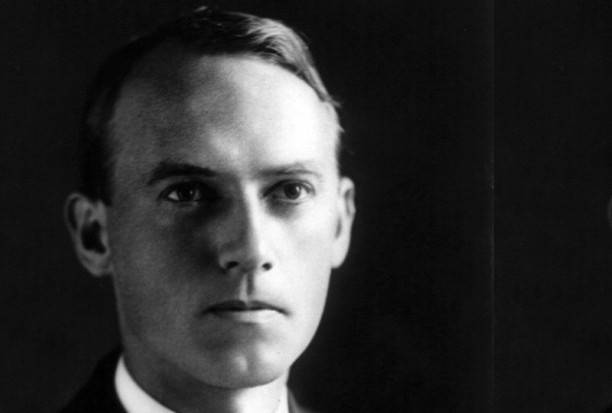
Scott Nearing on the consequences of a ruling class not fit to rule; the cataclysm of World War One.
“The Blind Leading the Blind” by Scott Nearing from Revolutionary Age. Vol. 1 No. 11. December 28, 1918.
OUR leaders have failed us.
The educated, trained, responsible men and women whose duty it was to show the way to their fellows, lost the way themselves. They were blind guides. When the great test came they proved by their own actions that as shepherds of the flock they were unworthy of trust.
Our leaders did not tell us the truth. Their mouths were full of words and phrases, but the words and phrases were lies.
They told us that we should let well enough alone. Things were not so bad. A little patience and they would improve-and they were to do the improving by sharing profits, building shower baths in the basement; “regulating” railroad rates, contributing to the Children’s Aid Society, and praying to God on Sunday. “We have things well in hand,” they said. “Follow us. We know!”
They told us that the system of society under which we live could endure, with its monstrosities of poverty, prostitution, child labor, unemployment and monotonous, endless, grinding toil. It was possible, they said, to continue a scheme that enabled the few who were booted and spurred to ride the many, who were saddled and bridled-gouging us for our coal and wheat; robbing us for the rent and plundering us for the dividends on watered stocks. Such a society, they insisted, would hold together–even if the hand of every man was raised against his neighbor.
While we plundered and enslaved the weaker peoples, “backward” races; while we raided those too weak to resist our assaults; while we spread desolation and terror over the face of the earth, in order to pay a profit of six per cent. or better on the investments of our ill-gotten gains–while we slapped Justice and Brotherhood in the face, they continually told us that God was on our side.
Can it be possible that they did not understand that civilization is built upon the united action of men? Did they deceive themselves so completely as to imagine that a system of society would last which “shelters the noble and crushes the poor”? Could they not see the whirlwind of human sighs and groans and the torrent of human tears that the ferocious system of exploitation and cut-throat living was gathering about them? No! Their education, their experience, their daily surroundings had blinded them to the realities of life. Living in a fool’s paradise of imaginary safety they twittered their song of contentment—as ignorant as the blind earth-worm of the coming storm. They even went so far as to tell us that we could keep peace among the nations of the world by building battleships–if we only built enough of them. “Preparedness,” said they, “will prevent war.” Every great nation of the West, acting upon this advice, bled itself, year after year, of its hundreds of millions of dollars to equip an army and construct a navy, to devise engines of death, and to mobilize its resources for conflict. Europe was for forty years an armed camp, with the common people sweating blood to pay the bills, and then–then the storm broke. This war was war. It was no child’s play, no flash in the pan; no game among amateurs–but a struggle among battle hosts that had been preparing for near a century. The preparedness of Europe brought on a war more fearful than any of which history bears record.
Then the shepherds betrayed their flocks.
All through the years the bitter years of exploitation and outrage–they had preached brotherhood and talked democracy. God was the father of us all and we, as brethren, must dwell together in peace upon the earth. They told us to love one another and overcome evil with good. They commanded us to do to others as we would have others do to us.
The preachers, teachers, editors and lawyers do not know about economic determinism. They did not understand that when convictions are placed on one side of the balance, and income, social position, a reputation for “respectability” are placed on the other, the great majority of men and women will forget conviction and stick to income. These many years they had taken their living from the hands of the plutocracy–the wealth power of the United States. When the great hour came, the plutocracy gave the well-known call and they responded.
They were blind–these leaders of ours. They did not understand life. They mixed up the true and false, unable to tell them apart. They played a game for the plutocrats–leading us to a precipice and then standing aside to watch, with horror and anguish, while even their own children were carried over the brink. We trusted them to lead us. They did not understand. They were blind, “and the blind lead the blind both shall fall into the ditch.”
The Revolutionary Age (not to be confused with the 1930s Lovestone group paper of the same name) was a weekly first for the Socialist Party’s Boston Local begun in November, 1918. Under the editorship of early US Communist Louis C. Fraina, and writers like Scott Nearing and John Reed, the paper became the national organ of the SP’s Left Wing Section, embracing the Bolshevik Revolution and a new International. In June 1919, the paper moved to New York City and became the most important publication of the developing communist movement. In August, 1919, it changed its name to ‘The Communist’ (one of a dozen or more so-named papers at the time) as a paper of the newly formed Communist Party of America and ran until 1921.
PDF of full issue: https://www.marxists.org/history/usa/pubs/revolutionaryage/v1n11-dec-28-1918.pdf#page=6
 Revolution's Newsstand