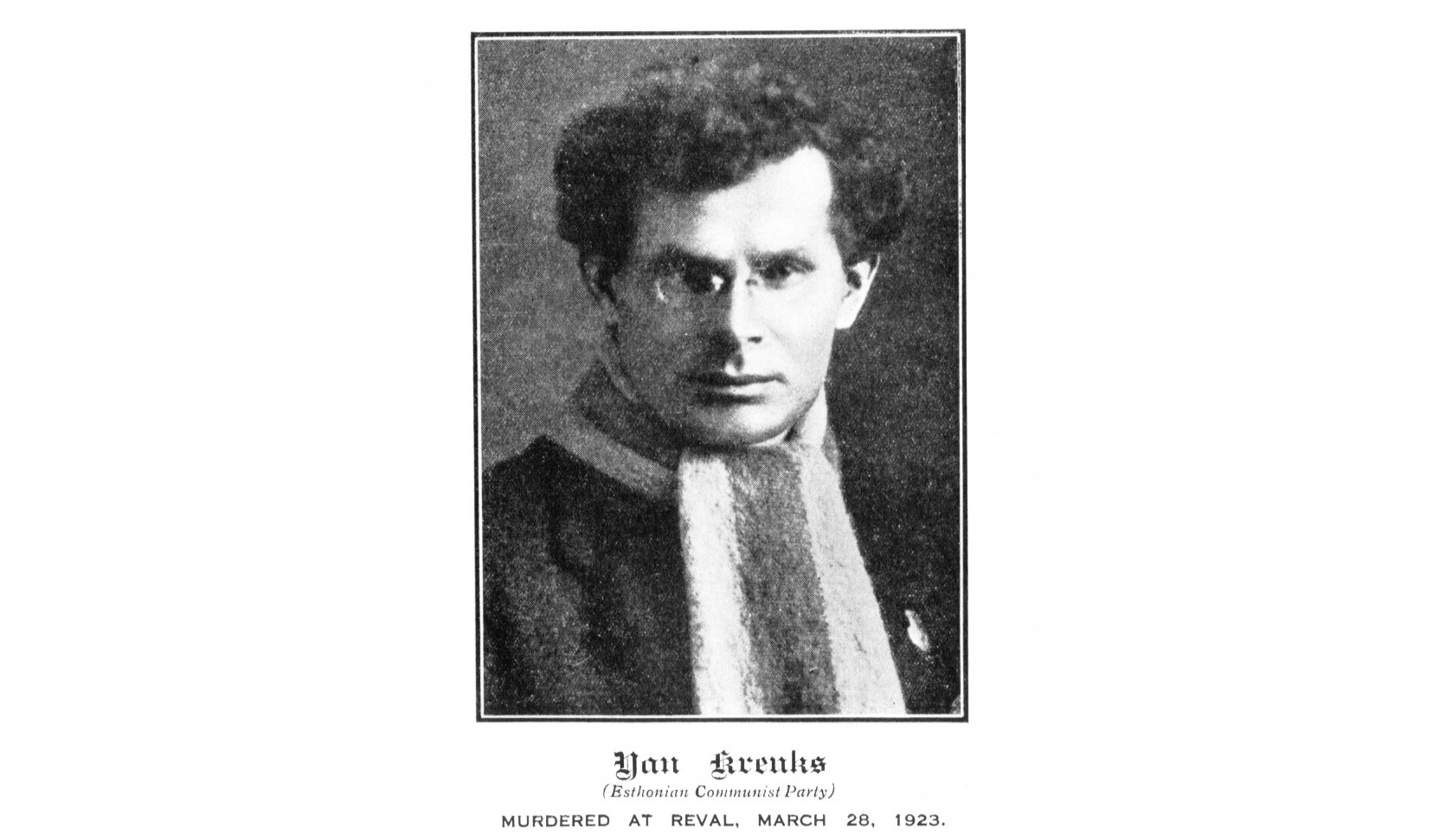
Tributes paid by the Chair of the Comintern to leading Estonia Communist Yan Kreuks, murdered by reactionaries on the streets of Reval, March 28, 1923.
‘Comrade Yan Kreuks’ by Grigory Zinoviev from Communist International. Vol. 1 No. 25. Summer, 1923.
On March 28, 1923, in a street in Reval, a hired assassin laid low our comrade Yan Kreuks, a prominent leader of the Esthonian workers, an underground worker and member of the Central Committee of the Communist Party and of the Central Committee of the Young Communist League of Esthonia.
The bourgeoisie of the “potato Republic,” knowing with what enthusiasm the Reval labour organisations accepted the candidature of Comrade Kreuks for the forthcoming elections on the United Front ticket, and fearing the presence of this trustworthy and energetic leader of the workers in Parliament, did not hesitate to resort to base assassination in order to remove one of the best champions of the liberties of the working class from their path. Comrade Kreuks was murdered without even the preliminary “hands up” by two shots from a revolver, one which entered his back and the other shot into his eye when he was already laying senseless on the ground,
Comrade Kreuks was born in Esthonia in 1892. His father was an agricultural labourer on the Alaviena Estate, so that from his earliest childhood he experienced all the charms of a labourer’s life in the smoky and gloomy hut of his parents, who were compelled to slave for the idlers rolling in luxury on the estate. At ten years of age he went to live in the town with his parents, and was sent to school, but it is not as easy for a labourer’s child to attend school as the sons of the bourgeoisie, for he had to help to maintain the family by selling newspapers in the streets after lessons. On leaving school he was apprenticed to a fitter, but, unable to tolerate the cruelty of his master, he left him and signed on a merchant ship as a seaman.
After staying abroad for some time and experiencing the life of a worker at sea, he returned to Reval and worked for some time as a brick-stove maker, and in 1911 went to Petersburg. Here he met some comrades, who acquainted him with the fundamental tasks of the organised struggle of the workers. Not lagging behind the Petersburg comrades, he closely followed the progress of the struggle against Czarism, took part in strikes and demonstrations, and felt the lash of the knout on his own back. After a time he returned to Reval, where he obtained employment as a smith’s hammerman. There he aroused the interest of his fellow workers by his stories of the lives and struggles of the Petersburg workers. Meanwhile, he did not neglect his education, and supplemented his knowledge at evening schools.
On the outbreak of the world war he was mobilised and sent to the Austrian front, where he served first as a male nurse and later as a writer at the staff. There he remained until the outbreak of the Revolution, when he hastened to Esthonia, joined the Bolshevik Party and devoted himself to revolutionary work, mainly the organisation of the Red Army.
In 1918 the occupation of Esthonia by the Germans made it necessary for all party and Soviet institutions to evacuate to Soviet Russia. Comrade Kreuks also came to Russia, but did not stay long. At the beginning of 1919 he returned to Esthonia and secured a job at the Reval Railway Depot as a labourer, in order to be able to conduct propaganda work among the railwaymen and to expose the predatory bourgeoisie who at that time, with the aid of the Mensheviks, were pacifying the Esthonian workers by promises of liberty and “the independence” of Esthonia. His ability and energy as an agitator soon made itself felt, and before six months had passed, the Mensheviks, who at that time possessed enormous influence on the workers in the Depot, were defeated during the elections of delegates to the First Esthonian Trade Union Congress, and Comrade Kreuks was elected as a delegate. At the Congress Comrade Kreuks was elected to the Central Council, which, however, was fated never to meet. Twenty-six of the members of this Council were murdered by the order of the Menshevik Minister for the Interior, Gallat, during their deportation to Russia. By sheer good fortune Comrade Kreuks escaped this fate and continued his activities in the Depot. Soon after the Trade Union Congress, a general railway strike broke out and Comrade Kreuks, as the initiator of the strike, was compelled to go underground in order to escape from the persecution of the military secret police.
At the First Congress of the Communist Party of Esthonia, held secretly in 1920, he was elected a member of the Central Committee and remained such until his death.
Comrade Kreuks was not a prominent theoretician. Nevertheless, from the very first moment he was an indispensable secret worker. Being himself a worker by origin and only just torn away from legal activity, he was able to judge every step in the class struggle from the point of view of practical application. As an organiser he served as an example to his comrades. Nearly all the nuclei and groups in the factories and large works were formed with his direct participation, and there was hardly a meeting of the Reval Committee or any of its sections at which he did not take a most active part.
Comrade Kreuks will live in our memory also as a leader of the Young Communist League in Esthonia, on the organisation of which he exerted all his efforts. In 1921, when the “democracy” strove to struggle the developing movement of the revolutionary youth, smashed up their legal organisations in Esthonia, Comrade Kreuks came to their aid and organised the first underground Young Communist nuclei, around which the membership increased all over the country. He did not neglect a single meeting, in spite of snowstorms, almost impassable mud or deluging rains, according to the season of the year, and by his energy and devotion, inspired all those who came in contact with him. It was under his leadership that the First underground Congress of the Young Communist League was convened.
At the end of last year the party delegated him to the Fourth Congress of the Comintern, and the Young Communist League delegated him to the Third Congress of the Young Communist International. Having fulfilled his mission, he, at the beginning of this year, returned to his difficult and dangerous work. Comrades urged him to rest awhile, but this untiring worker replied that the time had not yet come for resting, and that his duty called him to where he felt he was wanted—to underground Esthonia.
The death of Comrade Kreuks is a heavy blow to the Communist Party, to the Young Communist League, and the whole of the Labour Movement in Esthonia. Our loss is all the greater for the fact that Comrade Kreuks, being a worker, thoroughly understood the psychology of the working class, and being young and energetic, he might still have completed his theoretical knowledge and become a powerful revolutionary leader.
The bourgeoisie of this Lilliputian country, with a government like that of the Inquisition, fearing to arrest this active worker, who was known and respected by every Reval working man, basely assassinated him, and with the cowardice of a highway robber, fearing him even when he was mortally wounded, finished him off as an inexperienced butcher finishes off his victim. These poltroons violated not only generally accepted laws of humanity, but even their newly promulgated Czarist laws.
Comrade Kreuks is dead, but his memory will live with the Esthonian workers forever.
The sacred gospel of revolutionary struggle for which in one year two of the best of the leaders of the Esthonian workers, Commie Victor Kingissep and Yan Kreuks, will be carried out by workers of all countries, and this will be our vengeance for their death.
The ECCI published the magazine ‘Communist International’ edited by Zinoviev and Karl Radek from 1919 until 1926 irregularly in German, French, Russian, and English. Restarting in 1927 until 1934. Unlike, Inprecorr, CI contained long-form articles by the leading figures of the International as well as proceedings, statements, and notices of the Comintern. No complete run of Communist International is available in English. Both were largely published outside of Soviet territory, with Communist International printed in London, to facilitate distribution and both were major contributors to the Communist press in the U.S. Communist International and Inprecorr are an invaluable English-language source on the history of the Communist International and its sections.
PDF of full issue: https://www.marxists.org/history/international/comintern/ci/old_series/v01-n25-1923-CI-grn-riaz.pdf
 Revolution's Newsstand