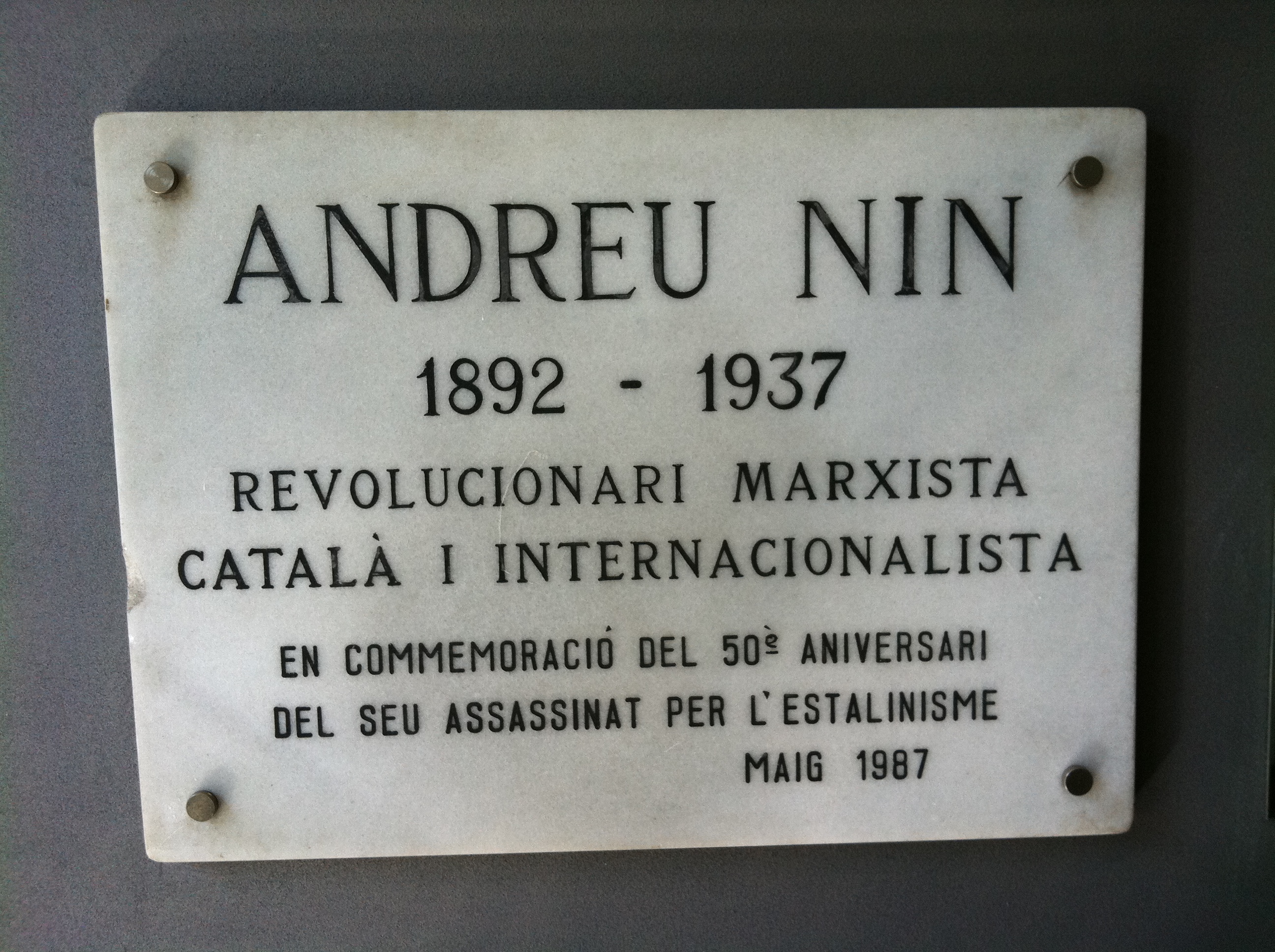
As the official Communist Party begins maligning the P.O.U.M. and C.N.T. as “agents of Fascism,” Serge warns that the Moscow Trials are coming to Spain.
‘Intrigue in Spain’ by Victor Serge from International Review. Vol. 2 No. 1. January, 1937.
From “Révolution Prolétarienne,” Paris
I.
WITH EACH resounding new crime committed by the gangs ruling the totalitarian States, the human feeling of our time falls a little lower and the crime that follows is rendered easier. Sixteen are shot in Moscow. What chance is there to save Edgar Andre’s life? The axe of the Nazi executioner swoops down. What is the worth now of the lives of the surviving October combatants inside the Stalinist prisons?
At the end of November, at the very moment when the Cahiers des Droits de’ Homme in Paris published the strange report by Mr. Rosenmark who finds that the assassination of Lenin’s companions had been perpetrated under sufficiently legal forms, there took place the horrifying Novosibirsk trial, at which the untruth of the confessions was displayed with such impudence that the reader of the newspaper rubbed his eyes unbelievingly. This crime is full of such cynicism; we must go back far in history to find its like. Nine poor devils, one of them a German, engineers and technicians at a mine where occurred a catastrophe costing the lives of 14 workers (Serge errs in one detail; we learn that Stickling was not employed at the mine in question but was thrown into the bargain because there was the need of a German “spy” in the case. Ed.), appear before the court and sign to the most unbelievable confessions. The German Stickling confesses to be an agent of the Gestapo. The engineers declare that they have provoked the catastrophe under the instruction of Trotskyites in order to annoy “our great People’s Commissar Ordjonikidze” and prepare the victory of fascism in the U.S.S.R. This is at the same time infamous and idiotic. In the course of the discussion, one of the accused declared that he was present in 1927—in nineteen twenty-seven—at a meeting where Trotsky sealed his alliance with the Nazis. Reading this, I asked myself if I saw right. Naturally, there was not a single Trotskyite among the accused. There were only some poor tortured, terrorized, helpless individuals who have lost all shame and all reason, caught between the certainty of being shot if they resisted and the feeble hope of escaping death at any price.
Occasionally there is heard from behind the stage the name of Muralov, a left oppositional communist after 1927—a real one this time—who took Moscow in February in 1917 and took it again in October 1917, an intrepid soldier of two revolutions. He is lost now. Piatakov, a capitulator of capitulators, who left us in 1928 to become a devout servant of Stalinism—he too is lost, unbelievable though it reads. I have asked friends of mine who knew him well why Piatakov went, and we found only two explanations: “No witnesses,” and “Piatakov used to drink.” He must have said, imprudently, something he, in spite of everything, carried on his chest.
The nine accused were quite naturally sentenced to die. The German was pardoned and thus saved the lives of two Russians. There were only six executions.
More trials are being prepared.
Something else is being prepared.
II.
Let us disclose the sore. Why keep silent?…Here are the facts. There is in Spain a large worker party of Communist oppositionists, that is, a party that takes an open hostile stand against the Stalinist conception of the totalitarian State and the bureaucratic system. It is the Workers’ Party of Marxist Unification, the P.O.U.M.
One of its founders, Joaquin Maurin, was shot by the rebels. The chief of its first motorized column, Echebehere, a real proletarian hero, was killed at Madrid some weeks ago…There were also Germinal Vidal, José Oliver, Pedro Villarosa. The dead of this party are many.
At the time of the formation of the defense junta of Madrid, the only committee that remained in Madrid was the committee of the P.O.U.M. And though the influence of this party is at least equal to the Stalinist party, it found itself excluded from the defense junta. The socialist, syndicalist and anarchist militants wanted to collaborate with the P.O.U.M. and said so to our friends Andrade and Gorkin. The anarchist minister Juan Lopez (C.N.T.) had an interview on this subject with the P.O.U.M. delegates, which was published in the Valencia press.
We learn from this interview that it was at the pressure and ultimatum of the Stalinist party and of the U.S.S.R. legation at Madrid that the P.O.U.M. was excluded from the defense junta. The Batalla of the 27th of November, commenting on this unheard of thing, writes (surely with great moderation):
“It is intolerable that for the price of a little aid, certain people try to impose on us predetermined political limitations, pronounce vetoes, and claim the privilege of guiding Spanish political life.”
We have here an explanation of other aggressions committed against Spanish revolutionaries. The pogrom perpetrated on the offices of Communist Youth of Madrid by a Stalinist band (during the siege) and the banning of the organ of the P.O.U.M. from Madrid, the first attack on the liberty of opinion in the revolutionary democracy.
The Batalla adds that “the Soviet consulate of Barcelona directs a campaign of insults and calumny against us.”
A campaign of threats also. The Stalinists of Spain already permit themselves to speak of “showing their iron hand” (sic). We shall see. Let us however take note of the style and tone.
On the 28th of November, the Soviet consulate at Barcelona communicated to the press a malicious note accusing officially the P.O.U.M. press of “being sold to international fascism.” The organ of the Stalinist party of Barcelona (the P.S.U.C.) Treball denounced categorically the comrades of the P.O.U.M. as the “agents of Franco-Hitler-Mussolini” and adds daily that they are, moreover, Trotskyists, and consequently agents of the Gestapo, “as has been proved at the Moscow trial.” Notice how all this infamy is related and how far it travels.
It is in order to strangle more efficiently the revolutionaries of Spain that the old revolutionaries of Russia were assassinated.
It goes without saying that the Soviet influence over the petty-bourgeois press of Catalonia is quite real. Many of their politicians wish to be able to rid themselves one day of the most intransigent revolutionary proletarians. The Humanidad takes up this calumny.
The Batalla replied on the 29th, in an extremely moderate note, reminding of its dead, its loyalty to the communism of the heroic years and its defence of the U.S.S.R. at a time when most of its praisers of today were maligning it.
Then there took place a curious and quite secret act, which seemed especially curious because the P.O.U.M. participated in the government of the Generalita of Catalonia, in which my old comrade Nin took charge of the Ministry of Justice. The censorship intervened to stop the publication of the P.O.U.M. note by other newspapers.
At the same time came the information that dark intrigues were plotted to eliminate the P.O.U.M. from the government of the Generalita.
If the Stalinists were successful (the comrades of the C.N.T. and the F.A.I. must have permitted themselves to be tricked—and they will pay for it dearly in time), the following stages of the operations could be foreseen: the Soviet consulate will try to obtain the prohibition of the Batalla, that is impose the gag on the Catalonian labor movement, and in order to get a hold on the movement, they will finish up by staging against the Spanish revolutionaries, in imitation of the court comedies of Moscow and Novosibirsk, “plots with Hitler-Franco-Mussolini.”
By maligning their political opponents as “agents of international fascism,” before a people that often does not know what it is all about because it is too busy fighting for its life and its homes—the official representatives of the U.S.S.R. and the Stalinists in Spain are committing a crime against a common cause and are preparing other crimes. This kind of calumny is a poisoned weapon that cannot be used with impunity. In the intrenched camp of the Spanish revolution, the agents of fascism should be shot, or at least rendered powerless to do any harm. The revolutionaries at whom these people attempt to throw mud in the face and who feel that a trap is being prepared for them, should not hesitate to show up their calumniators. The comrades of the P.O.U.M have given enough proof of strength and coolness to deserve our confidence. Let international labor opinion support them in all vigilance.
International Review was a short-lived, independent Marxist journal edited by Herman Gerson, pen name Integer, which hosted writers of the anti-Stalinist left, best known for its translation and publication of Rosa Luxemburg’s ‘Reform or Revolution’.
PDF of full issue: https://archive.org/download/international-review-1936_1937-01_2_1/international-review-1936_1937-01_2_1.pdf
 Revolution's Newsstand