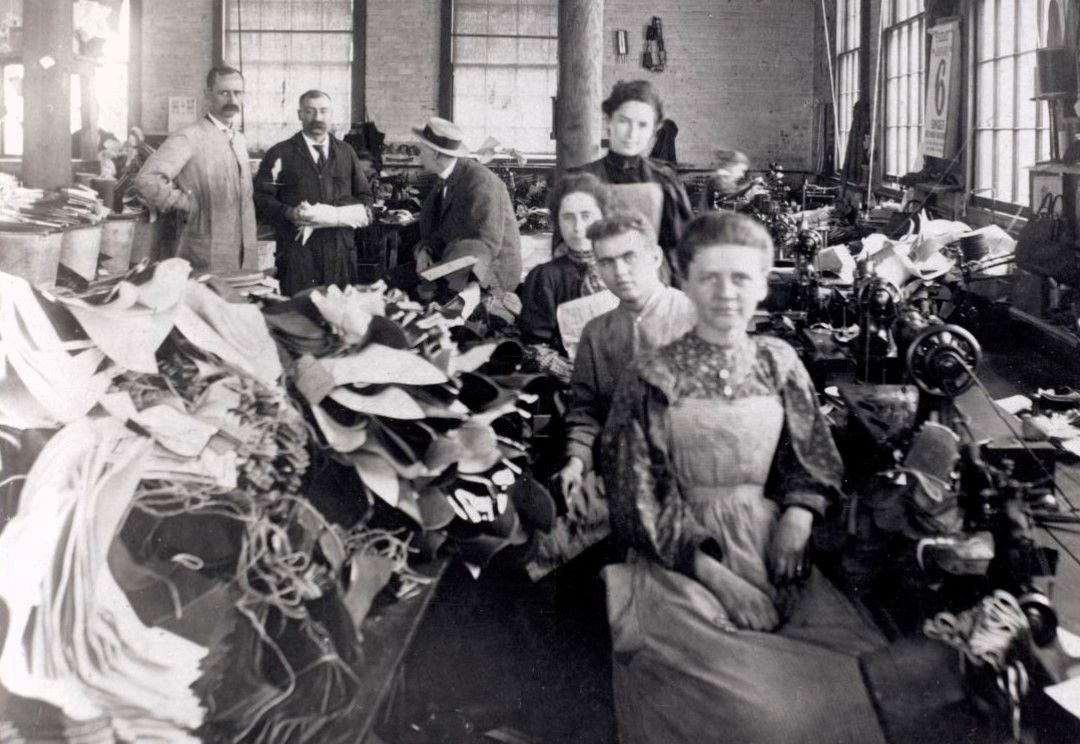
Centered in New England, over 250,000 people were employed in the shoe-making industry in the early 1900s. Brockton, Massachusetts being, perhaps, the town most associated with the manufacture. Here, a strike against the bosses AND the A.F.L.’s Boot and Shoe Workers’ Union.
‘Brockton Shoe Workers Revolt’ from Industrial Pioneer. Vol. 1 No. 4. August, 1923.
BROCKTON, Mass., is the scene of a revolt of 20,000 shoe workers. The factories are shut down. A strike is on against the Boot and Shoe Workers’ Union, affiliated with the American Federation of Labor, and with offices in Boston. Behind this union stands the bosses’ association. There have been repeated revolts against this organization, throughout the shoe industry of the country. Many other shoe centers have known bitter conflicts and cessation of operations due to the same causes before this. The Brooklyn 1911 strike of 10,000 workers, under I.W.W. leadership, was also a revolt against the Boot and Shoe Workers’ Union. The employers’ association boasted that it raised a $1,000,000 fund to beat that strike. There have been many other strikes since then, against the same union and against the same kind of backing.
Well Done, Shoe Workers!
The reason for this repeated occurrence speaks well for the shoe workers. It proves conclusively that they will not be submissive slaves and that the spirit of revolt within them never dies. They know from actual experience that the Boot and Shoe Workers’ Union is not a labor organization, but an auxiliary of the boot and shoe employers’ association. It is a strikebreaking, scab-herding agency for the latter, that’s all. This has been shown in every shoe center where it has been resisted by the workers and supported by the boot and shoe employers’ associations.
The officials of the Boot and Shoe Workers’ Union do not care at all about the working conditions, wages or hours. In return for the use of the union stamp and the members forced into their organization by the agreement made with employers, they unionize plants at the prevailing conditions and bind all the workers therein to arbitration of all differences that may arise. In the event of a strike or other disputes they undertake to furnish strikebreakers: and scabs to fill the places of all who go out. The employers, finding this arrangement to their advantage, collect dues and influence the election of officials favorable to their interests. They have been known to express their preference for certain candidates, through press statements and other ways more direct. They actually run “the union.” As already shown, they have been known to raise enormous strikebreaking funds through their various associations in order to keep the A. F. of L. Boot and Shoe Workers’ Union on the backs of a working class that refuses to be bled by it. These strikes have been known to last many months. The boot and shoe workers have always, be it said to their credit, fought this labor leech to the limit, at a great expense and cost to the employers’ association. They have thus prevented its more extensive growth.
Form Own Union
The Brockton District Shoe. Workers’ Union has been formed by the revolters. This is an independent union. I.W.W. speakers from Boston have addressed the strike meetings and been well received. The message of class-conscious industrial unionism has made a good impression. One of their bulletins, telling the story of the revolt, reads as follows:
To Our Fellow Workers:
We are representing 20,000 striking shoe workers in the Brockton, Mass., District, and this strike directly or indirectly affects 200,000 people.
This district, until the time of the strike one month ago, was completely in the control of the Boot and Shoe Workers’ Union, a strictly non-strike organization which compelled us to submit all differences to the State Board of Conciliation and Arbitration.
This board consists of three members appointed by the governor, the make up of which follows:
Chairman Fisher—Lawyer, and Ex-Senator (politically dead). Mr. Wasgat—Ex-Shoe Manufacturer. Labor Representative Samuel Ross—Retired Organizer of the Textile Workers; a feeble old man 73 years old, whose physical condition (because of advanced age) prevents him from having any weight or influence with the other members of the State Board.
At the last Convention of the Massachusetts State Branch of the A. F. of L., held at Springfield, Mass., action was taken, requesting Gov. Cox to remove Mr. Ross, the present labor representative of the State Board, but in spite of that fact at the expiration of his term, he was reappointed for three years.
The contract which compels us to submit all matters and contentions relating to conditions of labor and wage is made with the manufacturers with but one stipulation: that every employe, shall be a member of the Boot and Shoe Workers’ Union; adjustments of conditions, labor, or wages, are not taken into consideration at time of granting use of a union label stamp.
After Chairman Fisher of the Massachusetts State Board had given to the press of Boston the statement to the effect that New England was due for 10 percent reduction in wages, the manufacturers of Brockton in 1921, taking advantage of that clause in their contract made application to the State Board for a 20 percent reduction in wages.
The result of that request was that the State Board handed down a 10 percent reduction, in blanket form covering the entire industry in the Brockton District, admitting that inequalities existed and stating that “adjustments would follow in a reasonable time.” Bearing that in mind several locals applied for readjustments of inequalities.
After a series of decisions, with practically no change, the last decision affecting one of the poorly paid locals, (the Dressers and Packers) composed mostly of girls and women whose wage was $17.50 a week, and whose minimum wage was $11.00, a 20 percent raise was requested, and they received an increase granting them 85 cents a week raise.
At a mass meeting called to consider the award, the girls became incensed at the small amount granted them, and a little girl stood up and made a motion to strike, which was immediately seconded by unanimous acclamation of the entire membership of 900.
The General Office of the Boot and Shoe Workers’ Union revoked the Dressers and Packers Charter the following day.
Within a week, mass meetings of all locals were called and twelve of the thirteen locals voted to strike, because of the absolute conviction that justice could be had in no other way.
The result in the revoking of the Charters of four more locals, before the General Office called a halt, realizing that revoking of Charters could no longer scare us into submission.
We were in poor shape financially, because the Boot and Shoe Workers’ Union Constitution made us turn over two-thirds of all dues, and the remaining third barely covered the administration expenses of the locals.
As individual members, we were in exactly the same position, because of the fact that the previous nine months were the dullest period in ten years, along with the semi-annual spring stock raising period, which left every one in very poor financial condition to start a strike.
We have formed our own union, namely THE BROCKTON DISTRICT SHOE WORKERS UNION, a real solid progressive union, and are presenting the following demands:
1. Recognition of our Union.
2. Restoration of the old wage list.
3. We demand a quicker and more just adjudication of disputes, through a local board of arbitration.
4. We reserve the right to strike.
The manufacturers maintain they will never reopen until we consent to become members of the Boot and Shoe Workers’ Union, their organization.
The workers stand firm for their right to maintain their own organization, but must begin at the bottom with no treasury whatever. All the powers of the old organization, combined with that of the manufacturers and their money power, are arrayed against us.
Our lines are firmly established and we are done for all time with the old organization.
Thanking you for whatever you can do to help us; we remain yours fraternally,
Brockton District Shoe Workers’ Union, Eagle Hall, Ward Street, Brockton, Mass.
The Industrial Pioneer was published monthly by Industrial Workers of the World’s General Executive Board in Chicago from 1921 to 1926 taking over from One Big Union Monthly when its editor, John Sandgren, was replaced for his anti-Communism, alienating the non-Communist majority of IWW. The Industrial Pioneer declined after the 1924 split in the IWW, in part over centralization and adherence to the Red International of Labour Unions (RILU) and ceased in 1926.
PDF of full issue: https://www.marxists.org/history/usa/pubs/industrial-pioneer/Industrial%20Pioneer%20(August%201923).pdf
 Revolution's Newsstand