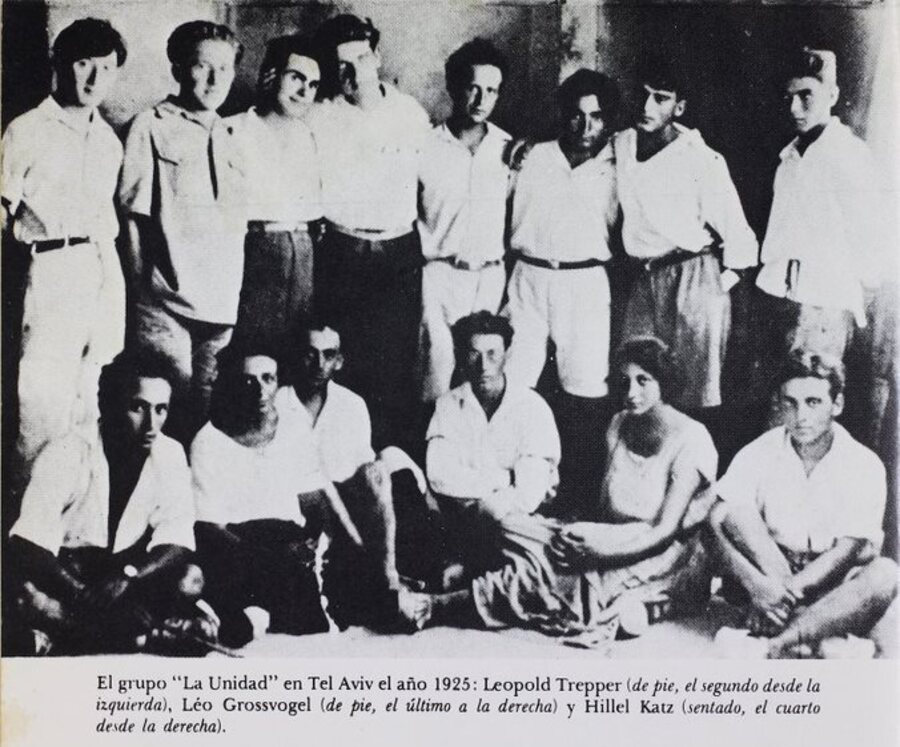
The mid-1920s saw a deep economic crisis in Palestine, which soon created a political crisis. As profound unemployment meant thousands of Jews leaving Palestine, the Zionist project felt threatened at its base, and Arab peasant reaction to ten years of dispossession with the connivance of Arab landlords under Balfour, was setting the stage for 1929’s revolt. For the Zionists, the Arab ruling class, and most of all, British Imperialism, it was the Communists, still mostly Jewish, not their policies, that were responsible for the discontent, and the hammer came down. Illegality for the Party, censorship, prison, torture, and deportation followed.
‘Intensified Reaction in Palestine’ by Joseph Berger from International Press Correspondence. Vol. 8 No. 1. January 5, 1928.
All the hopes entertained by the Zionist Labour Party of Palestine of an alleviation of the catastrophic unemployment of August, 1927, have proved to be vain. The Zionist Congress of August, of which money and remedy were expected, did nothing but establish the utter bankruptcy of the Zionist plans and cause the formation of a new Executive which is practically saddled with the liquidation of the former Zionist concerns, or, at least, with their “rationalisation” and “restoration”. The only solution found for unemployment by this new executive was: Suspension of the unemployment support in order to speed up the emigration of the unemployed. It was only after a mass demonstration of the workers that the further payment of the minimal unemployment support, at least for the time being, could be secured. But unemployment is not decreasing; on the contrary, it is increasing, for a portion of the public utility work which was begun in summer has already come to an end.
The unemployment gives the employers the possibility of making working conditions worse and worse. In the municipal enterprises and workshops, as also in the plantation colonies, labour is now cheaper than ever, while working hours are longer and exploitation is increasing.
This deterioration of the working class is naturally accompanied, apart from the fact that it feeds the steadily swelling stream of emigration from Palestine, by a growth of revolutionary feeling among the workers. The utter vanity of the hopes they based on Zionist help is becoming clear to the workers (it is further illustrated by the cynical attitude of the rich Zionist colonists in the country itself, who exploit the unemployment in order to extort greater profits out of the workers and who do nothing to alleviate unemployment). They are coming to understand how utopian it is to believe British promises, how criminal were the tactics of their leaders, who placed them under the British-Zionist yoke and how necessary it finally is to take up an oppositional attitude towards British imperialism. At the same time, a growth of class-consciousness among the Arab workers is also observable; workers’ unions have been formed in Jaffa, Jerusalem and Haifa; strike movements of Arab workers are breaking out on account of excessive exploitation (Nazareth); every encroachment on the part of the employers meets with protest and resistance.
The growth of these feelings appears so menacing to the British Government that it is exerting all its power to stifle the revolutionary labour movement. The reactionary course of the British Government in Palestine is directed principally against the vanguard of the revolutionary labour movement, the Communists. The British police have orders to “settle” the Communists radically and finally, and they are saving neither trouble nor money in carrying out their instructions.
In the course of the last two months, no fewer than nine clubs suspected of Communism have been either closed or prohibited. Among these were the clubs of the “Unity” movement, which was working for trade-union unity nationally and internationally, and has made considerable progress in this direction. Arrests and house searching are an everyday fighting method against Communists, whether they are juridically justified or only arbitrary acts.
The Courts support the work of the police by passing the severest sentences upon the Communists who appear before them. In this regard, an important role is played by the tendency to sentence Communists to deportation. They are then handed over defenceless to the police, who may do with them what they think fit. Not only the adherents of the Communist Party and of the Young Communist League but also the members of the non-party organisations, such as “Labour Fraction” (trade-union opposition) and “Red Aid” are being prosecuted most rigorously.
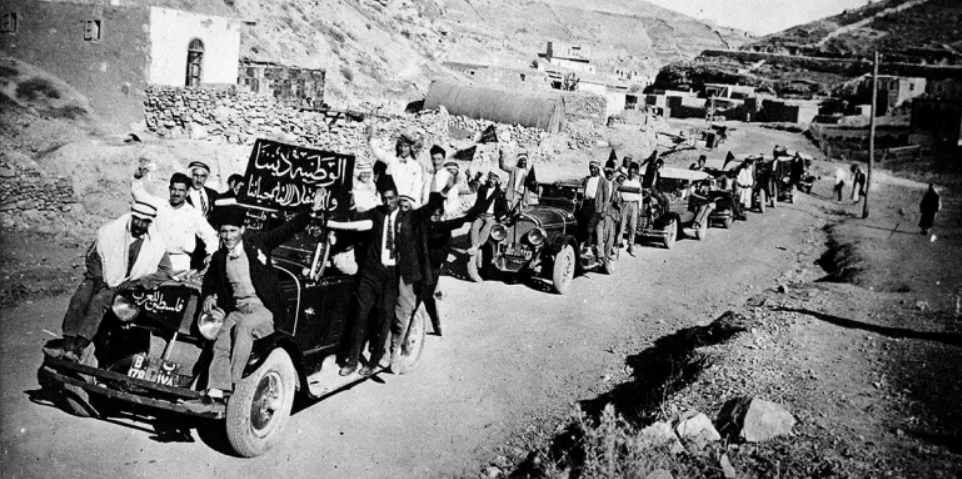
In addition, freedom of speech has been completely abolished. Brochures containing revolutionary ideas are confiscated, although there is no official preliminary censorship. The importation of Communist newspapers is strictly prohibited (recently the “Pravda” and the “Isvestija” have been forbidden). The Palestine Government is doing its best to rival countries of Fascist Terror in the matter of Communist persecutions.
The Zionist bourgeoisie (as also the Arabian reactionary elements who have recently advocated a policy of compromise with the British mandatory government) welcome the policy of reprisal against the Communists and are in favour of still more severe persecutions. The reformists of all shades, although at the last conference of the “Histadruth” they adopted a formal protest against the reactionary persecutions, prefer to devote their columns to the protection of persecuted counter- revolutionaries in the Soviet Union. It is characteristic that the chief newspaper of the “Histadruth”, the “Davar”, most willingly accepts communications from the police, while, on the other hand, it systematically boycotts information from “Red Aid”.
The workers themselves, however, react in a different manner to the intensified reaction: a number of actions have recently given expression to the enhanced sympathy for Communism and for the Soviet Union. The dispatch of a workers’ delegation to the celebration of the tenth anniversary of the Soviet Union deserves special mention. In spite of the lively opposition of the reformists, thousands of Jewish and Arab workers participated in the election of the delegation. November 7th was marked by imposing celebrations or demonstrations in all the towns throughout the country. The revolutionary organisations are growing in number and significance, even though they are illegal. All this goes to prove that the British Government will not find the fight against the revolutionary movement in the country an easy one.
International Press Correspondence, widely known as”Inprecorr” was published by the Executive Committee of the Communist International (ECCI) regularly in German and English, occasionally in many other languages, beginning in 1921 and lasting in English until 1938. Inprecorr’s role was to supply translated articles to the English-speaking press of the International from the Comintern’s different sections, as well as news and statements from the ECCI. Many ‘Daily Worker’ and ‘Communist’ articles originated in Inprecorr, and it also published articles by American comrades for use in other countries. It was published at least weekly, and often thrice weekly. Inprecorr is an invaluable English-language source on the history of the Communist International and its sections.
PDF of full issue: https://www.marxists.org/history/international/comintern/inprecor/1928/v08n01-jan-05-1928-Inprecor-op.pdf
 Revolution's Newsstand