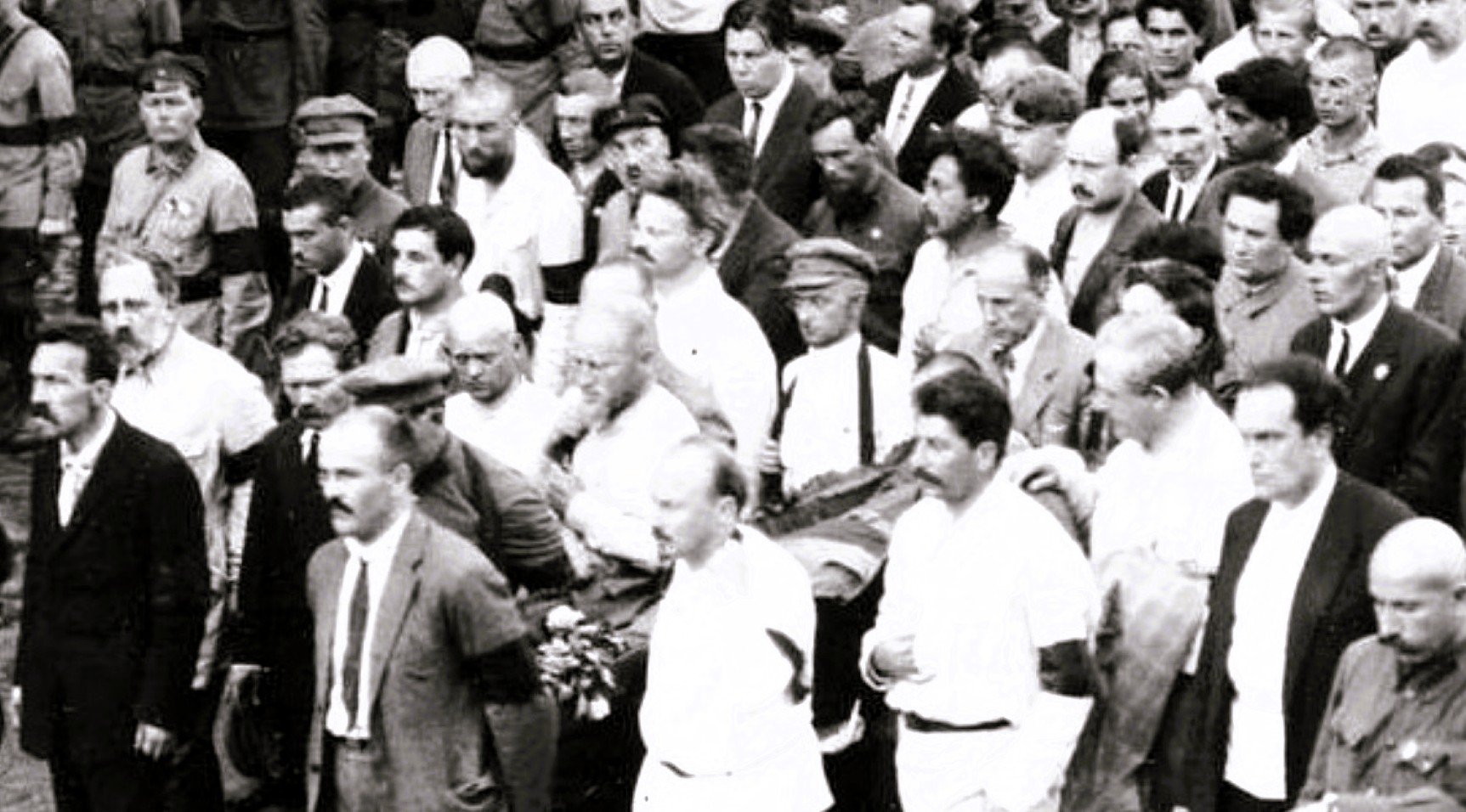
Full text of the United Opposition counter-theses to the 15th Congress of the Communist Party of the Soviet Union held in late 1927 that initiated the first Five Year Plan. In the aftermath of the United Oppositions’ public demonstrations on the tenth anniversary of Revolution in November, 1927, the Central Committee convened an extraordinary session to expel Trotsky and Zinoviev from the Politburo and the Party before December’s coming Congress. The Opposition, and this document, would have Kamanev and Rakovsky as its main, isolated, representatives to the Congress. While under the New Economic Policy, a multi-faceted debate on implementing industrialization had been going on in the Party. Very broadly speaking, two tendencies had developed on how to proceed. One, the so-called ‘genetic approach’ based the plan on existing trends within the largely peasant economy (Rykov, Bukharin, Bazarov, Kondratyev, and initially Stalin); another, the so-called ‘teleological approach’ sought to transform the existing economy through rapid industrialization (Kuibyshev, Strumilin Trotsky, and Krzhizhanovsky). The debate did not end with the defeat and expulsions of the the Opposition, but accelerated as 1927’s bad harvest created a crisis. Early 1928 saw Stalin dramatically switch course and support the ‘teleological’ transformation, and included seizure of crops and forced collectivization of agriculture. That policy in particular led to the split between Stalin and Bukharin and Rykov, who would be accused of ‘right deviationism’ and decisively lose power in the struggle that followed. Krzhizhanovsky’s co-report along with Rykov’s main report at the Congress should be read with this.
‘Counter-Theses of the Opposition on the Five Years’ Plan of National Economy’ from International Press Correspondence. Vol. 7 No. 70. December 12, 1927.
A Necessary Preliminary Remark.
Under normal conditions of Party development the theses and the various documents of the Party minority would be published before the discussion preceding the official opening of the Party Congress. And the discussion should precede all elections in the Party through which the choice of delegates to the Party Congress is determined or influenced. It need not be said that the discussion should take place under conditions securing for the members of the Party the opportunity of discussing the points in dispute from every aspect. Not one of these conditions has been observed in the smallest degree.
a) The elections to the nucleus bureaus, to the district conferences and to the Gouvernement conferences, have been and are being carried out before the discussion.
b) The coming Party Congress has thus been isolated in advance from the influence of the conflict of opinions within the Party. The discussion is condemned to futility. It can exercise no influence on the Party Congress. This means that the mass of the Party members plays not a legislative, but merely an advisory part.
c). Even this discussion is carried on under conditions aggravating to an unexampled degree the external forms of discussion (railing, whistling, breaking up of meetings, etc.), but at the same time reducing its positive (that is, educational) results to a minimum. This applies in every way to the question of the theses.
The theses of the C.C. were published on the 25th October of this year. We, the Leninist-Bolsheviki (the Opposition) were forbidden to oppose our platform to these theses of the C.C., and at the last joint Plenum of the C.C. and the C.C.C. permission was refused to us at least to publish, às counter-thesis, that part of our platform dealing with the questions dealt with in the theses of the C.C. The result is that the counter-theses of the Opposition do not appear until three weeks before the Party Congress, and until the sub-conferences of the Party have been proceeding for some time all over the country. In the remoter parts of the Union the counter-theses of the Opposition will not appear until the delegates have left for the Congress. This fact is the clearest and most characteristic expression of the purely bureaucratic method of preparation for the XV. Party Congress.
The chief questions of Socialist construction retain, however, their whole relevancy, independent of the methods employed in the preparation of the Party Congress. It has never yet occurred in history that an empty, organisatory mechanism has vanquished the correct political line. This breaks its way through all obstacles. Since we have been robbed, against all the statutes and traditions of our Party, of the possibility of preparing as the minority for the XV. Party Congress, or of influencing the choice of delegates and the eventual decisions, we turn with our theses to the public opinion of the Party, and appeal in particular to the proletarian core of the Party.
1. The Chief Sins of the Theses of the C.C.
Every communist worker expected from the theses of the C.C., in the question of the Five Years’ Plan of Economics, something very different from the purport of the theses presented by Comrades Rykov and Kshishanovsky.
Every communist asks himself anxiously: What about unemployment? Is no ray of light to be seen? What have the figures of the existing “Five Years’ Plan” to say on this subject, and what do the theses of the C.C. say to this Plan? The theses of the C.C. give no reply to these questions.
Every communist will put another and not less important question: What developments will result from the shortage of goods during the next few years? Even at the beginning of this year we were categorically assured by Comrades Mikoyan, Rykov, Bukharin, and others, in the course of a dispute with the Opposition, that the shortage of goods is rapidly diminishing. What have the workers and peasants to expect in this respect during the next few years? Will the shortage of goods be “overcome” only in the speeches of Comrades Mikoyan, Bukharin, etc., or will the supply of goods really begin to cover the demand? What have the three existing Five Years’ Plans of the State Planning Commission and the People’s Supreme Economic Council to say to this, and what have the theses of the C.C. to say to these Five Years’ Plans? Where will the shortage of goods lead in these five years? To this question, again, we find no answer in the theses and directions of the C.C. The same applies to a number of other vital questions, thus for instance, the question of the incontestably rising grain prices, of the difficulty in obtaining grain supplies, the restrictions on export, the endangered purchasing powers of the rouble, etc.
The theses of the C.C. refer to the necessity of “providing the working population to a greater extent with dwelling-houses”, but they do not state to what extent. The October subsidy of 50 million roubles for house-building is entirely insufficient in comparison with the shortage of dwelling-houses, and increases but very little the grants which would have been accorded in any case, even without the manifesto, in accordance with the general growth of economy.
The theses make general reference to the necessity of combating intemperance, but do not contain the shadow of a definite proposal to this end: Reduction of revenues from the sale of spirits in this and next year’s budgets, and a corresponding restriction on the programme of alcohol production. On the contrary, the economic plans, and the annual and five years’ plans, are based entirely on the assumption of an increased average consumption of spirits per head.
It will be seen that the first chief sin of the theses of the C.C. is that they undertake no responsibility, either to the Party or to the working class, for any one of the drafts of Five Years’ Plans, and that they do not accord one single word to the main ideas upon which these Five Years’ Plans are built up, but at the same time issue no directions as to how these Plans should be amended. And yet all the drafts of Five Years’ Plan hitherto published by the authorities, and drawn up under the guidance of members of the C.C., Comrade Rykov, Kchichanovsky, Kuibischev, Mikoyan, etc., are glaring contradictions of the pious wishes contained in the Party Congress theses of the C.C. There will therefore be no cause to wonder if the new Five Years’ Plans elaborated by the authorities suddenly prove to be “over-industrialistic”, and are found to have as little connection with the present situation, as little substantiation and reality, as many other anniversary celebration “surprises”.
The theses in their totality represent a compilation of vague wishes on various questions of the economic plan and economic policy, but fail to give the faintest indication to either the Party or the working class as to the methods of fulfilling these wishes in actual practice. The fogginess and vagueness of these theses and directions are the more unpardonable in that the C.C., which leads the whole economic apparatus of the country, is perfectly able to fulfil the duty which it has undertaken that of issuing clear and definite instructions, comprehensible to the Party and to the broad masses of the workers, and not liable to false interpretation on the part of the economic organs. This nebulousness and indefiniteness are, however, not accidental. They are intended to cloak the practice of continuous vacillation and zig-zag, the incapacity to lay down and defend a proletarian policy against petty bourgeois pressure, and–as an inevitable consequence–the continuous slipping downwards, the constant retreat before the non-proletarian classes.
2. The Economic Plans and the Class Struggle in the Soviet Union.
The second sin of the theses consists of the fact that their authors have omitted the most important and essential point, and that is, that at the present stage of the development of the NEP. every question of any economic importance, and therefore especially a Five Years’ Plan covering our whole economics, is a question of the class struggle. It is not difficult to issue a slogan of: “Enrich yourselves!” to people who are taking care to enrich themselves in any case. Such a slogan will always be seized upon and carried out to hundred per cent by the representatives of the new bourgeoisie in town and country. It is a very different matter when the C.C. at last–after more than two years delay–proclaims in the manifesto and in the theses the slogan of pressure on the NEP.-man and the kulak. If this slogan is taken seriously, it assumes a change in our whole policy, a fresh regrouping of forces, a new orientation of all State organs. This must be stated clearly and definitely. Neither the kulak nor the poor peasant is likely to forget that the C.C. has conducted a very different policy for two years. It is plain that the authors of the theses, whilst preserving silence on their former attitude, imagine that it suffices for them to issue a new “command” when they want to change their policy. But a new slogan cannot get beyond mere words and hope for realisation, until the desperate resistance of one class has been overcome and the mobilisation of the other accomplished.
During the last few years the kulak has been exerting an increasing pressure on the village poor and on the State power, and has forced the latter to alter its economic plans and calculations.
The merging of the kulak, the private capitalist, and the bourgeois intellectual, with numerous members of both State and Party bureaucracy is the most indisputable and at the same time the most disquieting process in our public life. Here the germs of a double power arise, endangering the dictatorship of the proletariat.
In order to overcome this danger, to enable severe pressure to be put on the kulak, the NEP.-man, and the bureaucrats, and above all to impose serious additional taxation upon the kulak, it is first necessary to drag the kulak to the light of day, and then to expose his concealed and steadily growing income.
It is impossible to adopt measures for safeguarding the agricultural labourer and the village poor from the exploitation of the kulak without the active help of the agricultural labourer and the village poor themselves. But if the agricultural labourer and the poor peasant are to raise their voices, and to help to throw off the pressure of the kulak, they must first cease to be afraid of him. They must not be forced into the position of saying: I drew attention to the kulak, but the Soviet power took no notice; I stood face to face with the kulak, and now I am at his mercy. I have no one to turn to, for there is unemployment everywhere. If this is to be avoided, the class struggle of the village poor against the kulak must be taken up in all seriousness. Those who cannot make up their minds to organise this struggle, those who have not thought out the consequences of such a struggle and have not worked out real plans for it, are futilely playing with the slogan of “pressure on the kulak”. It remains a demagogic phrase and nothing more.
The same applies to the pressure to be put on the NEP.- man in the city. During the last few years the NEP.-man’s rouble has already exercised a noticeable pressure on the workman’s copeck. This is apparent both in the housing problem and in the State apparatus, both in the market and in the school, in the theatre, etc., etc. Here a radical change cannot be brought about by simply issuing fresh instructions to the taxation officials of the Finance Commissariat. Only a dull-minded bureaucrat can suppose this. Real pressure on the NEP.-man is unthinkable unless the city workers are awakened, unless there is a rebirth of workers’ democracy in the Soviets, and unless all. Soviet organs are made really (and not only apparently) responsible to their proletarian electors. The same applies to the trade unions, and above all to the Party. Of all these highly important questions in the class struggle, without the solution of which no satisfactory execution of any Five Years’ Plan can be thought of, the theses of the C.C. contains not a single word.
The question of “Who–whom?” is decided by the uninterrupted class struggle in every department of economic, political, and cultural activity; the decision falls to the socialist or to the capitalist direction of development, to one or the other of the two corresponding methods of distributing our national income, in favour of the exclusive power of the proletariat or in favour of sharing this power with the new bourgeoisie. In a country with an overwhelming majority of small-holders and dwarf peasant farms, the most important processes go forward unnoticed and disunited up to a certain point, and then appear suddenly and “unexpectedly” on the surface.
The capitalist element finds expression above all in the growing differentiation of the village and the increase of private capital. The uppermost stratum of the village and the bourgeois elements of the city amalgamate more and more closely with various constituents of the State and economic apparatus. This apparatus not infrequently helps the new bourgeoisie to conceal its successful struggle for an increased share in the national income with a statistic fog.
The trade apparatus, as well as the State and co-operative apparatus and the private organisations, swallow up an enormous slice of our national income–considerably more than one tenth of the gross production. Private capital, on the other hand, controls of late years in retail trade considerably more than one fifth of the total sales, in absolute figures more than 5 milliard roubles yearly. Up to the present time the consumer receives more than 50% of the goods which he requires through the hands of the private retailer. Here lies the main source of the profit and accumulation of the private retailer. The disparity between agricultural and industrial prices, between wholesale and retail prices, the so-called “tension” between prices at different seasons, the disproportion between home and world market prices (smuggling),–all this supplies a constant source of enrichment.
Private capital pockets usurious interest on loans, and enriches itself from State loans.
The role played by private capital in industry is equally considerable. Although this has declined relatively of late, it has grown absolutely, Private capitalist census industry (over 16 workers in machine equipped undertakings and 30 workers by manual labour) produces a gross output of 400 million roubles yearly. Small trades and home workers yield more than 1,800,000. The production of non-State industry amounts to more than one-fifth of the total industrial production, and yields about 40% of the goods supplied to the mass market. The overwhelming mass of this industry is connected in one way or another with private capital. The various open and concealed forms of exploitation of the masses of small handicraft trades by the home industries capitalist is an extremely important and increasing source of the accumulation of the new bourgeoisie. The influence of the State apparatus grows, and with it the bureaucratisation of the Workers’ State. The absolute and relative growth of capitalism in the village, and its absolute growth in the city, are beginning to awaken the political self-consciousness of the bourgeois elements in our country. These elements are striving–often not without success–to demoralise even a part of the communists with whom they come in contact in their work and daily life. The slogan of “Fire against the Left”, proclaimed by Stalin at the XIV. Party Congress has necessarily promoted the concentration of the Right elements in the Party and of the bourgeois Ustryalovian elements in the country.
The theses of the C.C. continue the agitation against the Opposition, that is, against those communists who have fought obstinately for years for pressure on the kulak, the NEP.-man and the bureaucrats, and at the same time for that fresh distribution of national income without which it is impossible to dream of rapid industrialisation, of a rapid reduction of unemployment and the abolition of the goods dealer. No sensible person can believe that the best means of pressure against the kulak, NEP.-MAN, and bureaucrat, is that of pressure on that wing of the Party which has been fighting for this programme of action the whole time, against the present majority of the C.C. On the contrary, the growth of the kulak and the NEP.-man is urging the present Party leaders to a settlement of accounts with the Opposition. The bureaucracy which has crept into our State and economic apparatus enables the kulak and the NEP.-man to exert pressure on the Party. The “third force”–the bourgeois capitalist element awaits impatiently the annihilation of the Leninist Opposition in order to realise more easily its own economic programme of a free hand for the kulak and the NEP.-man, collaboration with foreign capital by means of the abolition of the foreign trade monopoly, etc.
Our general political course must be given a very decided turn if we are to organise a proper distribution of our national income, to furnish the basis for the rapid development of productive forces, to establish more firmly the proletarian dictatorship, and to accelerate the building up of Socialism.
3. Bureaucratic Optimism is an Aid to the Enemy.
The general estimate of comparative class forces given in the theses is wrong, the real state of affairs being glossed over in the style customary of late years. In the theses of the C.C. we read:
“Seen from the standpoint of the class struggle and of the competing class forces, the characteristic feature of the period on which we are now entering consists of the growing class power of the proletariat, in the firmer establishment of the alliance between the proletariat and the poor and middle peasantry, accompanied by a comparative decline in the private capitalist elements in town and country, though these may increase numerically.”
This “jubilee estimation” of the situation is wrong. It underrates the existing dangers, and can do much damage by lulling the proletariat into false security.
When a communist worker reads the lines here quoted, he must ask himself in amazement: If the powers of the kulak, the NEP.-man and the bureaucrat are thus “relatively declining”, and the powers of the proletariat are growing, then wherefore the necessity of altering the course, why issue a new slogan of pressure on the bourgeois strata, indeed of forced pressure? Does it not show the contrary to be the case? That is, is not this pressure (so far on paper) on the kulak necessary precisely because his power and his pressure on the proletariat have increased?
Matters do not by any means stand as they are depicted in the Directions of the C.C.
In the first place the theses of the C.C. make the mistake of lumping city capitalism and village capitalism together and maintain that agrarian capitalism, too, is only growing numerically. In reality capitalism in the village is growing both relatively and absolutely; it is growing with great rapidity; the dependence of the Soviet State and its industries on the raw material and export resources of the well-to-do kulak section of the village increases from day to day.
In the second place, it should not be forgotten for a moment that the growing pressure of the bourgeois elements on the proletariat does not by any means change in arithmetical ration to economic statistics. The development of agrarian capitalism, which supports the active city capitalism, has proved sufficient to awaken the consciousness of their own power among all the bourgeois elements of the country, elements further backed up by the great reserves of world capitalism.
In the third place, the forces of international capitalist encirclement must be taken into account. The growing pressure of world capitalism on the Soviet Union imparts more courage to our bourgeoisie at home, and our various defeats in foreign policy (China, etc.), caused to a great extent by the opportunist policy of the C.C., worsen still further the relation of forces of our working class and its enemies at home and abroad. The inland bourgeoisie is naturally no so open and insolent in its pressure on the proletarian dictatorship as is the world bourgeoisie. But the pressure exercised is in two directions and is applied simultaneously.
The pressure of the non-proletarian forces on the working class, intensified by the incorrect policy of the C.C., has thus not diminished, but increased. But to admit this fact would mean for the present majority of the C.C. an acknowledgment that the Opposition has been entirely in the right in all the disputes on the inner development of the Soviet Union. Shaken by the pointed criticism of the Opposition, a criticism confirmed step by step by realities, the majority of the C.C. copies from the platform of the Opposition the slogan of pressure on the kulak and the NEP.-man (cf. the platform of the Opposition and the “manifesto”.). The C.C., being however anxious to conceal its ideological bankruptcy, becomes hopelessly confused. Every worker will comprehend that the only reasonable explanation for such an abrupt change of political front (though at present only on paper) is the recognition of the fact that the class forces hostile to the proletariat have become stronger. The majority of the C.C., however, persists in hopeless attempt to adduce the “weakening” of the kulak and NEP.-man in comparison with the proletariat as a reason for the necessity of a “forced” pressure upon them. The C.C. therefore starts from a fundamentally wrong estimate of the class forces in the country, lulls into inactivity the energies of the proletariat, and undermines any confidence which might be felt in its change of policy, exposing it as being the zig zag line of the politicaster.
But even under the present regime, which seeks to destroy the workers’ democracy existing under Lenin, the pressure of the class enemy on the proletariat and its Party is beginning to arouse the activity of the most advanced strata of the working class. The Leningrad proletariat, in demonstrating its sympathy with the Opposition during the demonstrations on 17th October, showed that it already feels where the real danger threatens its class rule. Here ways and means have to be found to overcome the approaching political difficulties.
4. The “Starting-Point”.
The next sin of the C.C. theses consists of their complete failure to elucidate the present economic situation. Without a proper survey of the results of the economic management of the last two years, and without an analysis of the deficiencies of this management, no economic substantiation of planned economic activity is possible.
In the resolution passed by the July Plenum in 1927 we read:
“…The general economic results of the current year, so far as these can be judged from the provisional data, appear to be favourable, and on the whole economic activity has developed during the current year without crises. This proves the considerable improvement that has taken place in planned economic management.”
These assertions have been confuted by actual facts.
During the course of the past year, the whole official press has unanimously asserted that the goods shortage in our country has been considerably alleviated, if not entirely overcome.
This theory of the overcoming of the goods shortage was necessary for the purpose of refuting the theses of the Opposition on the failure of industry to keep pace with the growing needs of the population and of national economy.
As a matter of fact there has been no alleviation of the goods shortage, all that has been achieved is an apparent pacification of the goods market during the first half of the economic year 1926/27, brought about by measures artificially limiting the demand. The result has been that in the second half of the year the goods shortage revealed itself with full force.

The most striking proof of this goods shortage is the queues to be seen before the shops in the towns, and the entirely inadequate supply of industrial goods to the rural districts. The triumph of the People’s Commissariat for Trade over the market, proclaimed by the bureaucratic optimists, has suffered complete shipwreck.
In 1925/26 584.4 million poods of grain were bought up by the State and co-operative grain supply organs. Besides this, the amount bought up by private and small co-operative buyers was about 300 million poods. In 1926/27 these same supply organisations brought in less grain than in the previous year.
Although 1927/28 is the third year in succession in which the harvest has been good, the situation in the grain market has begun to worsen since the end of September. The quantities bought up become less, and are at present 10 per cent below last year’s level. When we take into account that the number of private and small purchases have also declined considerably in comparison with last year, the deficit in the supply becomes even greater. The decline of the total amount of grain products bought up is on the one hand a distinct sign of the profound chasm dividing the relations between town and country, and on the other a source of new and threatening dangers. The destruction of our export plans, and with this of our import plans, involving the retardation of industrialisation, is a self-evident result of this state of affairs (in the fourth quarter of 1926/27 the amount of grain exported was only 23 per cent of the export for the corresponding quarter of the previous year). To this must be added the unexampled disparity between the purchase and consumption prices.
“In 1927 the consumer pays for a pood of flour a price exceeding by 1.14 roubles the price paid by the buyer to the peasant for a pood of rye. In the case of wheat the difference is 2 roubles 57 copecks. This difference exceeds that of pre-war prices two and a half times.” (“Pravda”. July 1927.)
Do the present leaders of our economy understand the real import of this? No, they do not understand it. They say that in 1927 we began to “eat a great deal” (Rykov, in his report at the Proforov factory), that the war danger has upset economy (if that is the case, what will happen in time of war? But happily it is not so.), and that the apparatus is bad (which is true enough). These explanations do not rise beyond the level of ideas of a conventional minded farmer. Three facts alone serve to explain the difficulties in the grain market: the shortage of goods (backwardness of industry), the accumulation of reserves by the kulaks (differentiation of the village, and an imprudent policy in the sphere of money circulation (excessive issue of notes). If this is not grasped, the country will be inevitably plunged into an economic crisis.
With respect to the state of money circulation, the figures officially published, and therefore accessible to wide circles of the population (we are making use of such figures only) show the following:
According to the control figures of the State Planning Commission, it was intended to issue chervonetz to the total value of 150 million roubles for the whole year 1926/27. In reality notes were issued in this period to the value of 328 million roubles, the 75 millions laid down for the fourth quarter having swelled to 200 million.
The development of our trade credit has also taken an unfavourable turn. The resources of the credit system (note issues and current accounts) diminished in 1925/26 by about one third as compared with the previous year, and the year 1926/27 has witnessed a further falling off. The control figures of the State Planning Commission assumed an increase of savings investments by 250 million roubles for 1926/27. In actual fact the increase has been very much smaller, and this has led to a tightness of credit, to a frustration of credit plans, and to chaos in the granting of credits to the different branches of economy.
The budgets of the last few years have proved fictitious, and in actual fact they have resulted in a deficit. In 1925/26 the actual deficit in the budget revenues amounted to about 200 million roubles. The results up to the present of the 1926/27 budget show a considerable deficit in the income of the railway service. The consequence has been that a bank loan of about 100 million roubles has been required to cover the budget deficit for transport service. This was one of the reasons for the excessive issue of chervonetz notes in the third quarter. The excessively puffed up budget of 1926/27 led to the increase of indirect taxation and, other taxes, and to the raising of the railway tariffs, causing, according to the calculations of the People’s Supreme Economic Council, a 2.5 per cent increase in costs of production.
The directions issued by the Party on the necessity of creating a budget reserve to the amount of 118 million roubles in 1925/26 and 100 million roubles in 1926/27, by means of increased revenues as compared with expenditure, have not been carried out in the least.
The Opposition foresaw that in spite of the good harvest, difficulties might increase.
“Practically speaking, the good crops may have the effect–since there is a shortage of industrial goods–of causing larger quantities of corn to be employed for the distilling of spirits, and the queues before the city shops to become longer. Politically, this would mean a struggle on the part of the peasantry against the foreign trade monopoly, that is, against socialist industry.” (Stenographic minutes of the Plenary Session of the C. C., April 1926. Comrade Trotzky‘s amendments to Comrade Rykov’s draft of the resolution, p. 124.)
Subsequent events have fully confirmed the fears of the Opposition. Comrade Stalin attempted to misrepresent the purport of these warnings, and to sweep them aside with a cheap sneer.
“Comrade Trotzky” said Comrade Stalin–“seems to believe that our industrialisation will be realised, in a manner of speaking, by some sort of “failure of crops.” (Stenographic report of the 15th National Conference of the C. P. S. U., p. 459.)
All these grave errors and miscalculations of our economic leaders have brought about a disorganisation of the goods and money markets, and threaten the stability of the chervonetz. The demand for gold is growing among the peasantry, and the village shows an increasing distrust of the chervonetz. As the peasant has no possibility of exchanging the chervonetz for goods, he prefers to sell less, and this leads to the falling off the grain and raw material supplies, to increased prices, to the restriction of export, and to the disorganisation of the whole economic system.
Is it possible just to pass over such facts when estimating our economic situation, and when drawing up the Five Years’ Plan? To hide these facts from the Party merely because they throw a too glaring light on the policy of the C.C. during the last few years would be more than an error, it would be a crime against the Party.
5. Consumption per Head and the Shortage of Goods.
Socialist production is production not for the sake of profit, but for the satisfaction of actual needs. This is the fundamental historical criterion by which our success is to be measured. What does the Five Years’ Plan published by the State Planning Commission show us in this regard?
The personal consumption of industrial goods, though so extremely small at the present time, is to increase by only 12% during the next five years. The consumption of cotton fabrics in 1931 will amount to only 97 per cent of pre-war consumption, and no more than one-fifth of the consumption of the United States in 1923. The consumption of coal will amount to one seventh that of Germany in 1926 and one seventeenth that of the United States in 1923. The consumption of coast iron will amount to less than one quarter that of Germany in 1926 and 111.5 that of the United States in 1923. The production of electric energy is estimated at one third that of Germany in 1926, one seventh that of the United States in 1923. The consumption of paper will have risen by the end of the five years to 83 per cent of the pre-war level. The “optimistic” Five Years’ Plan of the People’s Supreme Economic Council alters nothing essential in the proportions adduced. Thus, for instance, the consumption of cotton per head is to rise by 1931/32 to only 106.8 per cent of pre-war consumption. All this 15 years after the October Revolution! To dish up such a parsimonious and utterly pessimistic plan as this, on the tenth anniversary of the October Revolution, is in actual practice to work against socialism.
These low standards of consumption per head go hand in hand with the growing goods shortage.
The Five Years’ Plan of the State Planning Commission has calculated the goods deficit of 1930/31 at about 400 million roubles. This calculation has, however, proved erroneous, an under-estimate. Taking the figures of the State Planning Commission as a basis, the People’s Supreme Economic Council estimates the goods deficit in 1930/31 at 1500 million roubles, the People’s Commissariat of Trade at 1200 millions.
The latest variation of the Supreme Economic Council, adapting itself especially to the “optimist” demands from above, does its utmost to reduce the goods deficit artificially, but cannot estimate it at less than 800 million roubles. The disproportion is increasing only too plainly, and puts an end to all hopes of reduced prices.
According to the intentions of the State Planning Commission, the disproportion is to be removed by a two and a half times increase in the present rents for workers’ dwellings, raising a sum of about 400 million roubles yearly. As the well-to-do population possesses surplus purchasing powers, the officials of the State Planning Commission, including many communists, seek to correct this state of affairs by cutting the wages of the workers. It is hard to believe that such a method of restoring the balance in the market can be proposed by the responsible organs of a workers’ state!
We are, however, already aware that the actual goods deficit will not amount to 400 million roubles, but a very much greater sum: between 800 millions and one and a half milliards. It is clear that plans leading to such results cannot be designated as plans for the building up of Socialism, but as plans for an economic and political catastrophe.
The colossal deficit of industrial goods must unavoidably bring in its train: the increase of the dead reserves of grain in the hands of the upper strata of the village, the increased differentiation of the peasantry, increased difficulties, as regards food supplies and export, and, as the final result of all this, increased pressure on the foreign trade monopoly.
Is there any means of escape from all these impending difficulties? Certainly there is. Do the theses of the C.C. point out this means of escape? Not in the least. What have the theses of the C.C. to say to the most urgent and burning question of this disproportion? Only a few purportless platitudes. But behind the cover afforded by these platitudes, the tide of indirect taxation is rising higher and higher, especially the tax on spirits. This means that resort is being had to that method of alleviating the goods famine which is in the end the most injurious of all to national economy.
The indirect taxes form the main source of revenue for our budget (outside of transport, postal, and telegraph service). Their share in the total taxation revenues also increases systematically: from 55 per cent in 1924/25 to 64 per cent in 1925/26, and to 67 per cent in 1926/27. (These percentages have been calculated on the absolute figures published in “Oekonomitscheskaya Schisn” by M. Frunkin, deputy People’s Commissary for Finance, 1st October, 1927; the sum total of the indirect taxes includes the customs duties.)
The greater part of the direct taxes are paid by the towns, and for the most part by the working class. This is sufficiently shown by the following figures on the distribution of the taxes on articles of consumption: in 1924/25 the agricultural population paid 1.46 roubles per head, in 1925/26 2.64 roubles. The non-agricultural population paid 12.93 roubles per head in 1924/25, 18.98 roubles in 1925/26. The percentual ratio of consumption taxation to income increased in 1925/26, as compared with 1924/25, by 0.8 per cent (from 5.0 to 5.8) in the case of the workers, by 1.3 per cent (from 5.4 to 6.7) for employees, and for the owners of commercial and industrial undertakings by 0.1 per cent (from 6.6 to 6.7 per cent). (Taken from the material supplied by the People’s Commissariat for Finance: “An attempt at the computation of the taxation of the different social groups of the population in 1924/25 and 1925/26”.) Here the distribution of national income between the classes is directed entirely against the working class. This means that the working class is burdened with a great part of the expenditure for the State apparatus, although this working class represents only one eight of the total number of the population capable of work. It is high time to raise the question of the gradual systematic substitution of indirect taxes by direct taxes. But even on this fully matured problem the theses of the C.C. preserve the strictest silence.
Alcoholic liquors. The tax on spirits still continues to play an increasingly important role in indirect taxation. The theses of the C.C. proclaim an official campaign “against drunkenness”. What effect have these new directions had upon the contemplated production of alcohol during the coming five years, as dealt with in the Five Years’ Plan?
The Five Years Plan of the State Planning Commission provides for the increased production and consumption of the following articles as follows: fabrics 41 per cent, goloshes 88 per cent, glass 96 per cent. cast iron 113 per cent, soap 121 per cent, spirits 227 per cent. The production of the most necessary articles of daily use thus grows more slowly than that of spirits, which is more than tripled, although the consumption of spirits has already increased during the last few years from 0.6 bottles per year in 1924/25 to 2.9 bottles in 1925/26 and 0.6 bottles in 1926/27 (Five Years’ Plan of the State Planning Commission, p. 73). We see that the Five Years’ Plan admits the production of alcohol to be the “leading” branch of industry. The campaign against drunkenness proclaimed in the Theses is to be begun by tripling the standard of consumption of alcohol.
6. Capital Investments.
Should there be an unexampled aggravation of the goods shortage, as forecast by every Five’ Years Plan, this would certainly lead to a serious undermining of the economic system of the Soviet power–if this increased shortage is not prevented by a determined class policy on the part of the Soviet power. In view of this possibility, one would have supposed that even the C.C. would seek to find a way out by means of a firm and energetic policy in the systematic increase of the capital invested in industry.
The capital invested in industry remains, however, almost unchanged from year to year (1,142 mill. in 1927/28 and 1.205 mill. in 1930/31). The percentual ratio to the sum total invested in national economy falls, however, at the same time from 36.4 to 27.8 per cent (p.33). The net grants from State means for industrial purposes drop, according to the Five Years’ Plan, during this period from 220 to 90 millions (p. 147). The new figures issued by the State Planning Commission provide for a more rapid growth of capital investment (1.250 millions in 1927/28 and 1.588 millions in 1930/31). Without dwelling on the fact that the Party is not informed as to the material foundations on which these calculations are built up, it must nevertheless be mentioned that even according to this variation of the Five Years’ Plan the investments made in industrial undertakings from outside are to be increased only in a most inadequate manner (from 147 millions in 1927/28 to 201 millions in 1930/31).
These figures are actually lower than has hitherto been the case (cf. for instance the “Balance of accounts between industry and the budget for 1925/26” published in the “Comparative production-financial plan of the Supreme Economic Council of the U.S.S.R.”, p. p. 224 to 229 and 381).
The Five Years’ Plan published by the Supreme Economic Council offers no improvement on this. According to this investments in industry from outside are to fall from 285.3 million roubles in 1927/28 to 104.5 million roubles in 1930/32 (p. 125). The share of the means provided by industry itself, that is the profits and amortisation of the capital invested, will increase during this same period from 75 to 95.5 per cent. (p. 124.) This means that the budget is to serve less and less as an instrument for the acceleration of industrialisation and for the employment of means obtained from the kulak and the NEP.-man in the service of industry.
What have the theses of the C.C. to say to this important question of the Five Years’ Plan? What figures do they give for capital investment? What figures on the extent of financing of industry required to liquidate the goods shortage? None whatever! They confine themselves to the vague observation that:
“the growth of inner industrial accumulation permits of the investment of capital in industry to an extent securing the necessary increase of production and its rationalisation, assuming that the strictest economy is observed in expenditure, that building costs are cut down to a minimum, and the Plan followed with the utmost strictness,”
The C.C. thus confesses its inability to give any concrete and definite answer to the fundamental question of socialist construction. But when industry is spoken of “as the leading principle”, and the firmer establishment of the alliance between town and country is referred to, and still not one definite measure is brought forward for the prevention of a goods famine which is to swell to the enormous extent of between 1000 and 1500 million roubles, then this means that the Party is being led blindfold into economic chaos. It is true that this question is replied to by the State Planning Commission. In that Five Years’ Plan in which the State Planning Commission foresees the above-mentioned growth of the goods famine, it states that this ailment can be cured only at the expense of the working class. The Five Years’ Plan of the State Planning Commission places no hopes on the taxation of the incomes of the city bourgeoisie, for
“in the first place this stratum of the NEP. bourgeoisie, newly arisen since the revolution, is very thin compared with our town population, and can for this reason alone scarcely serve as a source of budget revenue, and in the second place this is not an independent source, for in taxing the income of the capitalist section of our economy we cannot in any case get any more out of it than is produced by the work of the workers and peasants.” (p. 28.)
The State Planning Commission is therefore of the opinion that it is an impossible and hopeless idea to try and obtain means from the income of the capitalists in aid of our industrialisation, firstly because there are too few capitalists, and secondly because they obtain their profits from the labour of the workers and peasants! And on the other hand the “village” (read: the kulak) cannot serve as a source of socialist accumulation–for this the productivity of labour and the consumption per head are too low. This leads to the natural conclusion that:
“the main source both for the budget revenues and for socialist accumulation in general, can be found only in productive non-agricultural labour (read: the working class”).
The Five Years’ Plan of the State Planning Commission has found no official confirmation. but the “sum total of ideas” contained in it is extremely characteristic of the present system of our economy. This Five Years’ Plan is clear. It represents the substantiation of a system which dreams of smoothing out the inconsistencies of our development by an increased pressure on the muscles of the workers, and of preserving at the same time–on some pretext or other–the accumulation of the capitalist strata. And what do the theses of the C.C. oppose to this policy? Nothing. Do they emphatically reject these tendencies? No. Do they lay down an independent plan for the solution of the fundamental question of capital investment in industry? No. And in not doing any of these things they support a state of affairs in which in the main question of the relations between the socialist and capitalist elements of our economy, in actual practice, the anti-proletarian tendencies gain the upper hand.
7. The Position of the Workers and the Transition to the Seven-Hour Day.
Wages. With reference to the extent of the possible increase in wages during the next five years, and to the increased productivity of labour, the whole of the existing Five Years’ Plans give varying replies. The theses of the C.C. do not give even an approximate statement of figures as a guide, and confine themselves to a few purportless, general phrases.
All the Five Years’ Plans so far drafted have dealt in a highly unsatisfactory manner with labour questions.
The Five Years’ Plan must provide for an increase in real wages ensuring a really systematic and (by the end of the five year) considerable improvement in the standard of living of the working class. The variation of the Five Years’ Plan worked out by the State Planning Commission gives, however, no guarantee for a real improvement in the standard of living of the worker, to say nothing of the fact that the Five Years Plan of the State Planning Commission maintains complete silence on a matter so important as the regulations safeguarding the health and safety of the workers. According to these plans, the nominal working wage (first variation) is to increase by 33 per cent, the real wage by 50 per cent, or (second variation) by 26 and 40 per cent respectively. Even this extremely inadequate increase of wages is thus to be carried out to a great extent at the expense of reduced prices.
But the present policy–the policy of the goods shortage renders it extremely unlikely that prices can be reduced, and consequently real wages raised to any great extent. A proof of this is the obvious untenability of the calculations for the very first year of the five. In 1927/28 the nominal wage is to increase by 6.5 per cent, the real wage by 11 to 12 per cent. The recent development of prices deprives these assumptions on the rise of real wages of every foundation.
The considerable fall in wages which set in in 1926 was not made good again until the beginning of 1927. During the first two quarters of 1926/27 the average monthly wage in big industry was 30.67 roubles of 30.33 Moscow index roubles, as compared with 29.68 index roubles in the Autumn of 1925. In the third quarter wages were (provisional computation) 31.62 roubles. We see that real wages have reached a level this year but very slightly higher than that of Autumn 1925. It need not be said that the wages and the general material level have undoubtedly risen above the average level among certain categories of workers and in individual districts, especially in the capital cities Moscow and Leningrad. But on the other hand, the standard of living of broad masses of the workers has sunk even below these average figures. The increase in wages has not kept pace with the increased productivity of labour. The intensity of labour increases, the strain on the muscles of the workers is greater. The unemployed live directly of indirectly at the expense of the employed. The process of rationalisation now going on inevitably worsens the position of the working class, except where it is accompanied by such a raising of industry, transport service, etc. that the discharged workers are reabsorbed. The material position of the unskilled workers, the seasonal workers, and the women and juvenile workers, is particularly hard.
With regard to the housing conditions of the workers, at the present time 9 square archins of dwelling area fall to each member of the working population (see control figures of the State Planning Commission, 1926/27). In the cities the dwelling area allotted to each worker is smaller for the working class than for any other stratum of the population, and is steadily decreasing. This fact alone demonstrates the growing material pressure of the other classes upon the proletariat. But as if this were not enough, the Five Years’ Plan published by the State Planning Commission, whilst providing for an outlay of about 700 million roubles for erecting dwelling houses states that the average dwelling area per head will be less in 1931 than in 1926. An outlay of 1 milliard, as provided in the Five Years’ Plan of the Supreme Economic Council, will in five years maintain the present area per head. Instead of accepting this preliminary estimate of the State Planning Commission, or of rejecting it as too pessimistic and issuing instructions as to the resources to be tapped for the building of dwelling houses on a larger scale, the theses of the C.C. content themselves by passing over this most serious question with a few general wishes for an enlarged dwelling area for the worker. How this is to be accomplished at the present rate of industrialisation is not mentioned.
The theses pass over the unemployment question even more unpardonably. The assumptions of the Five Years’ Plan of the State Planning Commission on the unemployment question have already proved to be wrong for 1927. In place of the 1,131,000 unemployed assumed by the State Planning Commission, we had 1,478,000 registered unemployed in April of this year. The statements of the State Planning Commission give the total of all unemployed as 2,275,000, including 500,000 seasonal workers. (See the Five Years’ Plan published by the Supreme Economic Council. p. 93). According to the Computations made by Comrade Strumilin in the first draft of the Five Years’ Plan, the agrarian over population “at best will not increase beyond its present extent”, assuming that agriculture will absorb another eight millions of workers, and three millions will come into the towns. (Five Years’ Plan of the State Planning Commission, p. 16.) This means that even should the present level of unemployment continue in town and country a much more rapid development of industrialisation is required than is provided by the programme of all existing Five Years’ Plans.
The inadequacy of the insurance funds for the unemployed arouses much justifiable complaint. The average benefit is about 5 pre-war roubles, and this is paid to about only 20 per cent of the unemployed members of the trade unions.
Two million unemployed in the cities and a milliard poods of grain lying useless in the village–this is the most glaring and striking illustration of those anomalies existing in our economy, and increasing rapidly under the present management.
What does unemployment mean in a country in which the economy is in the hands of the State?
It means, first of all, a shortage of new means of production, of fresh capital in the hands of the State.
And what does a milliard poods of unutilised grain mean? It means dead capital for the Soviet society, dead capital chiefly in the hands of the better situated and kulak strata of the village. 150 million poods out of the 500 still remaining after the safety reserves have been deducted would give us new means of production to the value of hundreds of millions of roubles. (These means of production calculated according to our inland prices.) This vast sum of fresh capital would enable us to give work to many thousands of unemployed, to throw surplus goods on to the market to the value of many hundred millions, and to give a tremendous impetus to the advancement of economy. The Opposition would not hesitate for one moment to undertake the obligation of carrying out this plan as one part of its general programme for overcoming the crisis. The majority of the C.C., on the other hand, has become hopelessly stuck in the mud, and is condemned to tramp round and round the same spot; it clings obstinately to its errors, and aggravates a situation already difficult enough in itself. A policy that designate a helpless wandering around one spot as the greatest “precaution”, is worth nothing.
The platform of the Opposition proceeds from the conviction that the successful building up of Socialism requires that the working class should feel, in actual reality from month to month and from year to year, an improvement in its material and cultural position, and should participate to a steadily increasing extent in every sphere of constructive and creative work. For this reason the Opposition has protested against any attempt at realising rationalisation by means of pressure on the workers. And for this reason the Opposition demands a decided increase in the workers wages, as well as a number of other measures as the first prerequisite for the growth of productive forces. The programme of practical measures for the improvement of the position of the workers is given in the platform of the Opposition.
Basing its suggestions on this programme, the Opposition proposed, during the discussion on the anniversary manifesto, that the section of this manifesto referring to the workers should contain the following practical propositions:
1. Every tendency towards lengthening working hours beyond eight hours must be frustrated from the beginning. No abuses must be permitted regarding the employment of temporary labour or the classification of permanent workers in the category of seasonal workers. Every lengthening of the working day in trades injurious to health is to be done away with, and all regulations annulling the former enactments in this regard are to be cancelled.
2. It must be recognised that the first of our tasks is to raise wages at least in proportion to the increased productivity of labour attained.
3. Abolition of bureaucratic abuses in the sphere of rationalisation. Rationalisation must be closely bound up with a corresponding development of industry, with a systematically planned distribution of labour, and with determined efforts against the waste of the productive forces of the working class, especially of the qualified workers.
4. A number of measures for the alleviation of unemployment, increased benefit rates for the unemployed, especially among the industrial workers; term of receipt of unemployed benefit to be extended from one year to a year and a half, energetic measures against false economy in insurance; well thought out plans for public works extending over several years, etc.
5. The systematic improvement of the housing conditions of the workers, strict adherence to class policy with regard to rents. No eviction of discharged workers from their houses.
6. The collective agreements must be really discussed, not merely apparently, at the workers’ meetings.
7. An end must be put to the constant alterations in tariffs and standards.
8. Increased grants must be made for the furtherance of the technics of workers’ protection, and for the improvement of working conditions.
9. A revision of all elucidations of the labour code, and the annulment of regulations which have worsened working conditions.
10. With reference to women workers: Equal pay for equal work.
11. The introduction of unpaid overtime must be declared to be impermissible. The reduction of the wages of juvenile workers, already being practised, is also impermissible.
12. Measures of economy must on no account be undertaken at the expense of the vital interests of the workers. The “trifles” of which the workers have been deprived (creches, tramway tickets, lengthened annual leave, etc.) must be restored to them.
13. Medical assistance for the workers must be increased (Outdoor clinics, hospitals, etc.).
14. The number of schools for workers’ children must be increased in the working class districts.
These proposals were brought forward by the Opposition at the meeting of the Communist Fraction, at the second Conference of the Central Executive Committee of the Soviet Union (15. October 1927), in Leningrad, on the occasion of the first discussion on the manifesto.
Our proposals laid special emphasis on the following point:
“After all this, the question of practical measures for the reform of the working day is to be placed on the agenda, with the object of further reducing the working day to seven hours.”
These are replies of the opposition to the question of what is to be done for the improvement of the position of the workers.
The majority of the C.C. found in these proposals mere demagogy, an attempt to defend the “exclusive” interests of the proletariat, and replied to everything with the same question: Where are the means to be obtained?
Of course every communist is in favour of shorter working hours. The socialist State can and must proceed from the eight-hour day to the seven and the six-hour day. There can be no dispute about this. And if the question of the introduction of the seven-hour day had been put seriously and practically, then of course every one of us would have deemed it his duty to promote its realisation. But the manifesto puts the question in a most indefinite form. What does the manifesto actually say about it?
“For the industrial workers: In the course of the next few years the transition from the eight-hour to the seven-hour day, without reduction of wages, is to be secured. For this purpose the Presidium of the C.C. and the Council of the People’s Commissaries of the Soviet Union arc commissioned to begin, within one year at latest with the gradual execution of this measure in various branches of industry, in accordance with their fresh equipment, the rationalisation of the factories, and the increase of labour productivity.”
We see that a “beginning” is to be “gradually” made within one year at latest (!), in various branches of industry (which, is not stated); and all this is to be carried out in proportion to the degree of rationalisation attained, the improved prospects and the increased productivity of labour. In general, however, the seven-hours day is to be secured “in the course of the next few (how many?) years.” Here is nothing exact, clear and categorical.
The question has found no place in the Five Years’ Plan of our economic organs. There was no previous discussion by the workers, either in the Party or the trade unions. Every worker, including all of us, is naturally in favour of the seven-hour day; but it must be more than an empty phrase, an “Easter egg” for exhibition at the Party Congress, it must not involve less wages, etc.
For two years there has been a loud outcry regarding our “demagogy”, just because we have placed the wage question in the foreground. “Where are the means to be obtained?”, we are asked in thunderous tones. But where are the means to be obtained for carrying out the seven-hour day project?
If the seven-hour day is to be introduced without a reduction of wages, it will cost industry and the transport service 500 millions yearly. If we can raise these means, then the workers themselves are bound to ask: On what is it most important to expend these means? For raising wages, for building dwelling houses, or for the introduction of the seven-hour day? Why has the C.C. not asked the workers their opinion? Here there is no question of diplomatic secrets, nor of relations to foreign powers, in which the need of secrecy may be claimed. We are of the opinion that these means can be raised, if we pass from words to deeds and begin to exert real pressure on the kulak, the NEP.-man, and the bureaucrat, and if we make a serious effort to change the composition of the budget.
What conception of the seven-hour day had the leaders of the present majority a year ago? This is best shown in the speech delivered by Comrade Bukharin at the session of the XV. Party Congress held on 2nd Nov. 1926.
Comrade Bukharin represented the line of the Opposition as follows:
“A social democratic deviation prevails among us? Where? What we demand is higher wages for the workers, we demand the exemption from taxation of 50% of the village poor, and we do not want to join the Amsterdam International.”
To this Comrade Bukharin replied:
“But I ask you…how would it be if we had a purely parliament-bourgeois fraction in the Soviet Congress? (Stalin: A “Menshevist” one.) I am not speaking of a Menshevist fraction. But if we actually had a bourgeois fraction? What do you think? Would it not express the greatest affection for the workers? Certainly it would pronounce itself in favour of the seven-hour day…And why would it do this? Simply because it required the support of the masses for the purpose of overthrowing us. And then indeed it would show the workers this seven-hour day!…Comrade Trotzky says: (On the View of the Opposition) ‘What is there social-democratic about this?’ But this only means that you have not yet grasped the fundamental mechanism of the development of political forces.” (Stenographic report pp. 592/93.)
These remarkable words appear to have been adduced for the special purpose of facilitating the efforts of the Party to grasp the “mechanism” of the political development of that fraction of which Bukharin is the theoretician. It is only a year since Bukharin designated the seven-hour day slogan as the plainest and clearest proofs of social demagogy. He deemed not merely a Menshevist fraction to be capable of this slogan, but even a bourgeois fraction. According to Bukharin’s idea, such an obvious adventure could only be pursued by this or that group as a means towards seizing (or perhaps of maintaining?) power, after which that group would show the workers plainly enough what they meant with the seven-hour day in reality. We see that Bukharin elucidated the mechanism of political demagogy with the utmost accuracy, one year before he was forced to resort to it himself.
In this case not even the customary Bukharinian reference to “changed conditions” can suffice to transform into a practical proposition something which was alleged a year ago to be oppositional demagogy. The seven-hour day is not being put into practice; it is going to be arranged within the “next few years”. And if barely a year ago Bukharin designated the seven hour day as the extreme example of malicious demagogy, then we are left to infer that the situation has changed tremendously in the meantime not only economically, but Party-politically. The awakening of the proletarian vanguard and the growth of the Opposition have forced the Stalin fraction to supplement the policy of reprisals by the policy of irresponsible demagogy. In any case, the Party has the right to say:
Either the C.C. was right yesterday in asserting that there are no means at our disposal for the rapid increase of the material well-being of the masses, in which case the proclamation of the seven-hour day is pure nonsense;
or the seven-hour day is possible, in which case it was fundamentally false to accuse the Opposition of demagogy because it demanded a more systematic and determined raising of the standard of living of the workers.
The acceleration of the rate of industrialisation, the improved standard of living of the workers, the preparation of the prerequisites for a red and not merely documentary transition to the seven-hour day–all this is only possible provided there is a correction of the whole line of the Party.
8. The Roots of our Difficulties.
The chief and general cause of our difficulties may be briefly formulated as follows:
Industry has developed too slowly during the last few years, and fails to keep pace with the general development of national economy. The town cannot supply sufficient goods in exchange for the products of the country. The incorrect polititcal line adopted, especially the incorrect taxation policy, makes it easy for the kulak to concentrate the lion’s share of grain and other reserves in his hands. This disproportion is a constant source of growth of the parasitic elements, the speculators and the gigantic profits of the capitalist strata.
At the same time there is a rapid growth of the capitalist elements among the small agricultural producers. This growth is caused by the dependence of state economy on the capitalist kulak elements as regards supplies of raw materials, food, and export.
The kulak elements, relying on their improved economic position and on their growing reserves, join their capitalist allies in the city to sweep aside the economic plans of the Soviet power, place restrictions on export and thereby on capital investment and on the rate of industrialisation, which actually retard the process of building up Socialism.
A further aspect of these fundamental phenomena is the weak development of export, the insufficient import of means of production, the lack of fresh capital for the erection of new factories and for the enlargement and requipment of the old, the uninterrupted growth of unemployment in town and country. The result is that at the end of this decade we have not only economic successes to record, as for instance the uninterrupted growth of production in State industry; the increase of capital investment and of building activity; the growth of the traffic in goods between town and country, accompanied by the absolute and relative growth of the co-operatives and of State trade; and the improvement of the material position of the middle peasantry, but we have at the same time to record an indubitable growth of difficulties of a social and class character.
The Opposition demanded a more rapid development of industry by means of a more powerful and systematic taxation pressure on the kulak and Nepman, and by means of retrenchment in the enormous bureaucratic apparatus. The majority of the C.C. accused the Opposition of “super industrialism”, and of “panic” over the kulak. The majority drifted along without sail or rudder, trusting to chance. The present difficulties are the penalty for the procrastinating policy of the leaders.
At the beginning of the present year 800 to 900 million poods of natural products lay accumulated in the village, mainly in the hands of the kulaks and well-to-do peasantry. These reserves far exceed the security store required, are growing rapidly, and will increase by 200 to 300 million poods, reaching a milliard by the close of the present agricultural year. This fact is a threatening symptom of the stagnation of the circulation of goods in the village, and its end result is bound to be a hampering of the increase of the area under cultivation.
We have here a consequence of the inadequate development of industry which is not in a position to secure an exchange fund for these stocks in the village. The slow development of industry retards the development of agriculture.
This accumulation of agricultural products in the village is closely connected with the question of the inadequacy of our export, and the frustration of our export and import plans by the better situated or kulak strata. When Comrade Kamenev very rightly, explained the non-execution of our grain export plan in 1925, by referring to the fact that the kulak was holding back his grain, thereby thwarting the plan, he was overwhelmed with an avalanche of attack and statistic tables intended to “refute” his statement. But the present accumulation of natural products in the village, inaccessible to our buyers, has reached a point rendering Comrade Kamenev’s assertion a platitude recognised by every economist. And not only that; his successor, Comrade Mikoyan, will be faced this year by the frustration of the original grain export plan, and by the prospect of the failure of an import plan already considerably cut down. This second “miscalculation” is the more unpardonable in that it has been made two years after the first, that is, under conditions when the consequences of the differentiation of the village, have become obvious to everyone. Comrade Mikoyan, in his article in No. 255 of the “Pravda”, points out very rightly that “our foreign trade turnover is the boundary limiting the speed of our industrial development”. But who establishes this boundary? The extent of our foreign trade is determined to a certain degree by the extent of our industrial export (35.8 per cent in 1925/26), but chiefly by the extent of agricultural export, which comprised 64.2 per cent of our total exports in 1925/26. And since our supplies of grain and raw material surpluses for export are chiefly obtained from the better situated strata of the village, whilst precisely these strata are most determined to hold back their grain, the result is that we are being “regulated” by the kulak and well-to-do-peasant.
Foreign trade is rightly designated as one of the leading key positions of our State economy. The capitalist development of our village results in the passing of a certain and extremely important section of this key position (rendered important by the fact that ours is an agrarian country) into the hands of our class enemy. Here, there looms large before the working class one of the most dangerous results of that policy pursued by the C.C. since the XIV. Party Congress under the slogan of “fire, against the Left”. This crushing balance is comprehensible to the plainest worker. This balance signifies: Cutting down of export at a time when a milliard poods of grain reserves are on hand; difficulties in the import of raw material necessary for the textile, wool, and leather industries and for the production of articles of mass consumption; difficulties in the import of the most necessary machinery; difficulties in the settlement of credit obligations abroad; growth of the goods shortage in town and country.
The objective import of the economic policy of the C.C. during the last two years has been the protection of the increased growth of the capitalist elements, especially in agriculture, now reaching a point at which these elements exert a noticeable pressure on the economic plans of the Soviet power, and even thwart these. Even the blindest can see this (cf. the above-quoted declaration of Comrade Mikoyan, and other passages from the same article).
But only those who will not see can fail to observe that the above-named difficulties all tend in one direction the foreign trade monopoly.
There are only two means of escape from the situation thus created, and the situation as it stands cannot last.

The first way is that proposed by the Opposition, a compulsory grain loan from the 10 per cent richest kulak farms, totaling from 150 to 200 million poods. After the needs of the towns have been satisfied, the remainder of this grain is to be exported, raw materials and machines bought with the proceeds, and in this way there can be produced, within the country itself the additional masses of goods required to meet the goods shortage in the village and the lack of food supplies in the towns.
Those who reject this way are left with the sole alternative of abandoning the foreign trade monopoly, of resorting to foreign capital for export and import, and of importing foreign goods for the village in exchange for the export of the accumulated reserves of grain. The present majority of the C.C., with its policy of marking time on one spot, is organically incapable of making a timely choice, be it either to the Left or the Right. This irresolution leads to decisions being made at last moments in panicky haste, and then inevitably in the direction of a Right policy.
The Opposition has never at any time or place said that the C.C. has resolved to annul the foreign trade monopoly, to recognise all old debts, etc. The idea of the annulment or modification of the foreign trade monopoly has never been officially mooted, either in meetings or in the press. But in the offices of various authorities, and in narrower business circles, even among communists, a “reform” of the system of the foreign trade monopoly, a “modification”, is being referred to with increasing frequency as a necessary prerequisite for the growth of agricultural export and the development of the productive forces of the country (it need not be said, on capitalist and not on socialist lines). The general policy of the C.C. and its objective consequences are stronger than all assurances on paper. The Opposition warns the Party against the impending turn to the Right in the question of the foreign trade monopoly.
What answer do the theses of the C.C. give to the fundamental questions of economy and socialist construction? None whatever. The theses of the C.C. reply to all difficulties as follows.
“The only correct method of removing the above mentioned disproportions is that of reducing the cost prices of industrial production by means of an energetically organised enlargement and rationalisation of industry, resulting in a reduction in the prices of industrial goods; by means of widespread intense methods of land cultivation and the industrialisation of agriculture (by the development, in the first place, of the industries engaged in the first process of working up agricultural products) by means of the greatest participation of small savings (interior loans, savings-banks, investments in co-operatives, establishment of co-operative factories and their combination with the credit system).”
In how far does planned economy in practice, as expressed in the Five Years’ Plans of the State Planning Commission and Supreme Economic Council, agree with these nebulous directions?
The Five Years’ Plan published by the State Planning Commission proposes, for industry, a reduction of 16.8 per cent in the factory prices and an increase of 50.5 per cent in the productivity of labour. The Five Years’ Plan published by the Supreme Economic Council proposes a 17.5 per cent reduction of industrial prices (p. 648) and a 50.7 per cent increase of productivity (p. 102) The new variation of the Five Years’ Plan of the Supreme Economic Council, not yet published, proposes a 22 per cent reduction of factory prices and a 66 per cent increase of productivity.
Besides price reductions, the Five Years’ Plans provide for the following reductions in costs of production: Five Years’ Plan of the State Planning Commission 17.7 per cent (p. 155), that of the Supreme Economic Council 16.5 per cent (p. 407), that of the new variation of the Supreme Economic Council 24.4 per cent.
All these Five Years Plans assume that prices remain unchanged as regards agriculture but that the productivity of labour in agriculture increases to the extent of 15 per cent per head of the agricultural population. (Five Years’ Plan of the State Planning Commission, p. 12.)
With regard to these proposals it must first of all be observed that the experience of reduced costs of production during the last two years does not justify the hope that this can be accomplished–under present management. In 1925/26 a 5 to 7 per cent reduction of cost prices was planned, but in reality there was a 1.7 per cent increase.
The directions issued for a 5 per cent reduction of cost prices in 1926/27 remained unfulfilled.
During the first half of 1926/27 the costs of industrial production were not only not reduced, as assumed by the Plan, but they increased by 1.2 per cent. The results of the second half of the year will scarcely be much different. At best the year’s reduction may be 1.5 to 2%.
Despite this failure, industry has been induced by the price reduction campaign to lower its prices by about 5 per cent. The result has been a considerable falling off in industrial accumulation. State and co-operative trade, too, have reduced prices, not however with the aid of saving methods and cheapening of the apparatus, but chiefly by means of diminished accumulation.
This means that the whole price reduction campaign is based on administrative pressure, and not on any well thought out system of economic measures. This is the reason why the prices formally fixed have been evaded to an enormous extent. The official price index figures are an admission on the part of the State Planning Commission itself that:
“the prices of industrial products, fixed under the influence of the policy of price reduction, and of the prohibition against raising the prices of articles of which there is a shortage, do not express the full degree of the disparity between demand and supply in the industrial goods ‘markets”. (“Ekonomitscheskaya Shisn.” 27th Oct. 1927.)
That is a bureaucratically veiled acknowledgment that in actual practice the mass consumer has not noticed a real price reduction.
At the same time the enormous difference between home prices and world trade prices has increased in 1927 as compared with 1926.
On 1st July, 1927, our wholesale trade prices were two and a half times higher than those of the world market, not to speak of our retail prices, where the difference is greater still. (“Finance and National Economy”, No. 42.)
The policy of reduced costs of production and of lowered wholesale and retail prices, with simultaneous increase of labour productivity, is the only policy which can and must be pursued by the Soviet power. The theses of the C.C., however, forget one trifle: the inner contradictions of our economic development, the class situation of the Soviet Union, the conflict of interests between the socialist construction of the proletariat and the capitalist section of our economy.
It is perfectly clear that the prerequisite for the reduction of costs of production and prices must be the re-equipment and erection of factories. But the theses of the C.C. carefully ignore the obvious fact that this prerequisite demands a redistribution of national income, a transference of a considerable portion of this income from the capitalist section of our economy to the socialist, from kulak undertakings to State industry, from the accumulation of the Nepman to the improvement of the material position of the working-class, which is the first premise for increasing the productivity of labour. This has long since been demanded by the Opposition, but it is always postponed to an indefinite future on the pretext that any interference with the kulak and rich peasant will offend the middle peasant.
The theses, in preserving silence on this point, inevitably cast the whole burden of the task on to the shoulders of the working class.
As a matter of fact, the new variation of the Five Years’ Plan of the Supreme Economic Council provides for a retrenchment in the costs of production mainly at the expense of stricter standards of output, the expense of lowered outlay on wages (release of employers from obligations for the maintenance of creches, convalescent homes, etc.), and at the expense of a reduction in the percentage of the contribution to social insurance.
But that is not all. The theses of the C.C. refuse to grasp (or at least they do not mention to the Party) that the policy of the reduction of the prices of industrial goods not only means the extension of goods traffic between town and country and an alleviation of the goods shortage, a desirable and useful achievement, not only the firmer establishment of the alliance with the village poor and middle peasantry with resultant increase of their prosperity, another very great achievement, but at the same time the inevitable creation of more favourable conditions of accumulation for the uppermost kulak stratum of the village. The kulak will exchange his reserves for a larger quantity of industrial goods, and thereby increase his accumulation, that is, his weapons of pressure on the middle and poor peasantry will be reinforced and his importance increased. If the theses of the C.C. had taken this into account, then they should have accompanied their policy of reduced costs of production and prices by a number of measures ensuring that this policy, right in itself, is not exploited by the capitalist elements of our economy.
What is to be done to prevent this exploitation?
There can be no dispute whatever on the fundamental point: We must strive for the systematic reduction of costs of production in industry, and for a systematic reduction of the prices of industrial goods, agricultural prices remaining the same. But this alone does not solve the problem of disproportion. Every Five Years Plan must provide for the systematic and increased transference of hundreds of millions of roubles from the economically powerful agricultural undertakings, especially those of the kulaks, into the reserves of industrialisation, simultaneous pressure being put on the private owner and simultaneous limitations being placed on bureaucracy. If this is not done, then the whole burden of the advancement of industry, as far as the reduction of industrial prices is concerned, will fall upon the working class.
But not one of these Five Years’ Plans, nor the theses of the C.C., even raise the question of what is to be done with the enormous accumulations of the rich peasantry, growing from year to year, and aided in its growth by the exchange of agricultural products for industrial products, which are steadily cheapening.
9. Where are the means to be obtained?
To the question of where the means are to be obtained for a courageous, revolutionary solution of the tasks of an actual industrialisation and for a more rapid uplift of the cultural level of the masses, that is, the means for the solution of those problems upon the solution of which the fate of the socialist dictatorship depends, the Opposition replies as follows:
The main source of these means is the redistribution of national income by the proper use of the budget, credit service, and prices. A further source must be opened up in the proper utilisation of connections with world economy.
1. The net grants from the budget for the needs of industrialisation can and must reach the sum of 500 to 1000 million roubles yearly during the next five years.
2. It is necessary that the taxation system should accomplish: a) a real taxation of every description of excess profit gained by private enterprise, bringing in at least 150 to 200 million roubles, and not 5 millions, as at present; b) an impetus to export by means of a loan of at least 150 million poods of corn from the reserves of the rich kulaks, that is, from about 10 per cent of all peasant farms. After the needs of the towns have been satisfied, this corn will render it possible to import additional raw materials and machinery from abroad for our industries.
3. The energetic policy of systematic and constant reduction of wholesale and retail prices, and the alleviation of the disparity between wholesale and retail prices, must be pursued in actual practice in such a manner that the reduction of prices applies in the first place to mass articles of consumption required by the workers and peasants (without the present usual deterioration of quality, already inferior enough), and that this reduction of prices does not rob State industry of its needful accumulation, but aims chiefly at increasing the output of goods and the reduction of the costs of production, the diminution of working expenses, retrenchment in the bureaucratic apparatus, etc.
A policy of factory prices better adapted to the conditions of the market, more elastic, more individualised, according more attention to the market value of separate articles, would enable State industry to retain vast sums now feeding private capital and encouraging commercial parasitism.
4. The economization measures following the appeal made last year by Stalin and Rykov should have yielded three to four hundred millions annually, but in reality it has brought in very little. Economization measures are a question of class struggle, and can only be carried out under the immediate pressure of the masses. And the workers must dare to exercise this pressure. It is quite possible to reduce unproductive expenditure by 400 million roubles yearly.
5. The skilful utilisation of such instruments as the foreign trade monopoly, foreign credits, concessions, agreements on technical assistance etc., can be made to yield additional means, and can at the same time promote the usefulness of our expenditure to an extraordinary degree, fertilise it by technical progress, and accelerate the whole course of our development. Our real socialist independence from our capitalist surroundings would be thereby ensured.
6. The question of the choice of persons–from the lowest to the highest positions–and of the incorrect relations between them, is not in the last resort a financial question. The worse the choice, the greater the expenditure. The right choice and the right relations are frustrated by the bureaucratic regime.
7. The policy of procrastination in our economic management means in actual practice the loss of many tens of millions of roubles, the penalty of lack of forethought, of lack of agreement, of parsimoniousness, of backwardness. For example the fluctuation in the number of workers employed in our industrial trade and other undertakings alone costs our state economy, as has been variously calculated, a half million roubles. (Trade and Industrial News”. No. 173. 2nd August, 1927.)
8. The revenue obtained from taxation cannot cover the whole of the growing requirements of national economy. Our credit service must become a more powerful lever for the redistribution of the national income, furthering the building up of Socialism. This assumes, first of all, a stable currency and a sound money situation.
9. A more firm class economic policy, restricting speculation and usury, will facilitate the successful mobilisation of private accumulation in the service of State and credit institutions, and promote a much more effectual financing of industry by means of long term credits.
10. Further considerable means can be made available by the reduction of the enormous costs of circulation, which swallow up almost 19% of the national income as compared with 8.5% before the war, and by the increased circulation of State capital.
11. The sale of alcoholic liquors by the State was originally introduced with the proviso that the greater part of the proceeds was to be devoted to industrialisation, especially to the advancement of metallurgy. In reality the introduction of the State sale of alcoholic liquors has damaged industrialisation. This experiment must be regarded as a complete failure. The State sale of alcoholic liquors represents for the Soviet system not only a minus in private economy, as was the case under Tsarism, but mainly in State economy. The increase of wasted time, of negligent work, the production of inferior goods, the damage to machinery, the larger number of accidents, the fires, hooliganism, etc., cost hundreds of millions of roubles every year. The State industry loses as much through alcohol as the budget revenues gain from it. The cessation of the State sale of alcohol within the shortest possible time (two or three years), will automatically increase the material and intellectual resources of industrialisation.
This is the reply to the question of where the means are to be obtained. It is not true that the rate of industrialisation is being checked on account of lack of means. Means are scanty, but they exist. What is needed is the right policy.
The Five Years’ Plans of the State Planning Commission and the Supreme Economic Council must be emphatically rejected and condemned, for they are fundamentally incompatible with the task of “transforming the Russia of NÉP. into a socialist Russia”.
The distribution of taxation among the different classes must be reorganised; the kulak and the NEP.-man must be more heavily taxed, the workers and village poor more lightly. The specific weight of indirect taxation must be lessened. Our monetary unit must be made absolutely stable. The stabilisation of the chervonetz demands, on the one hand, the reduction of prices, on the other, a budget without deficit. The issue of notes to cover the budget deficit is unallowable.
We require a budget based on definite aims, a budget strict and without deficit, tolerating nothing superfluous or accidental.
The budget for 1927/28 must greatly increase the grants for defence (especially for war industry), for industry in general, for electrification, for transport, for house building, and for measures towards the collectivisation of agriculture.
All attacks upon the foreign trade monopoly must be determinedly repulsed. A straight course must be directed towards industrialisation, electrification, and a rationalisation based on the increased technical efficiency of our economy and the improved material situation of the masses!
10. Two Ways.
In our country there are two fundamental positions, one entirely excluding the other. The first is the position of the proletariat, building up Socialism, and the other the position of the bourgeoisie endeavouring to force economic development into capitalist channels.
The camp of the bourgeoisie, and of those strata of the petty bourgeoisie in sympathy with it, are setting all their hopes on the private initiative and personal interest of the producer of goods. This camp stakes its cards on the “powerful peasant”, and strives to press into his service the co-operative, industry, and foreign trade. This camp is of the opinion that socialist industry must not calculate on the State budget, which must not be allowed to damage the interests and development of capitalist and kulak accumulation. The struggle for the increased productivity of labour signifies in the eyes of the growing petty bourgeoisie an increased pressure on the nerves and muscles of the workers. In their eyes the struggle for reduced prices means a restriction of the accumulation of socialist industry in favour of trade capital. In their eyes the struggle against bureaucracy means the splitting up of industry, the weakening of the planned economic basis, the setting aside of the interests of heavy industry; in other words, further adaptation in favour of the powerful peasant, with the liquidation of the foreign trade monopoly as an immediate prospect. This is the path of Ustryalovism. This tendency is fairly strong, and influences even some circles of our Party.
What programme would these circles be likely to draw up for the present day? We can say, without danger of being wrong, that this programme would include the following points:
1. Further limitation of the minimum plan of capital investment already resolved upon;
2. Redistribution of these already reduced investments between the production of means of production and the articles of consumption, in favour of the latter;
3. Import of manufactured goods;
4. Use of credit for exercising political pressure on industry;
5. Restriction of the grants from the State budget for industry.
This is the programme proposed by the Kondratyevs of every shade of opinion (Kondratyew is a non-Party economic specialist. Ed.). To them it contains more “vitality” than Bukharin’s “forced offensive” against the kulaks and against the capitalist elements in general. The carrying out of this programme would mean the reproduction of the present difficulties on a higher scale, a fresh manoeuvre inclining even more to the Right, a fresh blow at the proletariat and socialist construction.
The second way, the proletarian, is expressed in the following words of Lenin:
“The victory of Socialism over capitalism, and the establishment of Socialism, can only be regarded as secure when the proletarian State power has finally crushed the resistance of the exploiters, and has ensured its own complete stability on the principle of collective wholesale production on the basis of the latest technical advance (the electrification of all economic undertakings). It is only in this way that the technical and social support given to the backward and differentiated village can be made so radical that the material basis for an immense increase in the productivity of land cultivation, and of agriculture in general, can be created and the small holders of land induced by the force of example, and by the advantage to themselves, to pass on to collective mechanised agriculture on a large scale.” (Resolution passed at the 2nd Congress of the Comintern.)
This is the point of view upon which the whole policy of the Party must be build up (budget, taxation, industry, agriculture, home and foreign trade, etc.) This is the fundamental standpoint of the Opposition, and this is the way to Socialism.
It is between these two positions–but always approaching more closely to the first–that the line of the Party leaders has run during the last two years. There have been brief inclinations to the Left and lengthy ones to the Right. Neither the “sharp turn” announced by the newspapers nor the theses prepared by the C.C. for the Party Congress secure in the least a really Leninist policy for the Party. In spite of the “turn” promised on paper, fire continues to be directed more sharply against the Left, and not against the Right.
Nevertheless, although the situation is strained, and has been rendered more so by the grave errors of the present leaders, it is not irretrievable to save it. But the line taken by the Party leaders must be altered, and very definitely altered, along the lines laid down by Lenin.
In order to organise the correct distribution of national income in the interests of a more rapid development of the productive forces, in the interests of the proletarian dictatorship and in the interest of socialist construction there is necessary in the first place:
a) that the slogan of “fire against the Left” be rejected;
b) that the Party grasp and proclaim that the danger threatens from the Right, that is, from the growing bourgeois classes in town and country, and from the Ustryalovian and semi-Ustryalovian elements supporting these both inside and outside of the Party;
c) that none of the threatening dangers be concealed from the Party;
d) that the agitation against the Opposition, which Opposition calls upon the Party to organise the proletarian defence against the growing bourgeois and bureaucratic danger and to make known to the whole Party the platform of the Leninist-Bolsheviki (Opposition), cease.
International Press Correspondence, widely known as”Inprecorr” was published by the Executive Committee of the Communist International (ECCI) regularly in German and English, occasionally in many other languages, beginning in 1921 and lasting in English until 1938. Inprecorr’s role was to supply translated articles to the English-speaking press of the International from the Comintern’s different sections, as well as news and statements from the ECCI. Many ‘Daily Worker’ and ‘Communist’ articles originated in Inprecorr, and it also published articles by American comrades for use in other countries. It was published at least weekly, and often thrice weekly. Inprecorr is an invaluable English-language source on the history of the Communist International and its sections.
PDF of full issue: https://www.marxists.org/history/international/comintern/inprecor/1927/v07n70-dec-12-1927-inprecor-op-alt-scan.pdf
་
 Revolution's Newsstand