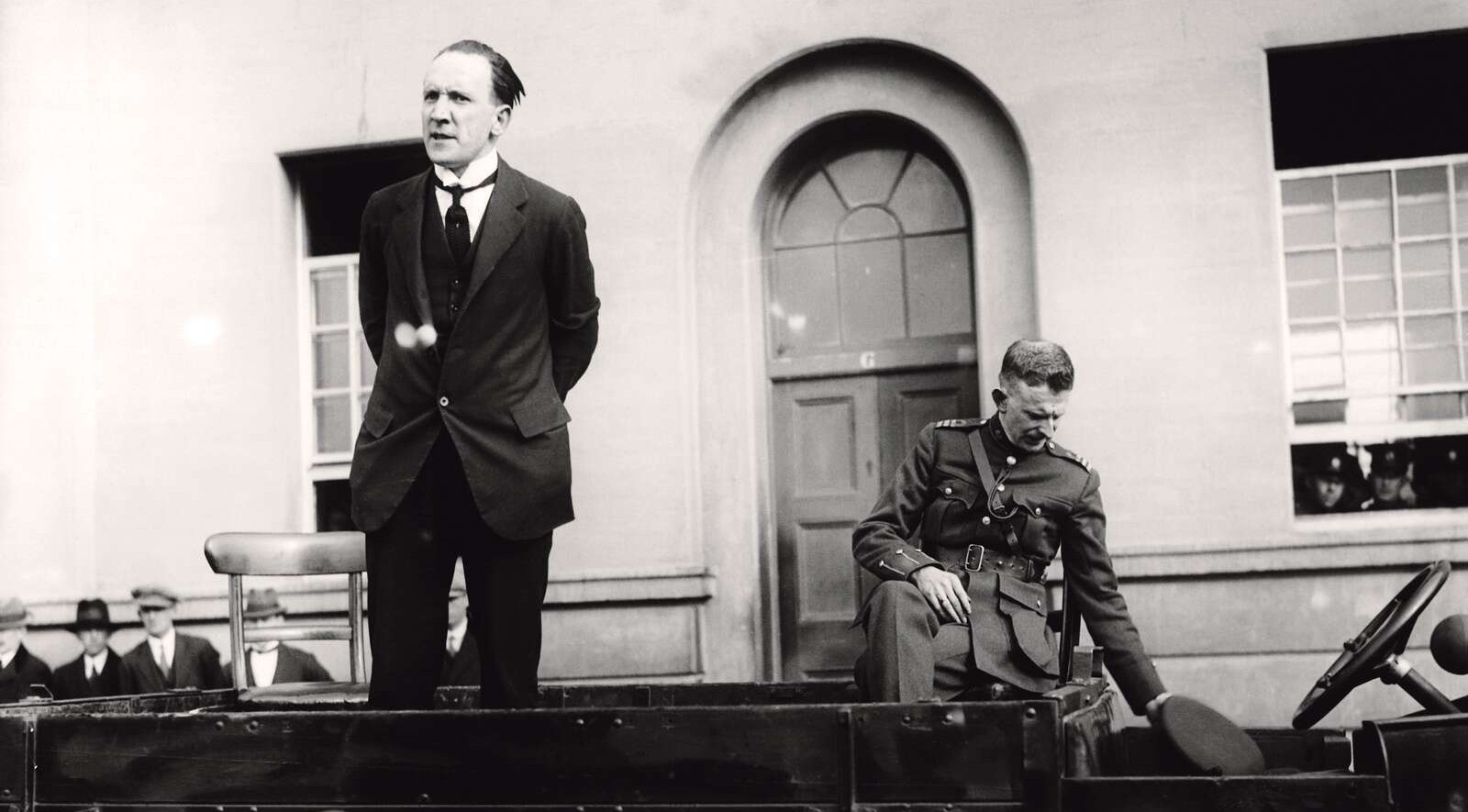
T.J. O’Flaherty sheds no tears over the assassination Kevin O’Higgins, leader of the Irish counter-revolution executed in 1927 by the I.R.A. for his role in the murder of over seventy Republican prisoners during the Civil War. A background to a type found in nearly all anti-colonial struggles, whose anti-imperialism is an accident of birth and who only wants a seat at the Empire’s table.
‘The Death of Kevin O’Higgins’ by Thomas J. O’Flaherty from The Daily Worker. Vol. 4 No. 158. July 18, 1927.
THOUSANDS of editorials have appeared in the American capitalist press on the death of Kevin O’Higgins, vice-president of the executive council of the Irish Free State, foreign minister and minister of justice, and practically all the editorial comment that I read was eulogistic of the dead official, condemnatory of the militant Republicans and appeared to be in the main, the product of one mind, with variations for each paper to create the appearance of originality. O’Higgins was extolled as a “strong” man, and the practical application of this virtue that won the approval of the capitalist scribes was his brutal suppression of the Republican movement that sought to bring about the political separation of Ireland from Great Britain and the unity of, the country under one government.
In crushing this movement O’Higgins did not hesitate to use the firing squad against his former intimate friends. The number of Republicans that he was directly responsible for murdering in this fashion is put at 77. Yet this is the monster who has been credited by the capitalist editorial hacks with having a kind heart, in proof of which they adduce his alleged collapse when he heard the sound of the gun shots that snuffed out the life of the rebel Rory O’Connor, his former bosom friend, who left all his possessions to the O’Higgins family by will.
THERE is no mystery surrounding the reason for the universal praise showered on O’Higgins by the imperialist press and their regret for his death. He was a defender of the capitalist system in Ireland and all over the world. Like many others in history and in the history of all oppressed countries he snatched at the opportunity afforded him by the treaty which created the Free State, to step in as England’s chief jailer of the Irish workers and peasants.
“The Irish Question” has been a thorn in the side of every British government for centuries. Against the rebellious Irish people, England used every method known to the tyrant, from the most brutal and bloody suppression to an international campaign of slander which painted them as either clowns and buffoons whose only virtue was a facility for making the world laugh at their antics, or else savage and ferocious being whose normal activities were murder, arson and lying. The policy of blood and terror failed to quench the unconquerable spirit of the people, but the campaign of character assassination was more successful. In fact even today there are radicals with a fairly intelligent grasp of the class struggle whose knowledge of the Irish struggle is hardly on a higher plane than that possessed by the hacks who write imperialistic editorials on the Irish question for the capitalist press.
SINCE the militant socialist James Connolly and his comrades raised the flag of rebellion against the British empire in Dublin in 1916 until today the sewer pipes of capitalist journalism have been exuding their poisoned filth against the gallant men and women who risked their lives for the cause of Irish freedom from British rule. Those lickspittles could not find terms harsh enough to hurl at those brave souls. They were murderers, agitators, lunatics. The traitor, the stoolpigeon and the renegade were exalted and the gibbet and the firing squad were suggested as the proper reward of self-sacrifice. It was the policy of glorifying the scab as the highest type of citizen applied internationally.
THE execution of O’Higgins by unknown persons was seized on as an excuse by those scribblers to trot out the hoary hokum about Ireland and the alleged inability of the Irish people to conduct themselves except in a manner that brings joy only to the undertaker and the manufacturer of embalming fluid. The murders take place with such monotonous frequency in the United States that only a very unusual one stays on the front page more than a few hours the capitalist editors adduced from the killing of O’Higgins that England was quite justified in withholding the right of self-government from Ireland. Before the creation of the Free State, there might be some excuse for a hot headed patriot in popping off an obnoxious British oppressor or a grasping landlord, but now that the Irish are permitted to govern their own country, nothing but an insatiable thirst for gore could be the motive for the crime. So the anvil chorus hammered.
That O’Higgins was a tool of the British government in Ireland not a representative of the Irish producing classes, the worker and peasants, is clear to anybody who has made a study of the recent Irish history. O’Higgins was only one of such tools. The whole executive council of the Free State serves the same purpose. O’Higgins was the outstanding British servant, not because he was more willing than his associates, but because he possessed those qualities which are indispensable to the successful execution of a ruling class’s decrees. That O’Higgins happened to be Irish instead of English only added to his usefulness. Here in America some of the most useful instruments of the employers in their perpetual war against labor are men who were trained for leadership in the trade union movement. Some of those tools remain in the trade union movement in order to better serve their masters, wh. others become employers or foremen and presidents of corporations or organize detective agencies to spy on labor. The traitor is to be found in all countries and in all social groups fighting for freedom. O’Higgins was a political relative of the social revolutionaries and mensheviks of Russia who joined with the foreign powers in trying to drive their own people back under the Czarist yoke.
BECAUSE of the general confusion that prevails over the situation in Ireland and because of its importance in the imperialist epoch a brief sketch of what transpired in Ireland since James Connolly, Padraic Pearse, Sean MacDermott and several other revolutionary leaders were murdered by the British government because they tried to free Ireland from British rule and refused to accept as sincere the feigned indignation of the British government over the German invasion of “poor little Belgium,” whose ruling class prostituted itself for Great Britain and France. (This is a good place to remind our readers that Arthur Henderson, the British right wing socialist who is now so exorcised over the execution of several Czarist conspirators by the Soviet government, was a member of Asquith’s coalition cabinet when James Connolly, a fellow socialist was murdered by orders of that cabinet. Needless to say Connolly was not an imperialist socialist louse, but a revolutionist).
AFTER the reign of terror that followed the Easter Week uprising the spirit of the nationalist revolution seemed crushed. Thousands of suspected persons–suspected of being hostile to British rule–were in various prisons. The majority of the Irish capitalist papers were bitterly opposed to the revolutionists. So were the clergy of all denominations with the exception of a few young catholic priests. All avenues of expression were closed to the revolutionary movement. But ways and means were found and within a year as a result of the policy of murder pursued by the government, the great majority of the people were won over to the Republican cause.
WHEN the world war was brought to a close with the defeat of the central powers the Irish republicans took advantage of Woodrow Wilson’s insincere speeches in behalf of the freedom of small nations and succeeded in making a lot of trouble for England. Here in the United States a gigantic propaganda campaign was launched which made the capitalist politicians sit up and take notice. They jumped on the bandwagon, hollered for Irish freedom and kept on shouting as long as there was a vote or a dollar to be gained thereby.
IN the elections that followed after the end of the war the Republicans won an overwhelming victory, wiping the old renegade Redmondite crew off the political map. The Redmond gang favored constitutional methods only, which in practice meant agreeing to the perpetuation of British rule in Ireland.
THE successof the Republicans frightened England and agents were dispatched to Ireland to try out the old method of political seduction. But the militant elements in the Republican movement held out for a Republic and complete independence. The established the Republican Parliament, called Dail Eireann and proceeded to organize a government. The British declared the parliament illegal and sent a horde of the most accomplished scoundrels into Ireland that were ever loosed on an unfotunate people. Those assassins were the Black and Tans, the off scourings of the slums and jails of England and the dives of her Oriental possessions. Against those human vermin the Irish Republican Army battled until the treaty which created the Free State was signed in the winter of 1921, between the British government and the representatives of Dail Eireann.
THE Dail split over the treaty, the pro-treatyites winning by a bare majority. De Valera, the leader of the opposition faction held out for an amended oath of allegiance, but most of his followers did not care so much about the wording of the oath as the fact that the treaty kept Ireland in the grip of the Empire and split the country in two political parts by granting autonomy to the tory North, thus giving the British a base of operations in Ireland against the nationalist revolutionists.
IN the elections that followed the split the pro-treatyites won a majority of the deputies for the treaty, the Labor Party accepting the pact as a step in advance.
The militant Republicans refused to accept the treaty and decided to maintain the military organizations that forced the British to make concessions. The Collins-Cosgrave-Mulcahy faction, the pro-treaty group, suddenly decided to fight the militants and civil war followed. Michael Collins, the leader of the treaty faction was killed in action and the Free State inaugurated a campaign of terror under the leadership of Kevin O’Higgins who took no part in the Easter Week Rebellion. Before O’Higgins halted the firing squad, 77 of his former comrades fell to rise no more.
WHEN the civil war ended and the military campaign of the Republicans was crushed for the time being, O’Higgins became one of the leading men in the Free State government. The British government liked him. He believed implicitly in imperialism and expressed his admiration for Mussolini. Ireland, which was hitherto a thorn in the side of British imperialism would now be a friend in peace and an ally in war. The Free State government thru its minister for external affairs pledged the manhood of the country to the defense of the empire. O’Higgins attended the last meeting of the imperial conference in London and only one week before his death attended the Geneva naval parley where he is said to have supplied the British naval experts with information on the co-operation that could be expected from the Free State in case of hostilities with another power or combination of powers.
IN the recent elections the anti-treaty Republicans made gains while the Free State supporters lost ground. Every sign pointed to a revival of the Republican spirit. The Free State government was considered in a precarious condition and for a while there was doubt that Cosgrave, O’Higgins and company would form ‘a government. Had the Labor Party under the leadership of the reactionary Thomas Johnson, who is supported by William O’Brien, secretary of the Irish Transport and General Workers Union and a former co-worker of James Connolly, adopted a militant policy, for labor and Republicanism, it would have taken the ground from under the feet of the quibbler De Valera whose policy is almost impossible to unravel or understand.
De Valera refused to take the oath of allegiance to the king. He had a formula of his own which meant practically the same thing. His group was not seated and the Labor delegation of 22 members now constitutes the opposition which is nulled and futile.
HAD the anti-treaty Republicans taken their seats and made; an alliance with the Labor Party or at least made an attempt to do so, it would be possible, the Labor Party being willing for the opposition to vote the oath of allegiance out of existence, thus creating a situation that would compel the British to either consent to a reopening of negotiations or resume the policy of terrorism at a time when her attention is devoted to holding her own in several parts of the world simultaneously.
If the Labor and the Republican parties had genuine revolutionary leaders of the Connolly type, they would be able to unite on an anti-imperialist program that would hasten the day of complete freedom for the Irish workers and peasants from foreign rule and native exploitation and constitute a valuable contribution to the anti-imperialist forces everywhere.
The usefulness of a dominant, brutal, imperialist like O’Higgins in a situation like this can be easily seen. It is not surprising that the British government and the imperialists of all countries should mourn his loss.
The Daily Worker began in 1924 and was published in New York City by the Communist Party US and its predecessor organizations. Among the most long-lasting and important left publications in US history, it had a circulation of 35,000 at its peak. The Daily Worker came from The Ohio Socialist, published by the Left Wing-dominated Socialist Party of Ohio in Cleveland from 1917 to November 1919, when it became became The Toiler, paper of the Communist Labor Party. In December 1921 the above-ground Workers Party of America merged the Toiler with the paper Workers Council to found The Worker, which became The Daily Worker beginning January 13, 1924.
PDF of full issue: https://www.marxists.org/history/usa/pubs/dailyworker/1927/1927-ny/v04-n158-NY-jul-18-1927-DW-LOC.pdf
 Revolution's Newsstand