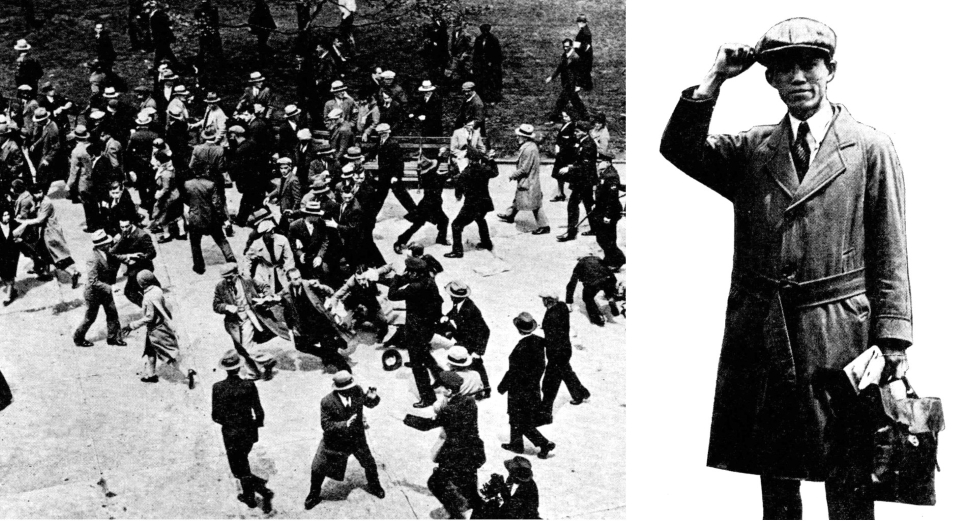
Tao Hsuan Li (Li Daoxuan) was a young Left KMT activist when he won a scholarship to Columbia in 1926. In the U.S. he would join the Communist Party and by 1929 was head of its Chinese Buro. Active and visible, he was arrested in December, 1930 during the Doak Deportations of radicals and labor activists with the plan to send him to Kuomintang-led China where he faced death. Protests by New York supporters led to confrontations with police and the I.L.D. began a campaign for his release. Li was held on Ellis Island, described below, where he organized protests against conditions. Failing to win his release, the I.L.D. was able to win deportation to the country of Li’s choosing; he chose the Soviet Union. Language barriers have made it hard to find out what happened to Comrade Li afterwards and would love to know. I hope he survived.
‘Hellish Condition on Ellis Island’ by Tao Hsuan Li from The Daily Worker. Vol. 8 No. 138. June 9, 1931.
Deportees Given Worse Food and Maltreated As If in Filthy Prison–Foreign Born in Spontaneous Protest Against Such Treatment of Themselves
(Chinese student and active antiimperialist whom the Labor Department sought to deport to Chiang-Kai-Shek and certain death for his activities. He has since been released on bail after the I.L.D., appealed the case in the District Circuit Court of Appeals.)
On May 26, 467 foreign-born arrived at Ellis Island in a special train from Seattle. Two hundred and fifty were deported the next day. The mass deportations of the bosses’ government will increase on a larger scale. Thus the hellish conditions on Ellis Island, against which the workers are constantly revolting, deserve the serious attention and help of the workers outside. Furthermore, to help the fight for better conditions, there must be considered as an integral part of the struggle against deportations and all other forms of attacks against the foreign-born workers.
What are the conditions in the Ellis Island, which stands shamelessly behind the gigantic “Statue of Liberty?”
Terrible Conditions.
The conditions there are simply terrible. In spite of the fact that the government appropriates 75 cents a day per capita for meals, the authority feeds the workers with the rottenest kind of food. When we have rotten meat or fish for dinner we will surely have the meatballs or fish cakes for supper. No one can tell what meat company supplies such stuff. No real butter nor real milk. The vegetables are canned stuff, mostly of cheap beans and peas. The coffee and tea are the same as in 1914. The Commissioner attempts to cover up this with the theory of national diversity of taste. But it was precisely the Italians who refused to eat his spaghetti.
How about the living quarters? There are a few large rooms for defended passengers, deportees and deportees with criminal records. All the rooms are overcrowded. Room 222, in which I stopped twice, last December and May, was filled sometimes up to 250. Many cannot find seats. The noise, especially when there was somebody coming in or shipping out, which happened every hour, could drive a nervous person to craziness. The porches adjusted to the rooms were not opened. Foul smell found a fertile soil there. Twice or thrice a week we were allowed to go out in the open yard for 15 minutes only, as if the sunshine and fresh air are too expensive in this land of private property and “prosperity.” The sleeping quarters are worse. One large room takes more than 300 people, while in a small room of 20 by 24, 14 people are stuffed in. One cannot stretch one’s arms. Those who stay in the small rooms are deprived of baths permanently.
Of course, these bad conditions give rise to nothing but sickness, primarily from the food. Almost every deportee has been sick once or more. Are the doctors careful or the hospital the real place for sick people? No. The doctors are careless. They give aspirin to cure every kind of sickness. The Marine Hospital is too small for the sick crowd. Corruption runs high in this lousy place, too If you do some work, like sweeping. etc., you have a chance to stay there the time required: otherwise, you will be ejected as soon as possible. With the same instrument, the nurse puts solutions on the sexual organs of all in the room on the assumption that everybody has some kind of venereal disease. When an Italian worker protested against the maltreatment of the doctor, he found himself in the jail for 110 days with only bread and water. An English sailor told me that for the months of February and March about 34 persons, including 6 Englishmen, died in the hospital! Many times, the workers, unless very serious, refused to call for the doctor or to go to the hospital.
Workers Protest.
Against these hellish conditions, workers have constantly made spontaneous protests. The authorities turned a deaf ear. Last December, when a rigid protest for better food was sent in, I and Guido Serio were put into solitary cells. Since then a few more protests were made. But the conditions are still the same. With the increasing number of deportees and the summer weather, it becomes worse.
On the very day, May 16, when I surrendered to Ellis Island, a German worker died in Room 222. How did it happen? This worker was sick the day before from stomach sickness and the doctor told him to wait until next morning. But he was so sick that night that the guards put him out of the room. The next morning the doctor found him dead in the hall! He was only 22 years old! On Saturday a Greek worker suffered again from the food. Again the doctor told him to wait. Knowing what happened the other day, the workers forced the guards to send him to the hospital before It was too late. Next morning a few more were sick One West Indian Negro worker reported he was sick. A guard, without any reason, beat him up before sending him to the hospital!
Everyone was nervous. Indignation ran high. The news spread in other rooms. A strong fighting spirit began to crystallize. On the next Tuesday morning a joint protest, signed by Room 222, 204 and B was sent to the Commissioner. It demanded only; (1) better food, (2) porches opened, (3) two hours out in the yard every day, (4) reduction of numbers sleeping in one room, and (5) doctors be instructed to be careful about the patients. The workers displayed very good spirit and solidarity. Out of the 120 in Room 222, 114 workers signed including 11 Chinese.
Again the authorities answered this outcry for humane conditions with high-handed suppression. On Wednesday night again I and two Italian workers were put in solitary cells, when many workers refused to eat the rotten supper. But this time the better organization, militant spirit and unity compelled the authorities to open the porches and give some improvement in food, which were two of the demands.
This struggle did not develop as it should be. Considering the extreme diversity of nationalities, professions and localities, this struggle is very instructive. Conscious of the partial victory of this struggle, with the worsening conditions there, the workers will inevitably give fresh waves of protest. But only with the help of workers from outside they may win their demands in full.
The Daily Worker began in 1924 and was published in New York City by the Communist Party US and its predecessor organizations. Among the most long-lasting and important left publications in US history, it had a circulation of 35,000 at its peak. The Daily Worker came from The Ohio Socialist, published by the Left Wing-dominated Socialist Party of Ohio in Cleveland from 1917 to November 1919, when it became became The Toiler, paper of the Communist Labor Party. In December 1921 the above-ground Workers Party of America merged the Toiler with the paper Workers Council to found The Worker, which became The Daily Worker beginning January 13, 1924.
PDF of full issue: https://www.marxists.org/history/usa/pubs/dailyworker/1931/v08-n138-NY-jun-09-1931-DW-LOC.pdf
 Revolution's Newsstand