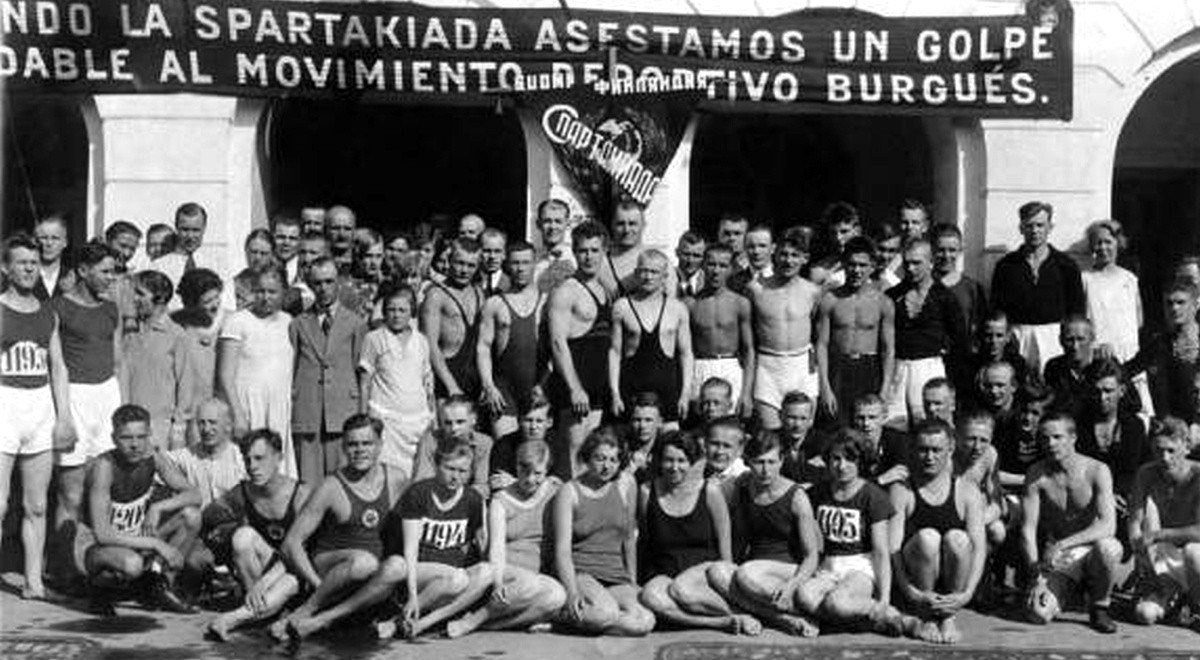
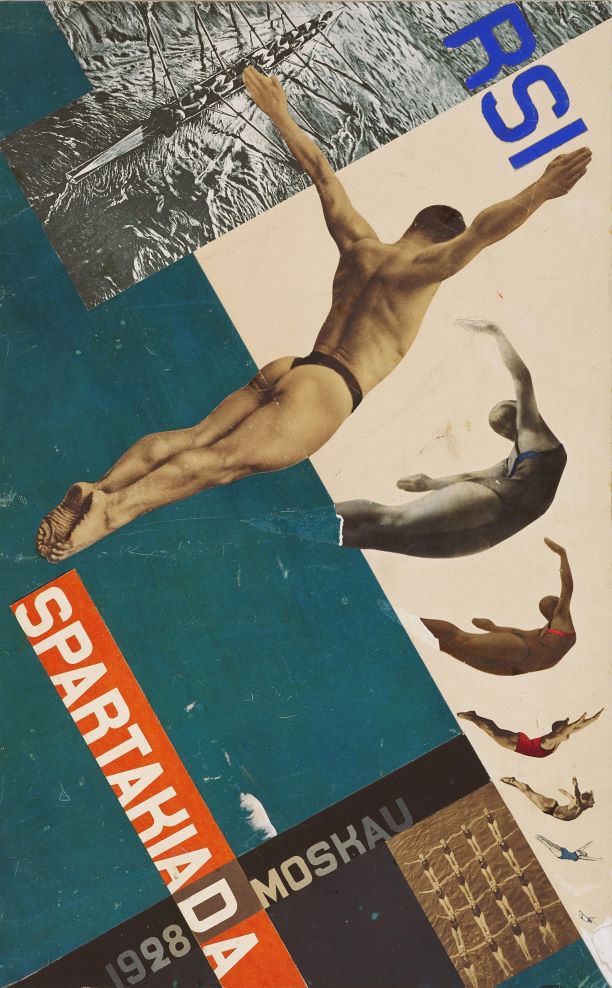
Fritz Reussner breaks down the numbers of the first Summer Spartakiad, the Comintern’s international sporting event, held during August, 1928 in Moscow and participated in by 4000 athletes from 41 countries.
‘After the Successful Spartakiad’ by Fritz Reussner from International Press Correspondence. Vol. 8 No. 62. September 14, 1928.
The Spartakiad in the Soviet Union has been a success for the whole international sport movement. The twelve festival days of the Soviet Union workers’ sports were at the same time twelve days of struggle against bourgeois sport, against the Amsterdam Olympic Sports, against the war armaments of the imperialists–and for proletarian solidarity, for the international unity of workers’ sport.
All the calumniations spread abroad by the reformist sport leaders of the Lucerne Sport International have completely broken down. In spite of the Terror exercised, many members of the Lucerne Sport International took part in the festival of workers’ sport. Most important of all is the fact that many social democrats insisted on seeing the Spartakiad with their own eyes, and forming their own judgment on how matters are looking in the Soviet Union. Two sections of the Lucerne Sport International, England and Esthonia, took official part in the Spartakiad in spite of everything done to prevent them. The foreign delegations, after a sojourn of several weeks in the Soviet Union, after visiting many works and factories, social institutions, etc., and after coming in close contact with people from every stratum of the population, resolved on their own initiative to make a declaration of solidarity with the Soviet Union. It was with heavy hearts that these delegates bid farewell to the Soviet Union, and many of them expressed their regret at having to return to capitalist serfdom after these few days in proletarian freedom. The delegations visited not only Moscow, but its environs, and had the opportunity of seeing other industrial districts. The French comrades visited Ural, some of the Finnish comrades Ukraine, and nearly all the delegations Leningrad.
Facts and figures best demonstrate the enormous success of the Spartakiad, in spite of some slight deficiencies in the technics of organisation.
A number of participators came to Moscow on foot or bicycle. Pedestrians came from Germany and Central Asia. Comrades cycled from Sweden. The Moscow trade unions undertook officially to provide for the foreign delegations.
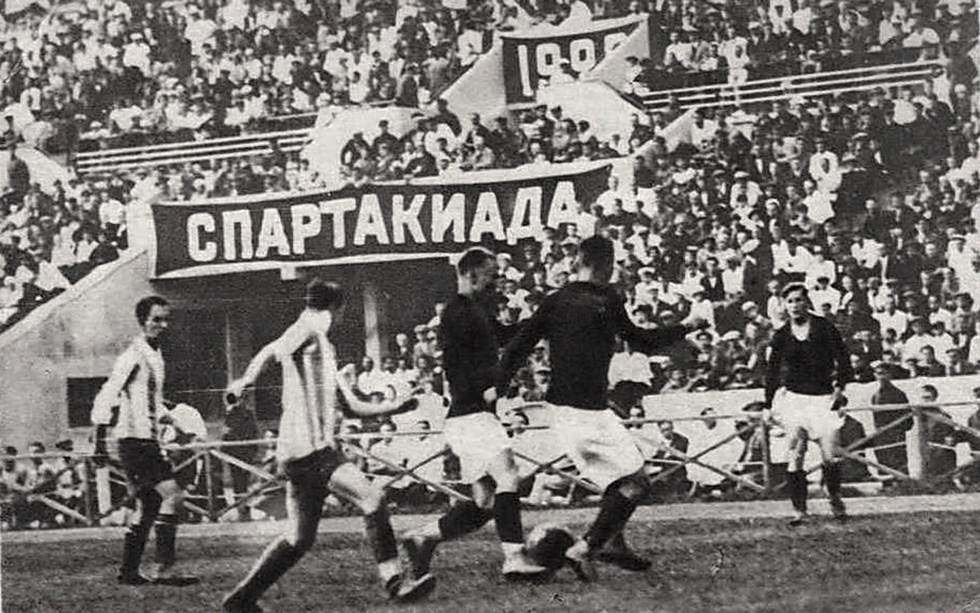
41 nationalities took part in the Spartakiad. This charaterises its really international character. Four continents were represented: Europe, Asia, America, and Africa. At the Lucerne Olympic Sports only European countries were represented.
The Spartakiad roused the interest of the masses of the people. About a million spectators visited the sports and celebrations during the 12 days of the Spartakiad. The great sport festival on the Moscow river alone was visited by about 300,000 persons.
The football matches attracted about 250,000 spectators, light athletics 40,000, the swimming matches 25,000. The rest of a million spectators was made up by those visiting the other mass festivals and sports.
3000 men and 879 women from the Soviet Union took part in the sports. 542 men and 70 women came from abroad.
The following interesting figures show the age of the competitors: from 17 to 21 years 37.8%; from 22 to 26, 35.9%; from 27 to 31, 13.9%; from 32 upwards 11.3%, etc.
It is of equal interest to note how many years the competitors have engaged in sport. 1 to 2 years, 18.8%; 3 to 5 years, 37.2%; 6 to 10 years, 2.7%, etc.
Among the sportsmen from the Soviet Union there were: 14% members of the C.P. of the Soviet Union; 19.1% members of the Youth League, and 66.9% non-party.
The trade union best represented numerically was the employees’ union: 17.8%, followed by the metal workers’ union with 17%, the railmen’s union with 7.1%, etc.
505 umpires and 115 sport physicians attended the Spartakiad, 3827 competitors were subjected to medical examination. Of these 823 were women. 111 of the total number of competitors were excluded from the sports by medical advice.
80 new records in various branches of sport were set up in the course of the sports. The technical efficiency shown was high, showing that our International, besides carrying the work of class education and participating actively in political and trade union life, accords due attention to the technics of sport. The results of the Moscow Spartakiad have surpassed those of the Frankfort Olympic Sports of the Lucerne International. We need only to glance at the light athletics results. The bracketed figures are the best results of the Olympic Sports held at Frankfort-on-the-Maine.
Men: Flat 100 metres 109 yards 10.8 secs. (11.2); 200 metres 22.0 (23.2); 400 metres 50.2 (51.6); 800 metres 2:00.9 (1:59.0); 1500 metres 4:08.8 (4:07.7); 5000 metres 15: 42.2 (15:31.0); 10.000 metres 32: 34.0 (32 : 21.5); 110 metres hurdle race 16.1 (16.4); 400 metres hurdle race 57.8 (58.0); 4 times 100 metre relay race 43.5 (44.0); broad jump 6.96 metre (6.88); high jump 1.85 metre (1.79); pole vault 3.60 metre (3.44); ball throwing 63.95 metres (55.96); putting the weight 12.76 metres (12.98); discus throwing: 41.55 metres (41.23); javelin 61.77 metres (55.07).
Women: 100 metres 12.6 (13.0); discus throwing 26.41 metres (20.39); weight putting 9.05 metres (8.59); broad jump 5.31 metres (4.96).
It will be seen from this that the Moscow Spartakiad can record considerable success from the technical aspect.
The results of the Spartakiad were broadcast all over the world in six languages. Labour papers in many countries sent their own correspondents.
The competitions between members of the Lucerne Sport International and members of the Red Sport International were of special interest. The days spent together in Moscow will linger long in the memories of all participants. The farewell evening will never be forgotten.
The class festival of the worker sportsmen is over. Our next task is to pass on what we have learned there to those who were not fortunate enough to be present. Steady and determined work is necessary if we are to guard against the chicane and expulsions of the reformist leaders. These days in Moscow have made the necessity of unity, of a common struggle against war danger, very clear to all taking part. And now we must make this equally clear to the broad masses.
International Press Correspondence, widely known as”Inprecorr” was published by the Executive Committee of the Communist International (ECCI) regularly in German and English, occasionally in many other languages, beginning in 1921 and lasting in English until 1938. Inprecorr’s role was to supply translated articles to the English-speaking press of the International from the Comintern’s different sections, as well as news and statements from the ECCI. Many ‘Daily Worker’ and ‘Communist’ articles originated in Inprecorr, and it also published articles by American comrades for use in other countries. It was published at least weekly, and often thrice weekly.
PDF of full issue: https://www.marxists.org/history/international/comintern/inprecor/1928/v08n62-sep-14-1928-Inprecor-op.pdf
 Revolution's Newsstand