
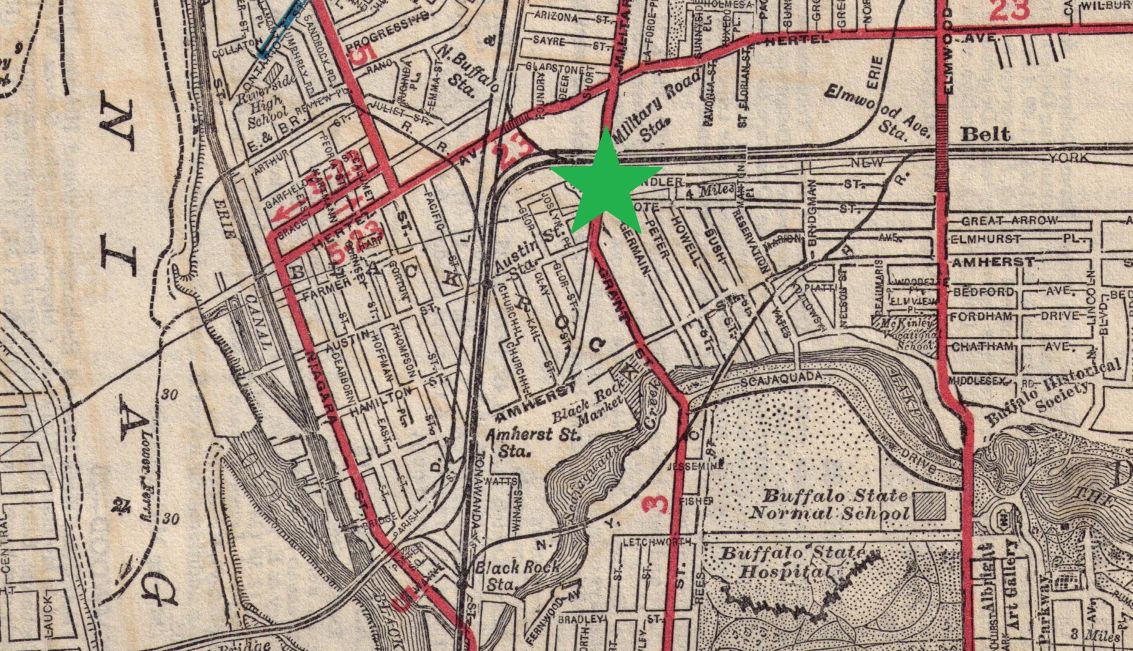
Communist cadre in a relatively small, local strike against the North Buffalo’s Acme Steel and Iron works straddling Polish and Black neighborhoods face organizational limits, race, nationality, gender, and division by union as they try to build the Steel and Metal Workers Industrial Union and win the strike.
‘Lessons of the Acme Steel Strike in Buffalo’ from Party Organizer (C.P. Internal Bulletin). Vol. 6 No. 8-9. August-September, 1933.
THE Acme strike is a direct result of the successful termination of the North Buffalo Hardware Foundry strike. The Acme Steel and Malleable Iron Works employs about 200 workers, including Negros and women. The average wage before the strike was 30c an hour for men, and 20c for women. The strikers demand an 8-hour day, $5 a day for molders, $4 a day for grinders, improved conditions and recognition of their shop committee.
The strike assumes tremendous importance primarily because we were able during the course of the 2 weeks struggle to arouse the entire Polish Section of Black Rock and involve thousands of workers, men and women and children, unemployed and shop workers, Negro and white. As a result of the correct leadership and most strenuous activity we succeeded in: 1) breaking through, to some extent, the most vicious terror unloosed in Buffalo, by rallying as many as 5,000 neighbors on the picket line in support of the 150 strikers, 2) Organizing the Acme shop into the Steel and Metal Workers Industrial Union during the strike, thus making it easier to force the bosses to recognize the shop committee, 3) organizing a women’s council, 4) make a start in organizing the children of the neighborhood and of the strikers, 5) organizing a shop unit in the Acme during the strike. Many outstanding mistakes and weaknesses could and should (in subsequent articles) be discussed. However, the purpose of this article is to analyze the role our Party played in this struggle. What were the tasks of our Party? How well did we carry through these tasks?
How the Strike Was Called
On the 10th of July, several of the workers of the Acme plant came to the Section organizer of the Party and told him they are ready to strike and asked for directions on how to proceed. About 40 workers were rounded up, demands worked out and arrangements for a larger meeting made. The next day about 75 workers came to the meeting at which they decided to strike the following day, July 12th. About 125 workers responded. Some of the machinists (at least two of whom are members of the A. F. of L.), the whole patternmakers’ department and the straw bosses refused to go out. The molders are the decisive department; they took the initiative in calling the strike and are out solid.
There are a few Negro workers in the shop. The comrades in the first strike meeting had the white workers take a unanimous vote to support the Negro workers in the struggle, and vice versa. A few women work in the shop also, and they receive less wages than the men, but are supposed to be doing lighter work.
At the outset a strike committee of 13, including Negro and women workers was organized, representing each department except the patternmakers. Picketing was organized. A publicity committee was elected, which was successful in securing considerable publicity in the local press; a functioning relief committee, capable of caring for the needs of the strikers; a defense committee, though too narrow, effective in the handling of the preliminary steps in arrests. Also delegations from the strikers have been sent to the police, etc., to demand the stopping of police interference on the picket line, demanding the right to carry banners on the picket line, etc. Also later in the strike, women’s auxiliaries have been organized with a large number signed up, and perspective of permanent organization. Likewise children’s troops have been organized.
The strike is led by the elected strike committee, which meets at least once each day. The leading Party members are not members of the strike committee, but meet with it, where all steps to be taken up are planned and discussed, and then presented to the general strikers’ meetings. The members of the strike committee are assigned the part each is to bring to the meeting and given guidance on how this should be done. The Party members speak on questions which come up during the general meeting and which the strikers are unable to solve themselves, also raising the discussions to a higher political plane. During the first few days the Party members spoke too much and too often, but this was soon corrected.
Mass meetings of the strikers and others are held every night at which the strikers are the main speakers, the Party members politicalizing the issues, exposing the A.F. of L., as well as countering such suggestions as bringing rifles to the picket lines, bombing the plant, etc. Because of the newness of the workers to struggles and the relatively small number of strikers, the leading comrades were compelled to picket with the workers the first few days in order to prevent the collapse of the picket lines. One definite result of these mass meetings, which were undertaken for one thing to raise the morale of the strikers which was very low in the first few days, was that on Friday (21st), over 5,000 men, women and children marched to the picket line, stoned and broke all the windows on the busses transporting scabs, sent several scabs and one bus driver to the hospital; with mass indignation against the police, scabs, etc., running high. The Party and Union Built during Strike Before the strike the Party and the T.U.U.L. had no contacts in this plant. Within the first few days four members were recruited into the Party and a nucleus formed which is the leader in the strike committee. These four constitute the leading members of the union. From the first day, members were recruited to the Steel and Metal Workers Industrial Union. To date, about 125 workers of this shop have signed applications, and 30 have paid full initiations, and the others have paid part. The workers of this plant receive very small wages and need relief, being unable to pay initiations and dues. The vice president of the union is a Negro.
Shortcomings and Errors
Despite many significant achievements for the Party in this strike, there are on the other hand very serious shortcomings and errors. The first and decisive error made was that the Party section organizer permitted the workers to tell the night watchman not to fire the blast furnaces when they were ready to strike. The demands should have been worked out more carefully; the present ones being maximum demands. (Norte: the strike is still on, and the errors and shortcomings stated have been criticized, and steps taken to overcome them. The period to which this criticism applies is mostly for from July 12th to 22nd.) The neglect of the Party is partly explained, but not justified, by the fact that must of the leading comrades were absent from the district during the early part of the strike. Briefly, the main shortcomings:
Insufficient Mobilization of Party around Strike
1) The Party units in the strike area were not mobilized in support of the strike, and for recruiting new Party members, etc., 2) no directives were sent to the other sections and units on the strike or on any other issues, 3) the Party was not brought forward in its independent role, organizing mass meetings, etc., in support of the strike, having Party representative speak at the strike meetings, otganizing Party members from the units to go on the picket line, selling literature, Daily Workers, etc., 4) Though the Y.C.L. organizer has been in the strike from the first day, yet no Y.C.L. unit has been formed, not only from the strikers, but the whole neighborhood which is there and struggling. The Party bears the responsibility. 5) Insufficient publicity in the Daily Worker on the strike. The Daily Worker has not been sold in sufficient numbers, and most of the time not at all. In this connection it is necessary to point out thar the Daily made an error in cutting down the article on the strike, appearing in the Monday (24th) issue. 400 copies of this issue wece ordered to be sold to the strikers, and the article having been cut, was discouraging to the strikers. 6) The Unemployed Councils have not been involved as an organization, though the members have been very active from the start. The I.L.D. has been brought into the situation. The strikers’ defense committee was elected under the direction of our comrades, yet the I.L.D. was not sufhciently brought forward in its independent role; a committee was formed to work with the strikers’ defense committee. I.L.D. attorneys will be used, and the strikers’ meetings are utilized for protest and demanding the release of the arrested workers, rousing the strikers and others against the police. The W.I.R. is as yet in no contact with the strikers’ relief committee, though the W.I.R. has an office there.
Scabs Recruited Because Party Failed to Mobilize Masses
An extremely important issue arose in this strike from the fact that the employers resorted to the tactic of using Negroes to scab, creating a situation threatening race riots. The Negroes were recruited in the Negro section of the city, miles away from the strike. This is important to bear in mind, in connection with the falling down of the activities of the Party units in this and in other areas, as a result of neglect of them, and it was far more difficult to mobilize the masses in that area (especially the Negro territory) to combat this vicious practice. This is being done, however. The L.S.N.R., I.L.D. and the strike committee have issued joint leaflets, held joint street meetings in the Negro territory, mobilized Negroes to go to the picket line, etc., and thus have succeeded to rouse sentiment against Negroes being used as scabs, directing the anger of the white workers against the real culprits, the bosses; informing the Negroes that they are being hired to scab, since many of them do not know this.
The employers are aware of the significance of this seemingly “small” struggle. They have concentrated upon it all their forces, the police, attempting to introduce the A.F. of L. through the police and the employers, radio talks against the strike by the Chamber of Commerce, Johnston of the local A.F. of L. Central Labor Council declaring it an “outlaw” strike.
Did We Carry thru Our Tasks?
In the main we did. But how? Not in an organized and planned manner. Party members were on the picket line. Party members were collecting relief, helping in the defense, speaking at the mass meetings, etc. Leaflets were issued, open air meetings were arranged, resolutions were sent in. However, this was done in a haphazard, unorganized way. The Party members did these things not because their units planned them, not because they received directives from the District to do so, but because many Party members had nothing else to do and when they came to the strike headquarters we involved them in the various phases of work. Our Party apparatus and organization were almost entirely neglected. Thetefore, in spite of the good work of the few Party comrades who were leading this struggle, we can say definitely that the entire strike was weakened because of our failure to have mobilized the Party in an organized manner. These lessons, once they become the property of our entire Party, will help us improve our work in the other strikes and struggles brewing everywhere—Steel Worker.
The Party Organizer was the internal bulletin of the Communist Party published by its Central Committee beginning in 1927. First published irregularly, than bi-monthly, and then monthly, the Organizer was primarily meant for the Party’s unit, district, and shop organizers. The Organizer offers a much different view of the CP than the Daily Worker, including a much higher proportion of women writers than almost any other CP publication. Its pages are often full of the mundane problems of Party organizing, complaints about resources, debates over policy and personalities, as well as official numbers and information on Party campaigns, locals, organizations, and periodicals making the Party Organizer an important resource for the study and understanding of the Party in its most important years.
PDF of full issue: https://archive.org/download/party-organizer_august-september-1933_6_8-9/party-organizer_august-september-1933_6_8-9.pdf
 Revolution's Newsstand