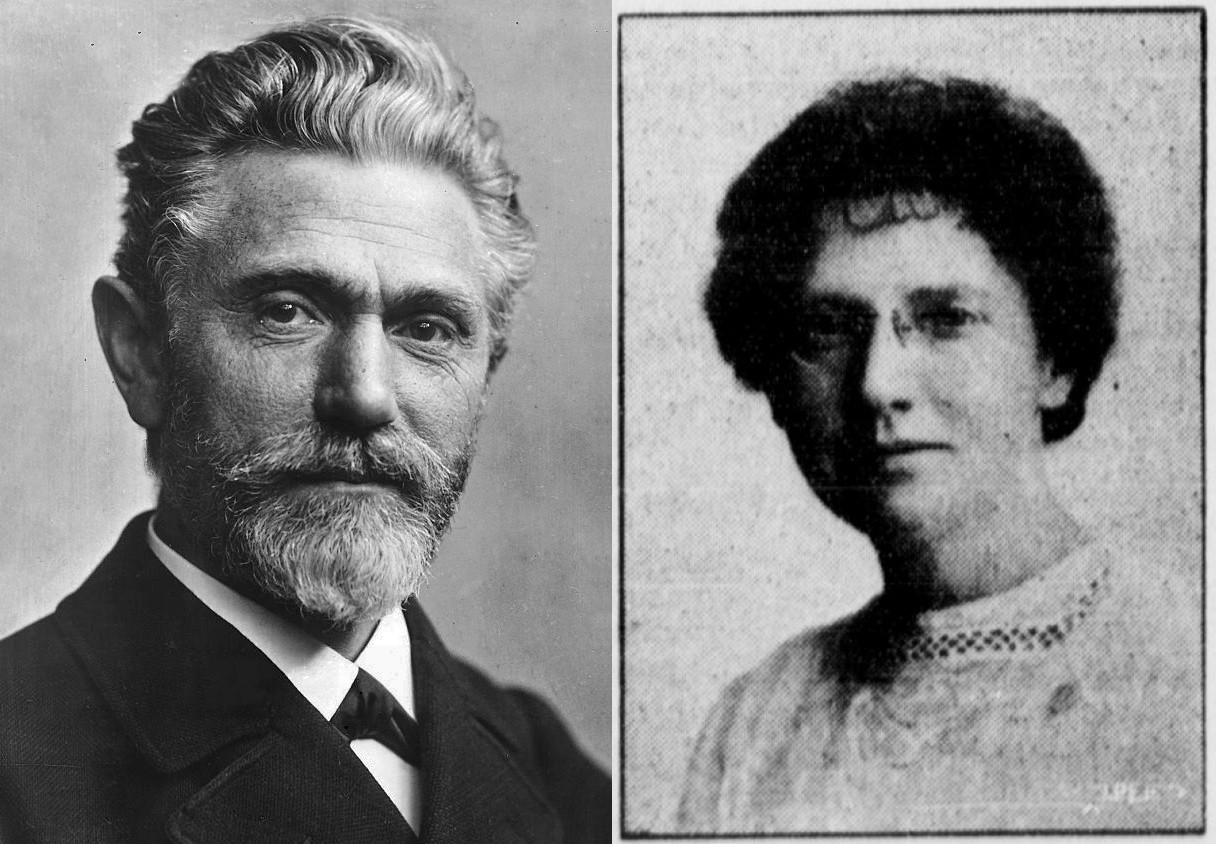
Luella Twining was a leader of the Socialist Party’s National Women’s Committee who toured Europe in 1911 investigating the Socialist women’s movement there. Here she relates the story of her and Alexandra Kollontai meeting August Bebel at his Reichstag office, surprised at his knowledge and interest in the U.S. movement.
‘A Word About August Bebel’ by Luella Twining from The Progressive Woman. Vol. 5 No. 51. August, 1911.
Miss Luella Twining:
Berlin, Germany, June 22, 1911.
Dear Comrade–It has given me the greatest pleasure to meet you and hear of the progress made by the Socialist women of the United States. I should like to meet them all.
When you return home please give them my heartiest greeting.
Your comrade, A. BEBEL.
The above letter is one of my most valued treasures. I received it from Comrade August Bebel the day after I met him in the Reichstag. It happened in this way:
Alexandrea Kollantay and I were sitting in the gallery of the German Reichstag listening to the deliberations over the State Insurance Bill for Mothers and Farm Laborers. A Clerical said they could not insure mothers because different women needed different assistance; an argument akin to those I heard used in Colorado against the eight-hour bill and in London, by a Lord, against feeding the school children during vacation.
I have had occasion to notice constantly while abroad that the methods of capitalism are the same everywhere. Suddenly there was a stir in the gallery. All eyes were turned toward the door and loud whispers announced “Bebel.” His name was on everybody’s lips. I have never seen such a sensation created over the entrance of any other member into any other parliament I have visited. It was a rare tribute to his greatness.
“Mit heder Bebel ist gekommen” (Representative Bebel has come), announced a young man at my side. “He seems to be popular,” I replied. ” Oh, yah, sehr populaire,” he said, nodding emphatically. I discovered later that the young man is not a Socialist, but he certainly has an exalted idea of Bebel’s genius. “Best speaker in the Reichstag,” he further volunteered.
Of course I was delighted to see Bebel. I noticed especially his good head covered with heavy white hair and his strong and pleasant face. Mrs. Lamonte says she saw him twenty years ago, and the white hair has softened his face. At that time his hair was black.
Bebel at once took up the argument and annihilated the Clerical. In fact, he did not seem much at ease, and stopped very soon after Bebel’s entrance. I must say that this session of the Reichstag was very different from those of our Congress I have attended. The Socialist delegation fills half the room and the left is much respected. You can imagine how much trouble they cause the government. (How different our Congress must be since Victor Berger entered!) After Bebel finished, Comrade Kollantay and I ran down into the lobby and sent in our cards to Bebel. He immediately came out and we had a long talk with him.
First of all he inquired about J.J. McNamara. It is another Moyer, Haywood and Pettibone case, he said. He is thoroughly familiar with the McNamara case and discussed it at length, asking many questions. Karl Kautsy, too, inquired about the case. Such instances certainly demonstrated that we have an international movement.
Bebel expressed great admiration for the Socialist women of the United States. I believe he thinks we are more advanced than we are, but I did not disillusion him, for I know we shall come up to his idea of us. I told him his “Woman Under Socialism ” accompanied me everywhere. He said, “I worked harder on that book than on anything I ever did.” That means something, for no Socialist in Germany has worked harder than Bebel.
Dr. Rosa Luxemburg told me “Bebel is the most popular Socialist in Germany. He is the most beloved by the working men and women.” Comrade Bebel laughed when Kollantay told him of a Socialist local in Russia she visited. The secretary pointed to a chair and said: “Here is the chair in which Bebel sat.” He laughed and mildly expressed disapproval of such a thing. He says the Socialist party is not possessed of so many great leaders as formerly, but the rank and file is better informed and disciplined. This gives him satisfaction.
Otto Hue, the miner, came for Comrade Bebel, announcing he was needed. We were sorry to see him go. He is entertaining and kind and he reads The Progressive Woman. Today I received the above letter, and hasten to send it with this word about Bebel, for I know it will give you, the readers of The Progressive Woman, pleasure to know he is watching and inquiring for your progress.
I am sorry to say that Comrade Bebel is not well. He has but partially recovered from the illness caused by the shock of his wife’s death.
The Socialist Woman was a monthly magazine edited by Josephine Conger-Kaneko from 1907 with this aim: “The Socialist Woman exists for the sole purpose of bringing women into touch with the Socialist idea. We intend to make this paper a forum for the discussion of problems that lie closest to women’s lives, from the Socialist standpoint”. In 1908, Conger-Kaneko and her husband Japanese socialist Kiichi Kaneko moved to Girard, Kansas home of Appeal to Reason, which would print Socialist Woman. In 1909 it was renamed The Progressive Woman, and The Coming Nation in 1913. Its contributors included Socialist Party activist Kate Richards O’Hare, Alice Stone Blackwell, Eugene V. Debs, Ella Wheeler Wilcox, and others. A treat of the journal was the For Kiddies in Socialist Homes column by Elizabeth Vincent.The Progressive Woman lasted until 1916.
PDF of full issue: https://books.google.com/books/download/The_Coming_Nation.pdf?id=DI1EAQAAIAAJ&output=pdf
 Revolution's Newsstand