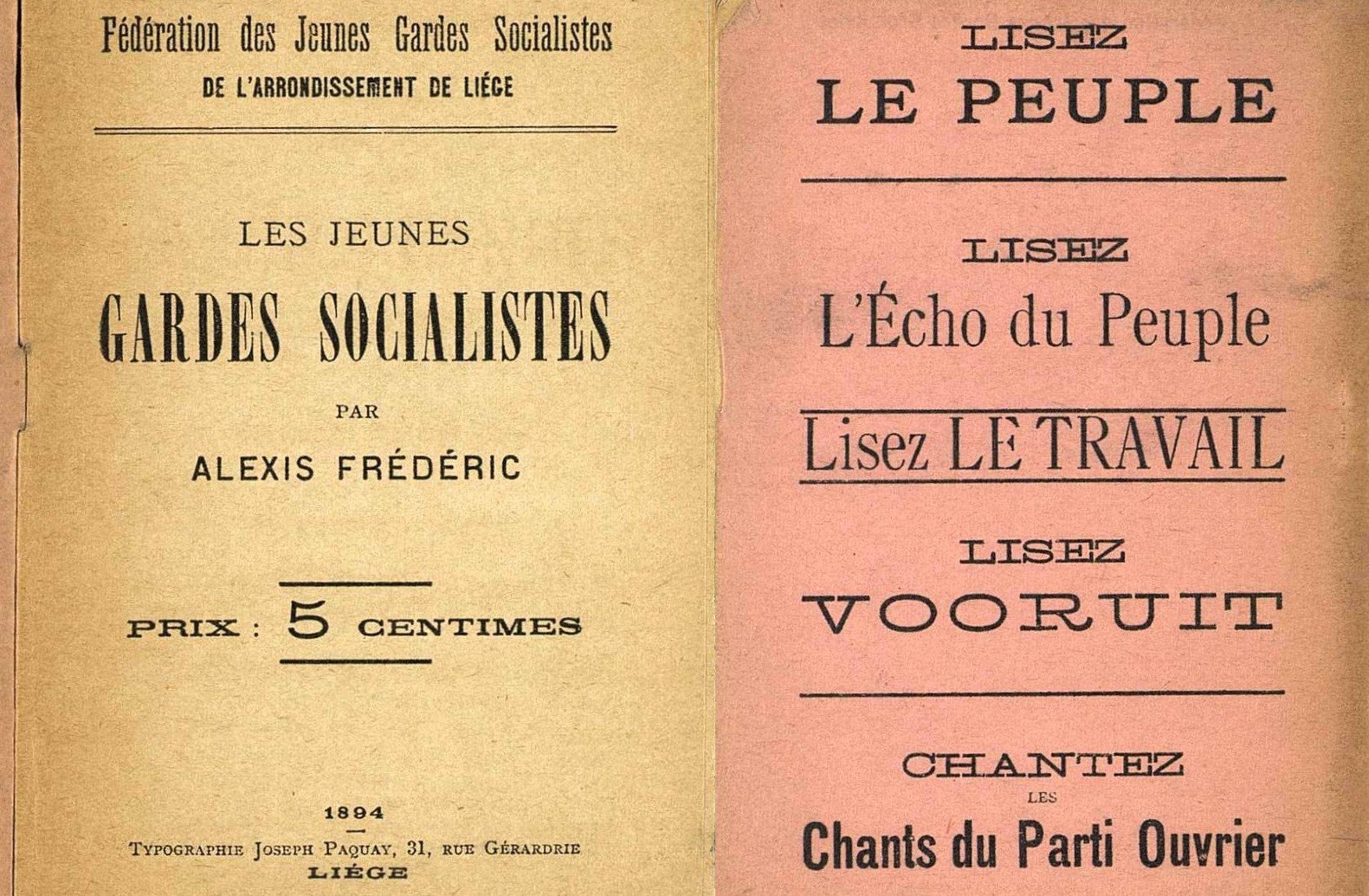
A brief history of Belgium’s Young Socialist Guard going all the way back to 1886.
‘The Early Days of the Belgian Jeunes Gardes’ by Henri De Boeck from International Press Correspondence. Vol. 7 No. 47. August 17, 1927.
On the occasion of the 20th anniversary of the first inter- national conference of Young Socialists, which took place in Stuttgart August 24-26, 1907, it will not be out of place to recall the “heroic” period of the Belgian Jeunes Gardes. After the Swiss Socialists (1,700 members) this was the strongest organisation represented at Stuttgart (1,300 members).
The Jeunes Gardes was founded in 1886. It was organised at the time of intensive industrial crisis which had prevailed for some years in Belgium and was just then entering upon its most acute stage.
From all sides was heard the same complaint, the same accusations. Workers demanded work, but they could not get it. They were hungry and cold and the shops loaded with goods tempted not a few workers.
Demonstrations and strikes were the order of the day.
The year 1886 marked the sharpest and most violent struggle of the heroic Belgian proletariat.
There was a miners’ strike at Jemmape and Liege. At first the strike was sporadic but in a few hours it extended throughout the whole district of Liege aggravated by the increase of misery and the innumerable impositions to which the workers were subjected. The strike did not take place for an increase in the miserable wages (the wages of the Belgian workers were the lowest in all Europe) but a demand was made for the maintenance of the present wages which were threatened with being reduced.
The intervention of the army, which fired on the strikers produced an enormous impression on the workers of other parts of the country. The miners in Charleroi, Centre, Borinage also declared a spontaneous strike.
Repressions were of a most savage nature! The strike which embraced all industrial centres was more in the nature of a revolt. The strikers were fired on without warning and workers’ blood began to flow.
In the midst of these battles the organisation of the Socialist Jeunes Gardes was born. It was the frequency of the intervention of the army during the strike which made the young Belgian Socialists organise the Jeunes Gardes during this terrible year.
The very conditions of its origin made of it an anti-militarist propaganda organisation. Since that time the Jeunes Gardes carried on this propaganda amongst the conscripts every year when the various classes are being called up or being demobilised.
In order to carry on this special propaganda, papers were published both in the French and Flemish languages: the “Conscrit” and the “Caserne”.
A National Federation was founded in 1889.
For years anti-militarist propaganda remained the chief activity for the Belgian Jeunes Gardes. This little Belgium “neutral” and independent (!!) and inviolate (!!!) according to its constitution always had to bear the brunt of militarism. It devoted a large part of its revenue to national defence and to the maintenance of the army. Out of a budget of less than 300 million in 1905 Belgium spent 95 million on war, that is to say more than it spent on the departments of Justice, Home Affairs, Public Education, Agriculture, Industry and Labour.
The “Conscrit” and “Caserne”, these two anti-militarist organs, had a circulation in 1907 of almost 100,000 copies. In addition to the publication of these anti-militarist journals several public meetings were held to which were invited the young people who subscribed to the papers.
Protest demonstrations were organised against the system of substitution which allowed the sons of the bourgeoisie to be replaced by a worker at a lower rate of pay.
The Jeunes Gardes also had to experience a number of attacks on their press.
More than once Vandervelde, Brouckere, Anseele, De Man were persecuted for their violent anti-militarist articles and they often were imprisoned for months at a time.
At the time of the Stuttgart Congress the Belgian Jeunes Gardes carried on the most extensive anti-militarist work. It had been doing so already for some years. One need only recall that in 1911 in an article on anti-militarist work Lenin quoted the Belgian Jeunes Gardes as an example for the entire II. International.
Our intention in the present article is not to relate the whole history of the J.G.S., but in conclusion we which to recall that the history of the J.G.S. is linked up with the history of the renegades whose names we have just mentioned. The leaders of the Jeunes Gardes such as De Man betrayed in 1914 in the same way as Vandervelde and Brouckere betrayed. De Man, the secretary of the International Federation of Young Socialist organisations at Stuttgart in 1907, some months ago has just been guilty of treachery for a second time. He has cooked up a new social theory which replaces Marxism (?) and demolishes Leninism (??).
We young comrades who have taken all that was revolutionary in the Jeunes Gardes of 1886 and 1907 will guard this heritage and show ourselves worthy of it. We will fight in the spirit of the Jeunes Gardes of 1886 and 1907 despite their leaders who betrayed them, despite their leaders of the present day who are content to follow their leaders of yesterday like eunuchs. This is what the history of the early days of the Belgian Jeunes Gardes teaches us.
International Press Correspondence, widely known as”Inprecorr” was published by the Executive Committee of the Communist International (ECCI) regularly in German and English, occasionally in many other languages, beginning in 1921 and lasting in English until 1938. Inprecorr’s role was to supply translated articles to the English-speaking press of the International from the Comintern’s different sections, as well as news and statements from the ECCI. Many ‘Daily Worker’ and ‘Communist’ articles originated in Inprecorr, and it also published articles by American comrades for use in other countries. It was published at least weekly, and often thrice weekly.
PDF of full issue: https://www.marxists.org/history/international/comintern/inprecor/1927/v07n47-aug-17-1927-inprecor-op.pdf
 Revolution's Newsstand