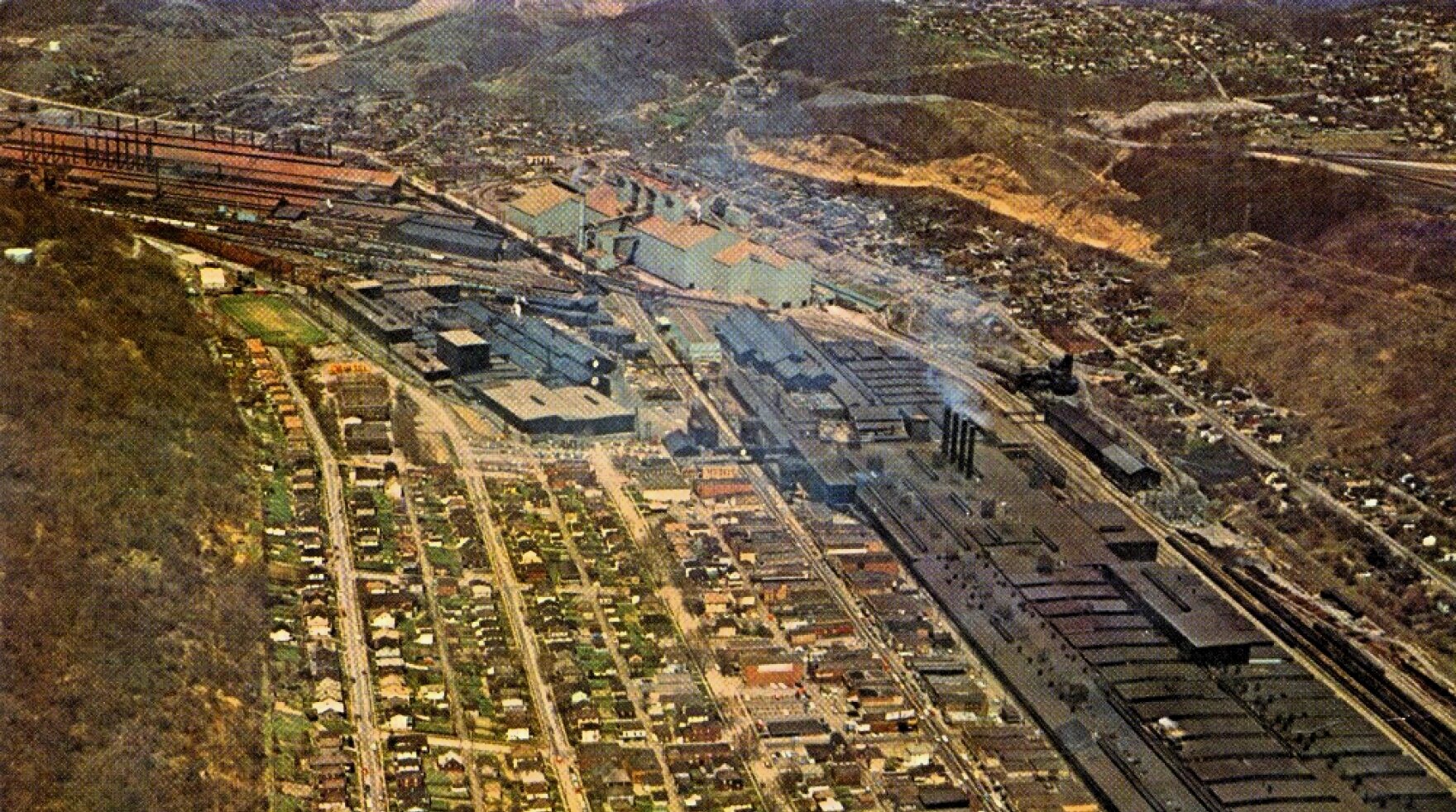
The history of Steubenville is intricately linked with that of Weirton, just across the Ohio River in West Virginia. The fiefdom of Ernest T. Weir and his Weirton Steel Corporation, at one time employing 14,000 people in the small city, the state’s largest single employer. In 1909 Weir took over the village of Holiday’s Cove to transform it into a steel-making labor camp. Steubenville, with a long history of craft unions, was relatively free by comparison, with the city being used as the base of various organizing efforts, like the one described below, to unionize the massive plant. Here, the C.I.O.’s Steel Workers Organizing Committee takes up the fight in 1936, three years after a strike went down to defeat. Weir fended off all unions until 1950, and it was not until 2007 that the plant, and its then meager workforce, were fully organized into the United Steel Workers. The final 800 employees of the plant were dismissed in 2024 and operations ceased.
‘Weirton: Feudal Domain’ by Marguerite Young from New Masses. Vol. 20 No. 7. August 11, 1936.
WEIRTON, W. Va. CAN this be America, 1936? Whole towns composed of nothing but houses, predominantly matchbox houses, a few churches and food stores and bleak little shops flaunting a dowdy silk dress or so. Communities without a hotel, much less a library; without one-tenth enough telephones or half enough bathrooms, much less a lecture hall or orchestra; nude, hot towns with hardly a tree, much less a park or flower. No, it must be eighteenth-century industrial England or a faked Hearst photo for a Soviet horror yarn.
But look across the land to the mill- and tipple-bound horizons. Yes, it is America, 1936. Nowhere else such rich colors of natural abundance and industrial development. Green knolls and vales giving up coal, and blue rivers sweeping past roaring red and black mills with rusty hills of ore piled beside them, to make steel, to make modern civilization’s hard bright base. And occasionally beside the bold old stacks and blast furnaces and fire-showering Bessemer converters, a new mill rising for ever more ingenious machines to make and to mold more and better steel.
Over all, there hovers the incubus of the feudal omniscience of the masters living somewhere in Pittsburgh’s suburb, Sewickley, or on Long Island; or taking their ease, here in Weirton, in a manorial clubhouse on the heights looking down upon the fief as in the days of Ivanhoe. Their flunkeys’ every word and gesture underscores their contempt for social progress, for modern social and political institutions.
The methods of intimidation are pretty much the same everywhere, but Weirton has devised certain extra-special features.
Weirton is one of six National Steel Corporation plants. It is something of a pace-setter in the one big bosses’ union, the Iron and Steel Institute, for its chairman is Ernest T. Weir, palm-holder for defiance of the NRA. Did not Weir make use of New Deal agencies first to stall a strike and later to obtain a settlement followed by wholesale black- listing to bust the union? Weir was an aggressive leader, too, in the subsequent resort through the courts to the “unconstitutionality” challenge to the statutory right to organize. He is more. He is a political as well as a labor policy-maker for his fellow reactionaries of industry and finance–a member of the national executive committee of the American Liberty League, national Republican finance committeeman, one of the prompters at the Cleveland convention.
And though some sixteen thousand people live here, yet Weirton is not a town at all. It is unincorporated! That means the company pays no local taxes, which probably halves its total. It means the people must look to the company for the upkeep of their streets, for garbage disposal, for any number of public needs. A thrifty arrangement for the mills. What little out-of-pocket expense it calls for is nothing in relation to the tax-saving, and the grip it gives the company upon the community. Spend a couple of days in Weirton, however, and you conclude it offers even more significant benefits to the company. It gives carte blanche to thugs, private police, and provocateurs. The only law enforcement officers around the town are two squires and five deputies under the Hancock county sheriff. It is against state law for a citizen to carry a weapon without a permit, but Weir’s private police are armed. Besides, Weirton runs into the town of Holiday’s Cove, incorporated before Weirton grew up round the mills, although it has only 6,500 citizens. Oddly enough its police operate in Weirton also, at least when Weir needs them. That was arranged under a West Virginia act giving them jurisdiction within a radius of five miles of Holiday’s Cove limits.
A Democratic office-holder explained matters succinctly, saying complacently, “Everybody breaks the laws around here. The Weirton Steel Company breaks ’em. What laws? All of ’em. You name me a law and I’ll tell you who breaks it. See that man riding down the street–?”
Pointing through his own second-story window crudely lettered, DANIEL FERGUSON, JUSTICE OF THE PEACE, the Squire singled out an auto moving below on the main street. He said the driver was a big politician and merchant and never bought a chicken, but got them from a gang of thieves who stole them for him out of the farmers’ coops.
“Yeah,” the Squire philosophized, “the laws are bound to be broken. There are too damn many of them.”
He volunteered that the mills “own” the other, the Republican, Squire, but considered himself “neutral,” in the organizing contest as always. He wanted to make it plain that E.T. Weir wasn’t involved in local plant affairs.
“This plant’s really run by the Weirton company president, T.E. Millsop,” the Squire went on. “He’s exactly my age and a good friend of mine. Last time I saw him I told him I’m going to run for sheriff and he said he would support me. I said, ‘Well, Tom, while I’m talking to you, I might as well say I expect to get union support.’ And Tom said, ‘Why, that’s all right, Dave, I’ll still support you. I know how it is when you’re in politics.’ I kept asking him to be more specific about lawbreaking. Was the Wagner Labor Relations Act disregarded?
“That,” he said, “is one law I never had a chance to look into.” Of course, it is a federal law, but in case of a strike to enforce its legal guarantee of collective bargaining, the Squire might have to do with peaceful mass picketing. What was his attitude to- ward mass picketing? He replied, “I really don’t know the law on that.”
SEVERAL weeks ago the Steel Workers Organizing Committee sent Organizer Kramer into Weirton and he was railroaded out. He stepped into Holiday’s Cove for a quiet meeting with the workers. On the main street two cops stopped him, “Mr. Kramer?” and told him the Mayor wanted to see him. He went along with them. Mayor C.F. Cattrell “warned” the organizer that if he hung around, he would be sorry, he would be “messed up.” Kramer was not impressed. When he got back to his hotel across the river in Steubenville, Ohio, however, eight men walked in, surrounded him, and took him to a train. Since then an ugly rumor spread: Kramer was just yellow! Nobody went into his hotel, the workers were told, no employe of the establishment would say he saw anyone. Fortunately, the SWOC forces in Pittsburgh have the evidence. Not only was Kramer taken out by eight men, but three of them were gentlemen from that famous strike-breaking agency, Railway Audit and Inspection, Director Clinton Golden said. Moreover, there is a very good reason why the hotel employes say nothing. The hotel, like almost everything else, is owned partly by Weirton and Wheeling Steel!
Holiday’s Cove Police Chief Joseph Kerr told me he didn’t “arrest” Organizer Kramer–he just “picked him up and brought him up to see what the Mayor wanted.” He said, “Sure it’s customary to pick people up like that. When any stranger comes around here we find out what’s his business. Holiday’s Cove is not like Weirton. We don’t tolerate any crime around here. Up there things aren’t the best.” I asked him why he didn’t go after crime in Weirton, since one of his cops went in to arrest Organizer Kovalski. He replied casually that they go into Weirton “only in cases of emergency.” Other queries he met with, “Ask the Mayor.”
So I spoke to the Mayor. He was brutally blunt. He said: “I knew Kramer was here and I knew the community was hostile to him and somebody would clean up on him. That’s the attitude of the mill workers. They don’t want any organizer in here, and I know if any organizer comes around, he’s going to get messed up.”
“You mean an organizer is likely to be set upon, is subject to physical violence?” I asked the Mayor. He replied, “I say an organizer is about as welcome down here as a tom-cat in a bulldog’s kennel, and if he stays I’ll not guarantee what’ll happen to him. I’ll warn him, that’s all. That’s all I did to Kramer.”
I had talked with many Weirton workers, and found exactly none hostile to the industrial union. Afraid of the bosses many were, but not hostile to the union. That did not impress Mayor Cattrell, however. Nor did a reminder that the Constitution requires him to exercise his police power to protect life–even an organizer’s life. He told me coldly, “I can’t do that. I’ve only four policemen for Holiday’s Cove with 6,500 people.”
“Isn’t it odd you can’t spare a cop to protect an organizer in your town, but you can send them outside to get one?”
“Why, that was only a few inches out of the city limits of Holiday’s Cove,” was the Mayor’s answer, “or maybe they got him inside Holiday’s Cove.”
Wishing to feel certain the Mayor realized what he was saying I asked again whether he refused to prevent physical violence to organizers. He merely rephrased, “I say the sentiment is hostile. If organizers persist in coming in here, and get messed up, that’s their trouble.”
“But they have a legal right to go in to organize. You recognize that, Mayor?”
“No, it’s not illegal. But if you go into somebody’s house and they don’t want you there, I can’t be responsible.”
“That’s hardly the same thing as walking the streets, organizing. Any worker who doesn’t want to join the union only has to say so.”
“It’s not the same thing and yet it is the same too,” the Mayor responded. “You know, you hear a lot about organized labor. Well, we don’t want it in here. They were in here about two years ago, and how long did it take to throw it overboard?”
“Why are you so sure something will happen to organizers?” I asked. “What made you so sure something would happen to Kramer?”
“How do you know,” the Mayor countered, “that the sun is going to rise tomorrow?”

Nor is there any necessity to wonder how Weirton expects to conduct the “messings-up.” Both Holiday’s Cove and Weirton are plastered with big red and white placards. In every little shop window you see: “WE SUPPORT THE WEIRTON STEEL EMPLOYES SECURITY LEAGUE BECAUSE WEIRTON EMPLOYES SUPPORT US.” You might think the whole town opposed the union, for in the name of the so-called “Employes Security League,” its leader issued anti-union statements to the press. The Employes’ Security League, said its leader, passed around a pink sheet declaring that in view of “unrest” which “is being brought about by the efforts of the CIO to organize the steel workers into one vast union under the leadership of John L. Lewis,” the undersigned would “vigorously” oppose any effort “to disturb the present satisfactory conditions.” The company announced that precisely 99.6 percent of its workers signed, thus becoming members of the Security League.
I talked to some people about it. A small business man who had the placard in his window said: “They just brought it in and told me to leave it there. I didn’t know what it was, but I knew that if I didn’t put it up I would be in trouble. You know, the company formed a Chamber of Commerce some months ago, and if you don’t do as they say, they will put the screws on, even though there are just about thirty-five business men in the Chamber of Commerce.”
Along the main street I stopped and talked with a dozen or more millhands. Only they did not talk, they whispered. They told me the “company representatives,” as they judiciously termed the company’s men in the company union–and some distinguished between those and the company union representatives who try to introduce a might of trade unionism into the setup–came around and demanded their signatures, with their department and check numbers. In some cases men were called into the office one by one and told to sign.
“Where can I find the head of the Security League?” I asked one worker.
“Humph,” he grunted contemptuously. “Don’t know.”
“Are you a member of the League?” “No.”
“Did you sign the statement it put out?” “Yes.”
“Then aren’t you a member?”
“No. Is no League. We have no meeting. They come around and say, ‘Sign.’ I ask if it means we don’t get no increase in wages and they say, no, it only means you don’t want the outside union.”
“Are you opposed to the outside union?” “No.”
“Then why did you sign?”
“If not,” the worker smiled, “boss put eye on you. First chance comes along, fire you.” “Do you expect to join the industrial union?” I asked him. He replied swiftly. “Yes. And when everybody strike, I go too. And I stick! Even if I be the last one back to work. Like I did in 1933.”
A group of three, one after the other, standing on a corner waiting for the whistle, said, “We’re ready–just waiting for the organizer.” A Negro youth on a bus declared, “The Company will be sorry they made us sign, because we signed one way but we’ll do another.” “You mean you’re for the industrial union?”
“Certny,” he flashed a smile.
“But you signed the League statement?” “We had to,” he said, “but that don’t mean we ain’t joining the union.”
“You yourself-are you joining?” “Certny,” he flashed again.
These words-in a town so terror-ridden that union organizers, working secretly, cautioned me against returning. Talk to officials once, they said, and you are marked. I did come in again, and once more, when opportunity offered, the workers spoke up for the union.
I FOUND the head of the Security League, Jack Larkin the head of the company union. For his company-union functions, Larkin is paid $25 a month extra, plus “operating expenses” of 50 cents per man voting in company-union elections, and, he commented, “It’s worth it.” He is a tough-spoken big Irishman, a roller who was promoted just about the time they fired Mel Moore, in February 1935. Moore had been a roller also, one of the most highly skilled and highly paid in the industry. But then, Moore was a Democrat and said so when asked about it in a “safety” meeting in the mills, and Moore was a leader in the Amalgamated Association and in the rank and file A.A. movement that gave impetus to the present drive.
Larkin was very busy in company-union headquarters, located in the company’s “industrial relations” building. As you go in there, you see a door bearing instead of the name of a union or of a wage committee, the prophetic legend, “Recreation and Athletics.”
He related proudly that he himself formed the Security League at “a mass meeting of company union representatives,” from three National Steel plants. He said, “I invited the men.” I asked him why. He replied. “They wanted to know whether we’d stand back and let this union drive go through or whether we wouldn’t. They wanted something to offset this Lewis drive.”
Was “they” the management, or the men? Larkin said it was the latter, but when pressed on the point, passed the buck: “Other company-union representatives would come around to me and tell me the men were complaining to them. They wanted protection.”
“You don’t really think anyone will believe the workers are afraid of the organizers, do you?”
“They are afraid!” he exclaimed. Then, after an instant’s scrutiny, he added belligerently, “And they’re perfectly well satisfied now. They can run things for themselves. They don’t need coal miners coming in here.”
“If that’s the case,” I asked him, “why do you need the Security League to ‘offset’ the Lewis drive?”
Larkin was getting sore. He retorted with asperity, “That’s the Security League members’ business.” Then he whispered dramatically, “What would you think if I told you a coal miner was caught here last night with a gun on him!”
The League has called no meetings of the workers, Larkin continued. “Why, it would be simply physically impossible to get them all together.” No, the Security League won’t take up wage questions or other grievances. Then what will it do? What’s the difference between the League and the company union?
“Why,” he specified, “in the Security League men are banded together for their own protection. The way it’ll work is this: if the organizer comes around to your house, you can get in touch with someone, and he can get in touch with someone else, and they can get in touch with me and we can furnish protection.”

The union men are using two anti-espionage tactics. In addition to isolating and exposing the stool pigeons, they seek, in the words of an organizer, “to make the company wonder about its own stooges-and we are doing it, too.” Two organizers who followed Kramer and Kovalski into this territory are still not making themselves known generally; they want to move freely among workers, completing the building of mill committees and the signing up of a fair number, before beginning their open campaign. It is no secret to the mills that Mel Moore, the wound-striped rank and file leader, remains friendly to the union drive. They have had his little gas station under surveillance off and on ever since Moore opened it, in Steubenville. I sat inside one evening waiting to see a CIO Organizer. I couldn’t talk to him then, however. He just drove in, got his gas, and rolled on like any other customer. Moore detected a watcher parked across the street.
“Yep, there he is,” Moore said. “Funny what a good job he keeps in the mills, though he never works at it. He never bought a gallon of gas here until this organization started. Now he’s awful friendly–so friendly I can hardly make a move.”
This is old stuff to Moore. From the beginning the mill boycotted his station. Men were called into the office and asked why their license numbers were seen at Moore’s. He noticed, also, some new neighbors a young couple who were continually at the window of the house next door. He took an old license plate, nailed it up directly opposite the window, and painted on it: PLEASE GET NUMBERS. Within two days the neighbors disappeared.
Finally the spotter departed and workers on their way to the midnight turn dropped in and began to talk about the mills and the union. To unity they look for decent homes and a Frigidaire and radio and car that are paid for, and for freedom from political coercion. And for education for their children, Mel Moore said, and for some security.
“If the union don’t come this time,” he said, lifting a hand minus a finger lost sometime during his twenty-odd years in the rolling mills, “then I say God pity the nation. But they can’t stop it-nohow.”
The New Masses was the continuation of Workers Monthly which began publishing in 1924 as a merger of the ‘Liberator’, the Trade Union Educational League magazine ‘Labor Herald’, and Friends of Soviet Russia’s monthly ‘Soviet Russia Pictorial’ as an explicitly Communist Party publication, but drawing in a wide range of contributors and sympathizers. In 1927 Workers Monthly ceased and The New Masses began. A major left cultural magazine of the late 1920s and early 1940s, the early editors of The New Masses included Hugo Gellert, John F. Sloan, Max Eastman, Mike Gold, and Joseph Freeman. Writers included William Carlos Williams, Theodore Dreiser, John Dos Passos, Upton Sinclair, Richard Wright, Ralph Ellison, Dorothy Parker, Dorothy Day, John Breecher, Langston Hughes, Eugene O’Neill, Rex Stout and Ernest Hemingway. Artists included Hugo Gellert, Stuart Davis, Boardman Robinson, Wanda Gag, William Gropper and Otto Soglow. Over time, the New Masses became narrower politically and the articles more commentary than comment. However, particularly in it first years, New Masses was the epitome of the era’s finest revolutionary cultural and artistic traditions.
PDF of full issue: https://www.marxists.org/history/usa/pubs/new-masses/1936/v20n07-aug-11-1936-NM.pdf
 Revolution's Newsstand