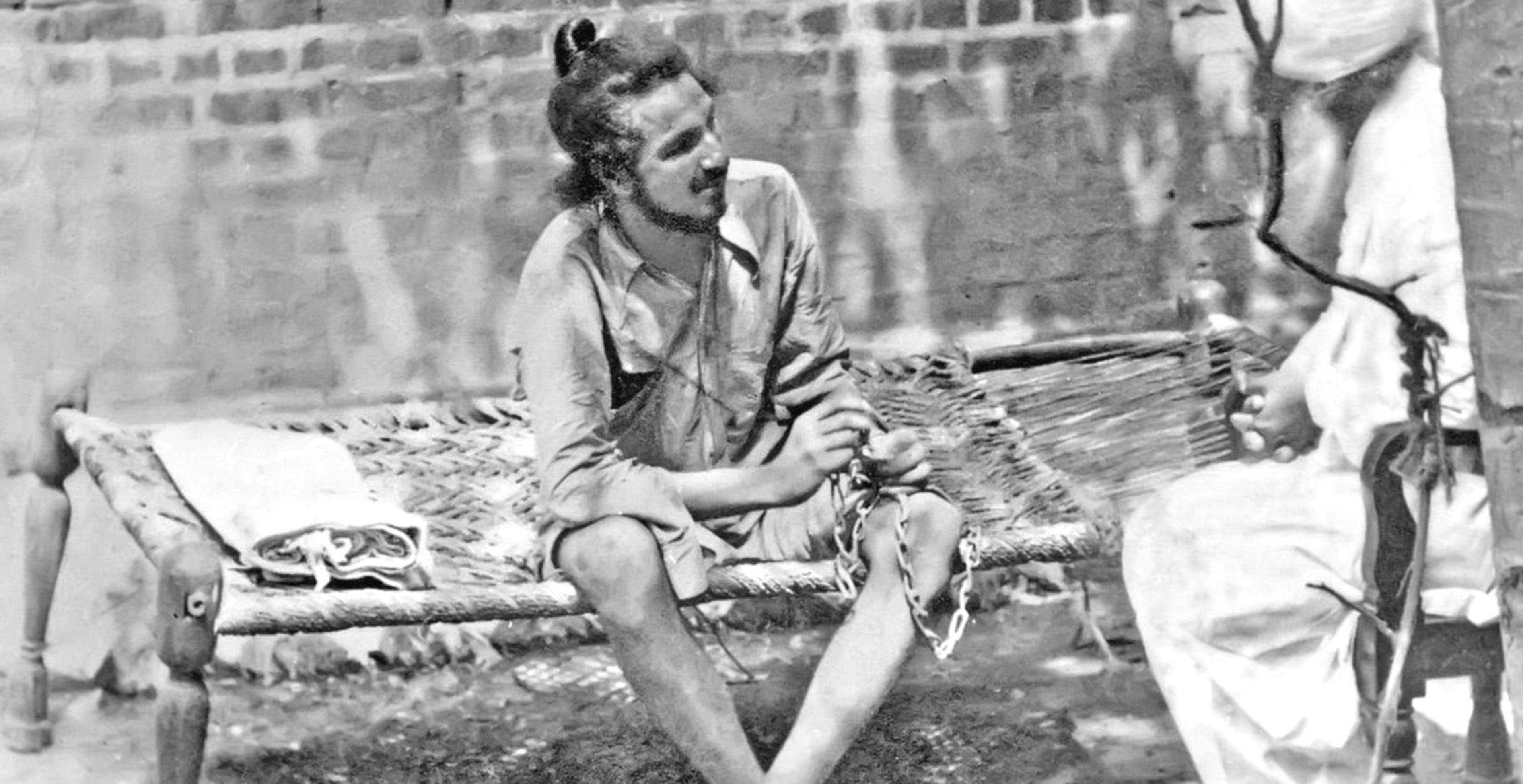
After a decade of Gandhian-led struggles saw the Empire unmoved, the militant anti-imperialist campaign of Bhagat Sing and the Hindustan Socialist Republican Association was part of a larger radicalization, and differentiation, of the Indian national liberation movement. The so-called ‘Lahore Conspiracy’ saw a dramatic chase, trial, and imprisonment before Bhagat Singh, Rajguru and Sukhdev were hung on March 23, 1931 by the colonial regime of Britain’s Labour government. The immediate aftermath saw mass strikes and confrontations with police resulting in many dozens killed. Bhagat Singh’s image and name even now is a byword for heroism and sacrifice. MacDonald, who?
‘MacDonald’s Labour Government Executes Three Indian Rebels’ from The Daily Worker. Vol. 8 No. 75. March 27, 1931.
WHILE the White Terror under Pilsudski in Poland is arousing the attention of the world, the “White Terror methods” of MacDonald in the colonies are little known to continental workers.
The events taking place in India under the MacDonald regime of naked terror equals anything known to have been carried out by Pilsudski and his butchers.
Below we give a brief account of only one case out of thousands that forever down the MacDonalds, Wedgwood Benns, Maxtons, etc., as the butchers of the oppressed colonial workers. While the MacDonald machine works feverishly to assist the capitalist campaign on so-called slave conditions and oppression in the Soviet Union, this same machine keeps a strict censorship on all news relating to the frightful regime maintained in the colonies, particularly India. When these social democratic butchers dare point their finger of scorn at the Soviet Union, when these prostitutes of socialism dare suggest that slavery exists in a country where capitalist class rule has been destroyed, then we must show the toiling European workers the India of MacDonald, the angel of peace–the bourgeoisie’s most beloved Prime Minister–the butcher of the colonial slaves.
Lahore Conspiracy Case.
The Lahore conspiracy trial opened in July, 1929, after a considerable amount of searching of the houses of known members of the revolutionary nationalist movement had taken place. Most of the people placed in the dock were accused and betrayed by police informers. Bhagat Singh and Dutt, two of the accused, were sentenced for life for throwing a bomb in the Assembly in June, 1929, and arising from evidence given during the trial, they were accused of the murder of Mr. Sanders, a government official, in 1928. The history of this so-called trial, unparalleled in the history of political persecution, is characterized by the most inhuman and brutal treatment which is the outcome of a frantic desire on the part of the labor imperialist government to strike terror into the hearts of an oppressed people.
Much indignation has been shown in India at the inhuman treatment meted out to these revolutionaries. An All-India “Dutt and Bhagat Singh Day” was observed in July, 1929, when thousands of Indians demonstrated upon the streets in sympathy, exhibiting banners bearing the slogans–“Long Live Revolution” and “Down With Imperialism.” Hunger striking was resorted to by practically every one of the prisoners as a protest against the inhuman and brutal treatment of political prisoners. At last one of the accused, Jatin Das, after a period of 63 days paid the price for his heroic gesture by death. Jatin Das had become paralyzed, blind, and his blood circulation only operated in the near vicinity of his heart. He had, in the process of hunger striking, been forcibly fed until such forcible feeding became a danger to his life. His body had been reduced by 60 pounds in weight and only weighed 19 pounds at his death. His body was carried through the streets of Lahore, followed by a huge procession of 50,000 shouting “Long Live the Revolution,” “Long Live Das.”
On Sept. 14, the day after the death of Das, the Meerut prisoners demonstrated in court. As they were brought in they shouted “Down With the White Terror,” “Down With the British Government.” One of the Meerut prisoners, Sharkat Osmani, addressed the others as follows:
“Comrades, Jatin Das is dead. He laid down his life in the cause of his country. We have to pay our homage to the departed patriot, and we should sing the ‘Red Flag’ bareheaded and standing.”
All the Meerut prisoners then stood and sang the “Red Flag” bareheaded.
Many of the prisoners, in spite of the brutal methods of forcible feeding, refused food for periods of over six weeks, and both Bhagat Singh and Bk. Dutt refused food for over ten weeks. But in spite of the terrible state of physical weakness caused by the hunger-striking, these comrades were brought into court on stretchers, handcuffed and fettered.

Many of the prisoners in October, 1929, were brutally beaten in court by the police, because they refused to be handcuffed. Unheard of brutalities were perpetrated upon the prisoners after Dutt had flung a slipper at a police informer, Jaigopol, whilst he was giving evidence. The magistrates, therefore, instructed the jail authorities to bring the prisoners to court in handcuffs. The following morning the handcuffed prisoners refused to leave the police lorry unless the handcuffs were removed. The jail superintendent ordered the prisoners to leave the lorry, and this they refused to do unless their request was granted. He therefore advised the magistrates to adjourn the case, because of the attitude of the prisoners. He ordered that the prisoners should return to jail, and while on the journey back they were beaten unmercifully by the police. One, Raj-quru, became unconscious and Bejoy was found to be bleeding. Dutt was sentenced to three months’ solitary confinement.
The following day the prisoners were again brought to court handcuffed, and again they refused to leave the lorry. The police, therefore, forcibly removed the prisoners, and so brutally did they carry out their task that the “scene in court was unbearable,” some of the prisoners were lying on the floor unconscious. The prisoners asked the magistrate to record their statement in the evidence as to the brutal treatment. This the magistrate refused to do. Bejoy asked for medical treatment, as some were unable to walk, one passing blood with urine, whilst all had acute pains all over the body.
One Indian paper described the tortures as follows:
“Each prisoner was assaulted by at least 20 to 25 policemen, the method of assault being most inhuman. One method employed was the penetration of fingers into the rectum and kicking of testicles. The assault continued for more than one hour, after which five prisoners got fever; all others had acute pains in different parts of the body. Mahabi Singh and Rajguree fell down senseless on the spot. Canes were frequently used, and marks can be actually seen on these prisoners.”
Under such circumstances, this political “frame-up” lasted for over nine months, the butchers of imperialism had thought it necessary to call some 600 witnesses in order to prove their charges. The government could not see the end of this great farce under such conditions, and the whole population had been incited against the barbarous treatment afforded to these prisoners, so it was necessary to hasten the proceedings.
The Viceroy, therefore, used his despotic powers, and on May 1, 1930, issued the Lahore conspiracy case ordnance, and a statement of the Viceroy which accompanied the promulgation of this ordnance contained the following:
After anxious consideration I have come to the conclusion that neither the end of justice, nor the interests of the accused are served by allowing these proceedings to drag out to a length which cannot at present be foreseen.
Public policy clearly demands that the grave charges against the accused should be thoroughly scrutinized and finally adjudicated upon with the least possible delay by a tribunal of indubitable impartiality and authority, and that the preliminary proceedings which have already extended over nine months, and the end of which is not yet in sight, should be terminated. It is also necessary to ensure that obstruction shall not further interrupt the course of justice. I have accordingly decided to avail myself of the authority conferred upon the governor-general under Section 72 of the Government of India Act, and to issue an ordnance which has the effect of entrusting the trial of the case to a tribunal to be constituted by the chief justice of the High Court of Judicature at Lahore, and consisting of three judges of the high court, and to invest this tribunal with powers to deal with willful obstruction. By these means the accused will be assured of a trial before a court of the highest possible authority, and it may be expected that a final and just decision will be reached with no unnecessary delay.” Under this new court of three judge’s “of the highest possible authority” the trial began again on May 5, 1920, and after 2 witnesses for the prosecution had been examined, two new members of the tribunal were appointed in place of two of the members who had been originally appointed.
But this did not matter–the trial proceeded for the “peace and good government of British India” and the change in the personnel of the tribunal did not matter to the ultimate finding of the court of the “highest possible authority.” The court on Oct. 7, 1930, for the “peace and good will of British India” sentenced three–Bhagat Singh, Shivram Rajguru and Sakh Dev–to death; Kishorihal, Mahabir Singh, Bejoy Qumar Sinha, Sheo Yarma, Gya Parshad, Jai Dev and Kanwal Nath Towari to transportation for life; Kundan Lal to seven years’ rigorous imprisonment, and Prem Dutt to five years’ rigorous imprisonment.
Against these savage sentences there is to be no appeal in law. The judicial committee of the Privy Council have refused the appeal of the accused and only the pressure of the international working class can save these heroic comrades from being sent to the gallows and that living death “transportation for life.”
A similar set of circumstances surround the trial of 31 comrades now proceeding at Meerut in India, who have been accused of “Conspiracy Against the King,” and have been kept in jail since March, 1929, undergoing trial.
These comrades have all taken some prominent part in the organization of the working-class movement in India, and this in itself is regarded as “Conspiracy Against the King.” It has taken the labor government of Britain nearly two years and some thousands of pounds to fake this trial–yet in the interests of imperialism it must proceed.
Unless the workers are prepared to stop this butchery, the Meerut trial can at any time be transferred in the interests of “peace and good will in British India” to a special court of the “highest authority” in order to bring about a speedy conviction.
The Lahore conspiracy political frame-up and the Meerut conspiracy political frame-up were initiated by the Baldwin government, but conducted by the brutal imperialist butcher, MacDonald. Judicial murder is their slogan, in order that British imperialism may retain its stranglehold on the bodies of the colonial peoples. The overthrow of imperialism is the task of the international world proletariat, under the leadership of the Communist International.
Down with the White Terror!
Down with imperialism and the Second International butchers!
Forward to world Communism!
The Daily Worker began in 1924 and was published in New York City by the Communist Party US and its predecessor organizations. Among the most long-lasting and important left publications in US history, it had a circulation of 35,000 at its peak. The Daily Worker came from The Ohio Socialist, published by the Left Wing-dominated Socialist Party of Ohio in Cleveland from 1917 to November 1919, when it became became The Toiler, paper of the Communist Labor Party. In December 1921 the above-ground Workers Party of America merged the Toiler with the paper Workers Council to found The Worker, which became The Daily Worker beginning January 13, 1924.
PDF of full issue: https://www.marxists.org/history/usa/pubs/dailyworker/1931/v08-n075-NY-mar-27-1931-DW-LOC.pdf
 Revolution's Newsstand