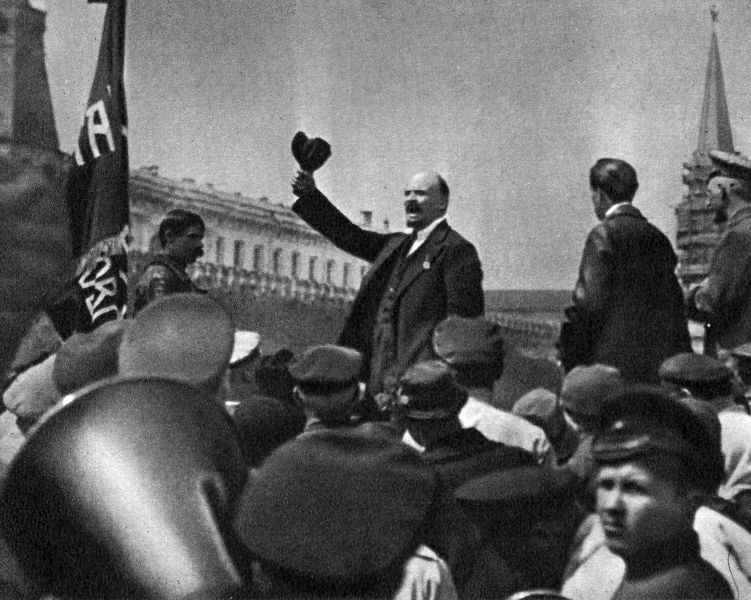
The First All-Russian Congress of Soviets of Workers’ and Soldiers’ Deputies began in its meeting in June, 1917 as the new Kerensky regime pushed the exhausted and mutinous Russian Army into the disastrous Summer Offensive. The Bolsheviks, then with only 105 of the 1090 delegates, already demanded an immediate end to that war and a transfer of power in the country from Kerensky to the Soviets. Below is Lenin’s June 22 speech to the assembly on the war taken from the Olgin and Trachtenberg ‘Selected Works’ of the 1920s.
‘Speech on the War’ (1917) by V.I. Lenin from Selected Works, Vol. 20, Bk. 2. International Publishers, New York, 1929.
Comrades! Allow me, by way of introduction to the analysis of the war question, to recall to your minds two points in the proclamation to all peoples issued on March 27 by the Petrograd Soviet of Workers’ and Soldiers’ Deputies. “The time has come,” the proclamation reads, “to begin a resolute struggle with the predatory aspirations of the governments of all countries, the time has come for the peoples to take the matter of war and peace into their own hands.” Another place in the proclamation addressed to the workers of the Austro-German coalition reads: “Refuse to serve as tools of depredation and violence in the hands of kings, landowners, and bankers.” These are the two points that are reiterated in tens, in hundreds, I think in thousands, of resolutions passed by the workers and peasants of Russia.
To my mind, these two points best reveal that contradiction, that hopelessly entangled situation into which the workers and peasants have fallen owing to the present policy of the Mensheviks and the Narodniks. On the one hand, they are for supporting the war, on the other, they are the representatives of classes that are not interested in the predatory aspirations of the governments of all countries, and they cannot help but say so. This psychology and ideology, however vague, is uncommonly deep-seated in every worker and peasant. It is a realisation of the fact that the war is being waged as a result of the predatory aspirations of the governments of all countries. But together with this, there is only a very hazy understanding, indeed, no understanding at all, of the fact that every government, whatever its form, is an expression of the interests of certain classes, and that, therefore, to contrast the government with the people, as it is done in the first passage I have quoted, is to be guilty of grave theoretical confusion and utter political helplessness, is to condemn oneself and one’s entire policy to a wavering, unstable situation and conduct. The same applies to the concluding words of the second passage I have quoted. The excellent admonition: “Refuse to serve as tools of depredation and violence in the hands of kings, landowners, and bankers,” is splendid, except that here are omitted the words: “and our own”; for when you, Russian workers and peasants, turn to the workers and peasants of Austria and Germany where the governments and ruling classes are conducting the same kind of a predatory brigand war as that conducted by the Russian, the English, and the French capitalists and bankers, when you say: “Refuse to serve as tools in the hands of your bankers,” while at the same time you let your own bankers into the cabinet and seat them together with the Socialist Ministers, you are reducing your declarations to zero, you are by your actions negating your whole policy. It appears as if you have never had those excellent aspirations and wishes, for you are helping Russia carry on exactly the same sort of imperialist war, the same sort of predatory war. You are pitting yourselves against the masses whom you represent, for those masses will never take the capitalist standpoint so frankly expressed by Miliukov, Maklakov, and others, who say: “There is no idea more criminal than that the war is being waged in the interests of capital.”
I do not know whether this idea be criminal, but I have no doubt that in the opinion of those who half-exist to-day and who will perhaps disappear to-morrow, it is criminal; yet this is a perfectly sound idea. It is the only one that expresses our conception of the war; it is the only one that shows that it is in the interests of the oppressed classes to struggle against the oppressors. And when we say that the war is a capitalist war, a predatory war, and that we must not create illusions, we do not in the least suggest that such a war could have been brought on by the crimes of individual persons, individual kings.
Imperialism is a distinct stage in the development of world capital. Capitalism, after decades of growth, has reached a point where a small group of overwhelmingly rich countries—there being no more than four of them: England, France, Germany, and America— has accumulated such fabulous wealth, reaching up to hundreds of billions, has accumulated such colossal power concentrated in the hands of a few big bankers and a few capitalists—there being half a dozen of them, at most, in each of these countries—has accumulated such colossal power, that it has the world in its grip, that it has, literally, partitioned the whole globe as far as territories and colonies are concerned. The colonies of these Powers are found adjacent to each other in every country in the world. Economically too these Powers have divided the globe among themselves; there is not a bit of territory in any part of the world where they have not got concessions, or where they have not penetrated with their finance capital. This is the basis of annexations. Annexations are not mere inventions, and they have come about not because freedom-loving people suddenly turned into reactionaries. Annexations are nothing else but the political expression and the political form of that domination by giant banks that is the inevitable consequence of capitalism. It is no one’s fault. Shares—these are the basis of banks; accumulation of shares— this is the basis of imperialism. Great banks ruling the whole world by means of hundreds of billions of capital, uniting entire branches of industry by means of capitalist and monopolist combines—this is your imperialism that has split the whole world into three groups of overwhelmingly rich brigands!
At the head of one, the main group that is nearer to us in Europe, is England; at the head of the other two are Germany and America; the rest are accomplices who are forced to help the others as long as capitalist relations exist. That is why, if you visualise clearly the core of the matter, a thing instinctively felt by every oppressed human being, instinctively realised by the vast majority of Russian workers and peasants,—if you visualise it clearly, you will understand how ridiculous is the thought of struggling against war with words, manifestos, proclamations, and Socialist congresses. They are ridiculous because, no matter how many declarations are issued, no matter how many political overturns are made, the banks remain all-powerful, despite the overthrow of Nicholas Romanov in Russia. Russia has made a giant step forward; it has perhaps caught up with France which, under different circumstances, has accomplished the same thing in one hundred years, but has remained a capitalist country nevertheless. The capitalists are still here. If they are somewhat pressed, so were they in 1905; but has this undermined their power? Though it seems new to the Russians, in Europe every revolution has proved that with each rise of the revolutionary wave the workers gain a little more, but that the capitalists retain power. It is impossible to carry on a struggle against the imperialist war in any way other than by a world-wide struggle of the revolutionary classes against the ruling classes. It is not the landowners, though there are landowners in Russia and though they are playing there a more important role than in any other country, but it is not they who have created imperialism. It is the capitalist class headed by the greatest financial magnates and banks; and while this class, lording it over the oppressed proletarians, is not overthrown, there is no escape from this war. To hold on to the illusion that you can, by means of proclamations and appeals to other peoples, unite the toilers of all the countries, is possible only from the limited Russian point of view, which is not cognizant of the manner in which the press of Western Europe, where the workers and peasants are used to political upheavals and have seen them dozens of times, is laughing at such phrases and appeals. In Europe one does not know that the proletarian masses of Russia, honestly believing and condemning the predatory aspirations of the capitalists of the world and wishing for the liberation of the peoples from the bankers, have actually risen. They, the Europeans, do not understand why you, who have organisations, not found in any other country in the world, such as the Soviets of Workers’, Peasants’, and Soldiers’ Deputies, why you, having weapons, are sending your Socialists into the cabinet, why you, in spite of everything, are giving the government over to the bankers. Abroad you are being accused not merely of naiveté, that would not be so bad, but also of hypocrisy: the Europeans have forgotten how to understand naiveté in politics, they have forgotten to understand that in Russia there are tens of millions of people who for the first time have been stirred into life, that in Russia they do not know the connection between classes and the government, the connection between the government and war.
The war is a continuation of bourgeois politics, and nothing else. The ruling class is also the one to determine the policy in time of war. War is all politics, and it realises the same capitalist ends but by different means. This is why your appeal, “Overthrow your bankers,” addressed to the workers and peasants, calls forth in a class-conscious European worker either mirth, or bitter tears; for he says to himself: “What can we do, if over there they have overthrown a half-savage, idiotic and beastly monarch, the kind we have removed long ago, and are now—together with their ‘near-Socialist’ Ministers—supporting the Russian bankers?”
The bankers remain in power, they are conducting their foreign policy by way of an imperialist war, supporting in toto all the treaties concluded for Russia by Nicholas II. In this country it is particularly glaring. The principles of Russia’s imperialist foreign policy have been determined not now but by the former government with the now deposed Nicholas Romanov at the head. It was he who concluded these treaties, and these treaties are still secret; the capitalists cannot publish them, for capitalists are capitalists. But a worker or a peasant cannot understand this tangle; for he reasons that if we urge the overthrow of the capitalists in other countries, then we ought first of all to overthrow our own bankers. Otherwise no one will believe us or take us seriously; they will say: “You Russians are naive savages, you write words that in themselves are excellent, that, however, have no practical meaning.” Worse yet, they may think that we are hypocrites. You could actually read such arguments in the foreign press, were the press of all shades allowed to enter Russia across the border, without being kept back in Torneo by the English and French authorities. From a mere collection of quotations from foreign newspapers you could realise what a glaring contradiction you find yourselves in; you could convince yourselves how incredibly ludicrous and erroneous is the idea of fighting against war by means of Socialist conferences, by agreements with Socialists at congresses. Were imperialism the fault or the crime of individuals, then Socialism could remain Socialism. Imperialism is the last stage in the evolution of capitalism, which has reached the point of having divided the whole world into bits, and of having two giant groups in a life and death struggle. You must either serve one, or serve the other, or overthrow both; there is no other way out! When you oppose a separate peace on the ground that you do not wish to serve German imperialism, you are right; this is precisely why we too are against a separate peace. As a matter of fact, however, and regardless of your wishes, you go on serving Anglo-French imperialism and its aims, as predatory and annexationist as those which the Russian capitalists had, with the help of Nicholas Romanov, embodied into treaties. We do not know the text of those treaties, but any one who has followed political literature, who has read at least one book in economics or diplomacy, knows the content of those treaties. And if my memory serves me right, has not Miliukov in his books written that those treaties and promises would rob Galicia, rob the Straits, Armenia, preserve the. old annexations and get a heap of new ones? This is known to every one, yet the treaties are kept secret, and we are told that any attempt at rejecting them means a break with the Allies.
As regards separate peace, I have already stated that there can be no separate peace for us; the resolution of our party proves beyond a shadow of a doubt that we reject this as we reject any agreement with the capitalists. To us separate peace means entering into an agreement with the German robbers, who are quite as predatory as the others. But an agreement with Russian capital in the Russian Provisional Government is also a separate peace. The Tsar’s treaties are still in force, and they also rob and stifle other peoples. When I hear, “peace without annexations or indemnities”—words every Russian worker and peasant ought to say, because life is teaching them to say so, because they are not interested in banking profits, because they want to live—I must say that the Narodnik and Menshevik leaders of the present Soviet of Workers’ and Soldiers’ Deputies are in utter confusion with regard to this slogan. In their Izvestia they have explained it to mean a status quo, i.e., the pre-war situation, a return to what existed before the beginning of the war. Would that not be a capitalist peace? And what a capitalist peace! If you advance such a slogan, remember that the course of events may place your parties in power. In revolutionary times this is possible, you will have to do what you promise, and if you now offer peace without annexations, it may be accepted by the Germans but not by the English, for the English capitalists have not lost one inch of ground; on the contrary, they have grabbed land all over the world. The Germans have grabbed much, but they have also lost much, and not only have they lost much, but they are facing now the intervention of America, a most formidable foe. If you, who are proposing peace without annexations, understand by it the status quo, you sink to a position where your proposal means a separate peace with the capitalists, for if you propose the status quo, then the German capitalists, confronted with America and Italy, with whom they had once made treaties, will say: “Yes, we accept this peace without annexations; to us it is not defeat, but victory over America and Italy.” Viewed objectively, it is you who are slipping into a separate peace with the capitalists for which you blame us, for you break neither in principle, nor in policy, nor in deeds, in your practical steps, with the bankers, who are the expression of capitalist world domination, and whom you and your “Socialist” Ministers in the Provisional Government are supporting.
You are thus placing yourselves in such a contradictory and shaky position, that the masses fail to understand you. The masses, not interested in annexations, declare: “We do not wish to fight for any capitalists.” When we are told that such a policy can be stopped by congresses and agreements among the Socialists of all countries, we say: “Perhaps, if imperialism were the fault of individual criminals; but imperialism is the culmination of world capitalism, and the working class movement is connected with it.”
The victory of imperialism is the beginning of an inevitable, unavoidable division of the Socialists of the world into two camps. He who persists in referring to the Socialists as to an entity, as to something that can be an entity, deceives himself and others. The whole course of the war, two and a half years of war, have led to this schism. The Basel Manifesto, which declared that war is a product of imperialist capitalism, was unanimously signed. Not a word about “national defence” is contained in that Manifesto. No other manifesto could have been written before the war,—just as at present no Socialist would propose to write a manifesto on “national defence” in case of a war between America and Japan, where neither his own skin nor that of his capitalists and Ministers would be involved. Just try. Write a resolution for international congresses! You know that war between Japan and America is imminent, it has been prepared for decades, it is not accidental, and it does not matter who will be the one to fire the first shot. It is ridiculous! You know full well that both American and Japanese capitalists are equally predatory. Still, there would be talk about “national defence” on either side; it would be either a crime or a terrible weakness, a “defence” of the interests of our capitalist enemies. This is why we say that the schism among the Socialists is irreparable. The Socialists have completely deserted Socialism, they have gone over to the side of their governments, their bankers, their capitalists, this they have done in spite of their verbal renunciation and condemnation of the latter. It is not a matter of condemnation. By condemning the Germans for supporting their capitalists, we are covering up the fact that we are defending the same “sin” committed by the Russians! Once you condemn the German social-chauvinists, i.e., those who are Socialists in words—perhaps many of them are Socialists at heart—but chauvinists in deeds, who in deeds defend not the German people but the filthy, greedy, predatory German capitalists, then do not defend the English, French, or Russian capitalists! The German social-chauvinists are not worse than those who, in our cabinet, are perpetuating the same policy of secret treaties and pillage, and who are covering it up with good innocent wishes. Those wishes may have much good in them, they may, on the part of the masses, be absolutely sincere, but I do not and cannot discern one word of political truth in them. These are only your wishes; the war, however, is the same old imperialist war, with the same old secret treaties! You call upon other peoples to throw off their bankers, yet you support your own bankers! Speaking of peace, you have not said what kind of peace! When we pointed out the glaring contradiction underlying the conception of peace on the basis of status quo, we received no answer. In your resolution which deals with peace without annexations, you will not be able to say that it is not a status quo. You will not be able to say that status quo means the restoration of pre-war conditions. What, then? To deprive England of the German colonies? Just try to do it by peaceful agreements! The whole world will laugh at you. Just try to take away from Japan, without a revolution, the stolen Kiaochow and the islands in the Pacific!
You have become entangled in inextricable contradictions. When we, however, say: “Without annexations,” we mean that this slogan is only a subordinate part of the struggle against world imperialism. We declare that we want to free all peoples, and that we mean to begin with our own. You talk of fighting against annexations, of a peace without annexations, yet within Russia you persist in conducting an annexationist policy. This is monstrous! In the case of Finland and the Ukraine, you, and your government, and your new Ministers, are carrying out an annexationist policy. You are picking flaws in the Ukrainian Congress, through your Ministers you are prohibiting its sessions. What is this if not annexation? Such a policy means mocking at the rights of a nationality that suffered tortures under the Tsars because its children wanted to use their native tongue. Such a policy shows fear of independent republics, which, from the point of view of workers and peasants, are not in the least terrifying. Let Russia be a union of free republics. The worker and peasant masses will not fight to prevent this. Let every people be liberated, let first of all those nationalities be liberated with whom you are making the revolution in Russia. Unless you do this, you are doomed to be “revolutionary democracy” in words, while in practice your whole policy spells counterrevolution.
Your foreign policy is anti-democratic and counter-revolutionary, and a revolutionary policy may place you in a position where a revolutionary war is indispensable. However, this may not happen, either. Of late this point has been stressed by speakers and the press. I would like to dwell on it at some length.
What practical way out of this war do we see? We say: the only way out of this war is revolution. Support the revolution of the classes oppressed by the capitalists, overthrow the class of capitalists in your own country, and thus set an example for other countries. This is Socialism. This is the only way to fight the war. Everything else is promises, or phrases, or innocent, well-meaning wishes. Socialism has been rent asunder in all the countries of the world. You make confusion more confounded when you associate with those Socialists who are supporting their own governments; you forget that in England and Germany the real Socialists, those who express the Socialism of the masses, have been left isolated, and are in prisons. Yet they alone stand for the interests of the proletarian movement. Suppose in Russia the oppressed class finds itself in power? People ask: “How will you alone tear yourselves free from the war?” We say: “To tear ourselves free from the war alone is impossible.” Every resolution of our party, every speech of our orators at meetings says that it is absurd to imagine we could tear ourselves free from the war all alone. Hundreds of millions of people, hundreds of billions of capital are involved in this war. There is no way out of it, except by the passing of power to the revolutionary class that is actually bound to destroy imperialism, i.e., to break all the financial, banking, and annexationist fetters. While this is still not done, nothing is done. The overturn reduces itself to this, that instead of tsarism and imperialism you now have received a thoroughly imperialist near-republic which, even on the part of the revolutionary workers and peasants, cannot treat Finland and the Ukraine democratically, i.e., without fearing a split.
When they say that we want a separate peace, it is untrue. We say: no separate peace with any capitalists, and first of all with the Russian capitalists! The Provisional Government, however, has a separate peace with the Russian capitalists. Down with this separate peace! While we do not recognise any separate peace with the German capitalists, and do not enter into any negotiations with them, we are at the same time opposed to a separate peace with the English and French imperialists. We are told that a break with the latter means entering into an agreement with the German imperialists. Untrue. We must break with them forthwith, for this is a predatory alliance. We are told that we must not publish the treaties. Indeed, this would heap disgrace upon our entire government, upon our whole policy before the eyes of every worker and every peasant. If we published these treaties, if we clearly said at meetings to the Russian workers and the Russian peasants everywhere, even in each remote little village: “This is what you are fighting for; for the Straits, for the retention of Armenia,” then they would all reply: “We do not want such a war.” (Chairman: Your time is up. Voices: Please. Ten more minutes. Voices: Please.)
I say that this alternative: either with the English or with the German imperialists, that peace with the Germans means war against the English, and vice versa—is absurd. Such an alternative is of service to those who do not break with their capitalists and bankers, who allow for every possible alliance with them. It is of no service to us. We speak of defending our alliance with the oppressed classes, with the oppressed nationalities. Stay faithful to such an alliance, and you shall be a revolutionary democracy. This is not an easy task. This task does not allow us to forget that under certain circumstances we may not be able to avoid a revolutionary war. No revolutionary class can forswear fighting a revolutionary war without being doomed to ludicrous pacifism. We are not Tolstoians! If the revolutionary class seizes power, if there are no more annexations in its state, if banks and big capital cease to wield power, a thing rather difficult in Russia, it will mean that the revolutionary class is waging a revolutionary war in deeds, not in words. We cannot forswear waging such a war. This would mean falling into Tolstoiism, into philistinism, into forgetting the whole science of Marxism and the experience of all European revolutions.
Russia cannot be stricken out of the war all alone. But Russia has mighty allies who keep on growing. They do not as yet have faith in you, because your position has been so contradictory and naive, because you have been advising other peoples to renounce annexations while you are introducing them in your own country. To other peoples you say: “Overthrow the bankers,” yet you do not overthrow your own bankers. Try a different policy. Publish the treaties and expose them to the contempt of every worker and peasant. Say: “No peace with the German capitalists, and a complete break with the Anglo-French capitalists! Let the English get out of Turkey, and let them not fight for Bagdad! Let them get out of India and Egypt! We do not want to fight to save the accumulated loot, just as we refuse to spend one atom of our energy to help the German brigands save their loot.” If you do the things you have talked about—and in politics words are not given much credence, and for good reason—if you not only say but actually do these things, then the allies that are now potential allies will show what they can do. Look at the sentiment of all the oppressed workers and peasants—they sympathise with you, they regret that you are so weak, that, having arms, you let the bankers stay. Your allies are the oppressed workers in all countries. You will have the same thing that the revolution of 1905 revealed. At the outset it was terribly weak. But what were its results internationally? What foreign policy did the history of 1905 determine for the Russian Revolution? At present you conduct the foreign policy of the Russian Revolution in full accord with the capitalists. But 1905 has shown what the foreign policy of the Russian Revolution ought to be. The fact is indisputable, that immediately after October 30, 1905, mass disturbances began in the streets of Vienna and Prague and barricades were built. Following 1905, there came 1908 in Turkey, 1909 in Persia, and 1910 in China. If you call the real revolutionary democracy, the working class, the oppressed, instead of making agreements with the capitalists, then your allies shall not be the oppressing but the oppressed classes, not nationalities where now the oppressing classes are temporarily in power, but nationalities that are now being torn to pieces.
We are reminded here of the German front concerning which not one of us has suggested any change, except the free distribution of our proclamations, which have the Russian text printed on one side and the German on the other, and which say: “The capitalists of both countries are robbers; their removal is only a step toward peace.” But there are other fronts. There is a Russian army at the Turkish front; its size I do not know. If this army, now kept in Armenia and perpetrating annexations which you, while preaching peace without annexations to other peoples, tolerate though you have authority and strength; if that army carried out this programme, if it turned Armenia into an independent Armenian republic, if it gave that republic the money that we give to the French and English financiers, things would be much better! It is said that we cannot get on without financial support from England and France. But this support “supports” as a rope supports a hanged man. Let the revolutionary class of Russia say: “Down with such support, we do not recognise the debts contracted with the French and English capitalists, we call upon all to rise against the capitalists! No peace with the German capitalists, and no alliance with the English and French capitalists!” If we actually carry on such a policy, our Turkish army will be free to turn to other fronts, for all the peoples of Asia would see that it is not only in words that the Russian people proclaims peace without annexations on the basis of self-determination of nations, but that the Russian workers and peasants actually place themselves at the head of all oppressed nationalities, and that their struggle against imperialism is to them of grave revolutionary importance and not an empty wish or a glittering ministerial phrase.
Our situation is such that the danger of a revolutionary war, though possible, is not inevitable, for the English imperialists will scarcely be able to wage war upon us, if we turn to the peoples surrounding Russia with our example of action. Prove that you are setting free the republic of Armenia; enter into agreements with councils of workers’ and soldiers’ deputies in all countries; prove that you are for a free republic, and the foreign policy of the Russian Revolution will become really revolutionary, really democratic. It is such now only in words; in point of fact, however, it is counter-revolutionary, for you are bound up with Anglo-French imperialism, but you do not wish to say so openly, you are afraid to admit it. Instead of calling upon others to “overthrow their bankers,” it would be better were you frankly to say to the Russian people, to the workers and peasants: “We are too weak, we cannot throw off the yoke of the Anglo-French imperialists, we are their slaves, that is why we are in the war.” This would be the bitter truth, but it would have revolutionary significance, it would actually bring nearer the end of this predatory war. This would mean a thousand times more than the agreement with the French and English social-chauvinists, than the convocation of congresses, than the continuation of a policy where you are actually afraid to break with the imperialists of one country and are the allies of the imperialists of another. You may rely on the oppressed classes in the European countries, on the oppressed peoples of weaker countries who had been crushed by Russia under the Tsars, who are still being crushed, as is Armenia now; basing yourselves on them, you can give freedom by helping their workers’ and peasants’ committees; you can become the leaders of all oppressed classes, of all oppressed peoples in their war against German and English imperialism, who cannot unite against you, for they themselves are in a life and death struggle against each other, for they find themselves in a helplessly difficult situation whenever the foreign policy of the Russian Revolution, a sincere union with the oppressed classes and oppressed peoples, is likely to be successful; and there are ninety-nine chances in one hundred that it will be successful!
In the Moscow paper of our party, we recently came across a letter from a peasant who speaks of our programme.” I take the liberty to conclude my speech with a quotation from the letter showing how the peasant understands our programme. The letter appeared in No. 59 of the Social-Democrat, the Moscow paper of our party, and was reprinted in No. 68 of the Pravda:
“We must press the bourgeoisie harder, let it burst at all the seams. Then the war will be ended. But if we do not press the bourgeoisie hard enough, things will be bad.”
Pravda, Nos. 95, 96 and 97, July 13, 14 and 15, 1917.
PDF of full book: https://archive.org/download/lenin0010mois/lenin0010mois.pdf
 Revolution's Newsstand