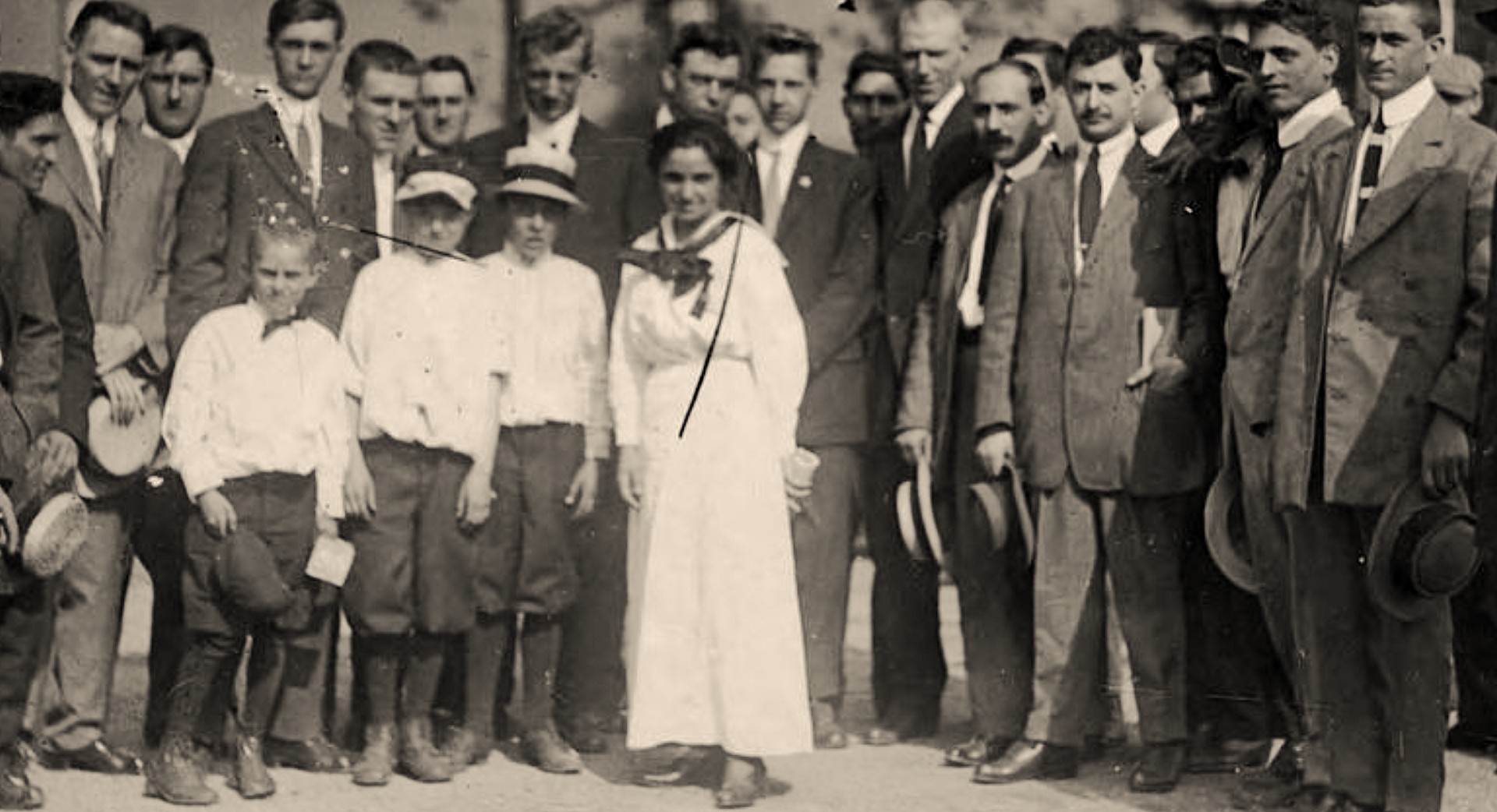
An important essay from Matilda Robbins on what is, in many ways, a microcosm of the U.S. labor movement. Robbins (sometimes signed Rabinowitz) exposes a direct ancestor to today’s UNITE/HERE union, the Amalgamated Clothing Workers of America, the misleaders of labor, and the liberals who love them. The A.C.W.A. was born as a radical rebellion, the Chicago Uprising of 1910, against the A.F.L.’s conservative United Garment Workers of America, led by the ‘Socialist’ leadership around Sidney Hillman. That leadership was both ‘progressive,’ becoming the by-word for ‘social-unionism’, and whose overriding anti-Communism led it to make common cause with the government and gangsters, which would come to dominate whole locals. Matilda had his number from the go.
‘A Near Industrial Union’ by Matilda Robbins from One Big Union Monthly. Vol. 2 No. 8. August, 1920.
Those who read the “New Republic” have recently been introduced to a series of articles on an organization known as the Amalgamated Clothing Workers of America, written by William Hard, star journalist of that periodical.
Hard is a very clever writer—clever with that superficial knowledge and play on words so peculiar to his trade. It is amazing with what degree of sureness he discusses things that are seemingly foreign to him and how misleading the whole tone of his articles is while appearing to be well-informed. He tries to show a familiarity with labor union jargon, with proletarian jargon, with revolutionary jargon. But his mind and his pen constantly run on bourgeois ethics, on “business” methods, on “specialists” and on leaders. The great mass of workers that comprise the Amalgamated Clothing Workers of America counts for nothing in his articles; he dwells among executives, officials and “leaders,” and it is from them that he gets his estimate of problems and conditions of labor. He may be a good observer, but labor organizations need more than observation; they need study. This he has not done, and the result is that he gets over, under guise of progressivism, a most pernicious set of practices by as unscrupulous a set of “leaders” as ever took root in the American labor movement.
I cannot quarrel with Hard too much. He is just a journalist, writing for a periodical whose readers are mainly liberal harmonizers between capital and labor and would always welcome such labor leaders as have fastened themselves on the Amalgamated Clothing Workers. My protest and the protest of my earnest and class-conscious fellow workers is against this newly powerful group of leaders who have come among us to cloak their conservatism, if not reactionism, with honeyed and “revolutionary” phrases; who speak of the A.F. of L. as reactionary and undemocratic, only to become as that organization and even worse.
A convention of the Amalgamated Clothing Workers of America was recently held in Boston. According to William Hard this is “the most proletarian” advanced trade union in America.” The president of this union, Mr. Sidney Hillman, who addressed the delegates to the convention—workers from the clothing shops of New York, Chicago, Baltimore, Rochester and other places—as “fellow workers,” costs the union $7,500 a year in salary alone. Small wonder that Hard saw in Hillman a “neat, trim, quiet, collected” (I should say collecting), agreeable, smiling…extremely successful manager of the most proletarianly advanced trade union in America.”
I think that Samuel Gompers is a much underpaid official, for he, president of the whole American Federation of Labor, gets only a little more than Sidney Hillman, president of the Amalgamated Clothing Workers, only lately a secession union of one of the A.F. of L. internationals.
I don’t know how much Sidney Hillman earned as cutter in a clothing factory five years ago, but I strongly suspect that it was considerably less than $7,500 a year, even in rush seasons when he worked overtime. Five years or so of managing a “proletarianly advanced” union, however, has a tendency to raise the standards of the manager. When I think of Lenin and Trotzky and other members of the Central Committee of the Federated Russian Soviet Republic receiving about $90 a month, and how little this sum can now buy in Russia, I wonder if those delegates who cheered Russia’s Soviet Republic and Russia’s Red Army could have remembered their $7,500 a year president and their other expensive officials.
A strange anomaly are these clothing workers! They fought their way through the most pernicious system of sweat shop exploitation known in this country into some semblance of organization in the A.F. of L. years ago. It took them more years to find out the corrupt leadership in their unions, the chicanery, the trading with the bosses. Then came the split of their international in the A.F. of L. and the Amalgamated Clothing Workers of America was formed.
This latest organization came into existence with the class-conscious element as a leaven. These were the rebels against the tyrannical domination of the A.F. of L. machine; against high-salaried, swallowtail coated, Civic Federationized officials; against autocratic executive boards; against the old form of craft union morality of “identity of interests between capital and labor.” This was to be an industrial, democratically managed union; a true workers’ organization. Such was the wish of the rank and file of the seceding faction. But such was not the will of the crafty ones who saw opportunity for themselves in the turn of events.
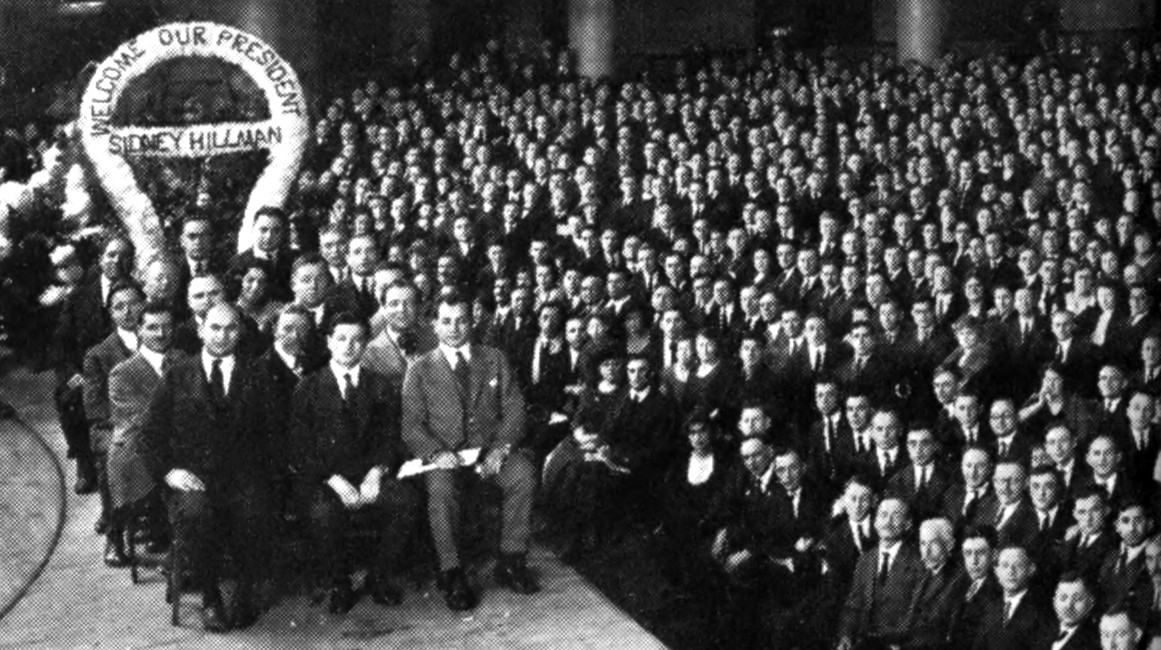
After five years of life the Amalgamated came to Boston for its 1920 convention with a swollen treasury, seeking an outlet in enterprise. It brought with it as expensive and domineering a set of officials as can be found in any of the A.F. of L. old internationals. It listened without rising in revolt against President Sidney Hillman’s plea for increased production! It silently concurred in the opinion of Executive Board Member Hyman Blumberg as to standards of work and the grading of workers according to measure of production in the co mg shops. It listened, although somewhat bored, to the lengthy reading of the secretary’s printed report, and it found no criticism with his juggling of “the philosophy of work and wages.” was perfectly behaved, this erstwhile rebellious contingent from the clothing shops, and it let the official machine run away with it.
I say “run away,” because the Hillman type of officialdom is too shrewd to run over it. This type found the steam roller of the Gompers official machine too crude and in the long run inefficient. It knows that the tendency among the workers is to recoil from craft union blows and strike back. So it has adopted the suave persuasiveness of certain lawyers in defense of ousted socialist assemblymen. It uses the term “comrade” a lot. It uses a certain kind of “good-fellow” diplomacy. It uses, above all, much verbiage—soft, superior, equivocal verbiage. Verbiage designed to show why it should get $7,500 a year jobs from the workers in the clothing industry; why these workers ought to be for increased production, for standards, for the “shop”; all these things, which really mean the maintenance of harmonious relations between the union and the boss.
It is no mere accident that the discussion of “standards” for increased production and measure of output by each “grade” of workers in the clothing shops, according to pay, was left to the very last hours of the convention. It has always been the game of officially manned conventions to leave important and delicate business to as near the close of the convention as possible, anticipating the waning freshness and patience of the delegates, and then rush it through with machine-like speed.
So the protests of those delegates who saw in this pernicious system of standards of output and increased production the revival of the old sweatshop, speeding-up, piece-work slavery were squelched by these “radical” labor-union diplomats and the convention went on record as endorsing it. These have become Amalgamated standards.
At this writing the report comes from Baltimore that 3,000 workers who pursued “Amalgamated standards” in the factory of Sonneborn & Co. are locked out. The firm claims that the manufacturing cost of clothing is too high, consequently clothing in the market is too highly priced and under-consumption ensues. Or shall we say “overproduction”? The firm proposed putting the workers with their Amalgamated standards on half time. This the union refused. So it was locked out—standards for increased production and all.
According to William Hard’s enthusiastic report of the executive board member’s emphatic demand that the opponents of standards at the convention “know that the workers in Sonneborn’s believe in standards” was about the biggest thing that happened at the convention. This grading and standardization of work and workers so impressed Hard that he could only compare it with one thing perhaps the one he knows most about—“handicapping in golf.” I’m sure the readers of the “New Republic” will understand what that means.
To the workers in the clothing industry, however, these standards that their officialdom foists on them are a real handicap—a handicap to efficient, revolutionary organization. What are these “standards but the old “identity of interests between capital and labor”? This old wolf in his new sheepskin proposes increased production—increased production so that the workers may all the sooner be thrown out of employment; increased production so that the lines of unemployed may grow even greater.
Ah, yes, but the convention voted that “The Industry,” the bosses, that is, should provide an Unemployment Fund of a million or so, which William Hard (whom it gives me pleasure to quote) declares to be “a principle natural to a truly industrial union.” I wonder if the officials of the Amalgamated Clothing Workers told Hard that this joker, designed to lead the workers away from the problem of organization along revolutionary lines, was a “principle natural to a ‘truly industrial union.” Or else, where did he get his information? It could not come from the workers, for those who did not protest against the crumbs of benevolent industrialism to be thrown to them by the bosses when they have produced too much wealth were just dumbly quiescent.
So at the convention of this “most proletarianly advanced trade-union” increased production and standards of grading were fastened on the workers in the clothing industry in the attempt of the officials to insure some degree of amity between the bosses and the union and to avert strikes. For the leaders are always against strikes. Strikes threaten their berths and disturb their peace and plenty. Anything but strikes. So the workers are led into intricacies and entanglements for which these “leaders” and interpreters and harmonizers and adjustment boards and all the rest of the legalistic machinery devised by “labor experts” must be retained at high cost. And the workers pay.
One Big Union Monthly was a magazine published in Chicago by the General Executive Board of the Industrial Workers of the World from 1919 until 1938, with a break from February, 1921 until September, 1926 when Industrial Pioneer was produced. OBU was a large format, magazine publication with heavy use of images, cartoons and photos. OBU carried news, analysis, poetry, and art as well as I.W.W. local and national reports.
PDF of full issue: https://www.marxists.org/history/usa/pubs/one-big-union-monthly/v02n08-aug-1920_One%20Big%20Union.pdf
 Revolution's Newsstand