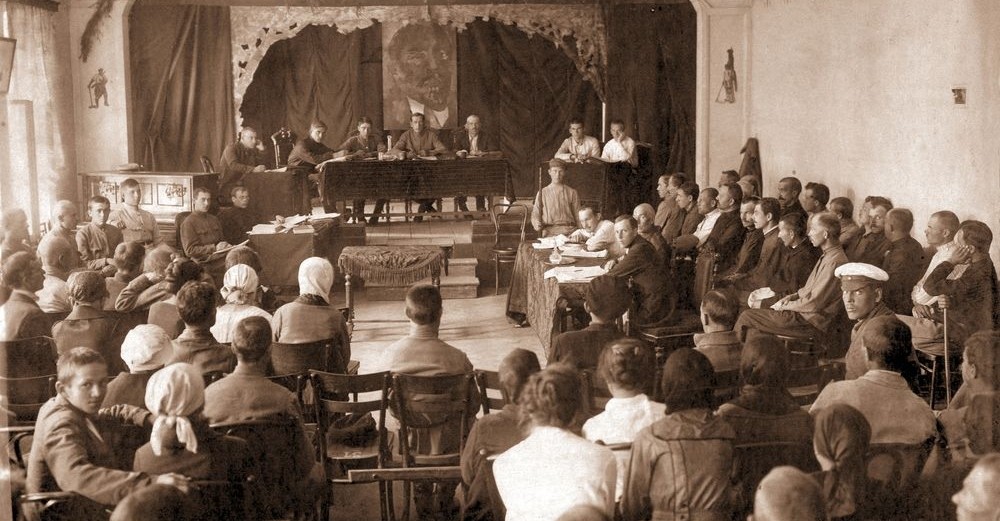
Preobrazhensky on the ideas and methods of the early Soviet legal system.
‘Proletarian Courts’ by Yevgeni Preobrazhensky from Soviet Russia (New York). Vol. 5 No. 3. September, 1921.
The Courts in Bourgeois Society
TOGETHER with all the other institutions of the bourgeois state that serve to oppress the working masses and betray their interests we must also consider the bourgeois courts.
This time-honored institution is guided in its judgment by laws that have been created in the interest of the exploiting class. Whatever may be the personal composition of the court, the court is thus limited in its decisions by the many volumes of provisions which are the outcome of all the privileges of capital and of the disfranchisement of the masses.
As for the actual organization of bourgeois courts, it corresponds fully with the nature of the bourgeois state. Wherever the bourgeois state is more or less frank, wherever it is obliged to cast aside its hypocrisy in order to force verdicts that are of advantage to the ruling class, the courts are appointed from above; even when they are elected, they are elected by the privileged portion of society. But if the masses are sufficiently trained by capital, are sufficiently obedient to capital, and regard its laws as their own laws, the workers will be permitted to a certain extent to serve, as judges themselves, just as they are also permitted to elect their exploiters or the lackeys of their exploiters to the parliaments. This explains the origin and continuance of the jury courts, with whose aid judgments pronounced in the interest of capital may be declared to be verdicts of the people themselves.
Judges Elected by the Workers
In the programs of the Socialists who were represented by the Second International the demand was raised to have judges elected by the people. In the epoch of proletarian dictatorship this demand appears just as reactionary and incapable of execution as the demand for universal suffrage or the universal right to bear arms. If the proletariat assumes power, it cannot permit its class opponents to become its judges. It cannot appoint, as guardians of the laws calculated to eliminate the domination of capital, ex-representatives of capital or of landed property. Finally, in the course of civil and penal cases, the procedure must be in accordance with the spirit of the Socialist society that is to be established.
Therefore the Soviet power has not only abolished the entire old court apparatus which, although serving capital, had hypocritically declared itself to be the voice of the people. But it has also called into life a new court, the class character of which it makes no effort to conceal. In the form of the old court the minority class of exploiters passed judgment on the working majority. The court of the proletarian dictatorship is the court of the working majority passing judgments over the exploiting minority. The structure of this court is of a nature to correspond with this situation. The judges are elected only by the workers, the exploiters retain only the right to be judged.
The Uniform People’s Court
In bourgeois society the organization of courts is extremely clumsy. Bourgeois jurists are very proud of the fact that a long series of successive courts assures complete justice and reduces to a minimum the number of errors in the application of justice. But as a matter of fact the passing of cases from one court to the other has always been in the interest of the possessing class. By having at their disposal a whole class of paid lawyers, the rich sections of the population are fully able to bring about decisions favorable to them in the higher courts, while the poor plaintiff is often obliged to desist from pressing his case, as he would find it too expensive to do so. The reference from court to court will produce a “just” decision only in so far as this decision may be in the interest of the exploiting groups.
The Uniform People’s Court of the proletarian state reduces to a minimum the period of time elapsing between the inauguration of a case in court and its disposition. The judicial waste of time–the law’s delays is rendered extremely limited, and if there are still such abuses, they are due to the necessary imperfection of all Soviet institutions in the first months and years of the proletarian dictatorship. As a final result, the court will be accessible to all the poor and uneducated sections of the population, and will be even more accessible after the period of the most bitter civil war has been passed and all mutual relations between the citizens of the republic have assumed a more stable character: “During war time all laws lie dormant,” said the Romans. But during the civil war the laws in favor of the workers did not lie dormant; the People’s Court still continued working; but unfortunately not all the population has yet had an opportunity to learn the character of the new courts and appreciate all their advantages. The task of the People’s Courts in the period during which the old society is being destroyed and the new one built up is an immense one. Soviet legislation must follow life. The laws of the landed noble and bourgeois order are abolished; the laws of the proletarian state have been set down only in the most general terms and will never have been completely recorded. The working class has not the intention to prolong its domination forever and it does not need dozens of volumes of laws of many kinds. Once it has expressed its will in one of its fundamental decrees, it may assign the interpretation and application of these decrees in practice to the people’s judges elected by the workers. It is important only that the judgments of these courts shall reflect this complete break with the customs and the psychology of the bourgeois order, that the People’s judges shall pronounce their judgments in accordance with their proletarian, socialistic conscience, and not with that of the bourgeoisie. In the endless number of litigations that will arise during the collapse of the old conditions and the inauguration of the proletarian rights, the People’s judges have an opportunity to carry out to its conclusion this transformation, which, beginning with the November Revolution in 1917, must be extended to all the mutual relations of the citizens of the Soviet Republic. On the other hand, the People’s courts, in disposing of the gigantic number of court cases which arise independently of the condition of the revolutionary epoch, of penal cases of petty bourgeois character, must assume an entirely new attitude on the part of the revolutionary proletariat toward these offenses, and execute a thorough revolution in the character of the punishments imposed.
Revolutionary Tribunals
The People’s Court, which is elected and may be recalled by the electors, and in which each worker has the right to exercise his function as judge, this People’s court is considered by the Communist Party as a norm for a court in the proletarian state. But in the most savage period of civil war the organization of revolutionary tribunals is also necessary, in addition to the People’s Courts. The tasks of revolutionary tribunals consists in passing judgment swiftly and ruthlessly on the enemies of the proletarian revolution. These courts are one of the arms for the suppression of the exploiters and in this sense they are just as much weapons of proletarian offense and defence as the Red Guard, the Red Army, the Extraordinary Commissions. For this reason these revolutionary tribunals are organized on less democratic lines than the People’s Courts and are appointed by the Soviets and not elected directly by the working masses.
Penalties Imposed by the Proletarian Court
In the bloody struggle with capital the working class may not relinquish the most efficient penalty that it can impose upon its open enemies. The abolition of the death penalty is impossible as long as the civil war continues. But any purely objective comparison of the proletarian court with the courts of the bourgeois counter-revolution will show how extraordinarily lenient the worker’s courts are, as compared with the hangmen of bourgeois justice. Death sentences are pronounced only in the most extreme cases. This is particularly characteristic of the court trials in the first months of the proletarian dictatorship. It is sufficient here to point out that the well-known Purishkevich of Petrograd was sentenced by the Revolutionary Tribunal to only two months of imprisonment. We also find in the practice of the proletarian court itself, a reflection of the greater leniency on the part of the advanced sections of society, to whom the future belongs, toward its enemies, as well as of the greater cruelty practiced in their vengeance by the moribund class.
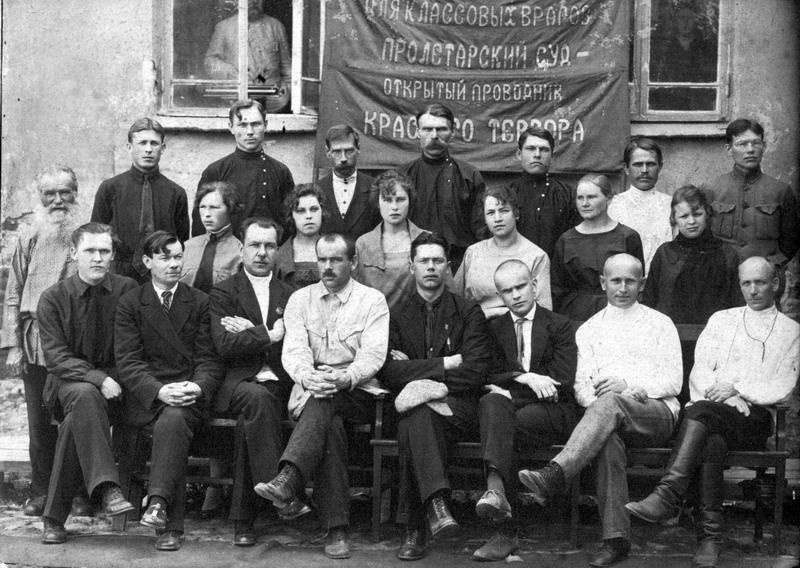
As for the penalties imposed by the proletarian court for crimes not of counter-revolutionary character, these are of entirely different nature than the penalties imposed by the bourgeois courts. And this is as it should be. The overwhelming majority of crimes committed in bourgeois society are either violations of the right of property or crimes connected more or less closely with the institution of private property. It is natural that the bourgeois state should take vengeance on criminals, and the penalties imposed by bourgeois society are nothing else than various forms taken by the vengeance of the angered property-holder. Equally stupid were and still are the punishments for crimes of accidental nature or such crimes as were due to the general disorder of bourgeois conditions as a whole (crimes based on the existing family rights, on a certain romantic predisposition, on the foundation of alcoholism and degeneration, of ignorance and stunted development of the social instinct). The proletarian court is obliged to deal with crimes the soil for which was prepared by bourgeois society, crimes that have not yet been completely outlived. The proletarian court has inherited from the old order great hosts of habitual offenders created by this order. The proletarian court knows no thought of revenge. It cannot wreak vengeance on persons for the fact that they were obliged to live in bourgeois society and therefore our courts already now are beginning to express a complete transformation in the imposing of sentences. Suspended sentences are becoming more and more frequent: in other words, a punishment without penalty, the main object of which is to prevent a repetition of the offenses. Public censure is frequently pronounced, a measure which will become truly effective only in the classless society, and which is calculated to enhance the social consciousness and the sense of public responsibility. Imprisonment without labor, this compulsory form of parasitism, so frequently practised by Tsarism, is now replaced by public work. The harm done by the criminal to society is to be made good, in general, under the direction of the proletarian court, by an increased labor contribution on the part of those guilty. In cases in which the court is dealing with an habitual offender, whose liberation may be a source of danger to the lives of other citizens even after his serving the penalty, the criminal is isolated from society, thus affording him a full opportunity for a complete moral rebirth.
All the measures enumerated above, constituting a complete transformation of the former means of punishment, have in most cases already been advocated by the best jurists in bourgeois society. But in bourgeois society all these measures necessarily remain only dreams. They could be made a part of real life only by the victorious proletariat.
Future of the Proletarian Court
As for the revolutionary tribunals, this form of the proletarian court has no more prospect of existing in the future than has the Red Army after its victory over the White Army, or the Extraordinary Commissions, or in short, any of the organs created by the proletariat in the period of the civil war, which is not yet disposed of–none of these institutions are to endure forever. With the victory of the proletariat over the bourgeois counter-revolution these organs, having become dispensable, will disappear. On the other hand, the proletarian court, as the People’s Court, will doubtless survive the end of the civil war and be obliged to aid in cleaning up the leavings of bourgeois society in their numerous manifestations. The abolition of classes does not of itself eliminate the class psychology, which continues to live after the social relations, the class instincts and customs producing it, have passed away. Besides, the process of the elimination of class may be long drawn out. The transformation of the bourgeoisie into a class of laboring beings, in the creators, of the Socialist society, will not be achieved all at once. Particularly, the development of the peasants will be a pretty slow one and will be accompanied by much litigation in the courts. Also the period of private property in commodities, which must still intervene before the period of a purely communistic distribution, will still afford many occasions for transgressions and crimes. And finally, crimes against society, the result of the personal egotism of its individual members, and the most varied violations of the common good, will likewise remain for a long time the subject of court transactions. To be sure, the court will change in character. Gradually, as the state dies out, the court will be transformed into an organ for the expression of public opinion, approximating the character of a court of arbitration, whose decisions are not executed by compulsion, but possess only a moral significance.
Soviet Russia began in the summer of 1919, published by the Bureau of Information of Soviet Russia and replaced The Weekly Bulletin of the Bureau of Information of Soviet Russia. In lieu of an Embassy the Russian Soviet Government Bureau was the official voice of the Soviets in the US. Soviet Russia was published as the official organ of the RSGB until February 1922 when Soviet Russia became to the official organ of The Friends of Soviet Russia, becoming Soviet Russia Pictorial in 1923. There is no better US-published source for information on the Soviet state at this time, and includes official statements, articles by prominent Bolsheviks, data on the Soviet economy, weekly reports on the wars for survival the Soviets were engaged in, as well as efforts to in the US to lift the blockade and begin trade with the emerging Soviet Union.
PDF of full issue: https://www.marxists.org/history/usa/pubs/srp/v4-5-soviet-russia%20Jan-Dec%201921.pdf
 Revolution's Newsstand