
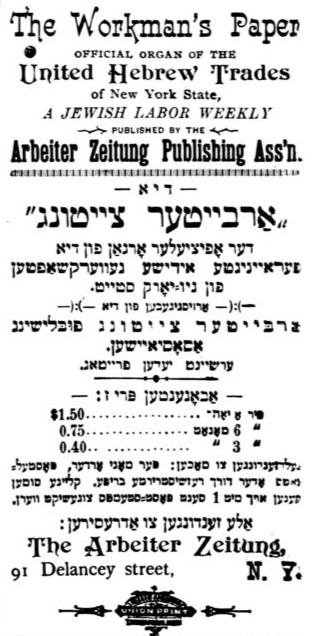
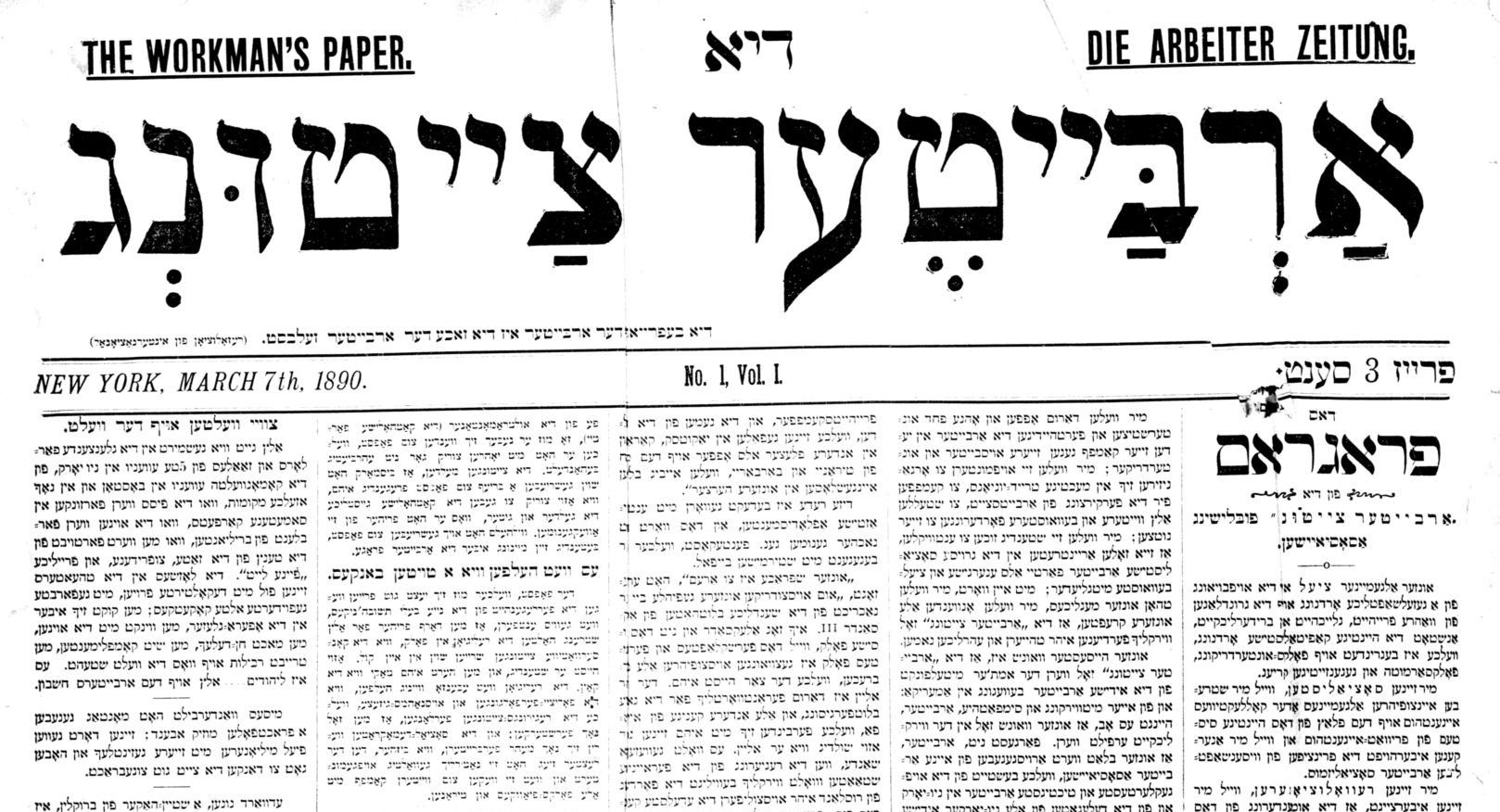
As the Socialist Labor Party developed its first Jewish (Yiddish speaking) Branches in the late 1880s, the demand for a newspaper increased, particularly in view of competition from the anarchists, whose Pioneers of Liberty were already publishing Freie Arbeiter Stimme. New York’s Arbeiter Zeitung (Workmen’s Paper) became the first Yiddish language Socialist newspaper in America. Established in 1890 as the official organ of the United Hebrew Trades and the S.L.P.’s Jewish Members, it was first edited by Philip Katz. From 1891 Abraham Cahan edited until he split with the paper in 1897 to found Vowarts (Fordward). The Arbeiter Zeitung helped to define Yiddish socialism here until its demise in 1902 with a nearly every Jewish Socialist of note writing for it. It quickly became one of the largest, and for a number of years, the largest, circulation S.L.P. newspaper. Below is a dossier of essential articles on its beginnings from the S.L.P.’s Workmen’s Advocate of 1889-90.
The First Yiddish Socialist Newspaper in the United States, the Founding of Arbeiterzeitung from Workmen’s Advocate (New Haven), 1889-1890.
Concert and Ball. March 2, 1889.
This (Saturday) evening the Jewish Branch of the New York Section, S.L.P. will give a concert and ball at Florence Hall, corner First street and Second avenue. The Lassalle Dramatic Society and the Jewish Choristers’ Union will assist. S.E. Sheviteh will speak. One of the taking features will be a raffle of seventy-five valuable articles. Admission 15 cents. Comrades, attend and assist the Jewish Branch which is doing a good work.
WANTED A JEWISH PAPER. July 27, 1889.
At the meeting of the Jewish Branch, Section New York, held July 10th, the following resolutions were adopted:
Whereas. The Jewish population of this country is constantly increased by the immigration of the Jews from Europe, who know no other language than the so-called German Jewish dialect: and
Whereas, In spite of the energetic and partially fruitful socialistic agitation carried on among the Jews for the last seven years, the practical results of the activity in this direction have hitherto been but very insignificant, especially as far as trade union organization is concerned: so that the complaints of trade organizations of the injury done to their cause by unorganized Jewish labor, which is instrumental in cutting down the prices, are as frequent as ever; and
Whereas, Experience leads us to believe that these evils are to be attributed solely to the lack of proper means of agitation: and
Whereas, The Jewish workingman. as a rule, can read only Jewish German printed with Hebrew letters; and
Whereas, The Jewish anarchists own a paper published in that dialect by which they succeed in destroying the results of the socialistic propaganda among the Jews, and in frustrating nearly every attempt at organizing the Jewish workingmen; and
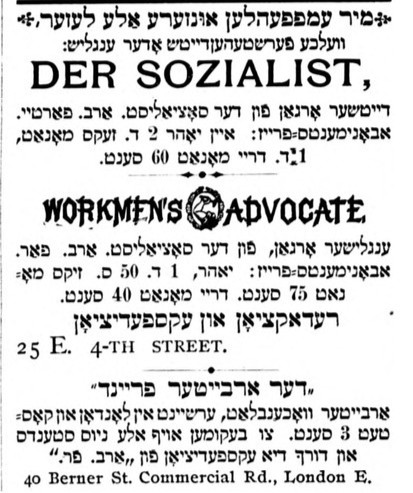
“Whereas, The only Jewish socialistic paper, The Arbeiterfreund, is published in London, England, so that though it does a great deal of effective propaganda among the Jews, it does not meet our local wants, especially in view of the resolution adopted by the S.L.P. favoring independent political action, whereby the political activity of the party will be greatly extended:
“Resolved. To establish a socialistic paper published in Jewish-German with Hebrew letters.”
A committee of ways and means, composed of eight members, was appointed for the purpose of carrying out the object of this resolution.
Summer Festival. July 27, 1889.
The Jewish Branch, Section of New York, S.L.P., in connection with the “Pioneers of Liberty,” will hold a picnic and summernight’s festival and concert in Phoenix Park, 148th street and Third avenue, on Saturday, the 27th inst. As all the Jewish trade unions have promised to attend, there is no doubt but that this festival will prove a great success. Friends and sympathizers of all nationalities are cordially invited. S.E. Shevitch will speak. The admission price is only fifteen cents.
JEWISH LABOR A MOVEMENT OF VITAL INTEREST TO AMERICAN WAGE-WORKERS. January 18, 1890.
Condition of the Jewish Immigrants–Their Activity and Tendencies–Anarchists Opposed to Organized Labor Frustrated by Socialist Organizers–A National Organ of Jewish Labor Interests to be Published Here in the German-Hebrew Dialect–Krantz, of London, the Editor.
Of the polyglot mass of immigrants that come to make this land their home no nationality ought to attract more attention on the part of Organized Labor than the unhappy sons of Israel. Homeless, despised and persecuted in Hungary and Galicia, hated and slandered in Germany and Roumania, debarred from almost every means of livelihood in the dominions of the Czar, unable to find shelter in the overcrowded, poverty, stricken cities of the more tolerant portion of Europe, those disinherited people have naturally made this country the cynosure of their hopes and flock to our shores from every nook and corner of the old world. Every incoming passenger steamer adds scores, sometimes hundreds of Hebrews to our population. While some favorable change in the economic situation of the Scandinavian, for example, may considerably curtail the influx of Swedes and Norwegians to this land, there is hardly an influence powerful enough to keep down the tide of the Jewish immigration to the only country where the wandering people finds a home.
There is scarcely a trade, scarcely a shop but gives employment to denizens of the Mosaic faith.
These constant additions to the labor market cannot obviously fail to have the effect of bringing down wages, unless the immigrant becomes a good member of the union of his trade and thus increases the force against capital instead of becoming a burden upon labor. Naturally ambitious, active and susceptible, the Jewish workman has proved to be as useful within the ranks of organized labor as he is dangerous outside of it.
While the Jew is found among the greediest and most heartless parasites, his coreligionists take rank with the most devoted, dauntless and indefatigable workers in behalf of the emancipation of labor.
The Jew seldom remains a passive, inert part of the whole; he is either perniciously or beneficently active. The Jewish immigrant cannot therefore too soon be won over to our cause and in all fairness to our Jewish speaking comrades it must be said that their wonderful activity among their brethren has borne great results in this respect.
It would suffice to take the reader around to the meeting halls of the 7th & 10th Ward of a Friday evening to convince him of the fruitfulness of their agitation. It would do his heart good to take a look at the hundreds of worn and haggard Russian or Polish Hebrews, many of them fresh from the steerage cabin, eagerly and absorbedly listening to the theory of surplus value popularly expounded in their own conglomerate dialect. Half a dozen of large meeting rooms are crowded every Friday with the audiences of lecturers and speakers on similar subjects in that neighborhood. There are sixteen well organized Unions in the city alone which are made up of people who speak no other language than the so-called “Jewish-German” besides the hundreds of Jewish workmen who enter the English or German unions of their respective trades through the mighty influence of these meetings. Nor is this admirable work confined to the metropolis. There is not a city, not a village with a considerable Jewish population, that has not some kind of an organization spreading the light among the recent subjects of the Czar. Thus in Boston we have the Jewish Workmen’s Education Club, whose regular Sunday meetings attract hundreds of the Jewish immigrants working in the factories of that city. In Chicago similar work is carried on by the Jewish Workmen’s Society; in Denver by the Jewish Agitation Club; &c., &c.
The results reaped from this exemplary activity would assuredly be much greater, were it not for the great financial difficulties with which the organizations have to struggle and owing to which their work is confined to oral agitation.
Hardly another class of workmen have such a passion for reading as is characteristic of the Russian, Polish, Roumanian and other Jews, as no orthodox will suffer his boy to reach his seventh year without being able to read the Bible and the prayer book in Hebrew. Jewish writers have utilized the Hebrew alphabet for works written in the Polyglot Dialect spoken by the Polish Jew.
There are many papers in this city, printed in Jewish German with Hebrew characters, and they are read by thousands of Jews. “Wanted, a Jewish Labor Paper”, is now the cry at the meetings. The need of such a paper is felt all the more keenly since for want of it the Jewish immigrant is exposed to the danger of reading that class of Jewish literature which seeks to keep the Jew out of every progressive movement and to thwart the influences of modern culture. On the other hand our Jewish comrades have the “pernicious partizanship” of a handful of Jewish Anarchists to cope with. These faithful disciples of John Most are as indefatigable in ridiculing trade unions and making themselves “generally useful” to capital by undermining the work of our comrades, as the latter are in behalf of organized labor.
Nothing short of a Jewish labor journal is adequate to grapple with all the difficulties and to meet all the present needs of the Jewish population.
The only labor paper published in the Jewish dialect–“Der Arbeiter Freund“–comes from London and is therefore insufficient to supply the local demands of the American movement. On the other hand that paper is utterly devoid of any definite and clear platform, being as it is the property of a semi-Anarchistic organization in London, while its editorial management, for want of any Jewish anarchists who would be competent to write anything worthy of publication, is in the hands of members of the “Social Democratic Federation”. The credit for the first attempt at establishing a Jewish labor paper on toe American soil belongs to the “Pioneers of Liberty”–an organization numbering a dozen of very young, very innocent, but unfortunately very energetic Jewish anarchists, to whose enthusiasm many a Jewish Union is indebted for its internal discord. The Jewish “Wahrheit,” which they founded last year, lived three months, that is just long enough to waste $1,000, made up of contributions from poor workingmen, and much longer than it took to establish the pitiful illiteracy and puerile imbecility of its anarchistic editors as well as the helpless anarchy of its management. The Jews who were not scared by its radical tenor welcomed neither the bombastic rant which filled the columns of that luckless journal nor the childish babble which was characteristic of its editorials. There are plenty of talented writers among the Jewish socialists in this country, but unlike their London comrades, they wisely withheld their literary help from the organ of a party whose whole activity is directed against everything connected with trade-unionism.
Recently, however, the Pioneers were shocked to learn of a serious movement, set on foot by the Jewish section of the S.L.P. and strongly supported by the “United Jewish Trades”, which is the name of the central body of all the Jewish speaking labor organizations of New York, for the purpose of establishing a Jewish paper with the same platform and on the same plan as the German “Volkszeitung“. But what chagrined them more than anything else. was the consent of Mr. Krantz, the very able and popular editor of the London “Arbeiter Freund“, to come to New York and assume the editorial management of the paper to be published by our comrades. Mr. Krantz is in perfect accord with the doctrines and policy advocated by us and is a staunch member of the Social Democratic Federation” of London. His work on the “Arbeiter Freund” has won for him the admiration of the Hebrew workmen throughout this country as well as in England and the respect and confidence of both socialists and anarchists. After four years of indefatigable and fruitful service to the cause of labor in his capacity of editor of that weekly he wearied, however, of the anarchistic tendencies of its owners and of the difficulties with which he constantly had to struggle on that account, and thus he recently left the office, preferring the counting room of the paper to its editor’s desk. It was on learning of this circumstance that our comrades sent him an invitation to edit their projected paper, which Mr. Krantz readily accepted.
Destitute of financial as well as of literary support, despairing of the cause of Anarchism among the Jews in view of the prospective publication and of the extensive oral agitation to be connected with it, the “Pioneers” began to talk of union and issued a call for a national convention of representatives of various Jewish labor organizations and of socialistic and anarchistic societies for the purpose of uniting the various forces upon a declaration of principles, that is of generalities, which would be adopted as the guide of an otherwise “free and non-partisan” labor paper. The proceedings of this interesting assemblage, the first of its kind ever convened since the beginning of the Jewish immigration, which took place in this City in the latter part of December and which absorbed two days and two nights, revealed the fact that the anarchists whose views were mouthed by Mr. Prener (the most candid of their leaders, who frankly urged the inauguration of a crusade against trade unionism) were bent upon preventing the establishment of a trade union paper with a clear cut programme and upon bringing about the publication in its stead, and capturing the management of a periodical whose columns would bid welcome to articles advocating the policy of the Most anarchists as opposed to the economic struggle and educational activity of organized labor. It also transpired that the convention was unscrupulously packed by delegates from bogus anarchistic organizations, the same handful of “Pioneers” having formed themselves into half a dozen different societies. At last a vote was taken which convinced the convention of the futility of the anarchist efforts, all socialists and trade-union men standing firm for a paper with an unambiguous platform essentially identical with that of the “WORKMEN’S ADVOCATE” and the “New-Yorker Volkszeitung“, while the anarchists vainly continued to clamor for a “free platform”.
This ruse, it must be confessed, was not altogether devoid of effect, since three of the union men who were unfamiliar with the mischief done by the anarchists in the Jewish speaking labor organizations were lured by the seemingly noble idea of a “free platform” into voting with the anarchists. Their action, however, did not meet with the approval of their constituencies.
The convention thus split, the Anarchists were left to themselves in the ball which they had prepared for the convention, while the delegates of the unions and of other organizations favoring the platform of the WORKMEN’S ADVOCATE continued their deliberations in another hall. The upshot of all this was the birth of the “Arbeiter-Zeitung Publishing Association,” which is essentially modelled after the “N.Y. Volks-Zeitung Publishing Association” and which thus far embraces the following Jewish speaking organizations: 1, The Knee Pants Makers Union (580 members); 2, The Pants Makers’ Union of New York (450 members); 3, Hebrew Typesetters’ Union (35 members); 4, Hebrew Chorists’ Union (50 members); 5, Jewelers (55 members); 6, Weavers (30 members); 7, Purse-makers’ Union (75 members); 8, Jewish Section, S.L.P. (56 members); 9, Educational Club of Hungarian Workmen (25 members); 10, Denver Workmen’s Educational Society (65 members); 11, Karmel Progress Club (110 members), and 12, The United Jewish Trades. Other organizations carry on a friendly correspondence with the newly organized association and promise to fall soon into line. One dollar shares of the Arbeiter-Zeitung Publishing Association are sold to individuals who can produce a membership card from any bona fide labor organization.
The enthusiasm for the prospective paper is indescribable. The first week’s receipts amount to the unexpected sum of $206. An appeal to the Jewish workmen, framed by comrade A. Cahan, was accepted by the association and 13,000 copies of it have been ordered for distribution throughout the country. Another appeal, written in German by comrade Hillkowitz, has been sent out together with subscription lists to the various sections of the S.L.P. Many a German and English speaking union has promised liberal support. The list is headed by Cigarmakers’ Union No. 90, who emphasized their encouragement of our Jewish comrades’ undertaking by the contribution of $20 and a promise of the members to buy the association’s shares. Editor Krantz is expected here by the 25th of January, and the first number of the Arbeiter-Zeitung (Workmen’s Journal) will, according to all appearances, be issued about three weeks later.
All moneys and letters for the Arbeiter-Zeitung Publishing Association are to be addressed to Benj, J. Gretch, Labor Lyceum, 25 E. 4th street, New York.
Progress of the Jewish Paper. February 1, 1890.
The Jewish Arbeiterzeitung Publishing Association held its regular business meeting last Sunday at Golden Rule Hall, at 125 Rivington street. Twelve new members and delegates of two new organizations–The Capmakers’ Union and Buttonholemakers’ Union–were admitted. The committee which attended German Unions reported that their ap- peal was favorably received every where and that shares to the amount of over one hundred dollars were bought already. The committee which has the theatre benefit to arrange reported that the selling of tickets goes on rapidly and that a grand success is assured. The benefit will take place on Thursday, February 6, at Piiling’s Theatre, Bowery, between Grand and Hester St., “The Polish Boy” will be played on that occasion. It was resolved that only persons can be admitted as members of the association who are bona fide workingmen and members of their trade-unions. After acting on some other routine business the meeting adjourned.
THE JEWISH PAPER. March 1, 1890.
Editor Krantz Ready–The First Number to Appear on March 6th.
The efforts of our Jewish comrades to establish a Jewish labor paper in this city have been crowned with full success. Thanks to the readiness and liberality with which the various German Unions and many Sections of the S.L.P have responded to the appeal of the “Arbeiter-Zeitung Publishing Association” for financial assistance as well as to the generous contributions and activity of the fifteen Jewish-speaking labor organizations represented in the Association, the printing office of the Arbeiter-Zeitung has sprung up much sooner than it was expected. It occupies two spacious and commodious rooms on the ground floor of 31 Henry street, which is in the very heart of the Jewish quarter. The type and other printing materials are all in and Mr. M. Hilkowitz, the business manager of the Association, expects to have everything in working order in a day or two, so that editor Krantz will have no difficulty in getting out the first and anxiously awaited issue of the paper on March 6, as announced.
Subscriptions pour in from every town and village of the United States where the Jewish dialect can be heard. The enthusiasm of the Jewish Socialists throughout the country is growing every day and this, added to the tested ability and wide popularity of Mr. Krantz and the material as well as moral support which the Association has received and continues to receive from German and American comrades, guarantees the success of the prospective paper, which is to become a mighty weapon in converting the thousands of Jewish immigrants that come here in search of bread and religious tolerance, into intelligent and devoted champions of our cause.
The hearty support which the Jewish labor paper has received from Christian workmen, besides accelerating the supply of a long-felt demand in the labor movement of this country, has served to greatly strengthen the ties of brotherhood between the Jewish immigrant and his German and American fellow-workmen.
Accustomed to be the victims of race prejudice at home, many of the former naturally doubted the brotherly feeling toward them which they were assured at the agitation meetings existed on the part of the American workmen, and they take much pride, therefore, in the stream of dollars which came from workmen in behalf of their paper. The very idea of a Christian contributing to the support of a journal to be printed in Hebrew characters is sure to call forth a smile of aggreable disappointment on the face of the Jewish immigrant who has not lived long enough in this country to forget the discrimination which he had to endure in Europe, and thus increase the chances of winning him over to the cause of organized labor.
For the Benefit of the Jewish Paper. April 12, 1890.
The Workingmen’s Educational Society of Chicago held a meeting and entertainment in commemoration of the Commune last Saturday for the benefit of the new Jewish paper, the Arbeiter-Zeitung, lately founded in New York city. The affair was a great success. Comrade Bisno acted as Chairman. Jesse Cox, ex-President of the Chicago Nationalist Club, delivered an eloquent address, tracing the continuous and persistent efforts of the people of France towards the realization of true liberty and equal rights from the days of Babeuf to the Commune. Comrade J.L. Christensen spoke in German. There was some good singing, after which the young people enjoyed dancing until a late hour. The leading spirits of the Workingmen’s Educational Society in Chicago are our Comrades Bisno, Sussman and LaVine. They are doing a great work in organizing the cloak- makers, the knee-pants makers and kindred trades in which our Russian fellow- workmen are engaged.
A Jewish Section S.L.P. Formed in Chicago. November 22, 1890.
Dear Comrade: I herewith apply for the admission to the party of a Jewish Section, organized in Chicago, and consisting of the members whose names are enclosed with the monthly dues of the same. Send us a few hundred party-platforms in the Jewish language anil some constitutions of the party. We have read your circular-letter, sent to comrade Berlyn, in relation to the Workmen’s Advocate. All we can do at present is to solicit subscribers, and this we are endeavoring to do. I may be able to send you some subscriptions next week.
Yours in the cause, P. Sissman, Organizer.
The Workmen’s Advocate replaced the Bulletin of the Social Labor Movement and the English-language paper of the Socialist Labor Party originally published by the New Haven Trades Council, it became the official organ of SLP in November 1886 until absorbed into The People in 1891. The Bulletin of the Social Labor Movement, published in Detroit and New York City between 1879 and 1883, was one of several early attempts of the Socialist Labor Party to establish a regular English-language press by the largely German-speaking organization. Founded in the tumultuous year of 1877, the SLP emerged from the Workingmen’s Party of the United States, itself a product of a merger between trade union oriented Marxists and electorally oriented Lassalleans. Philip Van Patten, an English-speaking, US-born member was chosen the Corresponding Secretary as way to appeal outside of the world of German Socialism. The early 1880s saw a new wave of political German refugees, this time from Bismark’s Anti-Socialist Laws. The 1880s also saw the anarchist split from the SLP of Albert Parsons and those that would form the Revolutionary Socialist Labor Party, and be martyred in the Haymarket Affair. It was in this period of decline, with only around 2000 members as a high estimate, that the party’s English-language organ, Bulletin of the Social Labor Movement, appeared monthly from Detroit. After it collapsed in 1883, it was not until 1886 that the SLP had another English press, the Workingmen’s Advocate. It wasn’t until the establishment of The People in 1891 that the SLP, nearly 15 years after its founding, would have a stable, regular English-language paper.
 Revolution's Newsstand