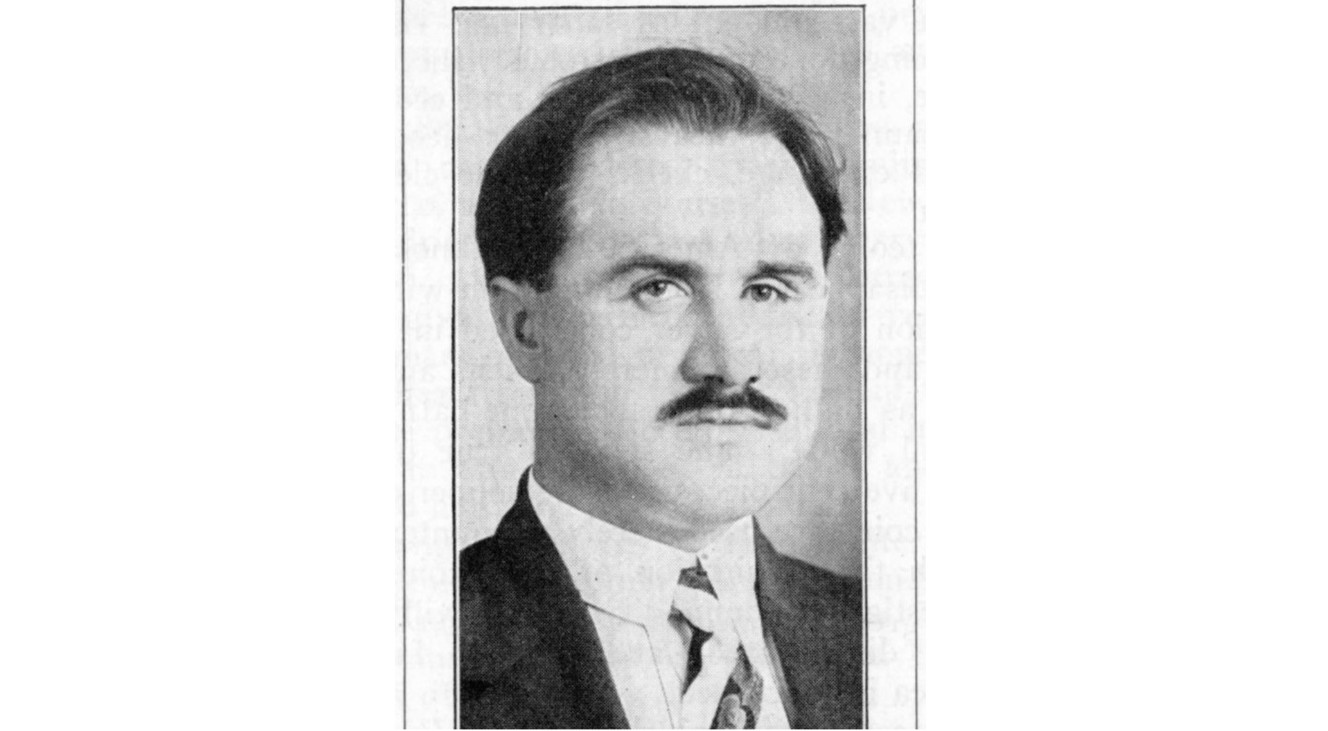
One of our history’s political prisoners that should be better known. Able to elude police for several years despite $25,000 on his head, Matthew Schmidt was arrested in September, 1914 for the Los Angeles Times bombing of 1910 for which the McNamara brothers were serving time. Noted for dignity and selfless defense after his capture, he was deeply respected by his comrades, Sentenced to life for providing the explosives, ‘Schmiddie’ was released after a long campaign in August, 1939 after twenty-five years at San Quentin.
‘Matthew Schmidt’s Speech to the Judge’ from International Socialist Review. Vol. 16 No. 10. April, 1916.
That speech of Matthew A. Schmidt is worth reading twice, keeping awhile and reading again. We live in an age when “bullcon” is glorified and bunkshooters get away with big bluffs. Here, though, was a real man, spurning freedom in the sense that any man is free who is outside of prison.
Here he was, this Matthew Schmidt, practically opening the door, stepping into prison, closing the door of his own cell house.
Months and months the Burns’ detectives and pussy-foots, agents and emissaries of all kinds, had tried to break his will, cow him, coax him, change his mind. It was no go.
He told the same story last as first. Burns and the pussy-foots and all their games and schemes were foiled.
He was charged with aiding in the murder of those who were killed in the explosion that wrecked the Los Angeles Times building. He explained to the court:
“I have said my case was not a murder case. No one really believes that it is I want to give you some facts not brought out in the evidence. A few days after I arrived here from New York, Guy Biddinger, formerly a Burns man, came to me and asked why I did not get in and get some of the reward money. He said: ‘They don’t want you, nor do they want Kaplan. They want to hang Tvietmoe and Johannsen, and you can help them and then you will be free.’”
He pictured the very judge who was to sentence him. He showed the forces behind that judge. He discussed the Zeehandelaar letter, in which the manufacturers’ association of Los Angeles is shown on signed admissions to have been active in extra-legal operations| in drawing the grand jury to indict Schmidt. Of this the speaker said:
“Your Honor ruled that such a letter was not material to the case, nor could you well do otherwise. The forces back of my prosecution would have pulled you from this bench and besmirched your name even as they secured my conviction.”
However, there wasn’t much that was personal back of Schmidt’s speech. All his references to himself are as though he was a leaf in a storm, one wave in a great sea, one working class finger on millions of hands. Look at the poetry and the historical perspective in, this:
“In the industries of this country more than 35,000 workers are killed and 700,000 injured each year—and all in the name of business. Who ever heard of a district attorney attempting to protect these victims or to obtain for them redress, unless, perchance, the employer happened to be a political enemy?”
“If for the moment we grant that all of the explosions recited here were caused by the iron workers, what do we find? For every ounce of steel, and for each broken bolt or rivet, I can show you a dozen lives snuffed out that profits might not be disturbed.”
Here he was, facing life sentence to prison. And he turns with mingled sneers of contempt and feelings of pity for the people–of the community sending him to prison:
“I understand the despair and horror that haunt the poor victims of the rotten industrial centers of the East. And I know the sacrifice made by their families and friends that they may bring their shattered lungs and wasted bodies to this land of balm and blossom, only to find that they must pay tribute to men who have capitalized their misfortune. It was almost wholly from this latter class of vultures that I was compelled to select a jury.”
Great orations are spoken only on great occasions. Around the head and mouth of Matthew Schmidt when he stated cause why he should not be sentenced surged the vast forces of working class strife and desire for more of life.
If appeal is denied and “Schmiddy” goes to the California penitentiary as a “lifer,” he will be remembered. Outside the fight will go on one way or another to spring the penitentiary doors and set free a hero who hates to hear anybody talk about heroes.
The International Socialist Review (ISR) was published monthly in Chicago from 1900 until 1918 by Charles H. Kerr and critically loyal to the Socialist Party of America. It is one of the essential publications in U.S. left history. During the editorship of A.M. Simons it was largely theoretical and moderate. In 1908, Charles H. Kerr took over as editor with strong influence from Mary E Marcy. The magazine became the foremost proponent of the SP’s left wing growing to tens of thousands of subscribers. It remained revolutionary in outlook and anti-militarist during World War One. It liberally used photographs and images, with news, theory, arts and organizing in its pages. It articles, reports and essays are an invaluable record of the U.S. class struggle and the development of Marxism in the decades before the Soviet experience. It was closed down in government repression in 1918.
PDF of full issue: https://www.marxists.org/history/usa/pubs/isr/v16n10-apr-1916-ISR-riaz-ocr.pdf
 Revolution's Newsstand