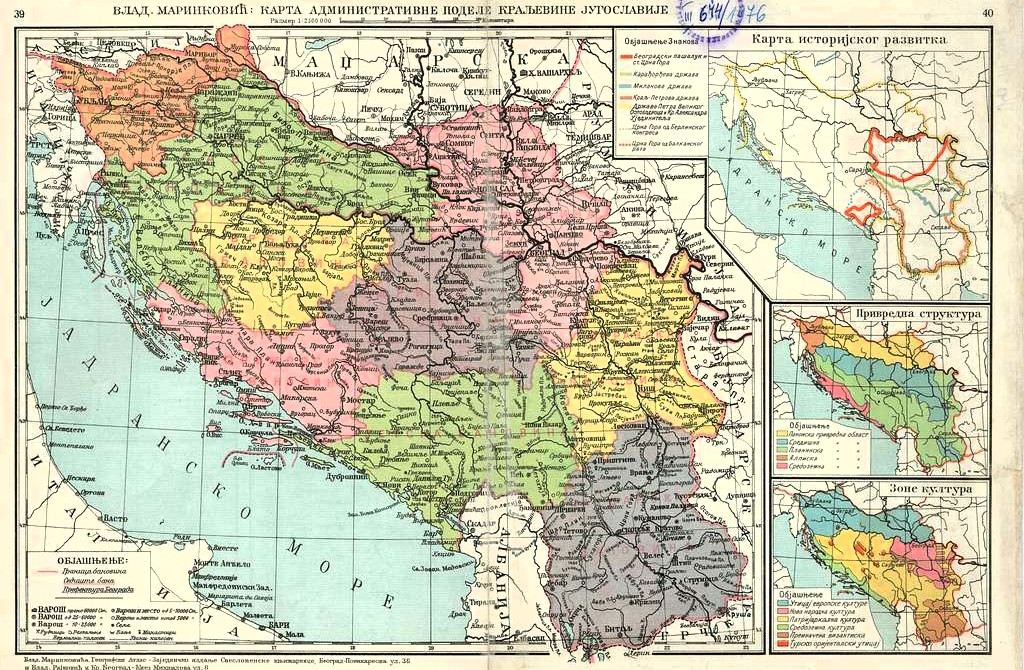
On October 3, 1929 the “Kingdom of Serbs, Croats, and Slovenes” was renamed the “Kingdom of Yugoslavia” by King Alexander I. The ‘Yugoslavia’ of this period was not a mulit-national state, but a vehicle for Greater Serbian nationalism. Comrade Dragashevatz explains.
‘The Yugoslavian Proclamation: The Crowning of the Great-Serb Policy of National Oppression’ by P. Dragashevatz from International Press Correspondence. Vol. 9 No. 60. October 18, 1929.
The proclamation of “Yugoslavia” in the place of the “Kingdom of the Serbs, Croats, and Slovenes” hitherto in existence and the simultaneous new administrative division of the country introduced on October 2nd, represent the most important political act since the inception of the dictatorship on January 6th of this year. The administrative division of the country sets the crown on the policy of national oppression practised by the Great-Serb regime.
In his manifesto of January 6th, King Alexander declared that he would relentlessly punish any attempt to disturb the creation of national unity. Since then the dictatorship has continued to carry on with undiminished vigour and brutality the Great-Serb policy of strengthening the Serb bourgeoisie while economically and culturally oppressing the non-Serb nationalities and persecuting, terrorising, and destroying entire non-Serb provinces.
Quite recently the State Bank published its balance-sheet, which showed that the city of Belgrade alone had received more credits than all the rest of the country together. Subsequently the yet more characteristic report of the State Mortgage Bank was published, showing that in 1928 the Serb branches of the Bank at Nish and Belgrade distributed credits totaling 1,603,937,088 dinars and all the other branches an aggregate of no more than 704,590,806 dinars. If we consider that practically all the credits at Novisad (75,077,094 dinars) and at Skoplie (130,285,154 dinars) were distributed to Serbs, the Serb share in the credits grows to about 1800 million dinars or from 75 to 78 per cent. of the total of 2308 millions. What a privileged treatment of the Serb bourgeoisie this implies is all the more apparent in view of the statistical proportion of the population in Yugoslavia, of which 4.5 millions are Serbs and 8 millions non-Serbs.
A Government decree in the first place abolishes a series of secondary schools, the majority of them being Croat schools. The Croat community of Krizevci determined to reopen the school thus closed down at its own expense, but the relative application to the Ministry was turned down. The latest issue of the Belgrade Fascist newspaper “Les Nouvelles Yugoslaves” publishes statistics regarding the schools of the national minorities in Yugoslavia, from which we quote a few figures. At the close of 1928, the Germans had only 30 elementary schools in which German was the language of instruction as against 236 elementary schools in which the language of instruction was Serbo-Croat, while German was taught as a secondary matter. The “Deutsches Volksblatt” publishes a contradiction of this statement, asserting that one third of the German school-children never hear a word of German at school. According to the official statistics of the “Nouvelles Yugoslaves”, there are 80 elementary schools with instruction in both the Hungarian and the Serbo-Croat languages. Purely Rumanian schools there are none; only 45 schools with mixed Rumanian and Serbo-Croat or Czecho-Slovak and Serbo-Croat instruction. There are said still to be special national departments in the Serbo-Croat elementary schools, 694 for Germans, 616 for Hungarians, 121 for Slovaks, and 28 for Russians. There are no statistics at all in regard to the schools of the Albanians, Turks, Bulgarians, Macedonians, Greeks, and Rumanians on the territory of pre-war Serbia and Montenegro.
The economic oppression of the non-Serb population is practised mainly in the Voivodina against Germans, Hungarians, and Rumanians. With few exceptions, these have been excluded from benefiting under the agrarian reform laws. The feudal lands in Macedonia were not distributed at all among Macedonian peasants but were to the main part appropriated by Serb agents and politicians, the latter including the King and Pashitch. Part of the land remained in the hands of the old proprietors if they were loyal to the Serb regime. An area of 100,000 hectares was reserved by the dictatorship for the exclusive purpose of being colonised with Serbs, the Government voting for a credit of 30 million dinars for the cultivation of part of this territory.
The most brutal of all was the manner in which the Kosovo region was colonised and “Serbified”. Here the authorities force the Albanians to emigrate by accusing them of high treason and selling their property for the purpose of paying their debts and defraying their legal expenses. Every barrister in the Kosovo district must engage to abandon the defence of Albanians in lawsuits as soon as there is any prospect of their succeeding. The Albanians are taxed extraordinarily. For strategic reasons entire villages near the Albanian frontier were expropriated, the Albanians being ousted and the farms being given to Serbs. The expulsion of the Albanians from the interior of Kosovo is effected in a special way, the Serbs being settled not only on land confiscated from landowners but also on free peasant land. Serb settlers enter the Albanian houses and take possession of the land, which is rarely more than from 5 to 10 hectares per farm. After a while the native Albanians are completely ousted by the colonists and driven out of house and home.
From statistics of the national-revolutionary organisations, published in 1929 by the “Balkan Federation” under the heading of a “Memorandum on the Situation of the Oppressed Peoples in the Balkans”, it may be gathered that in the course of the last ten years there were more than 600 political murders in Macedonia and 2692 in the district of Kosovo.
The Great-Serb regime has set itself the task of expelling as soon as possible all the Albanians of the Kosovo region and of replacing them with Serbs, so that in time Albanian Kosovo may become completely Serb. Since 1918, more than 10,000 Albanian families with a total of more than 100,000 persons have been forced to emigrate. (The Albanian families are all very numerous, with from 8 to 20 members.) 6500 of these families fled to Albania.
The new decree aims at the full centralisation and standardisation of the country in the Great-Serb sense, which means the utter annihilation of all national characteristics of the non-Serb nationalities. The administrative distribution of the country coincides mainly with the military division. Each of the administrative districts, which are to be known as “Banovinas”, comprises from two to three of the old national provinces. Due care has been taken that in the majority of the administrative districts there is a relative Serb majority so that on the occasion of any elections that may take place the Serbs may be sure of a majority. Thus, for instance, the district of Vrbas (Banialuka), comprises parts of Bosnia and Croatia, the district of Podbrezie (Spalato) parts of Croatia, Bosnia, and Dalmatia, the district of Drina (Sarajevo) parts of Bosnia, Serbia, and Kosovo, the district of Zeta (Cetinie) parts of Montenegro, Dalmatia, and Hercegovina, the district of Morava (Nish) parts of Serbia, Macedonia, and Kosovo, the district of Vardar (Skoplie) parts of Macedonia and Kosovo, and the district of Dunav (Novisad) parts of Serbia and the Voivodina.
By this division, which does away with all the old national borders and names, the dictatorship intends to destroy all possibility of a fight for national emancipation. At the head of each administrative district there is to be a “banus” or grand prefect appointed by the King and the Prime Minister and endowed with enlarged powers under the immediate control of the Prime Minister.
The great reform of the dictators has been accepted very quietly by all the oppressed nationalities. This silence is alarming for the dictators at Belgrade, for it serves to mask preparations for the emancipatory struggle of the oppressed and exploited nationalities.
The Communist Party of Yugoslavia and the national-revolutionary organisations are faced with the task of organising the masses of the proletariat, poor peasantry and oppressed nationalities in Yugoslavia and leading them to fight against the Belgrade dictators.
International Press Correspondence, widely known as”Inprecorr” was published by the Executive Committee of the Communist International (ECCI) regularly in German and English, occasionally in many other languages, beginning in 1921 and lasting in English until 1938. Inprecorr’s role was to supply translated articles to the English-speaking press of the International from the Comintern’s different sections, as well as news and statements from the ECCI. Many ‘Daily Worker’ and ‘Communist’ articles originated in Inprecorr, and it also published articles by American comrades for use in other countries. It was published at least weekly, and often thrice weekly.
PDF of full issue: https://www.marxists.org/history/international/comintern/inprecor/1929/v09n60-oct-18-1929-inprecor.pdf
 Revolution's Newsstand