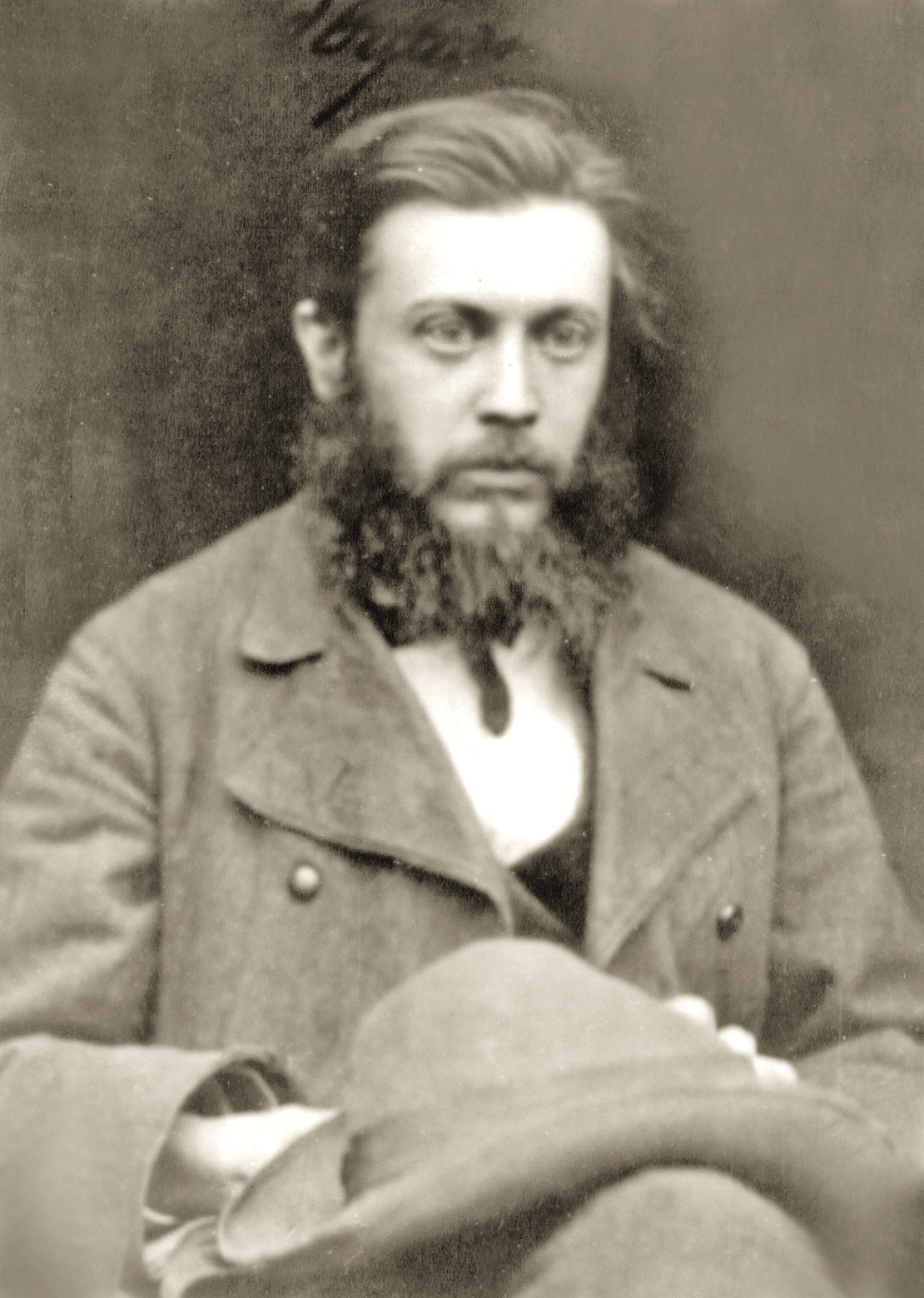
Another of Stepniak’s marvelous portraits of his Narodnik comrades. Dmitry Andreevich Lizogub was a central figure of the Land and Freedom Party from a moneyed family who lived in utter simplicity, giving all of his wealth, energy, and life to the revolution. Found guilty during the “Trial of Twenty-Eight’ and hung in Odessa with four comrades on August 22 (10), 1879.
‘Demetrius Lissogub, The Saint’ by Stepniak from Soviet Russia (New York). Vol. 7. No. 2. July 15, 1922.
IN December of the year 1876 I was present one day at one of those “Students’ meetings”, as they are called; one of the best means of propaganda among the young, and very characteristic of Russian life. It need scarcely be said that they are rigorously prohibited. But such is the abyss that separates society from the Government, that they are held, and were always held, in the worst periods of the White Terror. Sometimes they are very large meetings, almost public, and extremely stormy.
The danger by which they are surrounded communicates to them a special attraction for the young, giving to the discussions that passionate character which contributes so much to transform an idea into a war-like weapon.
The meeting of which I speak, however, was not a large one, and was very quie.t It was occupied with a project so frequently brought forward and so frequently ending in nothing, for uniting in a single organization all the secret circles established among the young. The thing being evidently impracticable, owing to the great variety of those circles, the project might be regarded ai still-born. Even the promoters of the meeting seemed half convinced of this. The discussion therefore dragged on wearily, and had no interest.
Among the few persons present, there was, however, one who succeeded in arousing the general attention, whenever during the languishing discussion he made some little observation, always spirited and slightly whimsical. He was tall, pale, and somewhat slim. He wore a long beard, which gave him an apostolic appearance. He was not handsome. It is impossible to imagine, however, anything more pleasant than the expression of his large blue eyes, shaded by long eyebrows, or anything more attractive than his smile, which had something infantile about it. His voice, somewhat slow in utterance and always pitched in the same key, soothed the ear, like the low notes of a song. It was not a musical voice, but it had the power of penetrating into the very heart, so sympathetic was it.
He was very poorly clad. Although the Russian winter was raging, he wore a linen jacket with large wooden buttons, which from much wear and tear seemed a mere rag. A worn-out black cloth waistcoat covered his chest to the throat. His trousers, very light in color, could be seen underneath the black line of his waistcoat every time he rose to say a word or two.
When the meeting broke up and those attending it went away, not all at once, but in groups of three or four persons, as is always the case in Russia upon similar occasions, I left with my friend together with this stranger. I observed that he had only a thin jacket, an old red comforter, and a leather cap. He did not even wear the traditional “plaid” of the Nihilists, although the temperature was at least twenty degrees below zero.
After bowing to my friend, whom he evidently was slightly acquainted with, the stranger went on his way, almost running, to warm himself a little, and in a few moments disappeared in the distance.
“Who is he?” I asked my friend.
“He is Demetrius Lissogub,” was the reply.
‘Lissogub, of Chernigov?”
“Precisely.”
Involuntarily, I looked in the direction in which this man had disappeared, as though I could still discern traces of him.
This Lissogub was a millionaire. He had a very large estate in one of the best provinces of Russia, and houses and forests; but he lived in greater poverty than the humblest of his dependents, he devoted all his money to the cause.
II.
Two years afterwards we met again in St Petersburg as members of the same revolutionary organization. Men know each other as thoroughly in such organizations as in the intimacy of family life.
I will not say that Demetrius Lissogub was the purest, the most ideal man whom I have ever known, for that would be to say too little of him. I will say that in all our party there was not, and could not be, a man to compare with him in ideal beauty of character.
The complete sacrifice of all his immense wealth was in him the least of his merits. Many have done the same in our party, but another Demetrius Lissogub is not to be found in it.
Under an aspect tranquil and placid as an unclouded sky, he concealed a mind full of fire, of enthusiasm, of ardor. His convictions were his religion, and he devoted to them, not only all his life, but what is much more difficult, all his thoughts. He had no other thought than that of serving his cause. He had no family. Love did not disturb him. His parsimony was carried to such an extreme, that friends were obliged to interfere in order to prevent him from falling ill from excessive privation. To every remonstrance he replied, as if he foresaw his premature end:
“Mine will not be a long life.”
And in truth it was not.
His determination not to spend a single farthing of the money with which he could serve the cause, was such, that he never indulged in an omnibus, to say nothing of a cab, which costs so little with us that every workman takes one on Sunday.
I remember that one day he showed us two articles, forming part of his dress suit, which he wore when, owing to his position, he was compelled to pay a visit to the Governor of Chernigov, or to one of the heads of the Superior Police. They were a pair of gloves and an opera hat. The gloves were of a very delicate ash color, and seemed just purchased. He, however, told us that he had already had them for three years, and smilingly explained to us the little artifices he adopted to keep them always new. The hat was a much more serious matter, for its spring had been broken a whole year, and he put off the expense of purchasing a new one from day to day, because he always found that he could employ his money better. Meanwhile, to keep up his dignity, he entered the drawing-room holing his opera-hat under his arm, his eternal leather cap, which he wore summer and winter alike, being in his pocket. When he passed into the street, he advanced a few steps with his head uncovered, as though he had to smooth his disarranged hair, until, being assured that he was not observed, he drew the famous cap from his pocket.
This money, however, that he endeavored to save with the jealous care of a Harpagon, was his determined enemy, his eternal torment, his curse: for, with his impassioned disposition and with his heart so prone to sacrifice, he suffered immensely from being compelled to remain with his arms folded, a mere spectator of the struggle and of the martyrdom of his best friends.
Subjected to a rigorous surveillance, having been denounced for participation in the Revolutionary movement by his relations, who hoped, if he were condemned, to inherit his fortune, he could do nothing, for at the first step, his property would have been taken away from him, and his party would thereby have been deprived of such indispensable assistance. Thus his fortune was, to him, like the cannon-ball attached to the leg of a galley slave; it hindered him from moving about.
His involuntary inaction was not only an annoyance, a cruel vexation, as it could not fail to be to a man who united in himself the ardor of a warrior with that of a prophet, it was also a source of profound moral suffering. With the modesty of a great mind« he attributed to himself not the slightest merit for what seemed to him the most natural thing in the world,—the renunciation of his wealth, and his life of privation.
Merciless towards himself, as a cruel judge who will not hear reason, and refuses to consider anything but the crime pure and simple, he regarded his inactivity, which was only an act of the highest abnegation, as a disgrace. Yet this man, who at the sacrifice of his own aspirations, sustained for a year and a half almost the whole Russian revolutionary movement; this man, who by his moral qualities inspired unbounded admiration among all who knew him; who, by his mere presence, conferred distinction on the party to which he belonged; this man regarded himself as the humblest of the very humble.
Hence arose his profound melancholy, which never left him, and showed itself in his every word, notwithstanding the sorrowfully whimsical tone he was accustomed to adopt, in order to conceal it.
Thus, resigned and sad, he bore his cross, which sometimes crushed him beneath its weight, throughout his whole life, without ever rebelling against his cruel lot
He was a most unhappy man.
He was arrested at Odessa in the autumn of the year 1878, on the accusation of his steward, Drigo, who was a friend, but who betrayed him because the Government promised to give him what still remained of the patrimony of Lissogub,—about twenty thousand dollars.
Although a veritable White Terror was prevailing at that time, and in Odessa, where he was to be tried, the hero of Sebastopol, and of Plevna, the infamous ruffian. Count Todtleben, ruled with the utmost bestiality, no one expected a severer punishment of Lissogub than transportation to Siberia, or perhaps some few years of hard labor; for nothing else was laid to his charge than that of having spent his own money, no one knew how. The evidence of Drigo, however, left no doubt upon the very tender conscience of the military tribunal.
Amid universal consternation, Demetrius Lissogub was condemned to death. Eye-witnesses state that, after hearing his sentence, his jaw fell, so great was his astonishment.
He scornfully refused the proposal made to him to save his life by petitioning for pardon.
On August 8, 1879, he was taken to the scaffold in the hangman’s cart, with two companions, Chubarov and Davidenko.
Those who saw him pass say that not only was he calm and peaceful, but that his pleasant smile played upon his lips when he addressed cheering words to his companions. At last he could satisfy his ardent desire to sacrifice himself for his cause. It was perhaps the happiest moment of his unhappy life.
Stefanovich was the Organizer; Clemens the Thinker; Ossinsky the Warrior; Kropotkin the Agitator.
Demetrius Lissogub was the Saint.
Soviet Russia began in the summer of 1919, published by the Bureau of Information of Soviet Russia and replaced The Weekly Bulletin of the Bureau of Information of Soviet Russia. In lieu of an Embassy the Russian Soviet Government Bureau was the official voice of the Soviets in the US. Soviet Russia was published as the official organ of the RSGB until February 1922 when Soviet Russia became to the official organ of The Friends of Soviet Russia, becoming Soviet Russia Pictorial in 1923. There is no better US-published source for information on the Soviet state at this time, and includes official statements, articles by prominent Bolsheviks, data on the Soviet economy, weekly reports on the wars for survival the Soviets were engaged in, as well as efforts to in the US to lift the blockade and begin trade with the emerging Soviet Union.
PDF of full issue: https://www.marxists.org/history/usa/pubs/srp/v6-7-soviet-russia%20Jan-Dec%201922.pdf
 Revolution's Newsstand