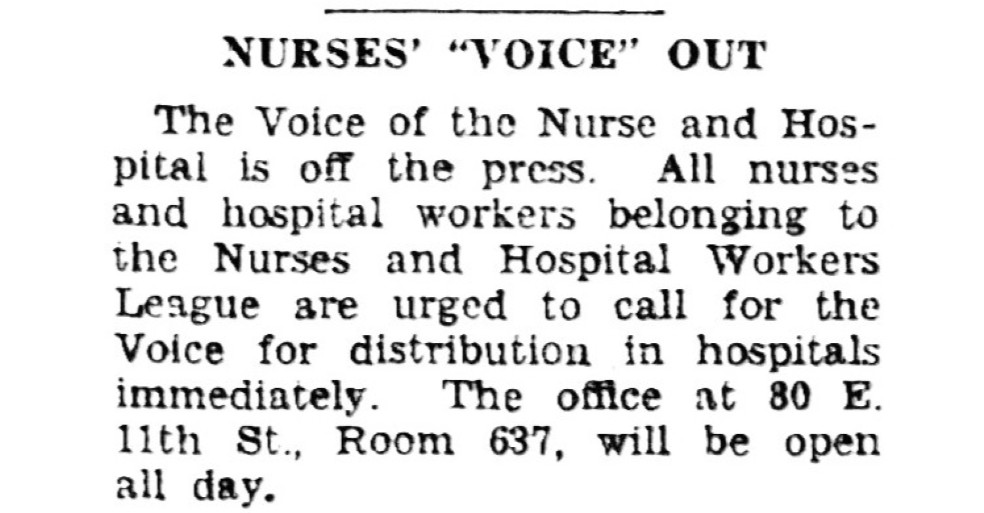
An internal report on Communist Party attempts to build the Nurses and Hospital Workers League in one New York hospital starting with five activists employed there.
‘How a New York Hospital Nucleus Was Organized and Built’ by Unit Org., N.Y. from Party Organizer. Vol. 8 No. 2. February, 1935.
About 10 months ago, among the workers in our hospital, there were three Party members, one Y.C.L.er and one very active I.L.D. member. After a little contact work, the I.L.D. member was recruited into the Party. Having five members already, we took up the question with the Section of organizing a nucleus in spite of opposition among some of our own comrades. But the section was not encouraging either. Its leading functionaries were in doubt whether shop nuclei should be organized in plants like hospitals, which do not belong to the basic industries. They did not realize that in hospitals, too, the workers are bitterly exploited and are discontented and, therefore, there is a place for organization.
But we were stubborn and a unit of five was finally formed. For two or three meetings, the Section Rep. met with us but then was taken away for street unit work (in our section, at that time, such work was considered more important). Lacking cooperation from the Section, and having no former experience in shop work, we had to grope and guess how to go about organizing the nucleus. We were constantly contacting workers and spreading our weapons of propaganda and organization throughout the hospital. Our literature became a familiar sight in the place. In a short time we obtained 15 Daily Worker readers, about 10 readers of Ny Tid, 10 subscribers to the New Masses and gained three new members into the unit.

This persistent work brought results not only from within the hospital but also made the Section Committee realize the importance of working within such plants as ours. The Section Rep. sent to us was capable; he was constantly planning for us, but, being busy with many other activities, he never had the time actually to show us how to carry on our work.
Meanwhile, a struggle for the reinstatement of two dismissed nurses developed. The campaign for reinstatement conducted by the Nurses and Hospital Workers League was done with the cooperation and guidance of the nucleus. Leaflets exposing the administration and their exploitation and discrimination against their employees were issued both by the League and the nucleus to the workers inside, and the neighborhood outside. The campaign was gaining tempo and the administration was beginning to feel it.
It seemed as if we were winning but, just then, at the apex of the campaign, a grave error was committed by the leadership of the Nurses and Hospital Workers League. The representative of the Section did not object to this decision. A truce was accepted by the League and for a week the whole campaign came to a standstill. This, and the fact that the Section failed to mobilize its members for an effective picket line, served as a blow to the whole struggle. The sentiment for the reinstatement of the two nurses subsided, picketing became lax, and the two nurses remained jobless.
However, picketing and the distribution of leaflets radicalized the workers in the hospital considerably. When, later on, a maintenance worker was discharged, he was promptly taken back as a result of immediate action on the part of a committee of workers demanding his reinstatement. In another case, a food worker was reinstated because a petition signed by over 60 workers was sent into the administration. In both cases, the nucleus was in the leadership. The workers gained confidence in the Communist Party. They would discuss their grievances with our comrades. We realized the importance of organizing them immediately into a shop group.
Another Section Rep. was assigned to our unit and he helped us in our work, but he, too, had to leave soon because of another assignment. The Shop Council, however, remained intact and became a part of the Nurses and Hospital Workers League. More and more workers signed up with the Council and at present it has over 75 members. At the same time, the nucleus kept on recruiting new members, and again we turned to the Section for aid.

This time they sent us a comrade who “comes straight from the bench.” He is capable, he has had trade union experience, and does not act like a governess. On the contrary, he arouses comrades’ initiative and is respected and liked by everybody.
Our nucleus has at present 18 members. We have no fluctuation due to the interesting inner life of the unit. We carry on discussions at every unit meeting linking up the general struggle of the working class with the life and work in the shop. The work of the unit is well planned and every member is activized. The attitude of the comrades towards one another is friendly and comradely and everybody is enthused.
Distribution of leaflets and our monthly shop paper is done inside by our own comrades; thus we learn illegal methods. Our first leaflet was distributed in front of the hospital by the concentration unit, but after the administration claimed that the leaflet was issued by the “outside disturbers”, we decided to distribute most of our literature inside the shop. This is done in an efficient way: at a definite time, the distribution is done throughout the hospital. The Party is very much respected among the workers. The closest and the most trustworthy of our contacts are involved in Party work and this makes them feel very much honored. It makes it much easier for us to recruit them into the Party.
At present, we have 18 members in the Party nucleus and 20 contacts. We are also on the road to organizing a Y.C.L. unit. Although we have already doubled our membership since the recruiting drive for new members began, by the end of the drive we expect to triple it.
The Party Organizer was the internal bulletin of the Communist Party published by its Central Committee beginning in 1927. First published irregularly, than bi-monthly, and then monthly, the Organizer was primarily meant for the Party’s unit, district, and shop organizers. The Organizer offers a much different view of the CP than the Daily Worker, including a much higher proportion of women writers than almost any other CP publication. Its pages are often full of the mundane problems of Party organizing, complaints about resources, debates over policy and personalities, as well as official numbers and information on Party campaigns, locals, organizations, and periodicals making the Party Organizer an important resource for the study and understanding of the Party in its most important years.
PDF of full issue: https://archive.org/download/party-organizer_1935-02_8_2/party-organizer_1935-02_8_2.pdf
 Revolution's Newsstand