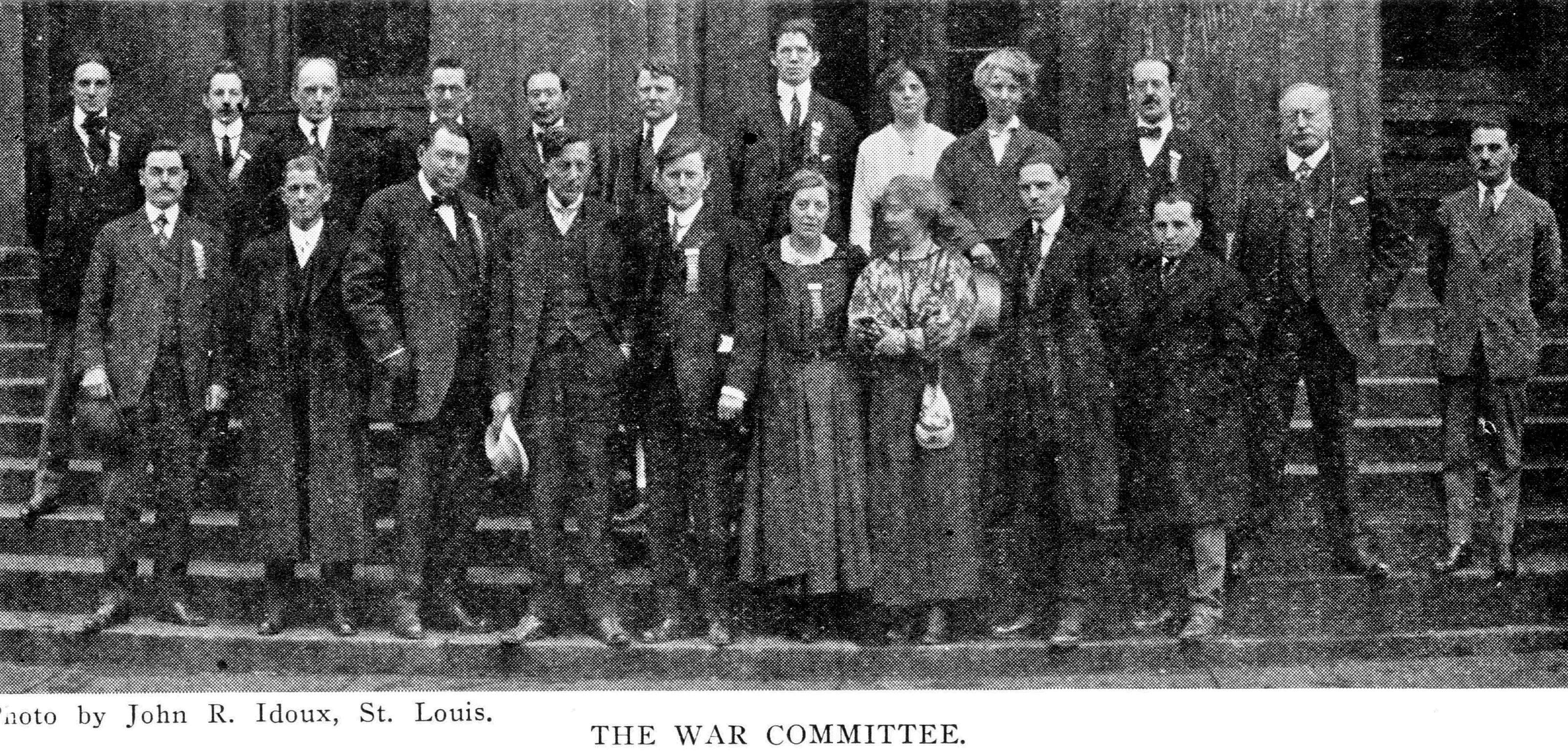
An important document from U.S. Socialist history. The week-long April, 1917 Emergency Conference in St. Louis met to discuss the Socialist Party’s attitude to US involvement in World War One. A culmination, rather than the beginning of a debate, the first day saw nominations for the fifteen-person Committee on War and Militarism to draft the Party’s position. While the fight with the pro-war Right is well known, there were three positions; the broad anti-war Majority, the Right, and the self-declared Left.
From the 200 voting delegates as well as representatives of eight Language Federations, elected were Boudin, of New York along with Kate Sadler of Washington and Walter Dillon of New Mexico representing the Left. The Majority was represented by Kate Richards O’Hare, Missouri; Morris Hillquit, Algernon Lee, New York; Patrick Quinlan, New Jersey; C.E. Ruthenberg and Frank Midney, Ohio; Dan Hogan, Arkansas; Job Harriman, California; Victor L. Berger, Wisconsin; Maynard Shipley, Maryland; Walter Dillon, and George Speiss, Connecticut. Finally Vermont’s John Spargo, for the pro-war Right.
The Majority report drafted by Morris Hillquit, Charles E. Ruthenberg, and Algernon Lee, at least rhetorically, asserted a strong anti-war and internationalist position and united broad swathes of a Party moving leftward. John Spargo was the voice for the isolated pro-War minority in the Party already heading for the doors, while Louis B. Boudin presented a Left Wing minority report. Though close to the Majority on many issues, Boudin insisted that the Party recognize the conflict as integral to imperialist capitalism, with the “revolutionary working class…the only social force either willing or capable” of stopping the war, defending democracy and guaranteeing national self-determination.
140 delegates, including many future Communists, voted for the majority report, 31 for Boudin’s report, with Spargo almost completely isolated receiving only 5 votes. Some additions from Boudin’s wing would make it into the final document from the Committee going to the national membership for a referendum as the pro-war Right doubled down and demanded one more try to move the overwhelmingly anti-war Party. With votes returned that July the Majority Report passed 22,345 to 2,752; the pro-war Right was routed and split to found their own short-lived National Party.
‘Minority Report on the War’ by Louis B. Boudin from American Socialist. Vol. 3 No. 41. April 21, 1917.
The Boudin minority report, written by Delegate Louis B. Boudin, of New York, and also signed by Kate Sadler, of Washington, and Walter B. Dillon, of New Mexico, was as follows:
In this grave hour in the history of this country, we, the representatives of the Socialist Party of the United States, in special Convention assembled, deem it our duty to place before the membership of the Socialist Party and the working class of America a succinct statement of our position on the questions involved, and to outline a program of action which we believe to be in the interest of workers of this country to follow.
At the very outset we desire to declare our unalterable opposition to all wars declared and prosecuted by any ruling class, no matter what the ostensible purpose. We believe that the interests of the great toiling masses cannot possibly be served by any such war. And we particularly warn the workers against the snare and delusion of so-called defensive wars and wars for the alleged furtherance of democracy.
Not Wars of Subjugation.
Modern wars are not–except under very exceptional circumstances–waged for the purpose of subjugating free peoples which have achieved such a degree of civilization as to have modern working class as one of its component elements; and none of the great civilized nations are in danger of being subjugated by any other nation. There can therefore be no question at least in so far as the great civilized nations are concerned–of any nation needing defense against actual subjugation. The defense needed–even in the case of a genuine defensive war–is almost always of some interest of the capitalist class, usually a trade interest or the right and privilege to subjugate or exploit some “backward” race or country.
In the few and exceptional cases where the danger of actual subjugation may exist–the case of the few small civilized nations occupying sea-coast coveted by their stronger neighbors,—the right of self-defense would be unavailing, and they would never dream of asserting it against one of the great powers but for the help which they may expect from some of the other great powers. This makes of the small nations mere pawns in the game of world-politics played by the big modern nations–a game in which the working class has nothing to gain and considerable to lose whenever it attempts to play it in partnership with its ruling class.
Socialism Based on Liberty.
This does not mean that we are indifferent to the independence of small nations; or to the right of all nations, great or small, to live their own life in their own way and to work out their own destinies. On the contrary–we feel very strongly on the subject. Socialism can only be brought about by the efforts of free men, and must be based on the fullest liberty of all races and nations.
But we believe and assert that the only security for the independence of small nations, lies in the ethical concepts and economic interests of the revolutionary proletariat.
The same is true of the progress of democracy. We are not indifferent to the fate of democracy. On the contrary, we believe that the Socialist movement is particularly charged with the duty of preserving and extending all democratic institutions. But we also know that the revolutionary working class is the only social force either willing or capable of doing it.
No Fight for Democracy
We deny that any of the nations engaged in this war fight for democracy, or that the ends of democracy will in any way be served by either side to the conflict winning a complete victory. This war is primarily the result of the economic forces which have brought about the imperialistic era in which we live, and of the general reactionary trend which is one of the most essential characteristics of this era. Modern imperialism is world-wide phenomenon, although it may be more pronounced in one country than in another. Similarly, the reactionary trend which accompanies it is as broad as our “civilization,” although for the time being it may assume in some countries more obnoxious forms than in some others. The only hope of democracy, therefore, lies in those revolutionary elements of each country which are ready to fight imperialism in all its manifestations and wherever found.
War for Capitalism.
The entry of the United States into this world-wide war does not in any way change the situation. On the contrary, it proves conclusively that no capitalist government, whether monarchical or republican in any form, can be depended upon to fight for democracy, or, indeed, for anything but sordid capitalist interests.
When the great war opened with one of the most lawless and ruthless acts in history, the invasion of Belgium by Germany,–an act not merely abhorrent in itself, but striking at the very root of those international arrangements for which we have contended so long and which must lie at the foundation of any international order that will put an end to all wars,–the President solemnly enjoined upon the people of this country the duty of remaining neutral not only in deed but also in thought. By that declaration President Wilson officially and authoritatively announced to the people of this country as well as to the world at large that the existence of international law, the dictates of humanity, the fate of small peoples, and of democratic institutions, were matters that do not concern “us”.
And they did not concern “us” so long as “our” trade was not interfered with. But when the enormous export trade which “we” have enjoyed during the past two and one-half years, was seriously threatened, our rulers suddenly recalled the solemn duty resting upon “us” to come to the defense of democracy, civilization and international law.
We therefore brand as a piece of monumental hypocrisy, President Wilson’s statement to the Congress that in this war “we wish to serve no selfish ends,” and we emphatically declare that our participation in the great world-war can serve nothing but the selfish and sordid ends of the capitalists of this country. We enter this war for the sole purpose of upholding the basic law of capitalist society that every consideration of humanity must be made subservient to the greed of the capitalist class, concretely represented in this instance by the sacred right of American capitalists to fatten upon the misfortunes of war-stricken Europe. And in defense of this sacred right the capitalists of this country are ready to sacrifice the lives and limbs of its workers.
Fasten Militarism on Nation.
We must also remember that the war will have the incidental effect of fastening upon the people of this country, a permanent military establishment of a character quite unknown in its previous history,–aside from the military tyranny which will prevail while it lasts, all to the great detriment of the democratic institutions of this country and of the moral and material interests of its toiling masses.
The working men and women this country will pay for this war while it lasts–in blood and suffering, only to inherit, when it is passed, a world in which their struggle for existence will be harder and the road to their final emancipation much more difficult.
All of these reasons lead us to the conclusion that we must oppose this war with all the powers at our command.
The American Socialist, edited by J. Louis Engdahl, was the official Party newspaper of the Socialist Party of America in the years before World War One. Published in Chicago starting in 1914, the Appeal continued the semi-internal Socialist Party Official Bulletin founded in 1904 which became Party Builder in1913. The American Socialist closely followed the SP’s electoral challenges, Engdahl was often an SP candidate in Chicago as he edited the paper, and took an early and prominent anti-war position. With a circulation of around 60,000 the paper was one of the leading anti-war voices in the run up to US entry into World War One. The paper was suppressed by Federal authorities, along with much of the anti-war left, in 1917.
PDF of full issue: https://www.marxists.org/history/usa/pubs/american-socialist/v3n41-apr-21-1917-TAS.pdf
 Revolution's Newsstand