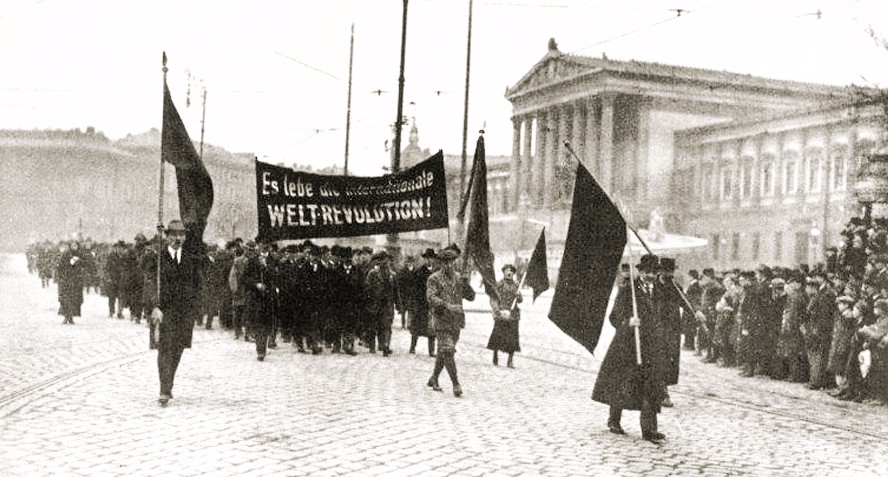
The introductory section to Louis C. Fraina’s informed and incisive context of the German Revolution written while it unfolded. Additional parts to follow.
‘The Background of the German Revolution: I. Socialism and the War’ by Louis C. Fraina from Revolutionary Age. Vol. 1 No. 12. January 4, 1919.
THE German Revolution is a product of the war and of the proletarian revolution in Russia. In turn, the war and the Revolution are products of the development of Capitalism and Imperialism, of the sharpening of class antagonisms generally and of the proletarian class struggle in particular.
Imperialism, the war, the attitude of Socialism during the war, the proletarian revolution in Russia, the aggravated economic and political crisis and its consequent development of class action–these are the causative, objective and subjective factors in the coming of the German Revolution, which, jointly with the proletarian revolution in Russia, is determining the destiny of the world.
The war was a product of Imperialism–of the economic, financial, political and territorial antagonisms and appetites of Imperialism.
What is Imperialism, its relation to Capitalism and Socialism?
Owing to the concentration of industry and the accumulation of capital, the development of technology generally, competitive Capitalism develops into monopolistic Capitalism. As industry concentrates and capital becomes monopolistic, three acts emerge: one, industry comes under the domination of finance-capital and the banks, finance-capital being the unity of industrial capital with banking capital; two, the home market becomes insufficient to absorb the energy of capital, it has become industrialized, and new, undeveloped regions must be acquired and industrialized; three, the terrific accumulations of capital producer a surplus capital which is not absorbed by the meant of the national economy, and which must be exported. The export of capital, accordingly, and its correlative industrial aspects, becomes the nerve-centre of monopolistic Capitalism and Imperialism; and a struggle ensues between each national Capitalism and Imperialism or control of foreign investment markets and undeveloped territory which can absorb equally surplus capital and means of production, of money and machinery.
Capitalism, at the stage of Imperialism, becomes international, but its form and control remain national; and the contradictions inherent in this condition produce acute antagonisms and war. Imperialistic Capitalism, moreover, is the final stage of Capitalism in this sense: that it has become parasitic, depending upon the exploitation of “backward” peoples, that it has developed fully the means of production compatible with the limitations of the private ownership of these means of production, and that it has projected the necessity of international production, a necessity that implies either the Social Revolution and Socialism, or war and the explosive antagonisms of imperialistic Capitalism. Only Socialism could solve the multiplying contradictions of Imperialism: but as Capitalism cannot accept Socialism, it chooses the desperate means of war.
Under Imperialism, the broadening of the economic opportunity of one nation necessarily means limiting the opportunity of a competing nation; each nation struggles, at first peacefully, for control of investment markets and undeveloped territory; but a time comes when this competition is insufficient, the antagonisms flare up, implacably, and war results–and out of war comes the revolutionary crisis and revolutionary action, the proletarian class struggle against war, against Capitalism and Imperialism.
The “national” question in the Great War, of Serbia and others, were of minor importance. The clash was between two groups of imperialistic belligerents; the war for which Serbia served as the pretext had been preparing for years, and might have flared up at the time of the Agadair crisis, when the issue was clearly imperialistic: whether French capital or German capital should exploit the resources of Morocco, which Imperialism should conquer the other.
In this imperialistic clash, Germany, because of peculiar historical causes, was immediately on the aggressive. Her two great rivals, France and Great Britain, were established; they had colonies which served as investment markets and undeveloped territory, and had penetrated financially all corners of the world; but Germany, having arrived later as a capitalist nation, possessed none of these advantages; and Germany, accordingly, had to assume the offensive in the great imperialistic struggle. But all these nations were imperialistic; and all were fundamentally on the aggressive, since Imperialism itself is the aggressor, actively or negatively.
The war flared up in August, 1914. And a momentous thing happened: Socialism, majority Socialism which had prophesied the war on the basis of the antagonisms of Imperialism, which had declared against the war, accepted the war and the government policy immediately upon the declaration of war. Each national Socialism, the majority Socialism in each nation, declared that its own country was on the defensive and that others were the aggressors; majority Socialism declared that the aspirations of the proletariat and Socialism depended upon victory for its own nation, its own Imperialism, and justified the war, manufacturing the popular ideology for the war. The German majority Socialists voted the war credits; the French Socialists voted credits and accepted direct responsibility for the war by sending its own representatives into the bourgeois cabinet; Austrian Socialism, British Laborism and Belgian Socialism acted identically. (Serbian and Italian Socialism, and, with the exception of Plekhanov & Co., Russian Socialism, remained faithful to Socialist and international ideals and acted against the war.) The call had come for the revolutionary struggle, but the dominant, petty bourgeois Socialism accepted Imperialism and the counter-revolution.
This brought the collapse of the International, since the most important parties of Socialism accepted nationalism and social-imperialism. The collapse did not consist in failure to prevent the war, but in accepting and justifying the war, manufacturing its ideology, declaring that an imperialistic war was in accord with Socialism, acting to prevent proletarian action against the war. It was betrayal of Socialism and the proletariat. Socialism, the dominant Socialism, had become nationalistic and petty bourgeois, a phase of the national liberal reform movement–had abandoned the revolutionary tasks of Socialism and developed into a conservative and conserving factor in the governing system of things.
Imperialism and the war had objectively introduced the social-revolutionary era–and the war had precipitated the revolutionary crisis. The policy or international Socialism as formulated at the Basel Socialist Congress was that, should war eventuate, it was the task of Socialism to use the economic and political crisis to develop revolutionary action for the overthrow of Capitalism. Majority Socialism argued that; since the proletariat did not make a revolution upon the declaration of war, there was no alternative but to support the war, “revolution” having proven an illusion. But this was a miserable subterfuge–it was majority Socialism that abandoned the revolution and the masses. Revolutionary Socialism never imagined that the war would immediately bring a revolution; it affirmed that the war would objectively create a revolutionary crisis which it was the task of Socialism to struggle to convert definitely into the Social Revolution. Majority Socialism abandoned this task; and under the stress of the war and its nationalistic, social-patriotic policy, developed into a counter-revolutionary instrument of Capitalism and Imperialism–against Socialism and the proletariat.
The collapse of the dominant Socialism was most miserable and complete in Germany. The Social Democratic Party there had been the most powerful of all Socialist parties, the exemplar of international Socialism; and the disgrace of its acceptance and justification of an imperialistic war of conquest was as great as its previous prestige.
Majority Socialism in Germany developed into a shameless ally of the government and the war. It sent its agents to Italy to urge Socialists to compel the government to enter the war as an ally of Germany just as the French Socialist Jules Guesde urged similar action to make Italy an ally of French Imperialism. The class character of Socialism was abandoned. While the German proletariat was being slaughtered in a war of conquest, German majority Socialism justified the slaughter and urged the proletariat to acquiesce. A certain section of German Socialism proclaimed boldly that Imperialism was necessary or the realization of Socialism. Majority Socialism allied itself with the Imperial Government and the General Staff, against Socialism and the proletariat, allied itself with the police against groups representing revolutionary Socialism.
On August 4, 1914, the Socialist representatives in the Reichstag, through Hugo Haase, had voted solidly for the war credit. But in the caucus there had been a division, eighteen having opposed the affirmative action, including Karl Liebknecht; the “party” discipline prevented them from voting “no” in the Reichstag. But in December, Liebknecht voted “no” on the credit; and this vote on a subsequent credit grew to eighteen. In May, 1916, Hugo Haase and others who voted against the credits were expelled from the German Socialist Parliamentary group; and in April, 1917, Haase and the growing minority within the Social Democratic Party organized a new party, the Independent Socialist Party. This party was, largely, against the war, not on revolutionary Socialist grounds, but on liberal, petty bourgeois and pacifist grounds; Karl Liebknecht, Rosa Luxemburg and others attacked the party bitterly as not being in accord with revolutionary Socialism. The revolutionary Socialists organized in the Spartacus Group and the Group Internationale, their policy being the struggle for the proletarian revolution in Germany–representing the real tendency and policy of revolutionary Socialism.
It was inevitable that the war should intensify Socialist divisions. The masses, abandoned by their unions and by majority Socialism, had to march quietly to the shambles; but as the war continued and the crisis became more intense, the masses began to stir, revolutionary currents developed against the war–all of which influenced organized Socialism. The Socialist minority against the war developed increasing strength everywhere; but this minority itself was divided: one faction, represented by the Independent Socialist Party in Germany and by Jean Longuet in France, was “against the war” on pacifist grounds; it did not embrace revolutionary Socialism; it wished to reconstitute the Socialist movement as it had been prior to August 4, 1914–this action did not realize that the old movement, its immediate purposes and tactics, was dead, and that the new social-revolutionary epoch of Imperialism required new immediate purposes and tactics: the revolutionary struggle against war and Imperialism by means of mass action and civil war. This revolutionary policy was the policy of the other faction, represented by Liebknecht and Rosa Luxemburg in Germany, by Loriot and Merrheim in France, by most of the Socialists in Italy, by Anton Pannekoek and his party in Holland, by MacLean and others in England, and by the Bolsheviki in Russia. The struggle of Socialism against the war could be nothing else than a struggle for the Social Revolution…
The horrors of the war, its slaughter, its demoralization of industry, its hopeless character, more and more developed the subjective conditions for revolutionary proletarian action. The Revolution flared up first in Russia, because of the more acute disorganization there, the inefficient character of Czarism and the revolutionary consciousness and reserves that the proletariat had acquired in the Revolution of 1905. The Russian Revolution of March, 1917 was the first break in the imperialistic war, the initial call to the European Revolution.
The Revolutionary Age (not to be confused with the 1930s Lovestone group paper of the same name) was a weekly first for the Socialist Party’s Boston Local begun in November, 1918. Under the editorship of early US Communist Louis C. Fraina, and writers like Scott Nearing and John Reed, the paper became the national organ of the SP’s Left Wing Section, embracing the Bolshevik Revolution and a new International. In June 1919, the paper moved to New York City and became the most important publication of the developing communist movement. In August, 1919, it changed its name to ‘The Communist’ (one of a dozen or more so-named papers at the time) as a paper of the newly formed Communist Party of America and ran until 1921.
PDF of full issue: https://www.marxists.org/history/usa/pubs/revolutionaryage/v1n12-jan-04-1919.pdf
 Revolution's Newsstand