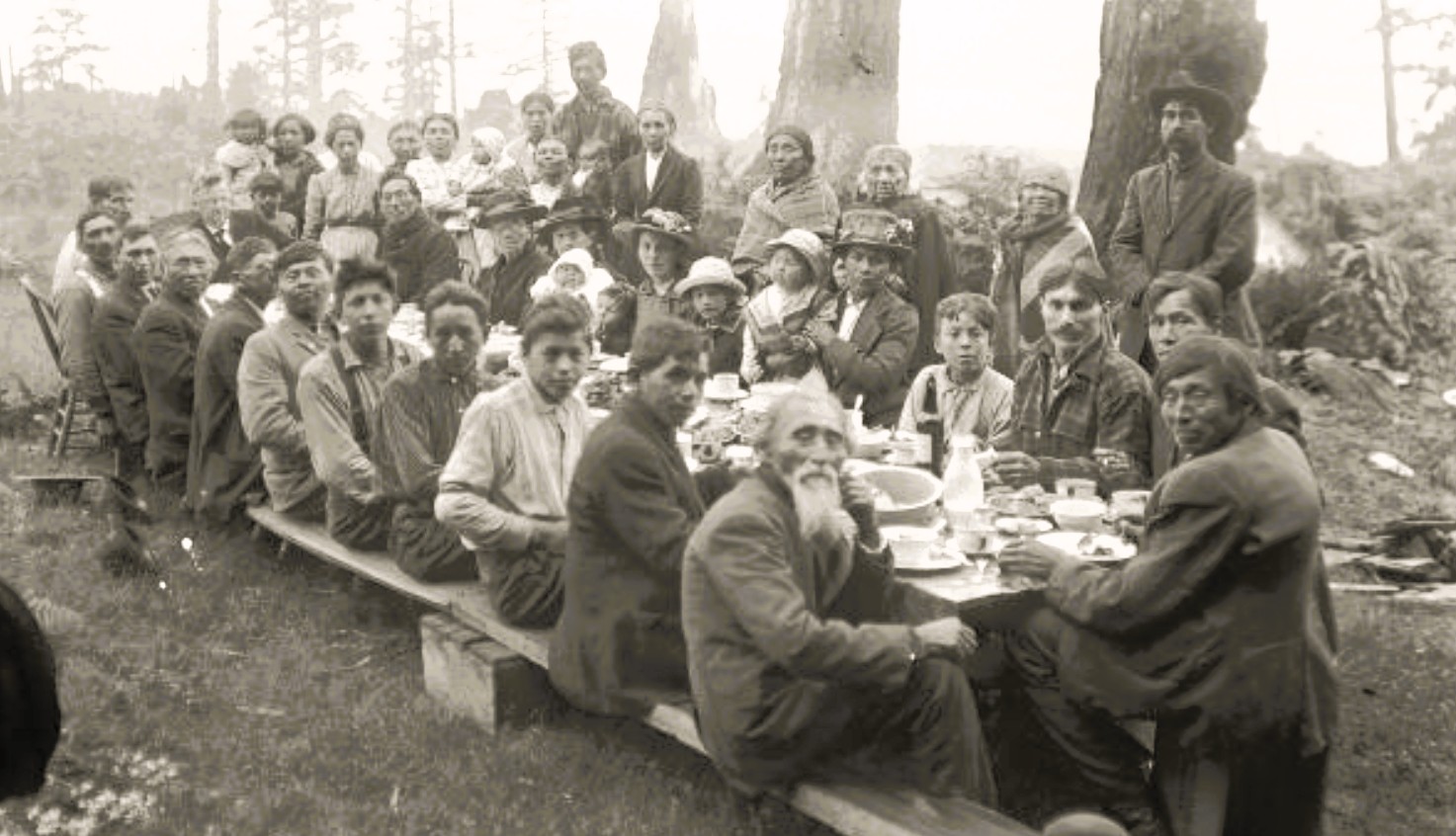
Three articles on the activity of the Tulalip Indian Relief Workers in their fight from their Reserve just north of Everett, Washington against discrimination and for equal relief during the Great Depression.
‘WASH. INDIANS ORGANIZE FOR RELIEF FIGHT’ from Western Worker. Vol. 2 No. 34. August 21, 1933.
Jobless Council Representatives Give Leadership
EVERETT, Wash., Aug. 8. Conscious of the discrimination against them in the distribution of relief. although thousands of dollars are appropriated every year for them. Indians of the Tulalip reservation are organizing to resist the program of misery and starvation imposed on them by the bosses.
A committee of workers investigating the reported deplorable conditions on the reservation, found that they were given no relief of any kind, but were forced to work for a living cutting pulpweed. They work from daylight to dark for about 75 cents a day.
The committee called a meeting at which 14 were present, discussed their problems and general meeting of 45 of the entire reservation resulted. At the latter meeting Comrade Parks explained how white workers have kept from starving only by organizing and struggling for relief, and pointed out that only by organization could the Indians get relief.
A strong committee was named to go to the Indian agent and demand relief, and were informed that it would be probably two or three months before anything could be done. As a substitute he suggested they sign up for the C.C.C. camps for $1.60 per day. Out of this 60 cents was for traveling expenses. Only 25 cents per day was to be paid to them outright, the rest to be used to feed them this winter.
The Indians refused the plan and demanded that they be paid at least $2.60 per day, the lowest prevailing wage at the mills–and this to be paid in full with no hold-backs. The Indians are finally awakening and are determined to struggle for the right to live.
‘INDIANS FORM UNION TO HIT LOW PAY SCALE’ from Voice of Action (Seattle). Vol. 2 No. 10. June 8, 1934.
MARYSVILLE, WA. June 6. On the Tulalup Reservation, near here, the only “real Americans” in this neck of the woods are learning to place more trust in their own ability to get what they want, rather than rely on the traditional procedure of trusting to luck and their Indian agent who works in roundabout ways of approaching the “Great White Father.”
The Indians have noticed that they work ten days a per month for $2.40 per day, while their white neighbors work a six-hour day, six day week for 50 cents pe: hour and have a budget plan.
Now they are organizing with their white neighbors, so they too may share in the “American pian,” and better the conditions of everyone, by joining the Relief Workers’ Protective Association.
Discussing the subject among themselves, they decided to organize and elected a committee to present their grievances to the road engineer. Failing in two attempts to see him, they notified him of their intended visit. The third time they were successful, holding the meeting in the Indian Assembly Hall. The road engineer wished them to adopt the P.W.A. relief measure, but the Indians asked 50¢ an hour, six hours a day, five days a week and the budget plan similar to their white neighbors.
Both the Indian agent and the road engineer decided something should be done about conditions among the Indians, and both did petition Commissioner Collier with recommendations it be sent to Hopkins at Washington, D.C. Elated over this small victory the Indians met the next week. After this meeting the Indian agent, in writing Commissioner Collier informed him of the activities of an earnest Indian worker, declaring her an agitator, Communist and too radical for the Indians.
After this discussion they decided to fight with their Indian leaders and white neighbors, realizing all workers must organize to obtain better conditions. One Indian girl grew so enthusiastic over the help offered by their white neighbors in their fight and the winning of their concession that in closing her speech she said, “We will stick to them like barnacles.”
With this victory the Indians decided to organize under the name of “The Tulalip Indian Relief Workers” with a membership of twenty-six. The next meeting will be held June 4.
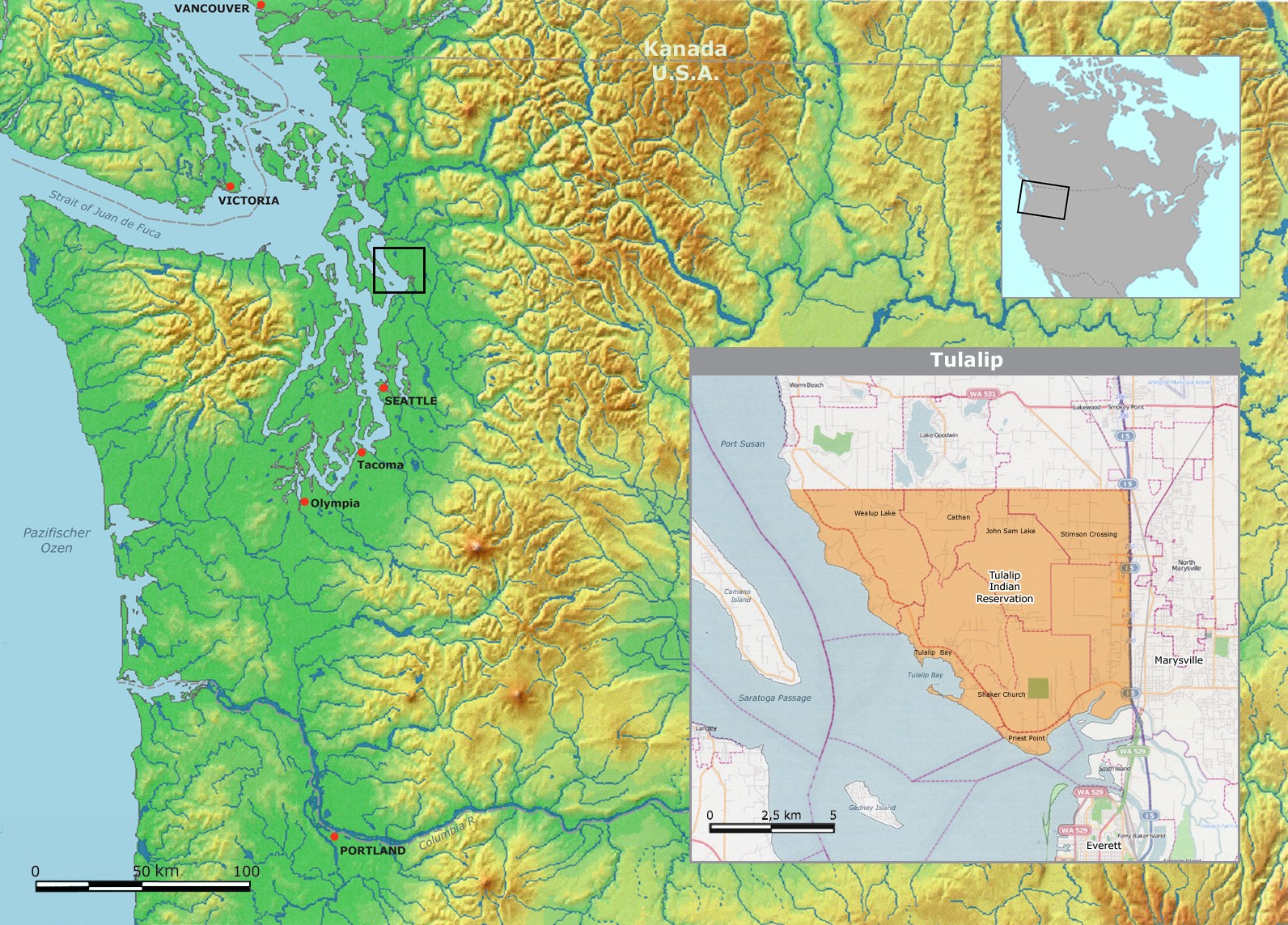
‘Tulalip Indians Win Relief Fight’ by an Indian Worker from Voice of Action (Seattle). Vol. 2 No. 18. August 3, 1934.
TULALIP INDIAN RESERVATION, Wash. With 40 members the Tulalip Indian Relief Workers has won relief for the Indians who live on the reservation, from the Welfare Board at Marysville.
The Indian workers organized about two months ago. They centered their struggle first on getting commodities from the Indian Agent and Commissioner Collier. This followed a period of road work which was paid at the rate of $2.40 a day for 8 hours. Food became very scarce,
Given Wormy Flour and Cornmeal
When the Indian agent finally gave the workers commodities, the flour and cornmeal were wormy. He gave them syrup, hard tack and lard. They demanded grocery vouchers and were refused.
They then went to Marysville, where relief is doled out every Wednesday., Many filled out applications: only one was given an emergency voucher. The rest had to wait until the next Wednesday.
More received vouchers the next week and the remainder expected to get vouchers Wednesday
Pledge Longshoremen Solidarity
At the meeting of the organization, the Everett strike committee spoke and the Indian and white workers pledged support to each other.
The Indians scheduled a baseball game to be played with the longshoremen after they all get grocery vouchers.
Western Worker was the publication of the Communist Party in the western United States, focused on the Pacific Coast, from 1933 until 1937. Originally published twice monthly in San Francisco, it grew to a weekly, then a twice-weekly and then merged with the Party’s Daily Worker on the West Coast to form the People’s Daily World which published until 1957. Its issues contain a wealth of information on Communist activity and cultural events in the west of those years.
PDF of full issue: https://www.marxists.org/history/usa/pubs/westernworker/1933/v2n34-aug-21-1933.pdf
The Voice of Action emerged in 1933 from a split in Seattle’s Socialist-dominated Unemployed Citizens League and their newspaper, The Vanguard, which had banned Communist supporters from their pages. The Hunger Marches had led many into the movement and the Communist-led UCL through the Washington State Committee of Action, the National Lumber Workers’ Union, the Fishermen and Cannery Workers’ Industrial Union began publishing in March, 1933. Lowell Alvin Wakefield and Alan were editors of the paper which lasted until the inauguration of the Popular Front in 1936 and the Voice was folded into The Washington Commonwealth. During its run, the Voice documented the Depression in the Pacific Northwest and covered the defining struggles of West Coast labor during the waterfront strikes, including 1934’s General Strike.
PDF of issue: https://chroniclingamerica.loc.gov/lccn/sn88085733/1934-06-08/ed-1/seq-1/
PDF of issue 2: https://chroniclingamerica.loc.gov/lccn/sn88085733/1934-08-03/ed-1/seq-3/
 Revolution's Newsstand