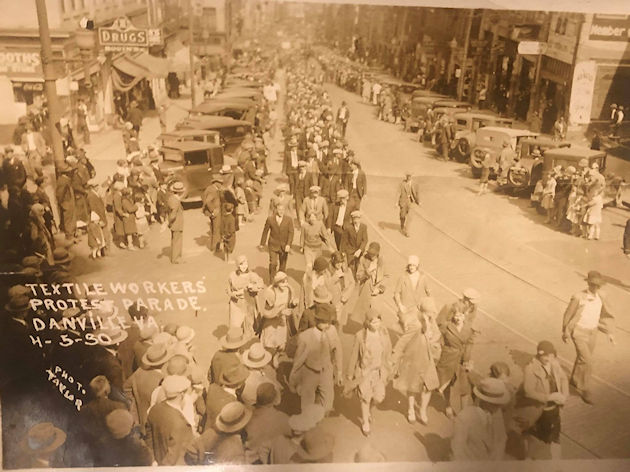
Another one of the militant Southern textile strikes in 1929-30 that opened the door to organizing the South, only to see it shut by a divided labor movement, and the misleadership of the A.F.L. Correctly seen as a grave threat to their power, the Southern bosses responded with enormous violence and repression.
‘An Analysis of the Danville Strike’ by William Murdoch from The Daily Worker. Vol. 8 No. 22. January 24, 1931.
(Editor’s Note. Murdoch, secretary of the National Textile Workers’ Union, was released Jan. 17 after serving a five months sentence, which was inflicted upon him because he exposed the strike-breaking activities of Gorman, an official of the United Textile Workers’ Union. Murdoch issued a leaflet showing up Gorman and the U.T.W. as soon as he arrived in Danville, shortly after the 4,000 went on strike. The employers’ courts of Virginia, knowing that the U.T.W. is their best strikebreaker, rushed to its defense; and ruled that the leaflet was a libel.)
The four thousand textile workers who still continue the fight for organization in Danville, Va., are beginning to feel the full force of. The bosses’ power. After six months of struggle, in which they faced the bared-bayonets of the state militia and reinforced city police, they have effectively tied up the mill in what has been one of the most fiercely fought strikes of the past few years.
Now these four thousand Danville workers are facing the worst month of the winter with a leadership that more and more brazenly exposes itself as a rank strikebreaking agency and the final reserve of the textile employers.
Gorman, Green, the United Textile Workers and the A. F. of L., are stabbing the strikers in the back.
Stirred by the example of the Gastonia strikers, spurred by the hunger marches (news of which occasionally filters through) and answering the direct call of the National Executive Board of the National Textile Workers’ Union, the workers came out on November 25 in massed formation and demonstrated their ability to keep the scabs from the mills. Not a, scab went to work.
The U.T.W. leadership, scared by the fighting determination of their following, accepted the decision of the city and state governments to send in the troops, and mass arrests were made, of both women and men at the point of the bayonets.
Over fifty workers were arrested and charged with unlawful assembly and arson, carrying long prison sentences.
Now the U.T.W. leaders refuse to guarantee the strikers the support of the union for their legal defense and has surrendered these most militant workers to the tender mercies of the courts.
Fake Relief.
While the northern labor press is full of statements that the workers are receiving wonderful relief the U.T.W. is forcing the workers to live on a daily ration of beans, fat-back and flour while the leaders draw their steady salaries of $75 a week or more. At the same time the “leadership” made a statement that they would not allow the workers to accept aid from the N.T.W.U.
The anxiety of the fakers to get this militant demonstration of the workers off their hands is to be explained only by an understanding of the national situation in textiles. Lawrence, Rhode Island, Philadelphia, and the entire South is ready for immediate action. Already 10 strikes are in progress in Philadelphia. In Kensington, Tom Macmahon (president of the U.T.W.) was booed from the platform at a meeting of carpet weavers where he made an attack on the N.T.W.U. in an effort to stop the strike there.
Strikes Coming.
The Philadelphia carpet weavers will strike against wage cuts. The Lawrence workers will strike against the starvation conditions being imposed on them. The workers in the South are ready to face the guns of the textile bosses’ thugs to secure decent living conditions. Speed-up, wage-cuts and hunger have made the textile workers desperate. The time has come for action.
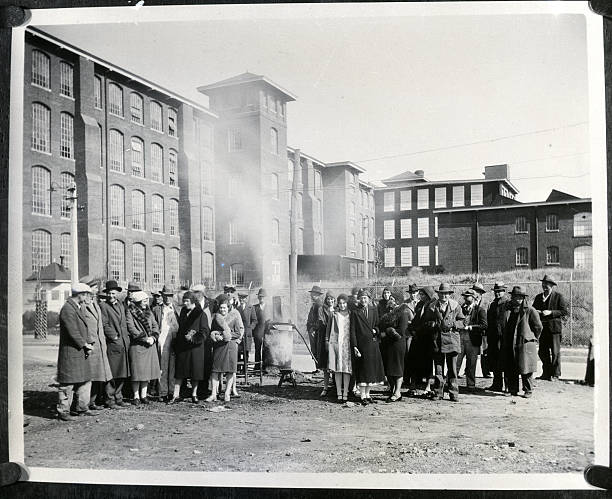
At the coming board meeting of the National Textile Workers’ Union the entire situation must be gone into. Our errors in the Danville situation and in the other districts will have to be thoroughly uncovered in the spirit of real constructive working class criticism.
We must tighten our ranks and prepare to fight. Let the action of the Danville strikers be an inspiration to all textile workers that even under the tremendous obstacles which we face the textile workers can fight and win!
The Daily Worker began in 1924 and was published in New York City by the Communist Party US and its predecessor organizations. Among the most long-lasting and important left publications in US history, it had a circulation of 35,000 at its peak. The Daily Worker came from The Ohio Socialist, published by the Left Wing-dominated Socialist Party of Ohio in Cleveland from 1917 to November 1919, when it became became The Toiler, paper of the Communist Labor Party. In December 1921 the above-ground Workers Party of America merged the Toiler with the paper Workers Council to found The Worker, which became The Daily Worker beginning January 13, 1924.
PDF of full issue: https://www.marxists.org/history/usa/pubs/dailyworker/1931/v08-n022-NY-jan-24-1931-DW-LOC.pdf
 Revolution's Newsstand