
An article conveying the intensity and drama of Chicago’s transformative 1910 strike of tens of thousands of garment workers against Hart Schaffner Marx. On December 15, Lithuanian-born picketer Franciskas “Frank” Nagreckis is murdered by special detectives, the second workers up to that point to die, and dozens beaten and arrested. Some of their stories below.
‘Chicago Police Guns Murder Garment Striker’ from The Chicago Daily Socialist. Vol. 5 No. 45. December 16, 1910.
Armed Police Say They Were Attacked by Defenseless Toilers.
One striker is dead and another dying as a result of a volley of bullets fired by special detectives working for the Hart, Schaffner & Marx shop at Bloomingdale Road and Wood Street early today.
The Dead
Victor Nogrekkis, striking garment worker, 1722 Gerard Street; shot by police.
The Injured
Mark Langewisz, 20 years old, 1730 North Wood Street: shot in lungs by Policeman Albert Winge of the West Chicago Avenue station; reported dying at St. Elizabeth’s hospital.
According to the stories told by eyewitnesses of the shooting, the detectives were accompanying a score or more of strike-breakers to the Hart, Schaffner & Marx shop.
Called to Scabs
A group of strikers gathered on the corner began to call upon the scabs to cease being led like cattle to a pen and assert themselves.
One of the detectives dashed at the group with drawn revolver and was met with the fists of the strikers. He received several blows and then fired into the crowd.
One of the strikers, the one lying dead, fell to the ground with a bullet in his back. He tried to rise and received another bullet which brought him to the ground forever.
Another Falls
The other detective began to use his revolver also, and another striker, Mike Lauglewise, fell with a bullet in his breast.
He was seized by newly arrived city detectives, led by Detective Sergeant Charles Wernecke, dragged into a nearby alley and there beaten over the head and face until his head was one mass of blood.
He was saved from being beaten to death only by the arrival of detachment of the strikers who forcibly took him away from the raving special detectives, strike breakers and policemen.
Fired Without Provocation
According to police reports the order to fire was given by Detective Wernecke, but witnesses of the shooting declare that only two special detectives were with the strike breakers and that they fired without the least provocation. When the detectives passed with the scabs only a few of the pickets were on hand, as each detachment of strikers is detached to watch various shops.
Many People on Scene
The firing of shots brought a mob of people to the scene, and when the two men fell with bullets in their bodies it took scores of policemen from Rawson Street station to disperse the enraged citizens and save the two special agents of the tailor bosses from being lynched.
If Lauglewise dies from his wounds three lives will have been taken by the conscienceless, stubborn clothing manufacturers through their hired agents and sluggers.
First Victim
George Lazinskas, a striking garment worker, who was shot by a strikebreaker special detective and buried by his comrades only last week, was the first victim.
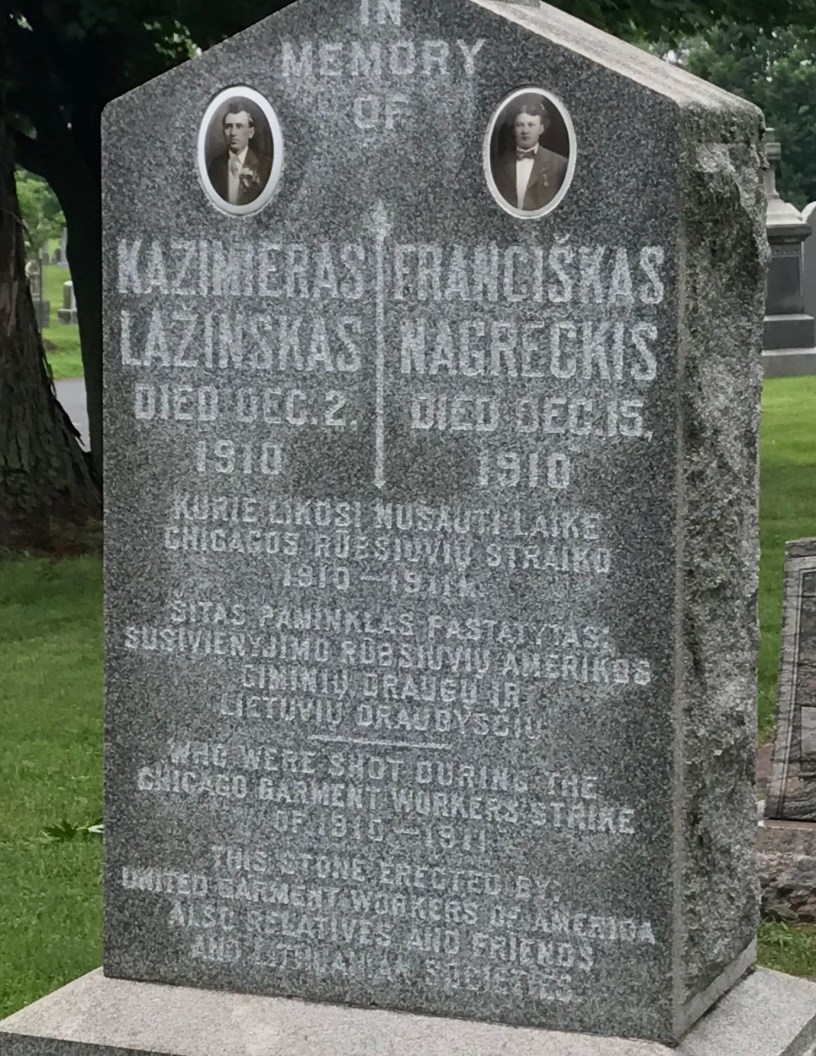
He fell dead by a bullet fired by a special detective employed by the Royal Tailors.
The unidentified man and Mike Laugelwise are victims of a special detective employed by Hart, Schaffner & Marx.
Brutality such as could be equaled only in bloody Russia was committed upon James Sekanina, a striking garment worker, at the Lawndale Street station.
Prisoner Beaten
The striker was brought to the station for picketing. He exchanged some words with the policemen while claiming he had done nothing to warrant arrest, and was beaten until almost unconscious or the stairs leading to the cells.
According to his story, the policemen leading him to the cells threw a blanket over him and then mauled and kicked him until has face and body were a mass of bruises and blood.
Upon being thrown into the cell in an almost fainting condition Sekanina asked for a glass of water and was told that such persons as he had no right to drink.
Will Punish Police
The names of the policemen who led in the beating are being held by the strike officials of the southwest side Bohemian tailors, and steps leading to the punishment of the cruel cops will be taken.
Twenty-three strikers were arrested yesterday on the southwest side while at a meeting in Krizek’s Hall, Homan Avenue and Twenty-fifth Street.
They were taken to the Lawndale Avenue police station wondering what kind of a charge would be made against them, for none knew of anything or could think of anything that he or she had done to deserve arrest or even interference on the part of the police.
Police Arrive
The meeting at Krizek’s hall was progressing splendidly under the direction of James Balvin, president of the Bohemian tailors, when a disturbance and cries at the entrance of the loaded hall attracted his attention.
Balvin left the platform and began edging his way to the door when a couple of policemen took him by the ears and began pulling him out.
Persons in the hall objected and a wholesale arresting took place. More than thirty persons were picked up by the police, but only twenty-three were brought to the station.
Some Dismissed
There five of the twelve girls and several of the men were dismissed without even being booked.
At the Maxwell Street court this morning, Judge Stewart was in favor of dismissing all, but the cases did not come up in time for a publication of the result.
“This is the most vicious strike I have ever seen,” said Assistant Chief of Police Herman Schuettler today, accepting the teamsters strike, when acid filled bags were thrown at horses in the street.
“Girls are daily being attacked both by strikers and strike breakers. I shall no longer doubt European reports that certain governments there find classes of their people so dangerous that they must get rid of them at any cost.
“The police will preserve the peace here at any cost. There will be no more play about it.”
Indignation Great
The indignation of the strikers and strike leaders at the various halls was indescribable when reports of the second murder of a striker were brought to them.
Loud exclamations of anger and protest were heard everywhere and the plans for another and even bigger funeral procession were hastily arranged. “All this talk of violence on the part of the strikers is untrue,” said Samuel Landers, national organizer of the garment workers.
“Almost for hundred strikers, both men and girls have been arrested, but the police have failed to find a weapon of any kind on any of them.
Only Scabs Have Guns
“Revolvers have been fired, but in each case by strike-breakers and special detectives or policemen. The lie is nailed, let them explain and invent new ones.”
A move to start protest meetings in every part of Chicago against the negligence of the police authorities in allowing strike-breakers and special detectives to carry revolvers and other weapons is on foot and is receiving the support of almost all the strike leaders.
Meet at Pilsen Park
It is planned to hold one meeting in Pilsen Park, Albany Avenue and 26th Street another in Walsh’s Hall, Noble and Milwaukee Avenue, another in Hod Carriers Hall, Halsted and Green Streets.
Suggestions have been made that the meetings be held right after the funeral of the murdered striker Victor Norgekiss, when thousands will march behind the hearse as they did at the funeral Lazniskas.
An attempt will be made by the union garment workers to meet with Chief of Police Steward in a conference this afternoon. It is not certain as yet whether the chief will agree to meet the union men.
The Chicago Socialist, sometimes daily sometimes weekly, was published from 1902 until 1912 as the paper of the Chicago Socialist Party. The roots of the paper lie with Workers Call, published from 1899 as a Socialist Labor Party publication, becoming a voice of the Springfield Social Democratic Party after splitting with De Leon in July, 1901. It became the Chicago Socialist Party paper with the SDP’s adherence and changed its name to the Chicago Socialist in March, 1902. In 1906 it became a daily and published until 1912 by Local Cook County of the Socialist Party and was edited by A.M. Simons if the International Socialist Review. A cornucopia of historical information on the Chicago workers movements lies within its pages.
PDF of full issue: https://www.marxists.org/history/usa/pubs/chicago-daily-socialist/1910/101216-chicagodailysocialist-v05n045.pdf
 Revolution's Newsstand