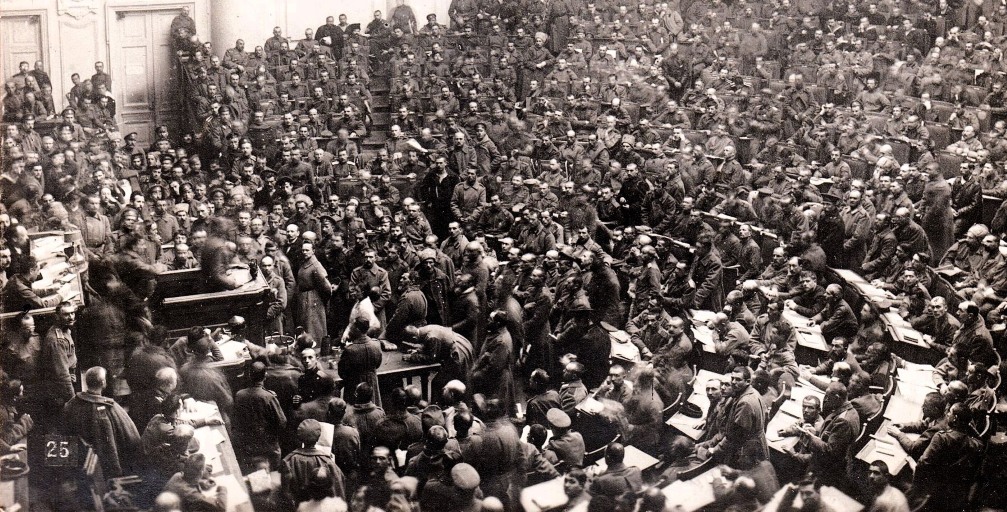
Germany’s moderate Socialists, its revolutionary workers, monarchists, and bourgeoisie; all eyes were on Russia in 1917. Those events would inform and shape the process of the German Revolution. Understanding that experience is essential to understanding what comes next in Germany.
‘The Background of the German Revolution: II. The Russian Revolution’ by Louis C. Fraina from Revolutionary Age. Vol. 1 No. 13. January 11, 1919.
In the early days of the war between the two belligerent powers, there was a third power, silent, unseen, but preparing to burst forth in irresistible action–the power of the Russian Revolution. During the days immediately preceding the declaration of war, when German Imperialism was trying to create a war psychology by exploiting the fears of Czarism, certain German Socialists acutely insisted that there was a power in Russia that should be considered in any real valuation of the situation, a power mightier than Czarism, and that was–the Revolution. But this was not heeded, and was forgotten by the German Social Democracy in the wild orgy of social-Imperialism and social-patriotic insanity that ensued.
That the coming Russian Revolution was a proletarian revolution was evident. The Revolution of 1905, betrayed and maligned by the bourgeois liberals; the subsequent counter-revolutionary period in which the bourgeoisie consolidated its power, accepting Imperialism and autocracy, and abandoning all revolutionary convictions–made it clear that the Socialist proletariat alone could make a revolution in Russia. This was emphasized by the bourgeois attitude during the war,–enthusiastic acceptance of the war and of its imperialistic objects, the abandonment of even ordinary liberal opposition in favor of victory and a bourgeois Czarism.
The Russian bourgeoisie was partially critical, truly, but it was within the limits of Czarism, a criticism based upon the fact of Czarism producing defeat instead of victory. When the “great Duma” met in March, 1917, it did not concern itself with the needs of the people, the mass agony and starvation: the Duma refused to grant powers to the Petrograd municipality necessary to provide food for the people; the Duma liberals were interested exclusively in the war and victory. The intervention of the revolutionary proletariat was necessary…
Then came the elemental mass action of the workers of Petrograd–mass strikes, demonstrations, food riots, revolutionary action against Czarism, that annihilated the reactionary regime mercilessly and completely, and which was the signal for the revolt of the soldiers, who were still agonizing in a hopeless, reactionary war. The bourgeoisie did not participate in this revolutionary action; their attitude was comprised in intrigues to depose Czar Nicholas in favor of a Grand Duke who would bring victory and recognize bourgeois requirements, in participation in the plots of Anglo-French capital directed against Czar Nicholas and a separate peace. It was the proletarian masses that marched to the assault against Czarism, that through the Workmen’s and Soldiers’ Council issued a call for the Republic and a call to the belligerent proletariat to act against Imperialism and the war.1 The bourgeoisie wanted a “constitutional monarchy”: this was admitted by M. Milyukov, the Constitutional Democratic leader, on March 13, after the revolution. It was the revolutionary action of the masses that gave the Duma courage to disobey the Czar’s ukase to dissolve; and it was the Workmen’s Council that imposed a republican program upon the first Provisional Government organized out of the old Duma opposition.
But the Provisional Government was bourgeois, the government of the capitalists, and accordingly counter-revolutionary. Its personnel was part and parcel of the imperialistic forces and purposes instinct in the war. It established the usual bourgeois freedoms; and it prepared to wage more aggressively the imperialistic war waged by Czarism, accepting the agreements and obligations of the Czar’s government to other nations. Foreign Minister Milyukov, of the Provisional Government, insisted that revolutionary Russia would fight until it secured Constantinople; and the Provisional Government accepted Milyukov’s policy. But the masses, who had made the Revolution in the name of peace, bread and liberty, negatived the proposition; on May 2 and 3, the revolutionary masses in Petrograd demonstrated against Milyukov the Provisional Government, and all imperialistic aims. As a consequence of this and other pressure, Milyukov and others were compelled to resign, and on May 18 a new Provisional Government was organized, a “coalition government” which contained representatives of moderate Socialism, of the Soviets,–coalition being accepted against the violent protests of the Bolsheviki.
At this stage, a bourgeois revolution had been definitely accomplished, not by the bourgeoisie, but by the proletariat, who momentarily, however, allowed the bourgeoisie to usurp power. It was a political revolution, but with this change at the top, there was a movement at the bottom, an elemental bursting forth of the revolutionary activity of the people. This activity alone, destroying and reconstructing fundamentals, could accomplish the Revolution, by means of an implacable class struggle against Capitalism and Imperialism.
The revolutionary masses had constituted as instruments of revolutionary action their Soviets, of Workers, of Soldiers and of Peasants,–the self-governing units of the organized producers, completed forms of the “sections” and “communes” of the French Revolution. These Soviets constituted the only real power; but under the influence of the moderate Socialists, all power was yielded to the bourgeois Provisional Government. The Soviets were class organizations characteristic of the proletarian revolution; under the pressure of revolutionary events, they usurped powers of government, developing from exclusive instruments of revolutionary action into instruments of revolutionary government. The moderate Socialists, under the guidance of the Mensheviki (representing the dominant opportunistic Socialism) and the Social-Revolutionists, wanted to degrade the Soviets into a “parliamentary opposition”; the revolutionary Socialists, represented by the Bolsheviki, wanted all power to the Soviets, a revolutionary government of the Soviets alone. This was the decisive struggle of the Revolution,–the struggle between the bourgeois Provisional Government and the developing proletarian government of the Soviets; the struggle between the petty bourgeois democracy of the Constitutional Assembly, and all power to the Soviets.
The world concerned itself much with the attitude and proposals of the politicians during these early days; but the decisive events of the Revolution were being prepared by the masses. The bourgeois political tendency, which aimed simply at a change in the forms of government, enthroning the bourgeois republic and bourgeois supremacy, was superficially dominant; but the real factor was the economic revolutionary tendency of the masses, which aimed at a complete annihilation of the old regime and a reconstruction of the industrial system. This was apparent in the peasants seizing the land (monopolized by a few, very few, nobles and rich peasants), in spite of the prohibitions of the Provisional Government; this was apparent in city after city, where, even at this early stage, the Soviet usurped the functions of government, in the workers electing Shop Committees to control factory production, and seizing factories closed down by owners as a measure against the Revolution.
The Provisional Government, being bourgeois, paltered on the land question, since confiscation would be inimical to the interests of the bourgeois peasants, capital and the banks; the Provisional Government, being imperialistic, had to dodge and bluster about the war and the purposes of the war, and lie about peace while continuing to wage an imperialistic war; and the Provisional Government, being capitalist, had to protect the interests of the capitalists in all vital measures. The old bureaucracy had been retained; and all progressive measures were sabotaged by these hang-overs of the old regime, as the capitalists sabotaged production. The crisis developed more acutely the revolution had only begun. But revolution is the great educator and developer of class action–temporary reverses created a new opportunity.
On June 18, the Petrograd workers, under the inspiration of the Bolsheviki, determined upon a demonstration against the Provisional Government. The All-Russian Congress of Soviets, then in session in Petrograd, issued a declaration against the demonstration, and the Government prepared to crush it by force. The Soviet moderates had become definitely counter-revolutionary; the demonstration was abandoned; but it broke out on July 16-17, after the ill-fated July offensive (determined upon as a diplomatic trick), and after the bourgeois ministers had resigned because of a disagreement on Ukrainian autonomy. The demonstration was to have been a peaceful one; but counter-revolutionary gangs and government troops provoked the masses, and for two days there was savage fighting in the streets, resulting in a victory of the Government. Then followed a reign of terror: the revolutionary masses were disarmed, Bolsheviki arrested, including Trotzky, and an order issued for Lenin’s arrest, who went into hiding, from where he continued to direct the revolutionary campaign. The All-Russian Soviet Central Executive Committee, dominated by the moderates, aligned itself with the Government: the moderate Socialists had become the real enemy of the Revolution. The proletariat and poorer peasants, the proletarian revolution could conquer only by the annihilation of moderate Socialism.
But the crisis had become more acute. The pressure of the masses increased; and a new Government was organized with the “Socialist” Kerensky as Premier: “Socialism” was now the last bulwark of defense of Capitalism. The first important act of Kerensky was to restore the death-penalty in the army, a restoration demanded by counter-revolutionary generals as a measure against the soldier democracy, and to call a conference at Moscow in August, at which convened all the reactionary forces of Russia, and where it was openly declared that the thing necessary for Russia was the abolition of the Soviets. It was apparent at this conference that the counter-revolutionary forces were preparing a coup against the Revolution. The coup materialized early in September in General Kornilov’s revolt, which Kerensky had invited to crush the revolutionary masses of Petrograd, but which Kornilov transformed into a coup equally against Kerensky, and which Kerensky thereupon opposed. The revolt was crushed; but it convinced the masses of the force of the Bolshevist contention–either all power to the Soviets, or the defeat of the Revolution. The aftermath was swift and certain in Soviet after Soviet the Bolsheviki became ascendant, and Leon Trotzky was elected President of the most influential Soviet, that of Petrograd. The final struggle approached: the masses prepared for all power to the Soviets, the reaction for the suppression of the Soviets, while the coalition government, symbolizing a fictitious unity of all the classes, was marching to destruction.
Kerensky tried to bolster up his declining prestige and power, by means of a Democratic Congress and a Preliminary Parliament, which declared Russia a Republic–an empty gesture. But Kerensky was completely discredited; he could talk, but he dared not act, hesitation, compromise and intrigues characterizing his desperate policy. With the discrediting of Kerensky came the discrediting of the moderate, petty bourgeois Socialists in the Soviets. This process was feverishly accelerated by the problem of peace. Kerensky had tried, and vainly, to secure a revision of the war aims of the Allies; the Soviet Executive Committee, still controlled by the moderates, elected Skobeleff to represent it at the coming Allied Conference in Paris which was presumably to discuss war aims and peace terms; but the Entente Governments through Jules Cambon declared that they would not recognize Skobeleff, and that, moreover, the Conference was to discuss only military measures. The conclusion was clear: only by means of international class action and the revolutionary struggle could peace be secured, only by means of the uncompromising struggle against all Imperialism and the repudiation of petty bourgeois Socialism.
This was at the end of October; some time earlier the Bolsheviki had called for a meeting of the All-Russian Congress of Soviets. This created consternation equally among the bourgeoisie and the moderate Socialists: the Congress, it was clear, would accept the program of the Bolsheviki. The Central Executive Committee, in spite of the fact that a Congress was due, refused to call it; but the Bolsheviki issued their call for a Congress to convene on November 7. This initiated the definite proletarian revolution in Russia, of which the uprising of November 7 in Petrograd was an incident: the revolution had been accomplished in the local Soviets, which accepted Bolshevism and which had become organs of revolutionary government as well as instruments of revolutionary action. The insurrection of November 7 swept the Kerensky Government away; and on the evening of the same day, the All-Russian Congress decreed all power to the Soviets–a workers’ and peasants’ government instead of a bourgeois government, an industrial Socialist state instead of a parliamentary capitalist state: Socialism and the proletarian revolution had conquered!
All power to the Soviets constituted a proletarian revolution, necessarily; a Soviet Government implied the adoption of revolutionary Socialist measures, the initiation of the process of introducing Communist Socialism, the immediate political expropriation of the bourgeoisie and its partial economic expropriation. But the proletarian revolution in Russia alone could rot permanently survive: it had to develop revolutionary allies in the proletariat of the other belligerent nations; and so the Soviet Republic struggled for the international proletarian revolution.
NOTE
1. This call to action to the belligerent proletariat was ignored, except among minority groups of revolutionary Socialism. Philip Scheidemann, German majority Socialist leader, declared it was out of the question to follow the Russian example, and severely scored strikes and action against the government. When the German proletariat prepared for large strikes and demonstrations on May Day, 1917, in sympathy with the Russian Revolution. The majority Socialism repudiated the plans and declared that there should be no revolution–the Berlin “Vorwaerts” even defended the monarchy!
The Revolutionary Age (not to be confused with the 1930s Lovestone group paper of the same name) was a weekly first for the Socialist Party’s Boston Local begun in November, 1918. Under the editorship of early US Communist Louis C. Fraina, and writers like Scott Nearing and John Reed, the paper became the national organ of the SP’s Left Wing Section, embracing the Bolshevik Revolution and a new International. In June 1919, the paper moved to New York City and became the most important publication of the developing communist movement. In August, 1919, it changed its name to ‘The Communist’ (one of a dozen or more so-named papers at the time) as a paper of the newly formed Communist Party of America and ran until 1921.
PDF of full issue: https://www.marxists.org/history/usa/pubs/revolutionaryage/v1n13-jan-11-1919.pdf
 Revolution's Newsstand